
What do you think?
Rate this book

336 pages, Paperback
First published October 1, 2008


Weber explained that paying attention to running or engaging in strenuous exercise is a distraction from studying the Torah. Still, two seminal Jewish scholars, Rabbi Akiba in the second century and Moses Maimonides, the twelfth-century philosopher, advocated taking care of one's body.
In a quarter century of marathons, this dramatic change in gender trends was made possible and inspired by three women, each a former winner of the New York City Marathon, each a pioneer of the sport: Nina Kuscsik, Kathrine Switzer and Grete Waitz.
It is as if the runners today, having passed through nearly nine miles of exuberant fans, blaring music and colorful signs, travel on Bedford Avenue into the nineteenth century. The community of the ultra-Orthodox Satmar sect lives along Bedford Avenue. Children peek out of the windows of overcrowded apartments or stand on the stoops to see the Marathon traipse by their block. Men wear black hats, long beards with hanging sidelocks (peius) and tzitzit (prayer shawl fringes that serve as symbolic reminders of faith) from their belt loops. The women have children at their long skirts. Children do not cheer or hold signs, though a few young boys and girls offer cups of water.
The New York Road Runners chief, Mary Wittenberg, is aware of the implication that charity entries are creating a pay-to-run image, which is one reason she struggled with the idea for a long time.
Powering their chairs solely with their arms and hands, these athlete compete around the world as often as two, even three races a month just to earn a living.
New York becomes the world's largest medal stand as people preen around the city, or in airports, showing off their prize. It is the key to an exclusive club, an instant status symbol, license to walk slowly, eat plentifully, gloat, groan and grin.
The Virginia Beach Marathon, in a sense, will seem almost "too normal," she will report. "No lottery, no four-plus-hour wait at Fort Wadsworth, no eavesdropping on animated conversations in other languages, no cannon, no people shamelessly peeing off a bridge, no five boroughs, no Olympic trials, no super-elites, no crowds that almost scare you with their cheering, no Stanley Rygor, no Central Park, and, they only hand you your medal, no put it around your sweaty, deserving neck!"
Although Radcliffe's success affords her and her husband a comfortable lifestyle in tax-free Monaco, when her feet hit the New York pavement and her head starts nodding, it is business as usual for her.
Why - and how - does a professional athlete, out of the running for the only two real prizes, keep running? She finds someone to pass.
Jelena: "It was a very difficult moment because, thirty seconds before, I felt so good feelings. I was so strong and then - irk! - I felt my liver spasm."
In 1969, Fred Lebow ran his first road race in the Bronx, a 5-miler, which consisted of eleven laps around Yankee Stadium. He also ran his first marathon in the Bronx, the 1970 Cherry Tree Marathon. While dodging cars and children who were throwing stones, he decided it was time to put on a marathon in Central Park, where the roads at least could be closed.
Jelena Prokopcuka (right), carrying a vial of anti-inflammatory liquid for precaution against a stitch in her side [...]
Since 1993, the London Marathon has always had the highest number of runners participating for charity among all international marathons - close to 78 percent in 2007.
She feels the same way whether she's running in the foothills of the Sandia Mountains in Albuquerque, New Mexico, on the soaring trails of the Pyrenees or with her father in the Delamere Forest behind her family home in Cheshire, England.
Radcliffe has had almost as many injuries as trophies in her career. From stress fractures to hernias, exercise-induced asthma to anemia to hematomas, she has had it all. Her body is not a temple; it is a hospital.
She ran twice a day through the first five months of her pregnancy - 75 minutes in the morning and 30 to 45 minutes in the evening. Following her doctor's orders, she was careful not to let her heart rate exceed 160 beats per minute, as opposed to her usual maximum heart rate of 190 while training.
Ramaala has placed the exact same pair of orthotics in his racing flats since he began his career in 1995, and they are virtually worn to the foam tread by now. Yellow and white strips of electrical tape bind the torn pieces of phone book pages which serve to pad these once-molded shoe inserts. (Dr. Scholl's meets MacGyver.) Ramaala's left leg is a couple centimeters or so shorter than his right leg, and his physical therapist in Johannesburg - who is as unconventional as Ramaala - constructed his orthotics to compensate.
In Latvia, it is the custom to give candy and flowers for a birthday.
Three months later at the Millrose Games indoor track meet in New York, Goucher wins the women's mile wearing a titanium necklace. Yes, she will admit with a sheepish grin: "I got it because of Paula."
Around Radcliffe's neck is the thin gold chain her mother gave her. It sits under an elastic titanium necklace, a product she endorses that is designed to restore equilibrium and improve blood flow.
[...] Radcliffe is wearing a red ribbon, as per her routine. She has attached one to her racing uniform since 1999 to protest what she believes is the sport's inadequate testing for blood doping, whereby athletes illegally boost the blood's oxygen with erythropoietin (or EPO).
Radcliffe also wears a strip on her nose to aid her breathing; she has exercise-induced asthma.
Hunkeler's first race back after the 2006 accident came on September 5 at the Osaka World Championships, when she finished second in the 1,500 meters to Canada's Chantal Petitclerc (who is also competing in today's race).
A full-time, top-level wheelchair professional can earn enough from prize money and endorsements - just over six figures - to make a living. But unlike an elite runner, who usually runs just two marathons a year, plus a handful of smaller races, wheelchair athletes compete as many as twenty times a year.
One woman, Sister Mary Gladys, a 75-year-old nun from Connecticut, competes in her twenty-fifth New York City Marathon powering a hand crank because she can no longer run or walk due to arthritis.
Noakes used Ramaala as an example during his inspirational speech to the South African rugby team before the Springboks left for the 2007 Rugby World Cup.
Lel lives in the temperate and lush Rift Valley of Kenya, in a secluded area in western Kenya that is a loosely incorporated village named Kimngeru.
Wami grew up in north-central Ethiopia, far from the southern highlands of the Arsi region that spawned the champions Tulu, Gebrselassie and the middle-distance star, Kenenisa Bekele. Her mountainous village of Chacha is about 75 miles northeast of Addis Ababa.
In a country where women are still trying to break out of their traditionally subservient roles, Tulu, who is five years older than Wami, empowered a new generation of Ethiopian runners. Fatuma Roba won the Olympic gold medal in the marathon in the 1996 Atlanta Games; Wami herself won a bronze medal in the 10,000 meters at Atlanta.
Tulu became the first black African woman to win an Olympic gold medal, in the 10,000 meters, at the 1992 Barcelona Games.
By 8 a.m., the volunteers have stirred the powdered Gatorade mix with water. They have poured Gatorade and water into cups, stacked three tiers high, 200 cups in each tier, according to Marathon protocol. Once the inspector from the Road Runners leaves, however, Santoli instructs his volunteers to stack the cups in five tiers, separated by cardboard. "If you do it only three tiers, the water will all be gone," he explains. He will prepare 57,000 cups of water and Gatorade today.
The day actually began at midnight, when the Marathon organizers dropped off seventy-two tables. Santoli went back to sleep until 4 a.m., when the shipment of water and Gatorade arrived. Santoli's first thought was to make sure people would not steal the supplies. Early in the morning, he saw a man who must have been closed to 70 years old walk off with two cases of water, holding six jugs each. Walk might me too strong a word. The man hobbled, sweating profusely, and shoved the cases into his car. When Santoli confronted the man, he denied it.
As Pam veers in toward a water station, she tries to slow down long enough to grab a cup, only she feels the force of the runners pushing her from behind her. The momentum sends her sprawling awkwardly toward the table, almost to certain injury.
They might also witness men emptying their bladders in a steady stream off the side of the bridge. Green bib runners on the lower deck beware.
Paula Radcliffe, Gete Wami, Jelena Prokopcuka and Catherine Ndereba are the most decorated in the field today.
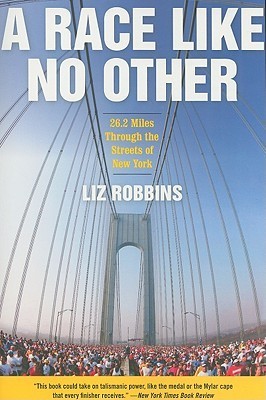
Radcliffe and her competitors surge to the peak of the Verrazano-Narrows Bridge, the highest elevation on the course today, at 260 feet above sea level and a dizzying 225 feet above shimmering New York Harbor.
Her heart, which will pound out a steady 180 beats per minute, in the next two-plus hours on the course, is revving like an engine from its resting rate of 38 beats per minute.
The items discarded on the bridge, however, will likely not be given to charity. In order for clothes to be donated, they must be washed. The volume of clothing, mixed with trash and even runners' urine, is just too great for the Department of Sanitation trucks to separate before the bridge must reopen in two hours.
When the New York Fire Department boats spray water in three fountains of red, white and blue at the start of the race, it is a sight so awesome that not even a camera lens can capture its scale. Only the runner on the bridge can truly appreciate its grandeur.
Giovanni da Verrazano was the first European to sail through these narrow waters in 1527.
By 9:30 a.m., runners are in line, stretching, laughing, befriending strangers, dancing to music from headphones, trying to stay warm, trying to stay positive, nervously bouncing on the balls of their feet, some even squatting and flushing their bodily fluids right there on the bridge as the minutes tick down to a day of certain torture.
Professional runners, even with their 140-mile training weeks, their tolerance for pain and their extremely regimented schedules, are not so different from the recreational athletes.
Professional runners pound the uneven pavement for more than two hours, taking an average of 190 steps per minute. Elite athletes will strike the ground about 25,000 times during the course of the race.
Since Radcliffe did not run the last two years, Wami's primary competition today for the series prize money is Jelena Prokopcuka (pronounced pro-kup-CHU-ka), the two-time defending New York champion from Latvia.
Flocks of Italian-speaking runners stroll around in disposable heat-retaining polypropylene coveralls sold at the bustling Marathon Expo in the days before the race [...]
Around the corner, a tent ten times the size, with plastic windows lining its walls, offers ecumenical Christian services conducted by clerics who are themselves running the race. Cindy Peterson, who grew up Catholic in Montreal, cannot discern whether there will be a Mass this morning. No matter; she is there anyway to keep warm.
A few feet from the curb of the main street heading into the start village, a small open tent holds some forty men and five women, swaying and praying. Jewish marathoners from around the world spill out of the tent. Many drape prayer shawls over their running outfits and wrap tefillin (black boxes holding biblical inscriptions) on the arm and the forehead. Their mumbling grows to a crescendo at the morning minyan (a prayer gathering that traditionally had to have at least ten men), forming an intimate community within a community.
The long lines will be elsewhere this year - at the parking lot where runners drop off their official clear plastic bags containing belongings not needed during the race; they will be deposited at numbered UPS trucks that correspond to their bib numbers. In the orange drop-off area, there is a gridlock of nearly one hour, as runners waiting to drop bags get caught in the exiting flow of those who have already done so.
Each distinct area of the village has the same characteristics - a massive arc of corral-colored balloons, first aid stations, and kiosks for coffee, tea, bagels and hot water. Runners queue for their prerace sustenance, but no line takes longer than five minutes. Due to complaints from 2006 participants who waited in lengthy lines to use portable toilets, 309 more were added in 2007 to the start village, bringing the total to 1,515.
When the time comes, runners will proceed to corrals that direct them to the starting line on the bridge. Runners with blue and orange bibs will start on the bridge's upper deck, while those with green proceed to the lower deck.
Some runners are overjoyed to be here, having gained automatic entry after not being chosen in the lottery three times in a row. Others were guaranteed entry by the fast qualifying times they ran in a marathon or half-marathon in the previous year.
Staten Island is the most overlooked of New York City's five boroughs, and the most suburban. Yet runners will spend as many (if not more) hours waiting here for the race to begin as they will running through the other four boroughs.
Somnambulant figures step from the shuttle buses that had collected them at the Staten Island Ferry terminal and traipse past him.


