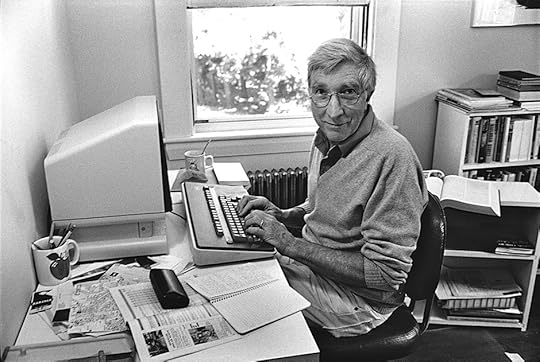
John Updike’s first collection of verse since Midpoint takes its title from a poem about insomnia. Throughout, this is poetry with its eyes wide open, restlessly alert for the oddities of reality and the double entendres of imagination. Fanciers of light verse will find a middle section of delicate fossil prints left by this vanished form; readers of Mr. Updike’s fiction will recognize some of the landscapes and preoccupations. In three long poems he, in turn, remembers a boyhood Sunday in Pennsylvania, addresses aspects of a Harvard education, and contemplates, with a Dionysian verve, the aesthetic challenge posed by the new sexual candor (“We must assimilate cunts to our creed of beauty”). Shorter poems treat of spring and flying, of gold and the Caribbean, of sand dollars and bicycle chains, of the shades of bliss and variety of phenomena accessible to a man past the midpoint of his life, trying to pace himself as he heads toward Nandi.
John Hoyer Updike was an American writer. Updike's most famous work is his Rabbit series (Rabbit, Run; Rabbit Redux; Rabbit Is Rich; Rabbit At Rest; and Rabbit Remembered). Rabbit is Rich and Rabbit at Rest both won Pulitzer Prizes for Updike. Describing his subject as "the American small town, Protestant middle class," Updike is well known for his careful craftsmanship and prolific writing, having published 22 novels and more than a dozen short story collections as well as poetry, literary criticism and children's books. Hundreds of his stories, reviews, and poems have appeared in The New Yorker since the 1950s. His works often explore sex, faith, and death, and their inter-relationships.
John Updike was married twice, first to a woman named Mary, then to a woman named Martha. If you know your Bible at all, you'll understand why that's funny.
(Especially since he was no messiah).
This poetry collection of his was published in 1977, and is dedicated to Martha, the woman he married that same year. He was a 45-year-old father of four at that point in his life, but he was also in a spanking new marriage. Though this compilation is a mixed bag of tricks, if I could sum up the feel of it in one word, I'd call it: playful.
Between these two covers (pun intended), you will find a frisky John, who ponders things like:
PALE BLISS Splitting a bottle of white wine with a naked woman in the middle of the day.
And a man who spends an appealing (and occasionally uncomfortable) amount of time reflecting on his new wife's genitalia:
let man never weary of such doting denoting, such cunnilocutions and lingual adoration. See him rise from his knees, chin wet and abraded but slavish heart in harmony: chords ring beyond the muffled clitoris of which he is one note, but one. . .
My saint. . . it is my pet, it is my altar, totalier altier: unknowable, known, and wild, subdued.
Damn. The man had it bad. (Or good?). You'll need a priest or a cigarette for a couple of these.
He's also surprisingly funny:
The cars in Caracas create a ruckukus, a four-wheeled fracacas, taxaxis and truckes.
Cacaphono-comic, the tracaffic is farcic; its weave leads the stomach to turn Caracarsick.
And uncharacteristically self-deprecating:
The scissors cut the long-grown hair; The razor scrapes the remnant fuzz. Small-jawed, weak-chinned, big-eyed, I stare At the forgotten boy I was.
It's an incredibly interesting gathering of 56 poems by a master wordsmith who never fails to knock me out, humble me, inspire me, ignite me, terrify me, and piss me off by his talent.
I experience the most bizarre sensation when I read anything by Updike: I visualize the words he uses gathered in a cereal bowl like cornflakes, and as I read them, they fly up playfully into the air and I chase after them, trying to catch them all with my tongue and my teeth.
I leave you with my favorite, which I selected for its ability to do what great poetry does best: conveys complicated emotions and experiences in a condensed space, and leaves the reader with a memory that wasn't theirs, but is now shared.
THE SOLITARY POND
The fall we moved to the farm, I was thirteen; the half-wild grapes on the dilapidated arbor could not be eaten, and the forests and brown fields also seemed to have no purpose. I grew accustomed,
that winter before the first spring, to hike alone, ducking first under our barbed wire, then our neighbor's, through thorny and hurricane-hit woods to a store selling candy and soft drink and gas by Route 11.
Returning one afternoon along an old wall, I came to a shallow, solitary pond, frozen, not more than fifteen feet across, and lined with stalks and briar-strands that left the center scarcely open.
Recalling the rink in the town we had moved from, I fetched my dull skates from the attic chest and blundered back through sharp thickets while the cold grew and a frown from the sky deepened the ominous area under
the black branches. My fingers were numb at the laces, and the ice was riddled with twigs, and my intent to glide back to childhood absurd. I fell, unstable on the clutter of wood and water bubbled and bent like earth itself, and thrashed home through the trees hating the very scratches left by my experiment.
John Updike is better known for his fiction than his poetry, and I think that's okay. His fiction is remarkable, and it feels like he's at his very best in a story (whether short or novel length).
However, because of his mastery of the English language, he really can do anything he wants, including poetry. He's everything that he is in his novels, in his poems: elegant, honest, pensive, Ivy League, clever, cerebral, sex-obsessed, flawed.
So when you pick up a collection of his poetry (this is now the second of his that I've read), you will be exposed to the full gamut of who he is, as a writer.
Remember how long-winded he was in Couples?? Well, there's a 5+ page poem called "Apologies to Harvard" which was just as interesting.
Remember his marital struggles in The Maples Stories? Read "The Melancholy of Storm Windows".
Remember his many (some say over) crafted sentences and playful wordsmithing in pretty much anything he wrote? That shines in "The Cars in Caracas" complete with the Spanish translation by Miguel Otero Silva.
Remember his many literary reviews over the years? There's a delightful tribute to Graham Greene, in "The Jolly Greene Giant" for you to appreciate.
Remember the gold coin scene in Rabbit is Rich?? Well, have a looksee on pages 75-81, friends. If you worship the female anatomy (or you long for someone who does), those pages are for YOU.
I read this during a time in which I needed great comfort. To be reminded of what lifts me in difficult times - and that is art, and the artist. For me, no one embodies that quite like John Updike, and so I am grateful. Thank you, Mr. U., for always being an inspiration, and friend, on the page.
From "Wind":
I lie here listening. God is crying, for- giiive, demanding, fore- go-ooo, proclaiming, no- wheerrre, and begging, let go-oo-ohhh.
Every single poem varied in so such unique variety that I could not help but to eat them up, each and every one of them, delightful. So clever! How does one come up with these things?! The way things are said are done like never before. And they get better the longer they are! Cunt and Apologies To Harvard are music to my mind. This inspire so much delving into Updike. I think he might get to being my new favorite! This guy must be a genius or something!
Updike always considered himself a poet, as well as a novelist. Personally, I think it was a good thing that his novels did so well. For the poetry, hmmm. In this particular volume of poetry (one of at least four, maybe more), he shows his abilities in all types of meter and rhyme. Several of the poems have subsequently been republished as broadsides (I have two of them hanging on my wall - signed). Nevertheless, I think I'm not going to take the time to memorize any of them to show off at a party.
This was enjoyable, I think there is some sympathies I have with Updike because he depicts the Gen-X Suburban mileu well, while being referential in an ostentatious way that is still aesthetic. This was just the poetry variant of that.