

What do you think?

A Laodicean
The daughter of a wealthy railway magnate, Paula Power inherits De Stancy Castle, an ancient castle in need of modernization. She commissions George Somerset, a young architect, to undertake the work. Somerset falls in love with Paula but she, the Laodicean of the title, is torn between his admiration and that of Captain De Stancy, whose old-world romanticism contrasts with Somerset's forward-looking attitude. Paula's vacillation, however, is not only romantic. Her ambiguity regarding religion, politics and social progress is a reflection of the author's own. This new Penguin Classics edition of Hardy's text contains an introduction and notes that illuminate and clarify these themes, and draws parallels between the text and the author's life and views.
For more than seventy years, Penguin has been the leading publisher of classic literature in the English-speaking world. With more than 1,700 titles, Penguin Classics represents a global bookshelf of the best works throughout history and across genres and disciplines. Readers trust the series to provide authoritative texts enhanced by introductions and notes by distinguished scholars and contemporary authors, as well as up-to-date translations by award-winning translators.
For more than seventy years, Penguin has been the leading publisher of classic literature in the English-speaking world. With more than 1,700 titles, Penguin Classics represents a global bookshelf of the best works throughout history and across genres and disciplines. Readers trust the series to provide authoritative texts enhanced by introductions and notes by distinguished scholars and contemporary authors, as well as up-to-date translations by award-winning translators.
427 pages, Paperback
First published January 1, 1881
About the author
Thomas Hardy
2,788 books7,051 followersThomas Hardy, OM, was an English author of the naturalist movement, although in several poems he displays elements of the previous romantic and enlightenment periods of literature, such as his fascination with the supernatural. He regarded himself primarily as a poet and composed novels mainly for financial gain.
The bulk of his work, set mainly in the semi-fictional land of Wessex, delineates characters struggling against their passions and circumstances. Hardy's poetry, first published in his 50s, has come to be as well regarded as his novels, especially after The Movement of the 1950s and 1960s.
The term cliffhanger is considered to have originated with Thomas Hardy's serial novel A Pair of Blue Eyes in 1873. In the novel, Hardy chose to leave one of his protagonists, Knight, literally hanging off a cliff staring into the stony eyes of a trilobite embedded in the rock that has been dead for millions of years. This became the archetypal — and literal — cliff-hanger of Victorian prose.
Excerpted from Wikipedia.
The bulk of his work, set mainly in the semi-fictional land of Wessex, delineates characters struggling against their passions and circumstances. Hardy's poetry, first published in his 50s, has come to be as well regarded as his novels, especially after The Movement of the 1950s and 1960s.
The term cliffhanger is considered to have originated with Thomas Hardy's serial novel A Pair of Blue Eyes in 1873. In the novel, Hardy chose to leave one of his protagonists, Knight, literally hanging off a cliff staring into the stony eyes of a trilobite embedded in the rock that has been dead for millions of years. This became the archetypal — and literal — cliff-hanger of Victorian prose.
Excerpted from Wikipedia.
Ratings & Reviews
Friends & Following
Create a free account to discover what your friends think of this book!
Community Reviews
Displaying 1 - 30 of 113 reviews

February 13, 2026
I absolutely adored this book!! I wasn't expecting to as much as it's an underdog of Hardy 🤣 It felt new for his usual style but I could discern and fall in very easily with the paradoxical themes x Most similar to Far From The Maddening Crowd I think 😅

December 10, 2010
This is typical Hardy, but not one of his better known novels. I found this one very variable; in parts as good as Hardy gets, in other places too rushed, too formulaic and predictable.
The title is based on the Laodicean Church in the Book of Revelation; who were neither hot nor cold. They were described as being tepid, possibly passionless; neither one thing nor another. However hardy's use hear relates more to one who is unable to make their mind up; torn between two possibilities.
The plot is straightforward enough. The De Stancy family are have fallen on hard times and have had to sell the ancestral home to a local indistrialist; a Mr Power. He dies and the castle passes to his daughter Paula. She becomes very wealthy, single and the owner of a large if somewhat delapidated castle. George Somerset, a young and rather impecunious architect is wandering round the countryside and drawing bits of buildings and churches. He comes across the castle and falls in love with Paula (so far very Hardy). Hardy uses his training as an architect here to go on at some length throughout the book about various architectural features and periods. Somerset manages to get himself taken on as architect to rebuild the castle. Meanwhile military man William De Stancy would quite like the ancestral home back and Paula is clearly very attractive (money and a castle!). Somerset and De Stancy are rivals and Paula struggles to make up her mind. There is a good cast of minor characters. Mr Dare is the villain of the piece and De Stancy's illegitimate son (unknown to everyone but De Stancy). Dare briefly works for Somerset and works for his father to win Paula by fair means some of the time, but mostly foul. There follows various architectural shenanigans, several perambulations around Europe, engagements made and broken, deception, treachery and most of all Paula Power's complete inability to fix on one course of action or one suitor.
Hardy sets up the action well in the first part of the book and as always builds the scene and characters in an assured way. The second half of the book is not as strong and the wanderings round Europe feel rushed. However the very last sentence of the book is brilliant and breathtaking; Hardy at his very best; it almost rescues the book, but not quite.
Hardy composed this novel whilst on his sick bed; dictated it to his wife. On the whole I enjoyed it, despite its variability. It has been described as a comic novel; although there are comedic touches, it is as much tragedy as comedy. Hardy's "happy" endings (when he does them) always have an edge; this one is no different. It's a shame about the variability of the middle part of the novel; it could have been great.
The title is based on the Laodicean Church in the Book of Revelation; who were neither hot nor cold. They were described as being tepid, possibly passionless; neither one thing nor another. However hardy's use hear relates more to one who is unable to make their mind up; torn between two possibilities.
The plot is straightforward enough. The De Stancy family are have fallen on hard times and have had to sell the ancestral home to a local indistrialist; a Mr Power. He dies and the castle passes to his daughter Paula. She becomes very wealthy, single and the owner of a large if somewhat delapidated castle. George Somerset, a young and rather impecunious architect is wandering round the countryside and drawing bits of buildings and churches. He comes across the castle and falls in love with Paula (so far very Hardy). Hardy uses his training as an architect here to go on at some length throughout the book about various architectural features and periods. Somerset manages to get himself taken on as architect to rebuild the castle. Meanwhile military man William De Stancy would quite like the ancestral home back and Paula is clearly very attractive (money and a castle!). Somerset and De Stancy are rivals and Paula struggles to make up her mind. There is a good cast of minor characters. Mr Dare is the villain of the piece and De Stancy's illegitimate son (unknown to everyone but De Stancy). Dare briefly works for Somerset and works for his father to win Paula by fair means some of the time, but mostly foul. There follows various architectural shenanigans, several perambulations around Europe, engagements made and broken, deception, treachery and most of all Paula Power's complete inability to fix on one course of action or one suitor.
Hardy sets up the action well in the first part of the book and as always builds the scene and characters in an assured way. The second half of the book is not as strong and the wanderings round Europe feel rushed. However the very last sentence of the book is brilliant and breathtaking; Hardy at his very best; it almost rescues the book, but not quite.
Hardy composed this novel whilst on his sick bed; dictated it to his wife. On the whole I enjoyed it, despite its variability. It has been described as a comic novel; although there are comedic touches, it is as much tragedy as comedy. Hardy's "happy" endings (when he does them) always have an edge; this one is no different. It's a shame about the variability of the middle part of the novel; it could have been great.

September 10, 2016
Not my favourite Hardy. It had some interesting characters and quite a twisting plot but I felt like the characters' motivations could have been developed more and it wasn't quite as engaging and moving as other Hardy books. The ending was also a bit weird.
On rereading: I rather like the ending.
On rereading: I rather like the ending.

July 13, 2020
The least pronounceable of Thomas’s novels (LAY-oh-du-SEE-an) is an overlong “romance” exploring one woman’s relationship between modernity and antiquity, the former an architect the latter a ramshackle Count. Paula Power’s POV is never explored in the novel, leaving her an arch and harried heroine, unbesotted with either suitor until the plot requires she chooses one of them. Half-written and half-dictated on his sickbed, the novel is a curio in the canon and worth reading for fans of the lighter side of Hardy.

February 22, 2019
There’s a particular pleasure that comes with having read so much of an author’s oeuvre that you find yourself reaching deep into the back catalogue for new experiences. I love reading the less-celebrated or more obscure works by a famous author. Sometimes they are less-celebrated and more obscure for good reason! Sometimes, though, as with A Laodicean, they turn out to be undiscovered treasures!
I picked up this used copy at the same time I picked up a copy of The Pickwick Papers. I’ve been having this urge to re-read Bleak House but for some stubborn reason thought I should read a different Dickens first. So far Pickwick has proved impenetrable to me this year. It was thus with some trepidation I picked up Thomas Hardy’s book, because I wondered if I just wasn’t in the mood to work as hard as one must to translate these older works. I was so, so wrong. While it’s true that it takes a few sessions for my mind to adjust to the older language, Hardy is most emphatically not Dickens. Once you get past the recondite title and the heavy architectural jargon (and skip the pedantic introduction, obvs), you have what I can only describe as a pulp romance tale. It’s wonderful.
George Somerset is an architect at the beginning of his practice. On his ambles across the countryside he stumbles upon Stancy Castle, now in the possession of young heiress Paula Power. She engages him to draft plans for revitalizing and restoring the castle, even as they begin a vacillating dalliance—Paula is the “Laodicean” woman referred to by the title, for her indecisive nature in matters spiritual and temporal. Somerset finds himself beset with two rivals, one professional and one personal: Havill, a local architect; and William de Stancy, who is manoeuvred into pursuing this woman who now owns his ancestral home. Both are assisted, in ways sanctioned and not, by the enigmatic and villainous scoundrel William Dare, whose identity links him closely to the de Stancys. Somerset desperately wants to win Paula’s love and affection, but she is afraid of commitment—and the machinations of Dare, de Stancy, and Havill might prove to be a wedge too wide for them to overcome.
This book is just so delicious. It’s got intrigue. Dare is all about the falsified telegrams, the manipulated photos. You could totally take this story and adapt it to a modern-day romantic comedy, or even a Gossip Girl–style CW show—literally all of the ingredients are there. I thought I’d be getting a palate cleanser after reading some YA, but this is pretty much YA if the young adults weren’t quite so young any more. You could transplant this to high school if you wanted: young, rich woman stuck in a love triangle, not sure who to commit to, while other characters manipulate the situation from behind the scenes. Dare’s villainy really clinches this aspect of the plot for me. He will basically stop at nothing; Hardy makes him out to be a despicable wretch of a man who puts so much effort into obtaining money dishonestly instead of getting an honest job.
Somerset and Paula’s romance isn’t the greatest, but it isn’t the worst either. I like that the attraction is largely intellectual, or seems to be conducted upon that playing field. Paula appreciates Somerset’s architectural and historical knowledge, and his somewhat dissenting views from traditional religious and political dogma. Likewise, even the more physically capable military man of Captain de Stancy tries to impress Paula by sharpening and displaying his knowledge of European history and nobility. Paula herself is, like so many of Hardy’s other heroines, intelligent but also educated and possessive of a fierce sense of individual self-determination. She may be frustratingly indecisive, and perhaps to a modern reader, fickle—but I really empathized with the position she was in.
Hardy is, once again, attempting to subvert the ideas of Victorian society when it comes to how men and women should court one another and ultimately marry. A Laodicean feels very progressive given its time. And a lot of what happens in the romantic plot feels relevant in today’s heteronormative society as well. Men are encouraged to pursue women and to stick with it, even if she is “playing hard to get.” De Stancy and Somerset both exhibit this ruthless perseverance. The former is constantly pressing his suit, while the latter literally pursues Paula and company across continental Europe. Paula, however, pushes back. In one memorable scene, she and de Stancy have been hiking the countryside. He is about to launch into another speech about why he would be an awesome husband, when she chides him:
I appreciate this portrayal, how Hardy shows de Stancy acknowledging his mistake and correcting his behaviour. For most of the story we’re supposed to see de Stancy as a somewhat likeable rival to the protagonist of Somerset, I expect—he is a noble figure. But the climax is supposed to reveal his true character, the way he has to choose between Paula and Dare and how his attitude suddenly becomes a mixture of imperious and pleading. It’s tempting to see this as inconsistent with his earlier character; on the contrary, it’s consistent with how Dare manipulates him throughout the book. De Stancy is noble but fairly weak-willed, according to Hardy: a good man easily led astray.
Indeed, the characters who surround this central love triangle are interesting in their own ways. Charlotte de Stancy finds herself in a quandary when she learns how Dare’s deceptions have prejudiced Paula against Somerset. Does she intervene, reveal the truth, dash her own brother’s hopes of marrying her best friend? Or does she keep it a secret, even though it means breaking apart two people she knows are well-suited for one another? I can’t say I’ve been quite in the same situation, but I can definitely sympathize with the difficulty of that choice. Close friendship of the kind between Paula and Charlotte often means having to make such choices—and also having to choose between what you want and what is best for your friend. Similarly, Havill is not quite a villain yet not an innocent either. He has a surprising amount of depth for a minor character.
The ending of A Laodicean is probably one of the reasons it hasn’t received more attention, I suppose. It’s a fairly rushed, unsatisfying, and predictable sequence of events. For modern readers who are familiar with the romantic comedy formula, it’s going to feel very, very familiar in a lot of ways. For Hardy’s readers I wonder if it felt less so—certainly, Paula’s change of heart and the actions she undertakes as a result seem quite bold and brash for a woman in her position. Her final words, which close out the book, are also somewhat enigmatic. As I read those in a bath on Sunday morning, I leaned back and pondered what Hardy might mean by them. In my opinion, he’s reminding us that love is not a panacea. Paula might be content with what she has decided, might love someone, but that doesn’t stop her from wishing things were different anyway. It’s a flawed and very human admission and quite an interesting way to end the book.
While by no means supplanting The Woodlanders or Tess as my favourite Hardy novels, A Laodicean was eminently enjoyable. It turned out to be exactly what I wanted to read right now, and it surprised me with its deftness of character and accessible, almost modern plot. Give me an adaptation!

I picked up this used copy at the same time I picked up a copy of The Pickwick Papers. I’ve been having this urge to re-read Bleak House but for some stubborn reason thought I should read a different Dickens first. So far Pickwick has proved impenetrable to me this year. It was thus with some trepidation I picked up Thomas Hardy’s book, because I wondered if I just wasn’t in the mood to work as hard as one must to translate these older works. I was so, so wrong. While it’s true that it takes a few sessions for my mind to adjust to the older language, Hardy is most emphatically not Dickens. Once you get past the recondite title and the heavy architectural jargon (and skip the pedantic introduction, obvs), you have what I can only describe as a pulp romance tale. It’s wonderful.
George Somerset is an architect at the beginning of his practice. On his ambles across the countryside he stumbles upon Stancy Castle, now in the possession of young heiress Paula Power. She engages him to draft plans for revitalizing and restoring the castle, even as they begin a vacillating dalliance—Paula is the “Laodicean” woman referred to by the title, for her indecisive nature in matters spiritual and temporal. Somerset finds himself beset with two rivals, one professional and one personal: Havill, a local architect; and William de Stancy, who is manoeuvred into pursuing this woman who now owns his ancestral home. Both are assisted, in ways sanctioned and not, by the enigmatic and villainous scoundrel William Dare, whose identity links him closely to the de Stancys. Somerset desperately wants to win Paula’s love and affection, but she is afraid of commitment—and the machinations of Dare, de Stancy, and Havill might prove to be a wedge too wide for them to overcome.
This book is just so delicious. It’s got intrigue. Dare is all about the falsified telegrams, the manipulated photos. You could totally take this story and adapt it to a modern-day romantic comedy, or even a Gossip Girl–style CW show—literally all of the ingredients are there. I thought I’d be getting a palate cleanser after reading some YA, but this is pretty much YA if the young adults weren’t quite so young any more. You could transplant this to high school if you wanted: young, rich woman stuck in a love triangle, not sure who to commit to, while other characters manipulate the situation from behind the scenes. Dare’s villainy really clinches this aspect of the plot for me. He will basically stop at nothing; Hardy makes him out to be a despicable wretch of a man who puts so much effort into obtaining money dishonestly instead of getting an honest job.
Somerset and Paula’s romance isn’t the greatest, but it isn’t the worst either. I like that the attraction is largely intellectual, or seems to be conducted upon that playing field. Paula appreciates Somerset’s architectural and historical knowledge, and his somewhat dissenting views from traditional religious and political dogma. Likewise, even the more physically capable military man of Captain de Stancy tries to impress Paula by sharpening and displaying his knowledge of European history and nobility. Paula herself is, like so many of Hardy’s other heroines, intelligent but also educated and possessive of a fierce sense of individual self-determination. She may be frustratingly indecisive, and perhaps to a modern reader, fickle—but I really empathized with the position she was in.
Hardy is, once again, attempting to subvert the ideas of Victorian society when it comes to how men and women should court one another and ultimately marry. A Laodicean feels very progressive given its time. And a lot of what happens in the romantic plot feels relevant in today’s heteronormative society as well. Men are encouraged to pursue women and to stick with it, even if she is “playing hard to get.” De Stancy and Somerset both exhibit this ruthless perseverance. The former is constantly pressing his suit, while the latter literally pursues Paula and company across continental Europe. Paula, however, pushes back. In one memorable scene, she and de Stancy have been hiking the countryside. He is about to launch into another speech about why he would be an awesome husband, when she chides him:
He again offered his arm, and from sheer necessity she leant upon it as before.
“Grant me but a moment’s patience,” he began.
“Captain de Stancy! Is this fair? I am physically obliged to hold your arm, so that I must listen to what you say!”
“No, it is not fair; upon my soul it is not!” said de Stancy. “I won’t say another word.”
I appreciate this portrayal, how Hardy shows de Stancy acknowledging his mistake and correcting his behaviour. For most of the story we’re supposed to see de Stancy as a somewhat likeable rival to the protagonist of Somerset, I expect—he is a noble figure. But the climax is supposed to reveal his true character, the way he has to choose between Paula and Dare and how his attitude suddenly becomes a mixture of imperious and pleading. It’s tempting to see this as inconsistent with his earlier character; on the contrary, it’s consistent with how Dare manipulates him throughout the book. De Stancy is noble but fairly weak-willed, according to Hardy: a good man easily led astray.
Indeed, the characters who surround this central love triangle are interesting in their own ways. Charlotte de Stancy finds herself in a quandary when she learns how Dare’s deceptions have prejudiced Paula against Somerset. Does she intervene, reveal the truth, dash her own brother’s hopes of marrying her best friend? Or does she keep it a secret, even though it means breaking apart two people she knows are well-suited for one another? I can’t say I’ve been quite in the same situation, but I can definitely sympathize with the difficulty of that choice. Close friendship of the kind between Paula and Charlotte often means having to make such choices—and also having to choose between what you want and what is best for your friend. Similarly, Havill is not quite a villain yet not an innocent either. He has a surprising amount of depth for a minor character.
The ending of A Laodicean is probably one of the reasons it hasn’t received more attention, I suppose. It’s a fairly rushed, unsatisfying, and predictable sequence of events. For modern readers who are familiar with the romantic comedy formula, it’s going to feel very, very familiar in a lot of ways. For Hardy’s readers I wonder if it felt less so—certainly, Paula’s change of heart and the actions she undertakes as a result seem quite bold and brash for a woman in her position. Her final words, which close out the book, are also somewhat enigmatic. As I read those in a bath on Sunday morning, I leaned back and pondered what Hardy might mean by them. In my opinion, he’s reminding us that love is not a panacea. Paula might be content with what she has decided, might love someone, but that doesn’t stop her from wishing things were different anyway. It’s a flawed and very human admission and quite an interesting way to end the book.
While by no means supplanting The Woodlanders or Tess as my favourite Hardy novels, A Laodicean was eminently enjoyable. It turned out to be exactly what I wanted to read right now, and it surprised me with its deftness of character and accessible, almost modern plot. Give me an adaptation!
September 22, 2023
Not my favourite Hardy, I've found others of his far superior.

April 4, 2013
A Laodicean: A Story of Today is a novel by Thomas Hardy, published in 1881. The full title was "A Laodicean; or The Castle of the Stanceys. A Story of Today", and first appeared in serial form in thirteen monthly installments by Harper’s New Monthly Magazine, with George Du Maurier's illustrations, from December 1880 to December 1881. It seems like half the books I read were originally published in serial form and with illustrations. Hardy fell ill during the writing of the novel and it ended up that most of if was dictated to his wife, Emma. Some years after the book was published Hardy told a friend that it contained more facts of his own life than anything else he had ever written. It seems his illness was so severe Hardy thought he wouldn't recover and that was the reason he put so much of himself into the novel. So, I had to go look up a biography of Hardy to see how much like our lead character he was. The only two possibilities were George Somerset, an architect who falls in love with our heroine, Paula and spends most of the book telling her he loves her, or William de Stancy, a captain in the Royal Horse Artillery who falls in love with our heroine, Paula and spends most of the book telling her he loves her. I'm guessing Hardy wasn't in the Horse Artillery, so he must most resemble George Somerset, or I suppose George resembles Hardy. I guess it could be one of the other characters, the pastor who seems almost obsessed with the idea of baptizing Paula, and probably everyone else if he could, or maybe the other architect, but he's pretty old and grumpy to be basing on yourself, or perhaps the awful Dare, I'm not sure what he is. I'm sticking with George.
Hardy wrote poetry throughout his life and regarded himself primarily as a poet, although his first collection was not published until 1898. Hardy's poetry, though there was a lot of it, was not well received during his lifetime. We are told of George:
"he was thrown into a mood of disgust with his profession, from which mood he was only delivered by recklessly abandoning these studies and indulging in an old enthusiasm for poetical literature. For two whole years he did nothing but write verse in every conceivable metre, and on every conceivable subject, from Wordsworthian sonnets on the singing of his tea-kettle to epic fragments on the Fall of Empires. His discovery at the age of five-and-twenty that these inspired works were not jumped at by the publishers with all the eagerness they deserved, coincided in point of time with a severe hint from his father that unless he went on with his legitimate profession he might have to look elsewhere than at home for an allowance."
I'm going to have to go see if Hardy wrote any poetry on the singing of his tea-kettle, if I remember that is. Dickens The Cricket on the Hearth certainly came to mind when I read that. Also of Hardy I found:
"his formal education ended at the age of sixteen, when he became apprenticed to James Hicks, a local architect. Hardy trained as an architect in Dorchester before moving to London in 1862; there he enrolled as a student at King's College London. He won prizes from the Royal Institute of British Architects and the Architectural Association."
When first published A Laodicean: A Story of Today received relatively good reviews, but now it is usually considered Hardy's weakest novel. Or it isn't considered anything at all, it doesn't even appear on the list I have of Hardy's novels. Even novels such as "Desperate Remedies" and "The Trumpet-Major" make the list and I wouldn't have thought they were any more known than "A Laodicean" is. In the story Paula Power has inherited a medieval castle, Castle Stancy, from her industrialist father, the great railway contractor, John Power. He had purchased it when the head of the De Stancy family had lost all the family money on one thing or another and had to sell everything, castle, furniture, family portraits, everything. Paula loves the old castle and the history of the castle and dreams of nobility. Her best friend is Charlotte De Stancy, yes one of those De Stancys. She loves having her for a friend and Charlotte just adores Paula. That seems strange to me, but she does. Here is what the landlord tells George about the relationship between the two women, it also tells us a little about Paula's personality:
'Now that's a curious thing again, these two girls being so fond of one another; one of 'em a dissenter, and all that, and t'other a De Stancy. O no, not hired exactly, but she mostly lives with Miss Power, and goes about with her, and I dare say Miss Power makes it wo'th her while. One can't move a step without the other following; though judging by ordinary volks you'd think 'twould be a cat-and-dog friendship rather.'
'But 'tis not?'
''Tis not; they be more like lovers than maid and maid. Miss Power is looked up to by little De Stancy as if she were a god-a'mighty, and Miss Power lets her love her to her heart's content. But whether Miss Power loves back again I can't zay, for she's as deep as the North Star.'
Paula employs two architects, one local and the other, George Somerset, who has recently arrived in the area on a summer tour before setting up his own business in London. Paula wants to restore the castle, when George asks her which part she tells him all of it. They then walked through the castle while George pointed out "where roofs had been and should be again, where gables had been pulled down, and where floors had vanished, showing her how to reconstruct their details from marks in the walls." One of the things I had trouble with was the modern things mixed in with the old castle. I don't know if it would have bothered me as much if Paula hadn't been so taken with the family who used to own the castle, and so determined to restore every part of it. At the same time there are wires for the telegraph going in an arrow-slit and a brand new shiny clock hanging on the front of the castle.
"The little village inn at which Somerset intended to pass the night lay a mile further on, and retracing his way up to the stile he rambled along the lane, now beginning to be streaked like a zebra with the shadows of some young trees that edged the road. But his attention was attracted to the other side of the way by a hum as of a night-bee, which arose from the play of the breezes over a single wire of telegraph running parallel with his track on tall poles that had appeared by the road, he hardly knew when, from a branch route, probably leading from some town in the neighbourhood to the village he was approaching.
Somerset decided to follow the lead of the wire. It was not the first time during his present tour that he had found his way at night by the help of these musical threads which the post-office authorities had erected all over the country for quite another purpose than to guide belated travellers. Plunging with it across the down he came to a hedgeless road that entered a park or chase, which flourished in all its original wildness.
Though he had noticed the remains of a deer-fence further back no deer were visible, and it was scarcely possible that there should be any in the existing state of things: but rabbits were multitudinous, every hillock being dotted with their seated figures till Somerset approached and sent them limping into their burrows. The road next wound round a clump of underwood beside which lay heaps of faggots for burning, and then there appeared against the sky the walls and towers of a castle, half ruin, half residence, standing on an eminence hard by.
He walked up to a modern arch spanning the ditch—now dry and green—over which the drawbridge once had swung. The large door under the porter's archway was closed and locked. While standing here the singing of the wire, which for the last few minutes he had quite forgotten, again struck upon his ear, and retreating to a convenient place he observed its final course: from the poles amid the trees it leaped across the moat, over the girdling wall, and thence by a tremendous stretch towards the keep where, to judge by sound, it vanished through an arrow-slit into the interior. This fossil of feudalism, then, was the journey's-end of the wire, and not the village of Sleeping-Green.
Thence he could observe the walls of the lower court in detail, and the old mosses with which they were padded—mosses that from time immemorial had been burnt brown every summer, and every winter had grown green again. The arrow-slit and the electric wire that entered it, like a worm uneasy at being unearthed, were distinctly visible now. So also was the clock, not, as he had supposed, a chronometer coeval with the fortress itself, but new and shining, and bearing the name of a recent maker. "
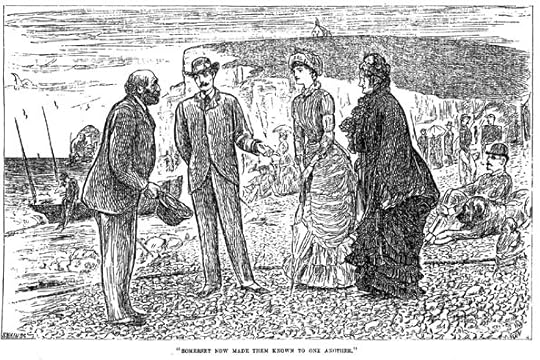
Well, I think I've told you enough of the story, we have George the handsome (I guess, I can't quite remember) architect who is going to restore the castle, then again, we also have William De Stancy who is after all a De Stancy in the first place, and Paula does love nobility, we also have a couple of bad guys, and we get to see who Paula finally chooses. We will also know if the castle finally gets restored, and if the bad guys lose the battle, whatever battle there is, and most importantly if someone takes those dumb wires and shiny clock off of the old castle. It was just OK for me for most of the book, there weren't any big surprises, although I found the last line rather interesting. I was only going to give it two stars, but I think I'll give it three, after all there were illustrations and I love illustrations, they are so Dickens like. Here's one of the illustrations from the original publication:
Happy reading.
Hardy wrote poetry throughout his life and regarded himself primarily as a poet, although his first collection was not published until 1898. Hardy's poetry, though there was a lot of it, was not well received during his lifetime. We are told of George:
"he was thrown into a mood of disgust with his profession, from which mood he was only delivered by recklessly abandoning these studies and indulging in an old enthusiasm for poetical literature. For two whole years he did nothing but write verse in every conceivable metre, and on every conceivable subject, from Wordsworthian sonnets on the singing of his tea-kettle to epic fragments on the Fall of Empires. His discovery at the age of five-and-twenty that these inspired works were not jumped at by the publishers with all the eagerness they deserved, coincided in point of time with a severe hint from his father that unless he went on with his legitimate profession he might have to look elsewhere than at home for an allowance."
I'm going to have to go see if Hardy wrote any poetry on the singing of his tea-kettle, if I remember that is. Dickens The Cricket on the Hearth certainly came to mind when I read that. Also of Hardy I found:
"his formal education ended at the age of sixteen, when he became apprenticed to James Hicks, a local architect. Hardy trained as an architect in Dorchester before moving to London in 1862; there he enrolled as a student at King's College London. He won prizes from the Royal Institute of British Architects and the Architectural Association."
When first published A Laodicean: A Story of Today received relatively good reviews, but now it is usually considered Hardy's weakest novel. Or it isn't considered anything at all, it doesn't even appear on the list I have of Hardy's novels. Even novels such as "Desperate Remedies" and "The Trumpet-Major" make the list and I wouldn't have thought they were any more known than "A Laodicean" is. In the story Paula Power has inherited a medieval castle, Castle Stancy, from her industrialist father, the great railway contractor, John Power. He had purchased it when the head of the De Stancy family had lost all the family money on one thing or another and had to sell everything, castle, furniture, family portraits, everything. Paula loves the old castle and the history of the castle and dreams of nobility. Her best friend is Charlotte De Stancy, yes one of those De Stancys. She loves having her for a friend and Charlotte just adores Paula. That seems strange to me, but she does. Here is what the landlord tells George about the relationship between the two women, it also tells us a little about Paula's personality:
'Now that's a curious thing again, these two girls being so fond of one another; one of 'em a dissenter, and all that, and t'other a De Stancy. O no, not hired exactly, but she mostly lives with Miss Power, and goes about with her, and I dare say Miss Power makes it wo'th her while. One can't move a step without the other following; though judging by ordinary volks you'd think 'twould be a cat-and-dog friendship rather.'
'But 'tis not?'
''Tis not; they be more like lovers than maid and maid. Miss Power is looked up to by little De Stancy as if she were a god-a'mighty, and Miss Power lets her love her to her heart's content. But whether Miss Power loves back again I can't zay, for she's as deep as the North Star.'
Paula employs two architects, one local and the other, George Somerset, who has recently arrived in the area on a summer tour before setting up his own business in London. Paula wants to restore the castle, when George asks her which part she tells him all of it. They then walked through the castle while George pointed out "where roofs had been and should be again, where gables had been pulled down, and where floors had vanished, showing her how to reconstruct their details from marks in the walls." One of the things I had trouble with was the modern things mixed in with the old castle. I don't know if it would have bothered me as much if Paula hadn't been so taken with the family who used to own the castle, and so determined to restore every part of it. At the same time there are wires for the telegraph going in an arrow-slit and a brand new shiny clock hanging on the front of the castle.
"The little village inn at which Somerset intended to pass the night lay a mile further on, and retracing his way up to the stile he rambled along the lane, now beginning to be streaked like a zebra with the shadows of some young trees that edged the road. But his attention was attracted to the other side of the way by a hum as of a night-bee, which arose from the play of the breezes over a single wire of telegraph running parallel with his track on tall poles that had appeared by the road, he hardly knew when, from a branch route, probably leading from some town in the neighbourhood to the village he was approaching.
Somerset decided to follow the lead of the wire. It was not the first time during his present tour that he had found his way at night by the help of these musical threads which the post-office authorities had erected all over the country for quite another purpose than to guide belated travellers. Plunging with it across the down he came to a hedgeless road that entered a park or chase, which flourished in all its original wildness.
Though he had noticed the remains of a deer-fence further back no deer were visible, and it was scarcely possible that there should be any in the existing state of things: but rabbits were multitudinous, every hillock being dotted with their seated figures till Somerset approached and sent them limping into their burrows. The road next wound round a clump of underwood beside which lay heaps of faggots for burning, and then there appeared against the sky the walls and towers of a castle, half ruin, half residence, standing on an eminence hard by.
He walked up to a modern arch spanning the ditch—now dry and green—over which the drawbridge once had swung. The large door under the porter's archway was closed and locked. While standing here the singing of the wire, which for the last few minutes he had quite forgotten, again struck upon his ear, and retreating to a convenient place he observed its final course: from the poles amid the trees it leaped across the moat, over the girdling wall, and thence by a tremendous stretch towards the keep where, to judge by sound, it vanished through an arrow-slit into the interior. This fossil of feudalism, then, was the journey's-end of the wire, and not the village of Sleeping-Green.
Thence he could observe the walls of the lower court in detail, and the old mosses with which they were padded—mosses that from time immemorial had been burnt brown every summer, and every winter had grown green again. The arrow-slit and the electric wire that entered it, like a worm uneasy at being unearthed, were distinctly visible now. So also was the clock, not, as he had supposed, a chronometer coeval with the fortress itself, but new and shining, and bearing the name of a recent maker. "
Well, I think I've told you enough of the story, we have George the handsome (I guess, I can't quite remember) architect who is going to restore the castle, then again, we also have William De Stancy who is after all a De Stancy in the first place, and Paula does love nobility, we also have a couple of bad guys, and we get to see who Paula finally chooses. We will also know if the castle finally gets restored, and if the bad guys lose the battle, whatever battle there is, and most importantly if someone takes those dumb wires and shiny clock off of the old castle. It was just OK for me for most of the book, there weren't any big surprises, although I found the last line rather interesting. I was only going to give it two stars, but I think I'll give it three, after all there were illustrations and I love illustrations, they are so Dickens like. Here's one of the illustrations from the original publication:
Happy reading.

December 5, 2021
It isn't Mr. Hardy's best novel, but it is still very very good. The quality of the writing is hugely better than most of the things that I read in terms of richness of expression, characters, plotting and thematic development. It's a pleasure to read. One of the things that I like best in Mr. Hardy's novels is the feeling of life on the cusp of modernity - values are changing, but the old way of life isn't gone yet and the complications between the characters are often emblematic of the complications between old and new. The telegraph line into the Norman castle owned by the daughter of a railroad baron who has bought it from old noble family sets the stage for the contrast between old and new that pervades the book.
My favorite character in the book is the evil Dare, who is stupid but smart, sometimes brilliant in his calculations, sometimes not, and often foiled by the honorable instincts of his father. He's a bad, bad guy who seemingly can't be stopped. Whenever it seems that he is down, he bounces back for more bad deeds. He reminded me of a Patricia Highsmith villain. The Talented Mr. Dare.
My favorite character in the book is the evil Dare, who is stupid but smart, sometimes brilliant in his calculations, sometimes not, and often foiled by the honorable instincts of his father. He's a bad, bad guy who seemingly can't be stopped. Whenever it seems that he is down, he bounces back for more bad deeds. He reminded me of a Patricia Highsmith villain. The Talented Mr. Dare.

November 28, 2019
I was not familiar with this novel by Thomas Hardy until I read it. I found it a very frustrating read. The men in this story do not come off very well. They all fall in love with the same woman, and they won't take her admittedly wishy washy get lost seriously.
She accidentally gets engaged to one of them, then inadvertently to the other, then sort of to the first, then becomes angry with him and gets engaged to the second again out of spite.
It's not like there aren't enough women to go around. There is another perfectly good girl there all the time, but as she is one man's sister that won't work out, so she runs off and joins a convent.
In other words, Thomas Hardy wrote a soap opera.
She accidentally gets engaged to one of them, then inadvertently to the other, then sort of to the first, then becomes angry with him and gets engaged to the second again out of spite.
It's not like there aren't enough women to go around. There is another perfectly good girl there all the time, but as she is one man's sister that won't work out, so she runs off and joins a convent.
In other words, Thomas Hardy wrote a soap opera.

June 18, 2022
Wow! This was very much unlike any other Thomas Hardy novel I’ve ever read. It was awesome. I highly recommend this one.

June 21, 2020
3.5 stars. A well written, pleasant read that Hardy fans should enjoy. Paula Power is a well off young lady who has inherited an estate which includes the historic ‘Castle de Stancy’. Paula’s father was a railway millionaire. Paula is an interesting character who gives off the air of being lukewarm towards her suitors. Paula is not totally sure of herself as evidenced in her reluctance to be properly baptised and her indecision on the plans for restoring the castle. One of her suitors is a young architect and restorer, George Somerset. His father is a famous painter. The other suitor is Captain de Stancy, who is in his late 30s and is currently in England on leave from the British army based in India. His grandfather and father were forced to sell the ‘castle de Stancy’ when the Captain was a small boy. A couple of villains are introduced, adding complications to each suitors efforts to win the affections of Paula Power.
Readers new to Thomas Hardy should firstly read his more famous and stronger novels, ‘Far from the Madding Crowd’ or ‘Tess of the d’Urbervilles’.
Readers new to Thomas Hardy should firstly read his more famous and stronger novels, ‘Far from the Madding Crowd’ or ‘Tess of the d’Urbervilles’.

April 8, 2012
I picked up a cheap penguin classics version of this in Camden to read while we were on holiday. I have to say the penguin edition was quite annoying as it had lots of footnotes and I found them very distracting as it disrupted the flow of the story when I had to go, Wait they really don't think we know what that is??? But on the plus side it did have some nice period engravings that went along with the story.
There wasn't very much social commentary it was nearly all romantic comedy, which probably is not Hardy's best genre. It was still an enjoyable and quick read though. One of the things that was most striking about the book was the main character of Paula who was an incredibly independent woman. She was wealthy, having inherited a huge estate from her father, had no guardian character and was able to do as she pleased. In fact in her introduction she is refusing being baptised in the local baptist church, which had been her father's dying wish. Unsurprisngly, everyone wants to marry her and the plot is a twist of the different attempts of her various suitors. But one of the things I liked the best was the hinted at romantic friendship she has with her best friend who lived with her in the castle at the start of the story. The relationship isn't developed enough and tends to seriously peter out in a most depressing fashion towards the end of the book but it was nice to see that it was there to start with. I'm glad I read it and will definitely continue my goal to try and read every novel that Hardy wrote.
There wasn't very much social commentary it was nearly all romantic comedy, which probably is not Hardy's best genre. It was still an enjoyable and quick read though. One of the things that was most striking about the book was the main character of Paula who was an incredibly independent woman. She was wealthy, having inherited a huge estate from her father, had no guardian character and was able to do as she pleased. In fact in her introduction she is refusing being baptised in the local baptist church, which had been her father's dying wish. Unsurprisngly, everyone wants to marry her and the plot is a twist of the different attempts of her various suitors. But one of the things I liked the best was the hinted at romantic friendship she has with her best friend who lived with her in the castle at the start of the story. The relationship isn't developed enough and tends to seriously peter out in a most depressing fashion towards the end of the book but it was nice to see that it was there to start with. I'm glad I read it and will definitely continue my goal to try and read every novel that Hardy wrote.

September 23, 2021
My immediate thoughts: why was this was so intricately prolonged? and then, I similarly enjoyed it because it was Hardy -- complicated relationships: convoluted and extensive, mixed up and tricky; and award-winning story telling. I gave him four stars, though A Laodicean will probably be my least favorite of the Hardys I have read. This is a good story for Hardy fans who adore his narratives about relationships and people and don't mind being bogged down in long-winded details about every day life. Be prepared for a longer than usual read.
November 28, 2013
What utter balls. It is bewildering to think that Hardy wrote the masterpiece that is The Return Of The Native and then immediately churned out two really weak and tedious books, of which this, the second, is by far the weakest and most tedious of his entire career up to this point. Really disappointing. I hope Two On A Tower is worth the effort.

Read
August 29, 2021We stan a Hardy love triangle
May 23, 2020
Though it has a pretentious title by twenty-first century standards, Thomas Hardy’s ‘A Laodicean’ is evidence aplenty that one should not judge a book simply by its cover or title. If you have the strange wish of reading a Hardy novel that spends much of its time outside Hardy’s beloved Wessex, this is the reading option for you!
Essentially a biblical reference to someone who is lukewarm in belief, the central character of Paula Power is the Laodicean of the title. Sounding more like a nineteen eighties pop recording artist than a pivotal character of a late nineteenth-century novel, Paula is an infuriating figure, who is a coquettish, dance-away lover, prone to the joys of being chased by sexually excited men. Somerset and de Stancy are the two admirers of Paula, both determined to attract and marry her. The novel focuses on their efforts and Paula’s extraordinary indifference. Added to the mix is the mysterious William Dare, who cheats and deceives his way through the novel, determined to sabotage Somerset’s wooing in favour of de Stancy, the offspring of the ancient Norman family that owned the castle now occupied by nouveau riche Paula. Once again, like in Tess of the d’Urbervilles, Hardy is preoccupied with how the old aristocracy are in some cases sinking from their elevated status, to be replaced by families like the Powers, enriched by railway building.
Where Hardy departs from convention is his treatment of modernity in this novel. Characterised by the tyrannical threshing machine in Tess and Farfrae’s mechanical farming innovations in The Mayor of Casterbridge, Hardy is often hostile to modernisation in the countryside. However, ‘A Laodicean’ provides a positive account of the telegraph, which was clearly the internet-style communication revolution of the Nineteenth Century. This modern technology provides a core role in aspects of the plot, as does the railway, which is also treated sympathetically.
Hardy’s continental tour with first wife, Emma, provided the inspiration for the travels across Western Europe that characterise the second half of the novel. The casino of Monte Carlo and the white cliffs of Etretat in Normandy are just two of the memorable venues on the itinerary as characters move around Europe, often in pursuit of each other following a sudden revelation being revealed.
Though lacking some of the sparkle of his best work, ‘A Laodicean’ is well worth a read. Where else in the Hardy universe do you have two men sitting at opposing ends of a table, pistols drawn in a church vestry? It’s also a novel that trades on the noun ‘erection’ for building and makes a reserved British wink towards possible elements of homosexual attraction. Reasons abound therefore to open this novel and see Hardy’s prose as you’ve never quite seen it before.
Essentially a biblical reference to someone who is lukewarm in belief, the central character of Paula Power is the Laodicean of the title. Sounding more like a nineteen eighties pop recording artist than a pivotal character of a late nineteenth-century novel, Paula is an infuriating figure, who is a coquettish, dance-away lover, prone to the joys of being chased by sexually excited men. Somerset and de Stancy are the two admirers of Paula, both determined to attract and marry her. The novel focuses on their efforts and Paula’s extraordinary indifference. Added to the mix is the mysterious William Dare, who cheats and deceives his way through the novel, determined to sabotage Somerset’s wooing in favour of de Stancy, the offspring of the ancient Norman family that owned the castle now occupied by nouveau riche Paula. Once again, like in Tess of the d’Urbervilles, Hardy is preoccupied with how the old aristocracy are in some cases sinking from their elevated status, to be replaced by families like the Powers, enriched by railway building.
Where Hardy departs from convention is his treatment of modernity in this novel. Characterised by the tyrannical threshing machine in Tess and Farfrae’s mechanical farming innovations in The Mayor of Casterbridge, Hardy is often hostile to modernisation in the countryside. However, ‘A Laodicean’ provides a positive account of the telegraph, which was clearly the internet-style communication revolution of the Nineteenth Century. This modern technology provides a core role in aspects of the plot, as does the railway, which is also treated sympathetically.
Hardy’s continental tour with first wife, Emma, provided the inspiration for the travels across Western Europe that characterise the second half of the novel. The casino of Monte Carlo and the white cliffs of Etretat in Normandy are just two of the memorable venues on the itinerary as characters move around Europe, often in pursuit of each other following a sudden revelation being revealed.
Though lacking some of the sparkle of his best work, ‘A Laodicean’ is well worth a read. Where else in the Hardy universe do you have two men sitting at opposing ends of a table, pistols drawn in a church vestry? It’s also a novel that trades on the noun ‘erection’ for building and makes a reserved British wink towards possible elements of homosexual attraction. Reasons abound therefore to open this novel and see Hardy’s prose as you’ve never quite seen it before.

September 22, 2023
I’ve always thought that someone should try writing a novel in which coincidences are deployed in opposition to the plot, rather than to further it, as is more often the case. It turns out that Thomas Hardy has already attempted this approach in A Laodicean. And it works pretty well. Despite the protagonists having terrible luck, the plot nonetheless moves along briskly.
This is the second of Hardy’s books I’ve read, and I liked this one better than Jude the Obscure. It was clever, funny, well-written, and insightful, with characters extending beyond late 1800s stereotypes. So why isn’t this better known? I’m guessing the weird title doesn’t help, and I can imagine that this book, with its more lighthearted approach, would have found disfavor with 20th-century Modernist critics. Not enough depression for them.
This is probably a 4.5 on the too-granular five-star scale. It definitely deserves more popularity than it has attained.
This is the second of Hardy’s books I’ve read, and I liked this one better than Jude the Obscure. It was clever, funny, well-written, and insightful, with characters extending beyond late 1800s stereotypes. So why isn’t this better known? I’m guessing the weird title doesn’t help, and I can imagine that this book, with its more lighthearted approach, would have found disfavor with 20th-century Modernist critics. Not enough depression for them.
This is probably a 4.5 on the too-granular five-star scale. It definitely deserves more popularity than it has attained.

October 16, 2022
Valutazione 3,5
Uno dei romanzi più ricchi di riferimenti autobiografici di Hardy scritto in un momento particolare della sua vita, un buon romanzo con un intreccio abbastanza prevedibile, qualche personaggio interessante, vedi il subdolo e indefinibile Mr. Dare, vari temi trattati: il rapporto tra architettura e filosofia per esempio, o la contrapposizione tra tradizione e modernità che Paula, la protagonista femminile con la sua "levità" incarna perfettamente. L'uso di arti figurative ricche di simbolismi: oltre la pittura e l'architettura, anche la fotografia, la scrittura come veicolazione della parola, attraverso mezzi moderni come il telegrafo o il telegramma.
A parte i pregi personalmente penso che manchi dell'intensità, del lirismo, della drammaticità dei suoi romanzi migliori, mi riferisco soprattutto a Il ritorno del nativo, Il sindaco di Casterbridge, Due occhi azzurri, Via dalla pazza folla, Due sulla torre...
Uno dei romanzi più ricchi di riferimenti autobiografici di Hardy scritto in un momento particolare della sua vita, un buon romanzo con un intreccio abbastanza prevedibile, qualche personaggio interessante, vedi il subdolo e indefinibile Mr. Dare, vari temi trattati: il rapporto tra architettura e filosofia per esempio, o la contrapposizione tra tradizione e modernità che Paula, la protagonista femminile con la sua "levità" incarna perfettamente. L'uso di arti figurative ricche di simbolismi: oltre la pittura e l'architettura, anche la fotografia, la scrittura come veicolazione della parola, attraverso mezzi moderni come il telegrafo o il telegramma.
A parte i pregi personalmente penso che manchi dell'intensità, del lirismo, della drammaticità dei suoi romanzi migliori, mi riferisco soprattutto a Il ritorno del nativo, Il sindaco di Casterbridge, Due occhi azzurri, Via dalla pazza folla, Due sulla torre...

January 3, 2022
First of all, the audio narration for this book wasn't very good at all, and the audio editing quite terrible too (I gave up counting instances of sentences being repeated after the first half dozen), so this may have has an impact on my enjoyment of this story.
But even bearing that in mind, I thought this not one of Hardy's better works. Though considerably less miserable than most of his books, I found this one very uneven, with a beginning I found extremely hard to get into, an excellent second quarter, a dull third quarter and a reasonably engaging end.
I also think this is probably the least 'Hardy' Hardy novel I've read.
Still, I enjoyed it overall, despite my initial impressions and the difficulty I had with the narrator's style (very monotonous, every sentence is a separate statement. I like my prose to flow, thank you. This isn't Hardy's fault, Hardy is pretty ok at that prose malarkey.).
But even bearing that in mind, I thought this not one of Hardy's better works. Though considerably less miserable than most of his books, I found this one very uneven, with a beginning I found extremely hard to get into, an excellent second quarter, a dull third quarter and a reasonably engaging end.
I also think this is probably the least 'Hardy' Hardy novel I've read.
Still, I enjoyed it overall, despite my initial impressions and the difficulty I had with the narrator's style (very monotonous, every sentence is a separate statement. I like my prose to flow, thank you. This isn't Hardy's fault, Hardy is pretty ok at that prose malarkey.).

January 17, 2025
This is silly but great fun. With it, Hardy has written his 'sensation novel', with secrets (illegitimacy), stealing, and forgery, but you can see him continually filling in details to explain bits of the plot. There's the devilish Dare who steals, forges, blackmails his own father—not the greatest of psychological insights into the effects of being an illegitimate child, but he's an a-moral Richard III type who constantly surprises by his ability to escape accountability, so a kind of black comic figure. There are constant meetings by chance and people overhearing others—this is part of what's silly but fun (at one point two characters on neighbouring balconies are overheard by a third at one balcony further on, then the middle person goes in and the two others share a comment on the one that has disappeared—and all the while a fourth person is listening to everything from a balcony above). Paula is the heiress, witty and skilled at keeping unwelcome suitors at bay (but Trollope is much better at witty heroines). The penultimate chapter finally has some Wessex types at the pub as a chorus commenting on the latest developments. The final tying up and resolution is done with the same lack of subtlety as the rest of the plot. It's a B-movie Hardy not without its enjoyable absurdities.

August 23, 2024
A fun but flawed Hardy, from his lesser works. Slow to gain traction this developed into a very entertaining romance. There were some inexplicable plot threads left hanging, but these might be explained by Hardys illness and subsequent dictation of the 2nd part of this novel.

March 7, 2026
Let it be that destiny alone had ruled that their hands should be together a second time.
I was completely engrossed by Hardy's writing, once again. Slightly disappointed by the ending but really loved reading this.
I was completely engrossed by Hardy's writing, once again. Slightly disappointed by the ending but really loved reading this.
October 9, 2025
This is a book that I read for a class, and I did not expect to enjoy it so much! It is full of exciting imagery and thought-provoking ideas and has a cast of interesting characters. The plot is frustrating yet entertaining and the payoff is well worth it. I loved the character of Paula, and her complexities give her the feel of a modern heroine. I think this will be one that I revisit again and again.

February 3, 2009
I have read Thomas Hardy before, so I wasn't afraid to read this very-small-print-and-many-pages book that my book club chose for this month. Sadly, The Laodicean took me far longer to get into than Tess and I never did find any love or real sympathy for the main characters.
The plot is thus: George Somerset is a young architect who stumbles into the life of the lovely Paula Powers. Not only is Paula the heiress of her late father's railroad fortune, she is also the new owner of Stancy Castle, the ancestral home of the De Stancy Family. Paula's desire to refurbish the castle often throw George and Paula into each other's company and a one-sided romance ensues. I won't share any more of the drama, in case you choose to read this, but let it be said that there is a plethora of drama, of the serialized, soap opera type. People are wooing, people are illegitimate sons, people are forging telegrams - misunderstandings and deceits abound.
An ongoing theme throughout the book is the contrast between historical and modern, forward and backward thinking, staunchly kept vows and lukewarm devotion. Paula is the ultimate representative of all that is lukewarm - her vagueness and indecision was incredibly frustrating, although she does reap the consequences, somewhat. Her desire to be both avant-garde and yet a part of a grand old family makes her a bit of an enigma. George is steadfast and honest, but far too simpering for me. They each have companions that help and hinder them, providing a good portion of all that aforementioned drama.
I like how Hardy set up the plot - always omniscient narrator but giving us a vision of the same scene from different viewpoints and cluing us in to things the other character's don't yet know. I enjoyed having architecture and design itself as a subplot to the book. He is a magnificent writer, I'll give him that, even though I thought this book as a whole was not really up to par. For example:
I have thought of fifty things to say to you of the too far sort, not one of any other; how unfortunate then is your prohibition, by which I am doomed to say things that do not rise spontaneously to my lips, but have to be made, shaped and fashioned.
Although I liked his style and found it, for the most part, fairly readable - this book went on way too long. Even if I hadn't known that it was a serialized publication, I could've guessed based on how certain scenes dragged on. I won't say it's not worth reading - I just don't think I'll be picking it up again.
The plot is thus: George Somerset is a young architect who stumbles into the life of the lovely Paula Powers. Not only is Paula the heiress of her late father's railroad fortune, she is also the new owner of Stancy Castle, the ancestral home of the De Stancy Family. Paula's desire to refurbish the castle often throw George and Paula into each other's company and a one-sided romance ensues. I won't share any more of the drama, in case you choose to read this, but let it be said that there is a plethora of drama, of the serialized, soap opera type. People are wooing, people are illegitimate sons, people are forging telegrams - misunderstandings and deceits abound.
An ongoing theme throughout the book is the contrast between historical and modern, forward and backward thinking, staunchly kept vows and lukewarm devotion. Paula is the ultimate representative of all that is lukewarm - her vagueness and indecision was incredibly frustrating, although she does reap the consequences, somewhat. Her desire to be both avant-garde and yet a part of a grand old family makes her a bit of an enigma. George is steadfast and honest, but far too simpering for me. They each have companions that help and hinder them, providing a good portion of all that aforementioned drama.
I like how Hardy set up the plot - always omniscient narrator but giving us a vision of the same scene from different viewpoints and cluing us in to things the other character's don't yet know. I enjoyed having architecture and design itself as a subplot to the book. He is a magnificent writer, I'll give him that, even though I thought this book as a whole was not really up to par. For example:
I have thought of fifty things to say to you of the too far sort, not one of any other; how unfortunate then is your prohibition, by which I am doomed to say things that do not rise spontaneously to my lips, but have to be made, shaped and fashioned.
Although I liked his style and found it, for the most part, fairly readable - this book went on way too long. Even if I hadn't known that it was a serialized publication, I could've guessed based on how certain scenes dragged on. I won't say it's not worth reading - I just don't think I'll be picking it up again.

Want to Read
April 4, 2015https://www.gutenberg.org/ebooks/3258
Opening: The sun blazed down and down, till it was within half-an-hour of its setting; but the sketcher still lingered at his occupation of measuring and copying the chevroned doorway—a bold and quaint example of a transitional style of architecture, which formed the tower entrance to an English village church. The graveyard being quite open on its western side, the tweed-clad figure of the young draughtsman, and the tall mass of antique masonry which rose above him to a battlemented parapet, were fired to a great brightness by the solar rays, that crossed the neighbouring mead like a warp of gold threads, in whose mazes groups of equally lustrous gnats danced and wailed incessantly.

October 19, 2020
Aristokrat olmayan burjuva bir genç kadının aristokrasiye özentisi içinde kimseyi beğenip aşık olamamasının hikayesi. İşin fenası aslında romanda ona aşık olanlar da kadına değil, kadının demiryolu işlerinden zengin olan babasının, düşmüş bir aristokrat aileden satın aldığı şatosuna yanıklar ama Hardy böyle anlatmıyor tabii :) Kadın tam sopalık, kitabı bitirdim ama sinir etti beni. İyi ve güçlü kadınlardır halbuki TH romanları kadınları ama o kadını sonradan görme aristokrasi özentisi çerçeyeye oturtunca soğuk, kalpsiz, had safhada kibirli, sonradan görme bir şey olmuş. Sen gene emekçi kadınları anlat THciğim, seviyoruz senin evlenmemek için direten, bağımsız hatta başıbozuk kadın karakterlerini.

March 21, 2009
Unfortunately, this book was a bit of a disappointment compared to the other books by Hardy I have read. It seems like it had the potential to be a really great book but is missing something. You never get inside the head of his heroine and never understand her motivations. This is strange considering Hardy's uncanny ability to understand the female perspective which is unrivaled in Tess.

September 29, 2018
Wasn't sure about this to start off with, but then grew to love it! Not what I expected from Hardy, but a great story, strong female lead character, a really good read (and would make a great TV costume drama).

May 15, 2021
Interesting story about an architect that falls in love with an aristocratic lady who owns a castle but falls into trouble when the lady draws another suitor. When his illegitimate son gets into the fray with deceit and trickery, trouble ensues.

September 23, 2025
Follow Hardy's depiction of the wooing of a wealthy woman, Paula Powers, by her two suitors.
They are George Somerset, an architect, and Captain William De Stancy.
Paula, an independent-minded woman, has moved into the ancestral castle of Captain De Stancy and his family.
This family have lost their ancestral wealth through financial mismanagement and horse-betting.
Paula's father is more grounded and has an industrial background.
Charlotte De Stancy, however, becomes Paula's companion, along with Paula's relative Mrs. Goodman.
George Somerset has been hired to renovate the castle.
A holiday on the continent by Paula and her two companions, along with a resurfaced uncle, Abner Power, depicts the travels of the wealthy and sets the scene for furthering the plot.
De Stancy intrigue is contrived by Captain De Stancy's illegitimate son, Mr. Dare, to regain an inheritance.
This adds criminal elements which are in keeping with the De Stancy's fallen social status and their reliance on their luck and circumstances, rather than capabilities
There is breathtaking, if longwinded, back and forth suspense in the relationship ups and downs between the three principal protagonists, Paula, Captain De Stancy, and George Somerset.
Depicts romantic ancestral notions as being over-rated and tainted with doom.
Depicts uncontrollable circumstances, and an uncaring world or god, as randomly affecting relational outcomes in a negative fashions, such as forged mail.
Also religious practices as negative influences.
Anglicanism is depicted as ancestral and royalist. Charlotte De Stancy takes refuge here.
The Dissenters are associated with Puritans and the roundheads.
Scientific and engineering feats, and women's welfare are associated with thoughtful future practices.
Paula has been baptized as a child in the Anglican church at the instigation of Mrs. Goodman.
However, Paula is referred to as a Laodicean because she no longer wants to subscribes to the paternal authoritarianism of conservative religious organizations.
The story contains a lot of contrivances to create a believable plot. Characters appear together in the right place at the right time, and conveniently see (or don't see each other) in a new location.
For instance, when the baptist minister, Mr. Woodwell, talks to Paula about her baptism. George Somerset comes along the path.
Hardy depicts women as objects of desire (from a man's point-of-view, rather than as people in their own right.
The men have difficulty deciphering women's behavior.
Charlotte De Stany is depicted as a dying breed, in keeping with the theme of outdated values, but also without a history and outcome of her own.
See other nineteenth century and early twentieth century novels for similar characterizations of the men and women is this story
- - Arthur Huntingdon (Ann Bronte), Milly Theale (Henry James), George Emerson (E. M. Forster), Emma Bovary (Gustav Flaubert).
Also Barbara Coymns's Our Spoons came from Woolworths for an unsatisfactory modern marriage.
They are George Somerset, an architect, and Captain William De Stancy.
Paula, an independent-minded woman, has moved into the ancestral castle of Captain De Stancy and his family.
This family have lost their ancestral wealth through financial mismanagement and horse-betting.
Paula's father is more grounded and has an industrial background.
Charlotte De Stancy, however, becomes Paula's companion, along with Paula's relative Mrs. Goodman.
George Somerset has been hired to renovate the castle.
A holiday on the continent by Paula and her two companions, along with a resurfaced uncle, Abner Power, depicts the travels of the wealthy and sets the scene for furthering the plot.
De Stancy intrigue is contrived by Captain De Stancy's illegitimate son, Mr. Dare, to regain an inheritance.
This adds criminal elements which are in keeping with the De Stancy's fallen social status and their reliance on their luck and circumstances, rather than capabilities
There is breathtaking, if longwinded, back and forth suspense in the relationship ups and downs between the three principal protagonists, Paula, Captain De Stancy, and George Somerset.
Depicts romantic ancestral notions as being over-rated and tainted with doom.
Depicts uncontrollable circumstances, and an uncaring world or god, as randomly affecting relational outcomes in a negative fashions, such as forged mail.
Also religious practices as negative influences.
Anglicanism is depicted as ancestral and royalist. Charlotte De Stancy takes refuge here.
The Dissenters are associated with Puritans and the roundheads.
Scientific and engineering feats, and women's welfare are associated with thoughtful future practices.
Paula has been baptized as a child in the Anglican church at the instigation of Mrs. Goodman.
However, Paula is referred to as a Laodicean because she no longer wants to subscribes to the paternal authoritarianism of conservative religious organizations.
The story contains a lot of contrivances to create a believable plot. Characters appear together in the right place at the right time, and conveniently see (or don't see each other) in a new location.
For instance, when the baptist minister, Mr. Woodwell, talks to Paula about her baptism. George Somerset comes along the path.
Hardy depicts women as objects of desire (from a man's point-of-view, rather than as people in their own right.
The men have difficulty deciphering women's behavior.
Charlotte De Stany is depicted as a dying breed, in keeping with the theme of outdated values, but also without a history and outcome of her own.
See other nineteenth century and early twentieth century novels for similar characterizations of the men and women is this story
- - Arthur Huntingdon (Ann Bronte), Milly Theale (Henry James), George Emerson (E. M. Forster), Emma Bovary (Gustav Flaubert).
Also Barbara Coymns's Our Spoons came from Woolworths for an unsatisfactory modern marriage.
Displaying 1 - 30 of 113 reviews