The Bible is the Word of God. The Bible, the Scriptures, primarily teach us what man is to believe concerning God—His nature and His acts—and what duty God requires of man. The Westminster Confession of Faith says this in its first chapter:
The whole counsel of God concerning all things necessary for His own glory, man's salvation, faith and life, is either expressly set down in Scripture, or by good and necessary consequence may be deduced from Scripture…. Nevertheless, we acknowledge the inward illumination of the Spirit of God to be necessary for the saving understanding of such things as are revealed in the Word…. All things in Scripture are not alike plain in themselves, nor alike clear unto all: yet those things which are necessary… for salvation are so clearly propounded… that not only the learned, but the unlearned… may attain unto a sufficient understanding of them.
Implicit in that confessional statement is the belief that there is meaning in the Bible, meaning that God intended and inspired, and that the meaning is accessible and understandable by man. Certainly, it is acknowledged that the illumination of the Spirit is necessary for a “saving understanding” of Scripture, however, that sill assumes that the text itself has meaning that man is meant to perceive. This conviction did not need to be specifically stated in the confession because it was simply understood by the Westminster divines to be a given.
Several centuries later, that conviction is no longer a given. Prominent postmodern literary and hermeneutic theory believes the exact opposite, i.e. meaning is relative to the encounter of the reader and the text. There is no meaning that is independent of our attempts to interpret anything—the text only reflects the reality of the reader. Nietzsche once said, “Ultimately, man finds in things nothing but what he himself has imported into them.” For postmodern philosophers this axiom not only holds true for written texts but for the world itself. Everything is a text, yet there is no inherent meaning in any text. Postmodernism, tersely stated, is “incredulity towards meaning.”
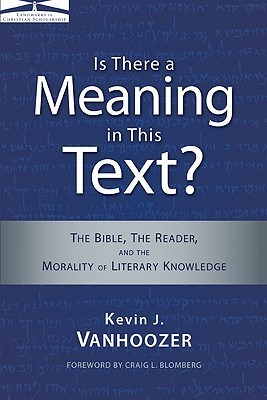
The Christian reader can easily see where this philosophy takes Biblical interpretation. Under these assumptions, Scripture has no inherent meaning, therefore meaning is not dependent on what God said but what the reader brings to the text. How can Christianity possibly function in this philosophical environment? Is there a meaning in the text, the Bible? As one can see by the title, that is the big question that Vanhoozer sets out to answer. Vanhoozer says, “the project for the present work: to articulate and defend the possibility, in the vale of the shadow of Derrida, that readers can legitimately and responsibly attain literary knowledge of the Bible.”
Vanhoozer takes on a difficult but necessary task in this work. He goes up against the postmodern “giants” of this age—Derrida, Rorty, Foucault, etc.—to show that there is a meaning in the text and that readers can get to it. In a charitable and extensive way, Vanhoozer exposes and brings to light the theological and philosophical foundations which undergird the present debate over meaning. He then produces a better literary theory that is inherently more plausible, coheres with Biblical truth, and shows that with humility and conviction interpretation can produce adequate (but not absolute) knowledge of the Bible.
The bulk of this work is divide into two large, well-organized sections—“Undoing Interpretation” and “Redoing Interpretation.” In each large section there are three chapters about the author, the text, and the reader, respectively. These three chapters form sectional parallels of “undoing” (attacks on the three elements) and “redoing” (resurrection of the three elements)—i.e. two parallels five, three parallels six, and four parallels seven. This is a formidable work to summarize, to say that least. Using Vanhoozer’s parallel framework, we will do our best to briefly state the key aspects of his argument, but no summary can do justice to the exhaustiveness of this work.
The First Parallel: In chapter two, Vanhoozer describes Postmodernism’s “case against the author.” It might surprise readers who are used to modernism presuppositions, but many postmodern literary theorists deny the author’s existence altogether. “How can someone get there?” one might ask. Vanhoozer shows how deconstructionists have followed Nietzsche in denying God’s existence. When one denies God’s existence, there is no foundation for believing that there is a mind-independent reality to which “true” descriptions must correspond. To put it another way, without God there is no metaphysical reality to which meaning can correspond, so meaning is not fixed for anything. So deconstructionists have denied the idea of a “fixed” meaning in texts; therefore identifying the “author” becomes difficult. “Who is the author?” becomes a metaphysical question that depends on the definition of “intention,” accessibility of intention, and whether a text’s meaning should be defined in terms of who wrote it or who reads it. “Why should the text’s meaning be defined in terms of the intention of the one who wrote it?” postmodern theorists ask. This is the result of the postmodern case against the author. In chapter five, Vanhoozer “resurrects” the author by challenging these philosophical assertions. He shows that the concept of “author” is really a theological issue. It is an issue dependent on the existence of God as a communicative agent who places the imago Dei in humanity, making them communicating agents as well. Therefore, the doctrines of God and creation are of paramount theological importance in the case for the author. In addition, by use of contemporary philosophies of common-sense realism and speech-act, Vanhoozer lays the groundwork for correlating the author’s intention and communicative action.
The Second Parallel: In chapter three, Vanhoozer tackles the postmodern problem with meaning itself. This is an epistemological problem about the nature and method of literary knowledge, i.e. interpretation. Postmodern philosophers ask questions about the nature of interpretive reality itself—“What methods, if any, enable us to gain knowledge of the text?” Are there criteria that can be used to judge one interpretation with respect to another and show its meaning? The postmodern deconstructionists answer, no. “There is nothing outside the text,” is Derrida’s most famous phrase. This brings hermeneutics to a state of complete relativism, killing the text and meaning. In chapter six, Vanhoozer “resurrects” the text and meaning. Since the problem is an epistemological problem, we need a solid epistemological foundation. Here Vanhoozer primarily builds on the foundation set by Plantinga in his famous work, Warrant and Proper Function. This (and the progress made in the first parallel) gives him the foundation to argue that there is meaning in the text—enacted communicative intention. He then goes on to discuss interpretation itself and argues that meaning can be adequately known by viewing the text as a communicative act, respecting the various levels from word definition to canonical setting. He holds that one should take the Bible literally, but this does not mean simply taking note of the locutions (dictionary definitions strung together), as many often do. One must consider the locutions and the illocutions (actions performed by saying something) of the author’s speech, i.e. the whole communicative act. He undergirds this with a Christological analogy—the person of Jesus cannot be reduced to His physical, visible humanity (just as the literal sense cannot be reduced to the locutions), but one must take into account His humanity and His divinity (just as the literal sense must take into account the whole communicative act). Through the process of using the literal sense as the interpretive norm and taking into account the various levels of the communicative act, the meaning of the text can be adequately known.
The Third Parallel: In this final parallel of chapters, Vanhoozer takes on the problem of the reader and the ethics of meaning (the problem in chapter four and his solution in chapter seven). Postmodern theorists now see the text as largely (or completely) inactive and the reader as active in the meaning of the text. Since, as described above, there is no “fixed” meaning, the reader takes part in the meaning. Some “conservative” theorists say the text draws the reader into participate in the elucidation of meaning. The “radical” theorists, like Derrida, give the reader complete reign. The reader being active, then, brings up the question of interpretive obligations? Is there an ethical or moral reader stance/constraint? Most postmodern theorists would answer, no. In chapter seven, Vanhoozer builds on his previous chapters and argues that communication requires regulation. He argues that the reader must normally understand the text, being a servant to the text and asking questions that it invites, but occasionally can “overstand” the text, acting as a lord and asking questions of it that it does not invite. One can only overstand, however, after one has sufficiently worked to understand and then only insofar as one aims to uncover the text’s significance, e.g. contemporary application. Into this discussion Vanhoozer brings the doctrine of the Spirit. He argues that ethical interpretation is a spiritual exercise that ultimately requires the Holy Spirit to be done rightly.
In his three sets of parallel chapters, Vanhoozer has engaged the postmodern critics and shown that the author can have communicative action and intent, that the text can be adequately understood, and that the reader has an ethical obligation in interpretation. In all this he uses Trinitarian theology as his foundation. In his final chapter, Vanhoozer describes what he calls the “hermeneutic of the cross.” He holds that there are two interpretative “deadly sins”: sloth and pride. Pride encourages us to think we have the correct meaning before we have adequately and ethically attempted to interpret the text. Sloth encourages us to think there is no meaning in the text and, therefore, should not attempt uncover any. The cross, however, gives both the hermeneutic of humility and conviction. In all his argumentation with postmodern critics, Vanhoozer has been charitable and also humbly accepted postmodern chastisement, when it is warranted. One of those is the danger of bringing our bias to the text and making our interpretation an idol, but humility reminds interpreters that we can get it wrong. Humility, however, must be balanced by conviction, or we end up treating the text like a postmodern critic. Vanhoozer summarizes, “While there may be more light on the Bible’s meaning to come, we have a firm enough grasp of the overall story line as to encourage boldness in our witness. Only such confidence, commitment, and conviction about what can be known can serve as the corrective to interpretive skepticism and sloth. The uncommitted interpretation is not worth hearing.”
One probably understands by now that Vanhoozer’s work is both compelling and demanding. His knowledge of the postmodern landscape is far-reaching and that is one of the greatest gifts of this work. He charitably, extensively, and readably works through the postmodern attacks on meaning and interpretation, showing the philosophical and theological issues with those philosophical theories. The engagement of the culture in which our preaching and theology exists is alone reason enough to read this book. His “redoing” of what Postmodernism has undone is, on the whole, exceptional as well. From a Trinitarian framework he builds a theological foundation for authorial intent, textual meaning, and ethical reader interpretation that is very helpful when engaging a postmodern world. Some may say it is too dependent on Christian theology, but we think that Vanhoozer is simply being faithful to his Reformed Presuppositionalism roots. Besides, if there is one thing that Postmodernism expects everyone to bring to the table, it is presuppositions.
Now comes the task of assessing any weaknesses of the work. We will give two that stood out while reading this work. First, we can hardly fault Vanhoozer for being charitable to the postmodern critics, for charity is a virtue that many of us lack. However, we do believe that he has given too much affirmation to Postmodernism. It is humble and wise to acknowledge certain postmodern correctives, but one cannot give away the proverbial farm when it comes to rationality. For example, Vanhoozer casts the Enlightenment as the ultimate example of rationality run rampant. However, rationality was integral to philosophical thought long before the Enlightenment, and was it not the coupling of rationality to human autonomy that gave rise to the central flaws of the Enlightenment? Second, Vanhoozer does not separate hermeneutics of Scripture from general hermeneutics but makes the former paradigmatic of the latter. Yet, one is not going to read Shakespeare and Paul in the same way, at least one should not. Does one really need a Christian theology to interpret Shakespeare’s intended meaning as one does with Paul? No. Vanhoozer would undoubtedly agree, however the emphasis on common ground downplays the differences between Scripture and all other texts. To emphasize the theological dimension of general hermeneutics seems to either raise human texts to a height they do not deserve or lower Scripture below is inspired right.
In conclusion, the two flaws mentioned above pale in comparison to the usefulness of this book as a whole for the case for Biblical meaning and interpretation, and we are overall very impressed with this book. It is not for the faint of heart, however. While readable, it is philosophically heavy and complex. It, of course, has to be given the subject matter of the book. We would not recommend this for the average Joe in the Church. We do think that pastors, theologians, and seminary students need to read this book. The cultural landscape that we preach and teach in is thoroughly entrenched in many of the presuppositions and ideals of Postmodernism that Vanhoozer describes. We need to learn to interact with those presuppositions, expose them to our people in understandable ways, and offer them a strong alternative so they can go to their Scriptures with humility, conviction, and confidence. In a postmodern world, our people need to be able to trust that “All Scripture is breathed out by God and profitable for teaching, for reproof, for correction, and for training in righteousness, that the man of God may be complete, equipped for every good work.”