Rodin was the great master of the human form in clay, bronze, and marble. This book collects many of his most famous and lyrical creations, from St. John the Baptist Preaching and The Thinker to Adam, Eve, and The Burghers of Calais. Color illus.
Gilles Néret (1933 - August 3, 2005) was a French art critic and historian, journalist and curator. He wrote extensively on the history of erotica.
He organized several art retrospectives in Japan and founded the SEIBU museum and the Wildenstein Gallery in Tokyo. He directed art reviews such as L’Oeil and Connaissance des Arts and received the Elie Faure Prize in 1981 for his publications. Since 1992, Néret was an editor for Taschen, for which he has written catalogues raisonnés of the works of Klimt and others, as well as the author of Erotica Universalis.
Man's naked form belongs to no particular moment in history ; it is eternal, and can be looked upon with joy by the people of all ages. - Auguste Rodin
The life and work of a man larger than life in a nutshell, packed into a flimsy booklet of 96 pages? As a basic introduction on Auguste Rodin (1840-1917) it was essentially what I hoped and maybe needed to read to prepare for embarking on the monograph Rilke wrote about Rodin between 1902 and 1907 (Auguste Rodin.) As mostly the case with Taschen, the reproductions of the work are visually attractive and finely arranged, the selected pictures often surpassing the ones one can find on the internet (and as larger, also more alluring than the small ones in the collection guide of the Musée Rodin). Each work is briefly commented; a short illustrated chronology of his life and a bibliography round up the book.
The book presents both sculptures and a few (mostly erotic) drawings – aside from being a prolific sculptor, Rodin painted in oils and watercolours and drew a bedazzling number of drawings and prints in chalk and charcoal, of which the Musée Rodin holds 7000. In broad strokes Néret follows Rodin as an artist from the formative years, when he was rejected entrance by art school and started as a craftsman and plasterer, embellishing roofs, staircases and doorways in Haussmann’s Paris to earn a living, staying in Belgium for a few years joining his employer, to the profound effect of his travelling to Italy in 1875 on his artistic views, reflected in works like Adam (1880), directly inspired by Michelangelo’s Adam which he has seen in the Sistine Chapel (the finger held out).
Néret paints Rodin’s modern, liberating approach towards the nude female body and sexuality (he encouraged his naked models to move freely around his studio) and clarifies how he worked four decades on the Gates of Hell, the (unfinished) portal depicting scenes from Dante’s Inferno in high relief he was commissioned to create for a museum of decorative arts that was never built - the creation of the portal in the process germinating many figures which became sculptures in themselves, among some of his most well-known (The Kiss, The Thinker, The Danaid).
Néret addresses the conflicted reception of his work by his contemporaries – the controversies on the reproach of having taken a cast from a living model (The Age of Bronze), the criticising and rejection of the memorial statues of Balzac and Victor Hugo – the Balzac of which Rodin himself asserted it was the culminating achievement of his entire life, the very lynchpin of his aesthetics ‘From the day on which I conceived it, I was a new man’. The ongoing interplay during his life of rejection, adoration, commissions, acclaim and disapproval I thought fairly remarkable.
Stressing the erotic elements of his oeuvre, Néret considers ‘sensuality and pessimism’ essential in Rodin’s work (l’amour fou symbolised by a few of the couples on his Gates of Hell, and in Paolo and Francesca (1887); despair and sensuality illustrated by The Danaid (1884-85)). I was intrigued by this observation, but would have preferred Néret to clarify this view.
A few allusions are made on the multitude of women in Rodin’s life, Rose Beuret, his almost lifelong companion whom he married a few months before they both died (in the translation the exact data are ), Camille Claudel, the many women who admired him and posed for him; his many models, muses and mistresses (Judith Cladel, Adèle Abruzzesi) elucidate why in his later years he was nicknamed ‘the sultan of Meudon’.
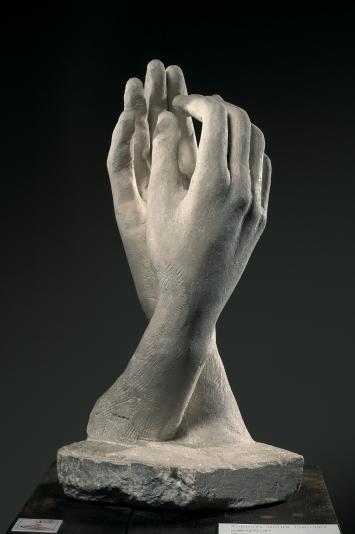
Even if I have been so fortunate to see many of his sculptures in museums and have visited the Musée Rodin – one of my absolute favourite places in Paris – quite a few times, this pretty rudimentary text touched on quite some aspects on his art which hadn’t occurred to me before, making me realise I have been as so often looking without seeing, needing words to lend me a hand in what I have found an incurable and deplorable personal weakness, my inattentional blindness - my sense of sight so substandard, Leonardo’s words are of little consolation (An average human looks without seeing, listens without hearing, touches without feeling, eats without tasting, moves without physical awareness, inhales without awareness of odour or fragrance, and talks without thinking). Rodin’s passion and fondness of hands – so prominent in for instance the hands of the figures in his The Burghers of Calais or in Cathedral was only one of those insights, and among the most striking (‘Even specialist surgeons have been intrigued by the accuracy with which Rodin rendered the straining muscles, tendons and joints’), as was the state of unfinishedness characterising many of his sculptures (‘And the cathedrals of France: have they been completed?’), also how he isolated sculptural fragments to give them an autonomous meaning.
The main thing is to be moved, to love, to hope, to tremble, to live. Be a man before being an artist. - Auguste Rodin)
How the man fleshed out the human passions in bronze, marble and clay likely illustrates he must has been both, in equal measure.
I wish this had more detail, and more photographs. Mostly I just wish it was more. Or that I was in a gallery showing of all the pieces. He was a fascinating, slightly ridiculous man.