

What do you think?
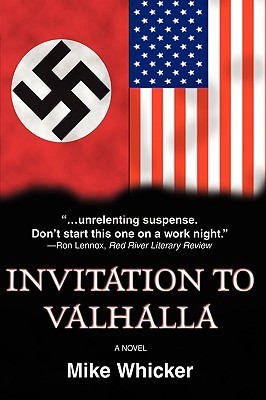
Invitation to Valhalla
While working on a top-secret project for the U.S. Navy in 1942 in Evansville, Indiana, a Jewish metallurgist falls in love with a beautiful woman who is the Nazis' top spy and who was sent to the United States to steal the very secret he holds and that could alter the course of the war.
404 pages, Paperback
First published December 5, 2001
About the author
Mike Whicker
50 books20 followersMike Whicker is a Colorado native. He now resides in the Midwest. Whicker is the author of the Erika Lehmann WW II spy trilogy, Invitation to Valhalla, Blood of the Reich, and Return to Valhalla. Whicker also authored the novel Proper Suda.
Ratings & Reviews
Friends & Following
Create a free account to discover what your friends think of this book!
Community Reviews
Displaying 1 - 30 of 45 reviews
March 7, 2009
I picked this book up for the local interest. It was written by an Evansville, IN high school teacher and a good portion of the story line occurs on the Evansville riverfront. The book is based on a true story during WWII. I was very impressed by the writing quality and the quick moving story line. I would recommend this book for any lover of the spy/thriller genre. The local landmarks and WWII history were simply an added bonus for me.

February 11, 2024
Oooh you GUYS this one really made me think… I definitely came for the spies and stayed for the character development. It’s a slower start but it’s so worth it - the ending had my heart RACING. Highly recommend, especially for an Indiana native😎

September 25, 2011
The notes at the end of this novel are perhaps as interesting as the novel itself. Invitation to Valhalla was recommended to me by one of the librarians who said the story takes place locally, during WWII. Mr. Whicker wrote an article for the University of Indiana magazine, which was found by David Mayer a few years later. Mr. Mayer contacted Mr. Whicker, saying he had additional information that Mr. Whicker might be interested in. That interest sparked the novel.
The first part of the novel takes place in Nazi Germany, following one Erika Lehmann. She is a beautiful young woman with a German father and a British mother. Her father was an envoy to the U.S. before WWII started, Erika was schooled in the U.S. and in England. She had an ear for languages and was very athletic. Her father was a personal friend of Adolph Hitler and rose to power along with the Fuhrer. And Erika was one of the few women spies in the Abwehr. Not surprisingly, she, through her father's power, had made enemies, including Heinrich Himmler, head of the Gestapo. Himmler decides, after doing research on Erika, she would best serve her country by dying.
The second part of the novel takes place in the United States, concentrating on the Midwest, where Erika has been sent to infiltrate the LST (Landing Ship-Tanks) shipyard in Evansville, Indiana. The reader follows a variety of people, concentrating on Joe Mayer, a metallurgist who has possibly discovered something that would help the U.S. and the Allies; Axel Ryker, the assassin Himmler has sent to follow and kill Erika and Charlie Pulaski, an FBI agent who survived being shot by the Dillinger gang; and Erika, going under the name of Sarah Klein and posing as a Jew to get in the good graces of Joe.
As a history novel, Invitation to Valhalla is a very interesting read. I recognize the names of the places mentioned. Mr. Whicker is very detailed in is research, providing a lot of historical information in in a way that is engaging to the reader. As a fictional novel, it works as well, as there are parts of the story that Mr. Whicker and Mr. Mayer (yes, Mr. Mayer is related to Joe in the novel) were unable to unearth. My main problem with the story is that it could use a good editor. Some of the sentence structures were awkward and, particularly during the first half of the novel, sentences and paragraphs would suddenly switch from past tense to present tense. Mr. Whicker did say in his talk at the local library that he self-published the first printing of Invitation to Valhalla, which might have something to do with it.
A second book on Erika Lehmann has recently been published. I'll be reading it soon.
The first part of the novel takes place in Nazi Germany, following one Erika Lehmann. She is a beautiful young woman with a German father and a British mother. Her father was an envoy to the U.S. before WWII started, Erika was schooled in the U.S. and in England. She had an ear for languages and was very athletic. Her father was a personal friend of Adolph Hitler and rose to power along with the Fuhrer. And Erika was one of the few women spies in the Abwehr. Not surprisingly, she, through her father's power, had made enemies, including Heinrich Himmler, head of the Gestapo. Himmler decides, after doing research on Erika, she would best serve her country by dying.
The second part of the novel takes place in the United States, concentrating on the Midwest, where Erika has been sent to infiltrate the LST (Landing Ship-Tanks) shipyard in Evansville, Indiana. The reader follows a variety of people, concentrating on Joe Mayer, a metallurgist who has possibly discovered something that would help the U.S. and the Allies; Axel Ryker, the assassin Himmler has sent to follow and kill Erika and Charlie Pulaski, an FBI agent who survived being shot by the Dillinger gang; and Erika, going under the name of Sarah Klein and posing as a Jew to get in the good graces of Joe.
As a history novel, Invitation to Valhalla is a very interesting read. I recognize the names of the places mentioned. Mr. Whicker is very detailed in is research, providing a lot of historical information in in a way that is engaging to the reader. As a fictional novel, it works as well, as there are parts of the story that Mr. Whicker and Mr. Mayer (yes, Mr. Mayer is related to Joe in the novel) were unable to unearth. My main problem with the story is that it could use a good editor. Some of the sentence structures were awkward and, particularly during the first half of the novel, sentences and paragraphs would suddenly switch from past tense to present tense. Mr. Whicker did say in his talk at the local library that he self-published the first printing of Invitation to Valhalla, which might have something to do with it.
A second book on Erika Lehmann has recently been published. I'll be reading it soon.
This entire review has been hidden because of spoilers.

June 3, 2016
This book was not just a fictional read for me, it was a history exercise as well, because I ended up researching after every chapter to find out what was fictional and what was not. Which, unsurprisingly, thrilled me to no extent. The first half of the book was so addictive I couldn't stop reading, the second half not so much. I enjoyed the pre-infiltration and Erika's part more than Sarah and the actual spying in Evansville, but that's because I enjoy WW2 Europe history, which was abundant in the first half. It was also fantastic to read about Hitler's inner circle.
Mad props to Mike Whicker for the incredible research he's put in this book. I wish, he could've penned down the plot with a different tone. His writing sounded like he was telling a very thrilling story to an acquaintance he didn't like. It was too mechanical.
Overall, a good read for WW2 history lovers.
Mad props to Mike Whicker for the incredible research he's put in this book. I wish, he could've penned down the plot with a different tone. His writing sounded like he was telling a very thrilling story to an acquaintance he didn't like. It was too mechanical.
Overall, a good read for WW2 history lovers.
October 21, 2009
This book was so interesting!! About a german spy in America during WW 2. Starts in Germany and then moves into the USA. So you learn about the spy training and the internal politics of Nazi Germany and then see how it applies as this person goes to America. Based on true events, so even better. I admit its closer to my heart because its set in Indiana, but still a great read!

April 23, 2012
Have to admit, found this book to be an enjoyable read (WWII, German spy infiltrating the US, FBI, etc) but was even more impressed when I finished it and discovered that it was a true story. Would recommend it to anyone who is a fan of that genre.

November 10, 2017
As we've learned in the years after World War II, not only did the Allies whip Nazi Germany on the battlefield, but in the secret espionage wars as well. That hasn’t stopped authors like Ken Follett from coming up with crackerjack thrillers like Eye of the Needle, in which top notch Nazi agents threaten to throw a big monkey wrench into the Allies’ war plans. An entertaining addition to this espionage sub-genre is Mike Whicker’s Invitation to Valhalla, which adds another entertaining element to the mix in the person of a female German agent who’s just as resourceful and deadly as any man.
The agent in question is Erika Lehmann, a family friend of Hitler himself, who is beautiful, perfectly fluent in English, well-schooled in all forms of espionage and combat and dedicated to the Third Reich. Her boss, Admiral Wilhelm Canaris, head of the Abwehr, the German military espionage agency, sends her to Evansville, IN, to get information on the Allies’ new landing craft, capable of landing multiple tanks and troops on a beach. As Erika adapts a new identity and gets close to the top-secret documents she needs, others get close to her as well, both the FBI and a Nazi assassin sent by Heinrich Himmler to eliminate her.
Author Whicker has obviously done a tremendous amount of research into the history of World War II and other topics as well, including life in the wartime United States and even the criminal spree of John Dillinger, and Whicker incorporates much of this material into Invitation to Valhalla. Real life personages play a number key roles in the book. In addition to Hitler (who’s not the worst character in the book by any means) and Himmler, readers will encounter Reinhard Heydrich, J. Edgar Hoover, and even William Powell and Myrna Loy. Indeed, Heydrich, Himmler, and Hitler don’t just show up; they are key characters in the storyline.
Ironically, Whicker’s attention to detail and intricate research become the book’s main weakbess as well. His information is often fascinating, but it gets in the way of the storyline, sometimes threatening to grind the action to a halt. I got the feeling the author tried to put every single bit of interesting trivia he learned into the book As a result, it takes approximately half the book for Erika to arrive in the United States, with the first half of the story being a combination of depictions of her training, various political intrigues, and flashbacks to a pre-war romance. This material could easily have been cut in half, allowing for more space devoted to the genuinely suspenseful part of the book, Erika’s efforts to infiltrate the shipyard and the FBI’s efforts to find her. Also, some of what’s in the book is a bit questionable as well. I don’t think we really needed as detailed and lengthy a description as we got of Gestapo interrogation techniques.
Despite a need for some better editing, Invitation to Valhalla has a number of things going for it that readers don’t often see in this type of book. There’s a good bit of action, as Erika proves herself quite resourceful, and she is quite willing to use her body and her feminine wiles to get ahead, while, at the same time, alleviating possible suspicion precisely because she is a woman. The author also gives readers a good bit of insight into Erika’s thought processes, and, by extension, those of other non-racist Germans who wound up supporting the war effort. We see how Erika finds herself accepting the official, somewhat benign explanations of the concentration camps and her comparisons of life in Germany to life in the American segregated South.
However, author Whicker isn’t out to write a treatise, but, rather, a thriller, and Invitation to Valhalla provides a good bit of suspense. Of course, just as in Eye of the Needle, the ultimate lack of success of Erika’s efforts is a matter of historical fact, but the author keeps up the tension about just what is going to happen during what proves to be a rather classic final confrontation between Erika and her various pursuers. Unfortunately, the impact of this confrontation is diminished a bit because the author describes it by means of flashbacks related during an FBI debriefing after the fact, but he does a good job of moving his characters into position for the book’s climax. In addition, the characterizations in Invitation to Valhalla are surprisingly detailed and complex, particularly the various Germans, who aren’t portrayed merely as stereotypical monomaniacal fanatics. Most of them are evil, of course, but there are a number of shades to their black, most of which Erika is able to use to her advantage. In fact, Erika’s resourcefulness will have most readers pulling for her to somehow get out of her situation by the end of the book (which I certainly won’t give away). All in all, although it moves slowly at times, Invitation to Valhalla is one invitation worth accepting.
The agent in question is Erika Lehmann, a family friend of Hitler himself, who is beautiful, perfectly fluent in English, well-schooled in all forms of espionage and combat and dedicated to the Third Reich. Her boss, Admiral Wilhelm Canaris, head of the Abwehr, the German military espionage agency, sends her to Evansville, IN, to get information on the Allies’ new landing craft, capable of landing multiple tanks and troops on a beach. As Erika adapts a new identity and gets close to the top-secret documents she needs, others get close to her as well, both the FBI and a Nazi assassin sent by Heinrich Himmler to eliminate her.
Author Whicker has obviously done a tremendous amount of research into the history of World War II and other topics as well, including life in the wartime United States and even the criminal spree of John Dillinger, and Whicker incorporates much of this material into Invitation to Valhalla. Real life personages play a number key roles in the book. In addition to Hitler (who’s not the worst character in the book by any means) and Himmler, readers will encounter Reinhard Heydrich, J. Edgar Hoover, and even William Powell and Myrna Loy. Indeed, Heydrich, Himmler, and Hitler don’t just show up; they are key characters in the storyline.
Ironically, Whicker’s attention to detail and intricate research become the book’s main weakbess as well. His information is often fascinating, but it gets in the way of the storyline, sometimes threatening to grind the action to a halt. I got the feeling the author tried to put every single bit of interesting trivia he learned into the book As a result, it takes approximately half the book for Erika to arrive in the United States, with the first half of the story being a combination of depictions of her training, various political intrigues, and flashbacks to a pre-war romance. This material could easily have been cut in half, allowing for more space devoted to the genuinely suspenseful part of the book, Erika’s efforts to infiltrate the shipyard and the FBI’s efforts to find her. Also, some of what’s in the book is a bit questionable as well. I don’t think we really needed as detailed and lengthy a description as we got of Gestapo interrogation techniques.
Despite a need for some better editing, Invitation to Valhalla has a number of things going for it that readers don’t often see in this type of book. There’s a good bit of action, as Erika proves herself quite resourceful, and she is quite willing to use her body and her feminine wiles to get ahead, while, at the same time, alleviating possible suspicion precisely because she is a woman. The author also gives readers a good bit of insight into Erika’s thought processes, and, by extension, those of other non-racist Germans who wound up supporting the war effort. We see how Erika finds herself accepting the official, somewhat benign explanations of the concentration camps and her comparisons of life in Germany to life in the American segregated South.
However, author Whicker isn’t out to write a treatise, but, rather, a thriller, and Invitation to Valhalla provides a good bit of suspense. Of course, just as in Eye of the Needle, the ultimate lack of success of Erika’s efforts is a matter of historical fact, but the author keeps up the tension about just what is going to happen during what proves to be a rather classic final confrontation between Erika and her various pursuers. Unfortunately, the impact of this confrontation is diminished a bit because the author describes it by means of flashbacks related during an FBI debriefing after the fact, but he does a good job of moving his characters into position for the book’s climax. In addition, the characterizations in Invitation to Valhalla are surprisingly detailed and complex, particularly the various Germans, who aren’t portrayed merely as stereotypical monomaniacal fanatics. Most of them are evil, of course, but there are a number of shades to their black, most of which Erika is able to use to her advantage. In fact, Erika’s resourcefulness will have most readers pulling for her to somehow get out of her situation by the end of the book (which I certainly won’t give away). All in all, although it moves slowly at times, Invitation to Valhalla is one invitation worth accepting.

June 27, 2022
Waited until I was able to grab this book at the library to read. Heard about it after visiting the USS LST 325 museum in Evansville, Indiana. It was written by an Evansville English teacher and based partly in Evansville, Indiana based on true events in WWII. Very well written. Was not able to put it down to see what would happen next.
November 15, 2022
Great book.
I have lived in Evansville, In my entire life. All the places and locations mentioned in the book are real. That gave the story a more realistic feel. It was difficult to find a place to stop reading. Well written and fast paced. I have read other books in the series and enjoyed them all.
I have lived in Evansville, In my entire life. All the places and locations mentioned in the book are real. That gave the story a more realistic feel. It was difficult to find a place to stop reading. Well written and fast paced. I have read other books in the series and enjoyed them all.

February 27, 2017
Excellent based on factual events novel about a female German spy who infiltrated in to the Evansville Shipyards during the LST construction. Love the local history: McCurdy Hotel, Dogtown Tavern, Trocadaro and more. Great local author!

September 14, 2017
I could not put this book down. It is a spy thriller taking place during WW 2 primarily in Evansville , Indiana. My ties with Evansville made the book even more fascinating. Even if I had no knowledge of the city of Evansville, I would rate the book as exceptional.
August 1, 2019
Excellent
Hard to believe this is a true story, was shocked when I read it really happened. Recommend this one for sure - just do not start late in the day - you won't sleep that night because you cannot put it down.
Hard to believe this is a true story, was shocked when I read it really happened. Recommend this one for sure - just do not start late in the day - you won't sleep that night because you cannot put it down.
April 3, 2020
This book was especially interesting to me since I am a WWII historical fiction buff, as well as an ex-LST sailor (1950s) on a WWII type "T", although my ship was made in Pittsburgh and not in Evansville. Really interesting read! Will definitely read more of you books!
July 17, 2022
Very good read. Started out slow but finally picked up.
January 2, 2024
Part of this story includes a nearby location. Interesting to recognize the locations and understand better how it fits into history

June 2, 2024
Evansville history
This is neat do to the history of local cities but honestly was a bit of a bore for me
This is neat do to the history of local cities but honestly was a bit of a bore for me
November 28, 2012
The story, the research, and the characters deserve five stars. I cannot get enough of Erika. It was great to see the point of view of someone on the very edge of Hitler's inner circle, and to see the training of Abwehr's competent spies (which, as I have learned, the spies in Ireland were not).
But the style was distracting. There's a little too much "As you know, [insert something for the reader's benefit that the character would never say]," and a little too much historical exposition at times. The action scenes are great, though, and my hope is that the style will be more to my taste in the second book. Which I am going to acquire presently. Because like I said, I can't get enough of Erika.
But the style was distracting. There's a little too much "As you know, [insert something for the reader's benefit that the character would never say]," and a little too much historical exposition at times. The action scenes are great, though, and my hope is that the style will be more to my taste in the second book. Which I am going to acquire presently. Because like I said, I can't get enough of Erika.
September 3, 2013
I read Invitation to Valhalla years ago, enjoyed it, and recently found out the story is now a trilogy and got the other books on Kindle. The second installment is entitled 'Blood of the Reich' and the third book is Return to Valhalla where Erika, the main character, returns to Germany during WW2. All three books are very good, with the last one -- Return to Valhalla -- my favorite. The author has a way of making you feel for the characters, even a female Nazi spy. And as a history buff of the WW II era myself, I admire the author's meticulous research. Well done.
One point, there are two WW2 novels out there entitled 'Blood of the Reich.' The one I'm referring to is by the author Mike Whicker.
One point, there are two WW2 novels out there entitled 'Blood of the Reich.' The one I'm referring to is by the author Mike Whicker.

April 28, 2007
Not the best written book in the world, but it takes place in my hometown (Evansville, IN) during World War II, and for that fact alone, it gets a star or two. It's supposedly based on the true story of a German female spy (ranked very highly in Hitler's cabinet) who ensconced herself in Evansville, which was a busy commercial center during that time, and busied herself with some Axis Power espionage til she realized the "error" of her ways and atoned. Or something. Really, it's not that great of a book.

May 6, 2010
Written by an Evansville man, it centers around a woman who was a Nazi spy in Evansville. We will have lunch with the author at the Dogtown Tavern. Hope the book's good!
I'll let my star rating suffice so as not to spoil the book for others.
Our lunch with the author was at the Dogtown Tavern, which figures prominently in the last chapters. Identifying specific locations in Evansville history (including the LST) encouraged us to plan to read the sequel, Blood of the Reich, for next month. Mike has done an amazing job of research for this book!
Note: loaned to Linda Powe
I'll let my star rating suffice so as not to spoil the book for others.
Our lunch with the author was at the Dogtown Tavern, which figures prominently in the last chapters. Identifying specific locations in Evansville history (including the LST) encouraged us to plan to read the sequel, Blood of the Reich, for next month. Mike has done an amazing job of research for this book!
Note: loaned to Linda Powe

June 21, 2012
You don't have to be an Evansville native like me to get swept up in the world of Erika Lehmann, where the good old American Midwest is transformed into one of the lesser-known battlegrounds of WWII. The astounding historical details and surprising character development combine at a brisk but realistic pace to make one of the greatest thrillers ever written. A review on the back cover warns you against starting it on a work night, and that review is 100% correct. You will keep telling yourself "just one more page" until it's delivered its final gut punch.

August 15, 2012
Hmm.....well, I can honestly say that while I enjoyed this book the writing was horrible! Was an editor involved in the creative process at all because I read so many grammatical errors I lost count! A good storyline, historically intriguing but I just couldn't get beyond the poorly written dialogue and the lack of character development (Joe Mayer....zzzzzzzz). The ending was just too "30's/40's Hollywoood esq" and all I could envision was Leonardo DiCaprio as J Edgar Hoover! However, if you like WWII spy novels this read is for you!

July 4, 2014
Excellent, excellent, excellent book! This is the second time I've read it. I wanted to read all three in a row but have not read the other two.
This book takes place in my home town of Evansville, Indiana. The author does a fabulous job of describing the local foods and places. I can see them all in my mind. Just fantastic.
It's well written and the action is fast paced with great descriptions of the characters.
Can't recommend enough.
This book takes place in my home town of Evansville, Indiana. The author does a fabulous job of describing the local foods and places. I can see them all in my mind. Just fantastic.
It's well written and the action is fast paced with great descriptions of the characters.
Can't recommend enough.
December 31, 2023
This is by far one of my favorite reads EVER! If you are from the Evansville, IN area this is a MUST read! The author is from the area & his mother was one of the Rosie the Riviters during this time period. It is a little fact & a little fiction all mixed together. If your from the area you will know some of the places referenced in the book from back then too. I couldn't put this book down from the moment I started it!
December 5, 2007
This is actually a really neat book. I'm not usually a fan of spy novels, but this one takes place during WWII (learn a lot about the Nazis!) and in Evansville, Indiana - which made it a lot of fun for me to read since I can picture the places. Not the best book I've ever read, but interesting enough.
December 25, 2010
Fascinating story, supposedly based on true events, about a WWII German spy who infiltrates the Ohio River shipyard in Evansville, IN. The fact that it is set in Evansville leads me to think it's true - it's is not exactly the first locale that comes to mind for a spy story - but the Hollywood ending makes me doubt just a little bit.

February 4, 2016
Wonderful read. A local high school teach wrote this and although I'm not really into WWII novels, this one really caught me up. A lot of the appeal is that there are many locations mentioned in the book that were actually here in Evansville. In particular, the shipyards, the Trocadero and the Knotty Pine cafe.
August 12, 2008
Great WWII spy novel from a German perspective, and a woman's. Interesting also because much of it takes place in in this area. Its always a plus to read a book and be able to visualize the settings because you've actually been there.

August 19, 2009
i really enjoyed this book. not one for history, i was mildy apprehensive when this book was recommended, but it really is more of a mystery than a historical read. great story, and i thoroughly enjoyed the part of the story including evansville during that time. i highly recommend it to everyone.
October 21, 2010
this was really great. lots of action and a great plot. I've read several WWII books from the Jewish perspective or sentiment (Book Thief, Suite Francaise) but this was so different since it's told mostly from the Nazi perspective. highly recommend this.
Displaying 1 - 30 of 45 reviews