Jump to ratings and reviews
Rate this book

In the Himalayas : Journeys Through Nepal, Tibet, and Bhutan

Rate this book
An updated edition of a New Yorker writer's profile of these mysterious lands.

353 pages, Paperback

First published January 1, 1989

1 person is currently reading
81 people want to read

About the author

Jeremy Bernstein

94 books24 followers

Ratings & Reviews

What do you think?
Rate this book

Friends & Following

Create a free account to discover what your friends think of this book!

Community Reviews

5 stars
7 (29%)
4 stars
5 (20%)
3 stars
9 (37%)
2 stars
3 (12%)
1 star
0 (0%)
Displaying 1 - 5 of 5 reviews
Profile Image for Bettie.
9,977 reviews5 followers
March 6, 2014
The Purple Dog, Colchester
Posted to Sweden from Sudbury

My ISBN: 9781853107665


Part one - Nepal: Once upon a time there was a lake called Serpent's Lake, for Karkotak, the king of the sepents dwelt in it. It was a big, beautiful lake surrounded by lofty mountains. All the water plants except the lotus grew in it, and one day the Vipaswi Buddha* came and threw a root of the lotus into the water.

* From wiki: In Buddhist tradition, Vipassī (Pāli) is the twenty-second of twenty-eight Buddhas described in Chapter 27 of the Buddhavamsa. The Buddhavamsa is a Buddhist text which describes the life of Gautama Buddha and the twenty-seven Buddhas who preceded him. It is the fourteenth book of the Khuddaka Nikāya, which in turn is part of the Sutta Piṭaka. The Sutta Piṭaka is one of three pitakas (main sections) which together constitute the Tripiṭaka, or Pāli Canon of Theravāda Buddhism.

[image error] Stupa of Swayambhunath and Bodhnath

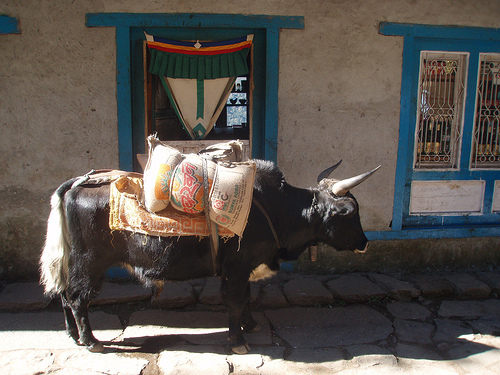
Zopkio is a crossbreed of buffalo and yak. In 1854 the jajguru declared that the yak was a species of deer, so that the Gurkha soldiers could eat them without breaking the Hindu law against consuming beef.
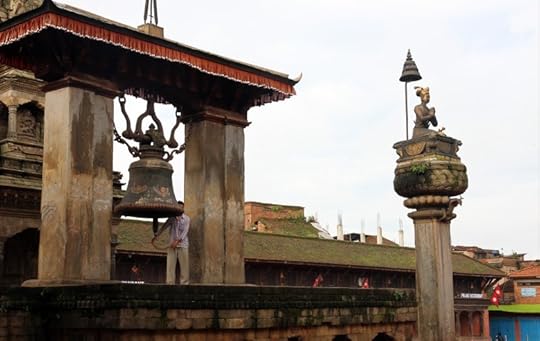
[image error] Nepal came up with the pagoda.

Built by Bhupatindra Malla built the Nyatpola in the early 18C.
In 1788 and 1791, Nepal invaded Tibet, at that time a domain of the Manchurian Emperors. In 1791 a Chinese army of 70K expelled the Nepalese from Tibet and marched over the the High Himalayan passes to within a short distance of Kathmandu.

The Kot Massacre resulted in the 'Ranacracy'.

The British expedition to Tibet during 1903 and 1904 was effectively an invasion of Tibet by British Indian forces under the auspices of the Tibet Frontier Commission, whose purported mission was to establish diplomatic relations and resolve the dispute over the border between Tibet and Sikkim.

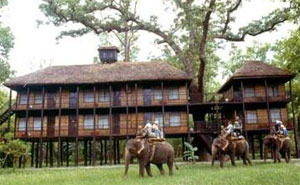
Tiger Tops Hotel

This bloody town's a bloody cuss,
No bloody trains, no bloody bus
And only Ravi cares for us
in bloody Kathmandu

The bloody roads are bloody bad
The bloody hash is bloody mad
It makes the saddest bloody glad
in bloody Kathmandu

From The Camp café register.


Part II Tibet: When Alexandre David-Neel died in her home in Digne, France on September 8 1969, she was just six weeks short of her 101 birthday.

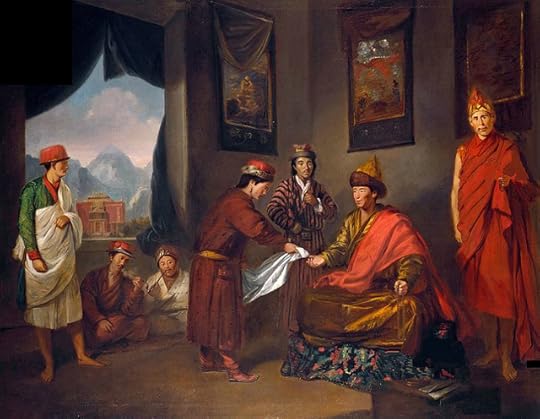
From wiki: George Bogle (26 November 1746 – 3 April 1781) was a Scottish adventurer and diplomat, the first to establish diplomatic relations with Tibet and to attempt recognition by the Chinese Qing Empire. His mission is still used today as a reference point in debates between China and Tibetan independence activists.

The Third Panchen Lama Receives George Bogle at Tashilhunpo, oil painting, Tilly Kettle, c. 1775
**Even funnier when the definition of bogle is: from Welsh bwg - ghost, hobgoblin**

All of China, including Tibet is on one time - Beijing time.


Of the three this is the most religious, as Bernstein starts his preface: This book, as its readers will discover, has a good deal to do with Buddhism - at least of the sort that is practiced in Nepal, Bhutan and Tibet - the latter in the face of terrible obstacles.

Berstein's historical recounting jumps back and forward in time, and at times describes an action from such disparate viewpoints that it takes a while before I realise that he had already had it covered.

Skimmed through the Tibetan chapters as there was little new on offer and was heartbroken that there was only 29 pages on Bhutan: short-changed!

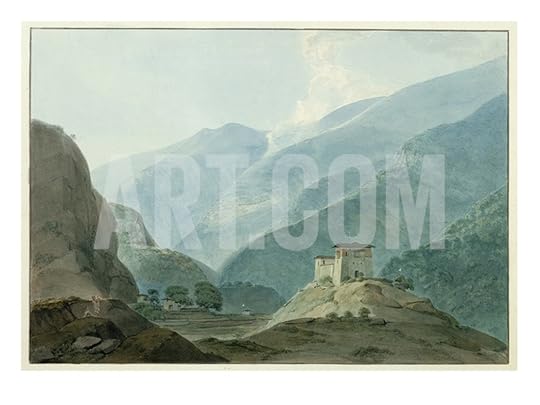
Chukha Casle in Bhutan by Samuel Davis

Himahlya reads in Spring 2013:

3* In the Forbidden Land
4* Trespassers on the Roof of the World
3* In the Himalayas


Profile Image for Connie.
116 reviews18 followers
May 22, 2015
Written by a Physicist and mountain climber, this book compares the early history of climbing and social culture in the highest three countries in the world, Nepal, Tibet, and Bhutan. It may need a bit of updating politically, but it brought many of the important of issues together, (religion,politics, invasions, boarders, climbing policies) that these three regions face. I just traveled to Tibet, and found the descriptions of 20 or so years ago quite interesting from what is happening now. I highly recommend for anyone interested in climbing history and making sense of what has and is happening in this complex region.
Profile Image for Daniel Wolgast.
2 reviews
September 15, 2012
Liked the history/background, but it did run a little long. Berenstein has a nice, conversational style that's easy to read.
259 reviews3 followers
October 30, 2016
A great read, especially the sense of mountain adventure by the long time New Yorker writer.
Profile Image for Niha Shetty.
1 review
January 8, 2021
good to learn about the background of nepal but the book ran a little long. very easy to read though!
Displaying 1 - 5 of 5 reviews

Can't find what you're looking for?

Get help and learn more about the design.