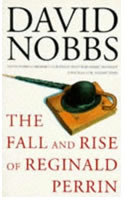
I have fond memories of the BBC sitcom, also written by David Nobbs, which was one of the funniest and most popular of the 1970s. But reading the novel, for the first time, I tried as hard as possible to banish all thoughts of it. The book actually came first: it was published in 1975, originally under the rather forbidding title The Death of Reginald Perrin. More importantly the excellent Jonathan Coe, my favourite living novelist, has described it as ‘one of the great British novels of the 1970s - as a piece of comic fiction streets ahead of anything by Kingsley Amis’, so it deserves to be appreciated in its own right.
Reginald Iolanthe Perrin (in a typically neat touch Nobbs informs us that his initials are engraved on his briefcase and handkerchief: R.I.P.) is a middle-aged sales executive with Sunshine Desserts who is gradually being driven mad by his comfortable but monotonously repetitive and soulless existence. Everything in his life is utterly predictable, even his train to work is always exactly eleven minutes late. He can no longer take the world of ‘exotic ices’ seriously. He feels suicidal but begins to rebel against his own fate. His rebellion starts with private notes to himself - instead of completing the newspaper crossword on his daily commute he scrawls ‘I am not a mere tool of the capitalist society’ across it - and gradually escalates in a series of increasingly absurd gestures. He visits an Italian restaurant at lunchtime and orders a starter of ravioli, followed by a main course of ravioli, rounded off with a dessert of ravioli. He invites his boss and colleagues for a dinner party and doesn’t serve any food. He feels an irresistible urge to use the words parsnips and earwig at random and finds himself referring to his mother-in-law as ‘the hippopotamus’. The first half of the book culminates with Perrin making a drunken speech at a conference in which he tries to point out the meaninglessness of the workaday world to his uncomprehending fellow delegates and is eventually forcibly removed from the podium. He then steals a works lorry and loads it with loganberry essence which he discharges into a river where his boss is holding a fishing party. Finally, he fakes his own death, leaving his clothes on a beach. The second part opens on his new life as he travels around the country incognito.
The Fall and Rise of Reginald Perrin has some similarities to a darkly comic novel published a couple of years earlier: Christie Malry’s Own Double-Entry by the experimental novelist B. S. Johnson (who happens to be another of Jonathan Coe’s literary heroes). This also concerns a man engaged in a rapidly escalating battle with capitalism. Perrin’s actions aren’t quite as extreme as Malry’s, he doesn’t kill anyone, and Nobbs isn’t as avant-garde a writer as Johnson. In its own way, though, his prose style is just as self-aware and distinctive. In addition to writing novels he was also a scriptwriter for many popular television comedians of the 1960s and ‘70s. The impact of his day job as a professional gagman is felt in this novel, which is an unusual mixture of entertainment, seriousness, broad comedy, near tragedy and social satire. It is full of inventive and logic-defying wordplay which might have come straight out of one of his sketches or monologues for The Two Ronnies. The anarchic and iconoclastic spirit of the Marx Brothers and René Magritte echo through these pages as the bourgeois world is subverted with surreal brilliance and the idiocies of management speak and consumer jargon are expertly skewered. I’m always sceptical when people say a novel made them laugh out loud, but this novel made me laugh out loud many times.
Perrin is a superb character, a Mr Pooter who has seen the futility of his life and gone feral, and he is supported by a strong cast of sharply drawn caricatures, all of whom seem to know they are caricatures: his well-meaning but profoundly boring liberal son-in-law Tom, his pompous boss C.J. and his hopelessly disorganised army officer brother-in-law Jimmy, who is forever visiting Reggie’s house to cadge food. Most of the characters have catchphrases. Although this is, or at least was, a common device in sketch comedy and sitcoms, it is unusual in a novel. It works because all the catchphrases derive from character. C.J. really would constantly preface his remarks by saying ‘I didn’t get where I am today by…’ and Reggie’s obsequious colleagues Tony Webster and David Harris-Jones really would herald C.J.’s every fatuous utterance with ‘great’ and ‘super’.
The book presents a darker vision of suburban life than the TV adaptation and Perrin’s despair is conveyed more intensely. The ‘Poets’ Estate’ of mock Georgian and Tudor houses Reggie lives on (Coleridge Close, Tennyson Avenue, Wordsworth Drive) is like an upmarket prison. At the start of the novel he is suicidal and impotent. He loves his wife but is unable to make love to her, so decides to have an affair with his secretary. He is also unable to make love to his secretary, mainly because he loves his wife. His married daughter is having an affair with her Uncle Jimmy. Following his ‘death’ Perrin visits a village which holds precious childhood memories for him only to discover, just like George Bowling in Orwell’s Coming Up For Air, that the past isn’t what it used to be. Indeed, The Fall and Rise…’ is rather like one of Orwell’s novels from the 1930s as rewritten by the absurdist playwright N. F. Simpson, another great satirist of English mores. Pretty much all of Orwell’s central characters undertake a journey from conformity to rebellion and then back to conformity. This is essentially Perrin’s trajectory, albeit with a bizarre twist which makes the ending a subversively happy one, in stark contrast to Orwell’s customary pessimistic fatalism. (I won’t give away the ending in case anyone reading this hasn’t read the novel or seen the series.)
Is Jonathan Coe right? Is this one of the great novels of the 1970s? It is certainly very funny and, as genuinely funny novels are rare in any decade, it is safe to say that it is one of the funniest. I must admit that I didn’t have particularly high expectations and read it partly out of nostalgia for the series and also on the strength of Coe’s provocative yet clearly heartfelt recommendation. It is much more substantial and original than I was expecting. Coe is probably correct in saying that if Nobbs had never turned it into a sitcom it would have a better reputation. English literary culture has always tended to be suspicious of writers who move between popular entertainment and literature, and combine the serious with the comic. This is a wonderfully entertaining and anarchic novel which says a lot about English society and is ultimately rather touching. Reggie’s exasperated feeling of ‘is that all there is?’ still resonates in the 21st century. Perrin doesn’t like his life and decides to change it by unusual means. The great thing is he succeeds, even if not quite in the way he anticipated. I look forward to reading more by David Nobbs, including the second book in the Perrin sequence, The Return of Reginald Perrin.