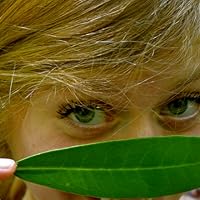
Silently, a tiny yellow spider spins her fragile web. As a young boy stops to watch, she crawls along the delicate silken threads, sometimes hanging, sometimes spinning, sometimes staring back. Before the boy knows it, the spider’s world has become his own. . . .
Jonathan London is the author of several celebrated children's books. His commitment to honoring the wonders of the natural world has been lauded by readers and critics alike. He is the author of more than 70 children's books, many of which are about nature. He's also the author of the popular Froggy series. He lives in Graton, California with his wife and two sons.
The pictures are the first thing that stand out as soon as you begin reading, but the text is very nicely done! Good way to talk about poetry with a class!
Book Title: Dream Weaver Author/Illustrator: Johnathan London Reading Level: LG Book Level: 2.4
Book Summary: A boy takes a walk and sees a yellow spider spinning her web. As he watches her, he starts to see the world from a different point of view.
Bookshelf Mentor Writing Trait: Sentence Fluency- The way the book is written provides an opportunity for students to practice their fluency by joining me in reading the book aloud. I would scan the book in to the computer and then have students join me by reading the book aloud from the smartboard. We would take turns reading the pages and pausing as needed for punctuation to practice sentence fluency- saying the words smoothly. I would make copies of a student's piece of writing already completed. I would give the copy to their partner. They would work with their partner. The partner would read the piece aloud and while the partner was reading they would be making edits or changes to their writing to include pauses where they wanted to the reader to pause. This would allow them to make sure their writing reflects how they wanted the story to sound in the reader's head while they were reading it. I would remind students to make notes of when they used the words: then, next, and, so by circling those words. I would also ask students to look at the beginnings of their sentences and where they use "I" and "The" and "Then." We would talk about how to make changes and make edits to include different ways to vary the beginning of their sentences. Other suggestions: This book would be great for showing conventions as it has strategically placed punctuation and poetic quality to it. I think this book would also be a great addition to emphasizing making observations about the world around you. So possibly including it in a science lesson on making and recording observations.
I don't think you could ask for a more evocative and engaging writer about animal biology and habitat than... Jonathan London.
For this spider-themed saga, he's aided by Rocco Baviera, whose pictures strike me as edgy-verging on surreal. (Always in a kid-friendly way, I must hasten to add. Just wait until you've seen a Rocco-designed gem of a raindrop.)
Among the wonders of this book, don't skip the back cover flap. There you'll find the most ingelligence-revealing photos of the author and illustrator when they were boys.
Dream Weaver by Jonathan London would appeal to my visual and creative learners. The idea of being able to weave your own dreams would be very thrilling for some students. This could be an introduction into a spider unit or a dreaming, science unit.
This was a very nice 'nature' storybook. But heads up it is about a spider. It's beautifully written so it's not 'scary' but if you or your child are scared of spiders you will be scared of this book. It is written in a way that shows the beauty of what a spider 'could be' out in nature. The little boy sees it as such and 'rescues' the spider when a raindrop knocks it off its web. My almost 3 year old granddaughter enjoyed this book and enjoyed looking at it by herself even after we read it together. But had my daughter read this to her niece she would have been freaked out (for lack of better words) due to her fear of spiders. So just beware...beautifully written book with great illustrations but the subject may not be for everyone.
This book begins with a little boy who discovers a spider. He starts to see the world through her eyes. For instance, rain drops become pools and a snail becomes a giant. When her web gets destroyed, it’s understood that it’s really her home that gets destroyed. With this new perspective, his world becomes more magical; the yellow spider is now like a star in the sky. It’s important to see the world through different perspectives, and in doing so, your world will become different. While this book is very colorful and creative, I feel the theme of this book is hard for children to understand. The font could be more appealing.
I'm a huge sucker for art work. I love the art in this! I can't help it, the colors were incredibly vibrant and wonderful. This will be read to my daughter when she gets old enough, I want her to grow up not being afraid of spiders, like me.
A story about a spider in which children imagine the perspective of the world from a spider's web. The illustrations help the children see what the spider sees.
I love everything about this book, from the font, to the illustration, to the actual story. It's beautifully done! I'm reading it to my preschoolers for SRC this summer!