

What do you think?

Vieux Carré
Born out of the journals the playwright kept at the time, Tennessee Williams's Vieux Carré is not emotion recollected in tranquility, but emotion re-created with all the pain, compassion, and wry humor of the playwright's own 1938-39 sojourn in the New Orleans French Quarter vividly intact.
The drama takes it form from the shifting scenes of memory, and Williams's surrogate self invites us to focus, in turn, on the various inhabitants or his dilapidated rooming house in the Vieux Carré: the comically desperate landlady, Mrs. Wire; Jane, a properly brought-up young woman from New York making at last grab at pleasure with Tye, the vulgar but appealing strip-joint barker; two decayed gentlewomen politely starving in the garret; and the dying painter Nightingale, who tries to teach the young writer something about love--both of the body and of the heart. This is a play about the education of the artist, and education in loneliness and despair, in giving and not giving, but most of all in seeing, hearing, feeling, and learning that "writers are shameless spies," who pay dearly for their knowledge and who cannot forget. Building on two decades of Williams scholarship since Vieux Carré was originally published, Robert Bray, editor of The Tennessee Williams Annual Review, has provided a new introduction for this edition, giving the most authoritative account yet of its background and genesis.
The drama takes it form from the shifting scenes of memory, and Williams's surrogate self invites us to focus, in turn, on the various inhabitants or his dilapidated rooming house in the Vieux Carré: the comically desperate landlady, Mrs. Wire; Jane, a properly brought-up young woman from New York making at last grab at pleasure with Tye, the vulgar but appealing strip-joint barker; two decayed gentlewomen politely starving in the garret; and the dying painter Nightingale, who tries to teach the young writer something about love--both of the body and of the heart. This is a play about the education of the artist, and education in loneliness and despair, in giving and not giving, but most of all in seeing, hearing, feeling, and learning that "writers are shameless spies," who pay dearly for their knowledge and who cannot forget. Building on two decades of Williams scholarship since Vieux Carré was originally published, Robert Bray, editor of The Tennessee Williams Annual Review, has provided a new introduction for this edition, giving the most authoritative account yet of its background and genesis.
116 pages, Paperback
First published January 1, 1979
About the author
Tennessee Williams
786 books3,903 followersThomas Lanier Williams III, better known by the nickname Tennessee Williams, was a major American playwright of the twentieth century who received many of the top theatrical awards for his work. He moved to New Orleans in 1939 and changed his name to "Tennessee," the state of his father's birth.
Raised in St. Louis, Missouri, after years of obscurity, at age 33 he became famous with the success of The Glass Menagerie (1944) in New York City. This play closely reflected his own unhappy family background. It was the first of a string of successes, including A Streetcar Named Desire (1947), Cat on a Hot Tin Roof (1955), Sweet Bird of Youth (1959), and The Night of the Iguana (1961). With his later work, he attempted a new style that did not appeal to audiences. His drama A Streetcar Named Desire is often numbered on short lists of the finest American plays of the 20th century, alongside Eugene O'Neill's Long Day's Journey into Night and Arthur Miller's Death of a Salesman.
Much of Williams' most acclaimed work has been adapted for the cinema. He also wrote short stories, poetry, essays and a volume of memoirs. In 1979, four years before his death, Williams was inducted into the American Theater Hall of Fame.
From Wikipedia
Raised in St. Louis, Missouri, after years of obscurity, at age 33 he became famous with the success of The Glass Menagerie (1944) in New York City. This play closely reflected his own unhappy family background. It was the first of a string of successes, including A Streetcar Named Desire (1947), Cat on a Hot Tin Roof (1955), Sweet Bird of Youth (1959), and The Night of the Iguana (1961). With his later work, he attempted a new style that did not appeal to audiences. His drama A Streetcar Named Desire is often numbered on short lists of the finest American plays of the 20th century, alongside Eugene O'Neill's Long Day's Journey into Night and Arthur Miller's Death of a Salesman.
Much of Williams' most acclaimed work has been adapted for the cinema. He also wrote short stories, poetry, essays and a volume of memoirs. In 1979, four years before his death, Williams was inducted into the American Theater Hall of Fame.
From Wikipedia
Ratings & Reviews
Friends & Following
Create a free account to discover what your friends think of this book!
Community Reviews
Displaying 1 - 30 of 39 reviews

January 27, 2013
New Orleans, 1938
White: "Jane"
Black: Young Tennessee Williams
King's Gambit
1. e4
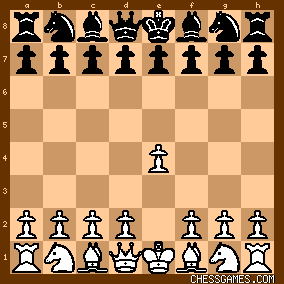
An attractive, well-brought-up young woman from New York who finds herself living with a drunk, bisexual strip-show barker in a disreputable Southern boarding house will of course be longing for a chess partner.
The rest of this review is available elsewhere (the location cannot be given for Goodreads policy reasons)
White: "Jane"
Black: Young Tennessee Williams
King's Gambit
1. e4
An attractive, well-brought-up young woman from New York who finds herself living with a drunk, bisexual strip-show barker in a disreputable Southern boarding house will of course be longing for a chess partner.
The rest of this review is available elsewhere (the location cannot be given for Goodreads policy reasons)
This entire review has been hidden because of spoilers.

August 20, 2020
Vieux Carre
Tennesse Williams' plays after "The Night of Iguana" in 1961 were not commercially successful. Williams wrote "Vieux Carre" in the mid-1970s, drawing from his diaries and journals and from earlier plays and stories. The play failed on Broadway but had a successful run in 1978 in London.
The play consists of two parts and twelve scenes. Although it is intimate in tone, it requires a cast consisting of five men and five women. The play is autobiographical. Williams revisits has days between winter 1938 and spring 1939 as a young and poor writer in a shabby rooming house in New Orleans' French Quarter. Williams gives the specific address: 722 Toulouse Street, but the portrayal is meant to be universal. Williams writes, "In the barrenness there should be a poetic invocation of all the cheap rooming houses of the world." The play moves between the particulars of Williams' life as a young man of 28 and broader themes.
The primary character is Williams himself but he is called simply and more suggestively "Writer". He speaks directly to the audience as a narrator, on occasion, as well as being a participant in the play. The remaining characters in the play are tormented, each in their own way, as is the Writer. They include, the delusional, witchlike, and greedy landlady, a figure who symbolizes rooming house landladies everywhere, and her longsuffering aged servant Nursie,, an African American woman who suggests she would rather be a bag lady than to continue working in the rooming house. Besides the Writer, the other boarders in the house include Nightingale, a painter suffering from tuberculosis with whom Writer has his first, and unhappy, homosexual experience. Other boarders are two elderly and impoverished spinsters, and Jane and Tye. Jane is a designer from the northeast who comes to New Orleans when she learns she has a serious disease of uncertain nature. She becomes romantically involved with Tye, an addicted and criminal drifter who works as a barker for a strip club. The play develops the tensions of each of the boarders among themselves and with the landlady.
The plot of "Vieux Carre" is loose and disjointed with more of a focus on characterization and language. Williams mostly avoids sentimentality as he remembers his bohemian years and he also captures a degree of detachment in his memory. Loneliness and desperation form much of the lot of the Writer and of the other characters. In scene two, the stage directions describe the Writer as making a "sound of dry and desperate sobbing which sounds as though nothing in the world could ever appease the wound from which it comes: loneliness, inborn and inbred to the bone." In the following scene, where the Writer visits Jane and Tye, the young woman describes herself as "frantic with loneliness". Their lives play out for a short time with the writer faring better than the others. He meets a young musician, Sky, and is able to travel with him west to California to the call of a clarinet to begin the next stage of his life. The writer sees the door opening before him as offering a "desperate undertaking". The writer looks back and forward -- to a life which he didn't know at the time would bring him success together with a great deal of misery. He remembers that old companions "remain with you only as ghosts; their voices fading but remembered."
In his new biography, "Tennessee Williams: Mad Pilgrimage of the Flesh" (2014), John Lahr describes "Vieux Carre" as "a crepuscular spectacle of dead souls, [which] includes among its spectral figures the jejune Writer himself." Although the play failed on Broadway, Williams writing had beauty and strength. Lahr quotes New York Times reviewer, Walter Kerr: "Tennessee Williams' voice is the most distinctively poetic; the most idiosyncratically moving, and at the same time the most firmly dramatic to have come the American theater's way -- ever. No point in calling the man our best living playwright. He is our best playwright and let qualifications go hang."
"Vieux Carre" is a movingly effective play about loneliness and about the perils of creativity. Those who love Williams' more famous works will enjoy getting to know this under-appreciated play. It is available in this separate volume and in the second of the two Library of America volumes devoted to the plays of Tennessee Williams.
Robin Friedman
Tennesse Williams' plays after "The Night of Iguana" in 1961 were not commercially successful. Williams wrote "Vieux Carre" in the mid-1970s, drawing from his diaries and journals and from earlier plays and stories. The play failed on Broadway but had a successful run in 1978 in London.
The play consists of two parts and twelve scenes. Although it is intimate in tone, it requires a cast consisting of five men and five women. The play is autobiographical. Williams revisits has days between winter 1938 and spring 1939 as a young and poor writer in a shabby rooming house in New Orleans' French Quarter. Williams gives the specific address: 722 Toulouse Street, but the portrayal is meant to be universal. Williams writes, "In the barrenness there should be a poetic invocation of all the cheap rooming houses of the world." The play moves between the particulars of Williams' life as a young man of 28 and broader themes.
The primary character is Williams himself but he is called simply and more suggestively "Writer". He speaks directly to the audience as a narrator, on occasion, as well as being a participant in the play. The remaining characters in the play are tormented, each in their own way, as is the Writer. They include, the delusional, witchlike, and greedy landlady, a figure who symbolizes rooming house landladies everywhere, and her longsuffering aged servant Nursie,, an African American woman who suggests she would rather be a bag lady than to continue working in the rooming house. Besides the Writer, the other boarders in the house include Nightingale, a painter suffering from tuberculosis with whom Writer has his first, and unhappy, homosexual experience. Other boarders are two elderly and impoverished spinsters, and Jane and Tye. Jane is a designer from the northeast who comes to New Orleans when she learns she has a serious disease of uncertain nature. She becomes romantically involved with Tye, an addicted and criminal drifter who works as a barker for a strip club. The play develops the tensions of each of the boarders among themselves and with the landlady.
The plot of "Vieux Carre" is loose and disjointed with more of a focus on characterization and language. Williams mostly avoids sentimentality as he remembers his bohemian years and he also captures a degree of detachment in his memory. Loneliness and desperation form much of the lot of the Writer and of the other characters. In scene two, the stage directions describe the Writer as making a "sound of dry and desperate sobbing which sounds as though nothing in the world could ever appease the wound from which it comes: loneliness, inborn and inbred to the bone." In the following scene, where the Writer visits Jane and Tye, the young woman describes herself as "frantic with loneliness". Their lives play out for a short time with the writer faring better than the others. He meets a young musician, Sky, and is able to travel with him west to California to the call of a clarinet to begin the next stage of his life. The writer sees the door opening before him as offering a "desperate undertaking". The writer looks back and forward -- to a life which he didn't know at the time would bring him success together with a great deal of misery. He remembers that old companions "remain with you only as ghosts; their voices fading but remembered."
In his new biography, "Tennessee Williams: Mad Pilgrimage of the Flesh" (2014), John Lahr describes "Vieux Carre" as "a crepuscular spectacle of dead souls, [which] includes among its spectral figures the jejune Writer himself." Although the play failed on Broadway, Williams writing had beauty and strength. Lahr quotes New York Times reviewer, Walter Kerr: "Tennessee Williams' voice is the most distinctively poetic; the most idiosyncratically moving, and at the same time the most firmly dramatic to have come the American theater's way -- ever. No point in calling the man our best living playwright. He is our best playwright and let qualifications go hang."
"Vieux Carre" is a movingly effective play about loneliness and about the perils of creativity. Those who love Williams' more famous works will enjoy getting to know this under-appreciated play. It is available in this separate volume and in the second of the two Library of America volumes devoted to the plays of Tennessee Williams.
Robin Friedman

January 27, 2013
Saw the play last night at 45 Downstairs. Hesitating between 3 and 4 stars. I'd like to see another production of it some time, which is not to say this was a bad one, but that I'd like a second opinion. In Melbourne it was put on as part of the Midsummer Festival: unfortunately it is therefore being marketed as a play about homosexuality, which it is not - or rather no more so than it is about mental illness, poverty, relations between men and women, the nature of art and the ways in which the people of New Orleans relate to their surroundings....
Not least, it is about whether the cook should spit in the gumbo as it is being prepared.
Not least, it is about whether the cook should spit in the gumbo as it is being prepared.

May 1, 2018
Tennessee Williams's Vieux Carré is set in a New Orleans boardinghouse in which there are a set of tenants who are every bit as picturesque and decayed as the building they inhabit. The landlady, Mrs. Wire, rides herd on all of them, constantly threatening them with eviction. The main character is a young writer (presumably the author as a young man).
There is a good deal of hinting at homosexual sex, especially with the character of the writer's neighbor, Mr. Nightingale. There is also some raw language that is more typical of the time the play was released, some 40 years after the author started writing it in 1938.
Although I had never heard of the play before I read it, I enjoyed it. As the writer prepares to leave with a clarinet-playing drifter for California, Williams gives us one of his poetic endings as the writer says:
There is a good deal of hinting at homosexual sex, especially with the character of the writer's neighbor, Mr. Nightingale. There is also some raw language that is more typical of the time the play was released, some 40 years after the author started writing it in 1938.
Although I had never heard of the play before I read it, I enjoyed it. As the writer prepares to leave with a clarinet-playing drifter for California, Williams gives us one of his poetic endings as the writer says:
They're disappearing behind me [the other characters]. Going. People you've known in places do that: they go when you go. The earth seems to swallow them up, the walls absorb them like moisture, remain with you only as ghosts; their voices are echoes, fading but remembered.

April 16, 2018
Williams began writing Vieux Carré in 1938 but didn't complete it until nearly forty years later. The play was ahead of its time in that it was the first (and the last) play published during Williams's lifetime to portray explicitly queer characters. Keeping this in mind, it's easy to see why it took so long for Tenn to get it published and why the critical and commercial reaction was so tepid.
Quirky, nostalgic, and, like most of the Williams's later work, faintly self-satirical, Vieux Carré follows a period in the life of a young unnamed writer, sexually inexperienced and harboring gentlemanly pretensions that render him woefully out of place in the amoral French Quarter of the 1930s. I like to think of him as a slightly older, worldlier Tom from The Glass Menagerie. Like Tom, he is both a participant in the action of the play and a detached spectator who narrates from some indeterminate point in the future. The plot (if it can be called a plot) follows his misadventures as a boarder in a rooming house at 722 Toulouse Street in New Orleans, accompanied by a wacky supporting cast that includes a tubercular painter, a scheming landlady with a misplaced sense of propriety, a saintly black maid, fallen society ladies, a junkie strip club bouncer, and his leukemia-addled girlfriend from New York.
Much like in A Streetcar Named Desire, Williams structures Vieux Carré as a series of vignettes; unlike in Streetcar, however, these vignettes never really manage to coalesce into a distinct whole. I'm of two minds about this. While I liked the episodic structure, this lack of cohesion negatively impacts the quality of the play. And while the dialogue is in top form as always, the characterization is somewhat weaker than I expect from Williams. As other reviewers have pointed out, the characters often err on the side of caricature. I'm thinking specifically of Tye and Jane--less-rounded versions of Stanley and Stella from Streetcar. This, I think, is partly the result of too many characters, all of whom are vying with each other for stage time.
Ultimately, I can't help but wonder if perhaps Vieux Carré, much like Night of the Iguana, is flawed by virtue of its form. Iguana, as Williams more or less admitted, would have worked better as a dramatic poem. Likewise, Vieux Carré probably would have made more sense as a novella or perhaps a short story collection. Such a format would have better suited the episodic structure of the plot, and the freedom of length afforded prose works would have allowed Williams more space to flesh out his cast.
Three stars.
Quirky, nostalgic, and, like most of the Williams's later work, faintly self-satirical, Vieux Carré follows a period in the life of a young unnamed writer, sexually inexperienced and harboring gentlemanly pretensions that render him woefully out of place in the amoral French Quarter of the 1930s. I like to think of him as a slightly older, worldlier Tom from The Glass Menagerie. Like Tom, he is both a participant in the action of the play and a detached spectator who narrates from some indeterminate point in the future. The plot (if it can be called a plot) follows his misadventures as a boarder in a rooming house at 722 Toulouse Street in New Orleans, accompanied by a wacky supporting cast that includes a tubercular painter, a scheming landlady with a misplaced sense of propriety, a saintly black maid, fallen society ladies, a junkie strip club bouncer, and his leukemia-addled girlfriend from New York.
Much like in A Streetcar Named Desire, Williams structures Vieux Carré as a series of vignettes; unlike in Streetcar, however, these vignettes never really manage to coalesce into a distinct whole. I'm of two minds about this. While I liked the episodic structure, this lack of cohesion negatively impacts the quality of the play. And while the dialogue is in top form as always, the characterization is somewhat weaker than I expect from Williams. As other reviewers have pointed out, the characters often err on the side of caricature. I'm thinking specifically of Tye and Jane--less-rounded versions of Stanley and Stella from Streetcar. This, I think, is partly the result of too many characters, all of whom are vying with each other for stage time.
Ultimately, I can't help but wonder if perhaps Vieux Carré, much like Night of the Iguana, is flawed by virtue of its form. Iguana, as Williams more or less admitted, would have worked better as a dramatic poem. Likewise, Vieux Carré probably would have made more sense as a novella or perhaps a short story collection. Such a format would have better suited the episodic structure of the plot, and the freedom of length afforded prose works would have allowed Williams more space to flesh out his cast.
Three stars.

May 14, 2017
The play centres around loneliness in company - the different stories of the inhabitants of this "madhouse" as the patrolman refers to it are crafted to make the reader want to participate in the ridiculousness of their circumstances, to give them some advice, even help them out a little.
In the preface, the character of Nightingale is presented as somebody who "represents the kind of human effluvium both responsible for and victimised by his own circumstances", accentuating the idea that one can only help himself out of the mess they concocted. However, most of the characters are not entirely pitiful, they seem to have a certain inexplicable strength to them. They are all so set in their ways and always true to their character, and some of this rubs off on the writer and the reader as well.
By the end of the play, the writer feels like he's attended university, and the reader also can't help and take away some wisdom from the lunatics. And aren't those the wisest people of all?
In the preface, the character of Nightingale is presented as somebody who "represents the kind of human effluvium both responsible for and victimised by his own circumstances", accentuating the idea that one can only help himself out of the mess they concocted. However, most of the characters are not entirely pitiful, they seem to have a certain inexplicable strength to them. They are all so set in their ways and always true to their character, and some of this rubs off on the writer and the reader as well.
By the end of the play, the writer feels like he's attended university, and the reader also can't help and take away some wisdom from the lunatics. And aren't those the wisest people of all?

March 28, 2015
"Vieux Carre" is by no means Tennessee Williams' best play. No; cruder, harsher and rawer, for better and for worse, but it stands as a very interesting testament to his latter days.
It is a character play; you see a group of people who are taking abode in a rooming home in New Orleans. This group is heterogeneous, each voice being its own, but they share one thing in common: a lack of means and a viable future.
The play is, from the get go, very intense. The interesting thing though, is how it very obviously was written in Williams' latter years, when he was broke, brushed to the sidelines of the contemporary theatre scene and in semi-obscurity. The Writer character is very obviously a stand in. But what really shines through is the despair. Despair isn't anything new in Williams' plays, as any one will tell you, but this time this feeling really does grasp you from the beginning. His characters are always at breaking point, but in "Vieux Carré" they're already broken, far beyond.
There is no glimmer of hope, nobody comes to the rescue. Situations worsen, but it isn't because of any action, just natural progress. The erosion of the eroded. Despair, lack of light, filth, dust, sex as relief but no love, never.
The play while a fascinating read in itself, bleak as it is, shows more of a window into how the author was dealing with his life at the time, and that is curious from a studying point. None of the characters try to break from their misery but are so far gone they just act as if it were a condition of their existence, something they can't rebel against, god given and unchangeable.
The description says that [it] is a play about the education of the artist, an education in loneliness . I don't see it that way. Tennessee might have intended it, but these feelings affect all characters. None of them grow, none of them change, none of them feel they can change.
It is a character play; you see a group of people who are taking abode in a rooming home in New Orleans. This group is heterogeneous, each voice being its own, but they share one thing in common: a lack of means and a viable future.
The play is, from the get go, very intense. The interesting thing though, is how it very obviously was written in Williams' latter years, when he was broke, brushed to the sidelines of the contemporary theatre scene and in semi-obscurity. The Writer character is very obviously a stand in. But what really shines through is the despair. Despair isn't anything new in Williams' plays, as any one will tell you, but this time this feeling really does grasp you from the beginning. His characters are always at breaking point, but in "Vieux Carré" they're already broken, far beyond.
There is no glimmer of hope, nobody comes to the rescue. Situations worsen, but it isn't because of any action, just natural progress. The erosion of the eroded. Despair, lack of light, filth, dust, sex as relief but no love, never.
The play while a fascinating read in itself, bleak as it is, shows more of a window into how the author was dealing with his life at the time, and that is curious from a studying point. None of the characters try to break from their misery but are so far gone they just act as if it were a condition of their existence, something they can't rebel against, god given and unchangeable.
The description says that [it] is a play about the education of the artist, an education in loneliness . I don't see it that way. Tennessee might have intended it, but these feelings affect all characters. None of them grow, none of them change, none of them feel they can change.

July 31, 2017
The play's wistfulness and charm to me mostly comes from Williams' elegiac look back on the beginning of his career. The setting, time, narrator - and likely most of the characters - are all drawn from Williams' time in New Orleans when he was first starting out. He was there for a few months - but they must have been very rich months. Alas, at that age we are so ripe for experience that it is like duck imprinting on the first moving thing.
We see familiar Williams - the bickering heterosexual couple like Blanche and Stanley, the half-mad boisterous older woman, the failed homosexual artists etc. I'm not sure what someone with no experience or knowledge of Williams would get out of this play, the only action is that everyone is leaving, by choice, by sickness or by madness. I think the metaphor is the only place the characters really exist is in memory and in art. At the play's end, there is nobody home. While on the page it is pretty depressing - it is also uplifting because we know Williams in his later life made great art out of what he saw there.
We see familiar Williams - the bickering heterosexual couple like Blanche and Stanley, the half-mad boisterous older woman, the failed homosexual artists etc. I'm not sure what someone with no experience or knowledge of Williams would get out of this play, the only action is that everyone is leaving, by choice, by sickness or by madness. I think the metaphor is the only place the characters really exist is in memory and in art. At the play's end, there is nobody home. While on the page it is pretty depressing - it is also uplifting because we know Williams in his later life made great art out of what he saw there.

January 2, 2017
“There’s a lot of human material in the Quarter for a writer.”

May 28, 2022
I love Tennessee Williams, so it’s no surprise I enjoyed Vieux Carre, one of Williams only plays with openly gay characters and one of the most autobiographical plays in his oeuvre.

May 13, 2024
I purchased this book when I visited Faulkner House bookstore in New Orleans... really on a whim. It is a short play full of human longing and disappointment. I felt I knew the characters intimately which is a testament to Williams skill as a writer since, as I mentioned before, the play was rather short in length.

February 16, 2021
Despicable characters who spend time performing deviant activities. No likable characters and very little to feel good about. Dismal

December 6, 2020
I see a house that inspired a character play.
A story about life and death of an amalgamation of the tormented. The tormented artists and dreamers come together and have until the end to die or leave a life they are beginning to resent. Frustration is not stated but these characters are expecting and answer that they do not have unless they risk their residence at Vieux Carre. The Angel that gives this insight is Sky. [spoiler here stop reading].
. . .Sky comes back for a bag that he cannot afford to retrieve from the delusional house manager. He accepts taking risk and extends this confidence to TW main character who narrates with participation and detachment.
I love this play. It is set in a circumstance that I believe many people live in just not this extreme.
A story about life and death of an amalgamation of the tormented. The tormented artists and dreamers come together and have until the end to die or leave a life they are beginning to resent. Frustration is not stated but these characters are expecting and answer that they do not have unless they risk their residence at Vieux Carre. The Angel that gives this insight is Sky. [spoiler here stop reading].
. . .Sky comes back for a bag that he cannot afford to retrieve from the delusional house manager. He accepts taking risk and extends this confidence to TW main character who narrates with participation and detachment.
I love this play. It is set in a circumstance that I believe many people live in just not this extreme.

July 6, 2015
Evocative, sombre, and a true work of art. Based upon the writings and memories of William's himself, Vieux Carre truly gives you a minds eye perspective of life in the French Quarter of New Orleans during the late 1930's. Though unconventional by means of staging and typical play structure, it truly shines in the fashion that only a William's style memory play can. The characters, each diverse and troubled in their own ways, find a subtle way of attracting the reader into appreciating the darker side of humanity through glimpses of the human condition; leaving you with an oddly optimistic view of the future.

September 4, 2007
I read this on Wayne's recommendation for my mock U/RTA senior year... and it is probably one of the best Tennessee William's play I've ever read. The characters are so damaged and beautiful. It's kind of the pre-cursor to Blanche Devereaux.

September 24, 2008
Vieux Carre is probably the finest play of Williams' "Late" period--and it's terrific, though unfairly neglected. It's much more like the earlier work in terms of a "straight" narrative.

March 20, 2013
Many different characters inhabit this house, each drawn unforgettably even without a lot of "on" time. Sad. Trapped. Yet with a glimmer of a light that called to my heart.
October 22, 2025
I actually enjoyed this a lot although my read was very fragmented and not well taken care of. But I enjoyed his witty writing and like Wilde, makes me laugh out loud.
I went to bed just thinking of my grandma crying the night before I read this part. Felt very aligned.
WRITER: When I was alone in the room, the visitor having retreated beyond the plywood partition between his cubicle and mine, which was chalk white that turned ash-gray at night, not just he but everything visible was gone except for the lighter gray of the alcove with its window over Toulouse Street. An apparition came to me with the hypnotic effect of the painter's sandman special. It was in the form of an elderly female saint, of course. She materialized soundlessly. Her eyes fixed on me with a gentle questioning look which I came to remember as having belonged to my grandmother during her sieges of illness, when I used to go to her room and sit by her bed and want, so much, to say something or to put my hand over hers, but could do neither, knowing that if I did, I'd betray my feelings with tears that would trouble her more than her illness. . . Now it was she who stood next to my bed for a while. And as I drifted toward sleep, I wondered if she'd witnessed the encounter be- tween the painter and me and what her attitude was toward such-perversions? Of longing?
I went to bed just thinking of my grandma crying the night before I read this part. Felt very aligned.
WRITER: When I was alone in the room, the visitor having retreated beyond the plywood partition between his cubicle and mine, which was chalk white that turned ash-gray at night, not just he but everything visible was gone except for the lighter gray of the alcove with its window over Toulouse Street. An apparition came to me with the hypnotic effect of the painter's sandman special. It was in the form of an elderly female saint, of course. She materialized soundlessly. Her eyes fixed on me with a gentle questioning look which I came to remember as having belonged to my grandmother during her sieges of illness, when I used to go to her room and sit by her bed and want, so much, to say something or to put my hand over hers, but could do neither, knowing that if I did, I'd betray my feelings with tears that would trouble her more than her illness. . . Now it was she who stood next to my bed for a while. And as I drifted toward sleep, I wondered if she'd witnessed the encounter be- tween the painter and me and what her attitude was toward such-perversions? Of longing?

November 8, 2025
loneliness. illness. a housefull of characters that are flawed and human and familiar. the play offers little comfort to its characters and to the reader and yet... something about tennessee williams' writing is very comforting.
the lit major in me is also thrilled to ponder one of his later works as opposed to the earlier hits like a streetcar named desire, the glass menagerie and cat on a hot tin roof. this one has an undeniable touch of postmodernity that i don't remember present in those previous ones.
i love williams and will read more of his stuff, definitely. i'll also have to go back to those earlier hits and give them a re-read - gotta refresh my memory.
the lit major in me is also thrilled to ponder one of his later works as opposed to the earlier hits like a streetcar named desire, the glass menagerie and cat on a hot tin roof. this one has an undeniable touch of postmodernity that i don't remember present in those previous ones.
i love williams and will read more of his stuff, definitely. i'll also have to go back to those earlier hits and give them a re-read - gotta refresh my memory.

June 23, 2023
With no lurid Southern Gothic trappings, this work gives us a real TW and real friends and neighbors. Yes, it's episodic, but we have about a dozen characters to understand, so for me this works nicely.

November 15, 2021
What can I say, I’m a Tennessee Williams lifer.

December 26, 2022
I took 2 edibles and I feel like I understand this whole play. So fucking deep.

January 23, 2023
“We all have our confusions.”

September 25, 2024
Favorite type of setting: in-between

September 15, 2025
This definitely was much more on par with Williams' earlier plays. Back in form I'd say.
Grade: B+
Grade: B+

January 27, 2026
“I consulted a doctor about it once, and he said “You don’t sleep because it reminds you of death.”
T. Williams VC
T. Williams VC

July 20, 2026
do you know what it meansssss to miss new orleanssssss

March 19, 2018
Quaint autobiographical play that portrays the esoteric culture of Southern gays.

January 10, 2020
not my favorite tennessee williams play, but it was still great, nonetheless!! i really loved the complexity and diversity of all the characters. such an odd mix of humans but it works great to create that “freak show” that i believe was intended. i enjoyed this play but it did leave me confused with many things and left wanting a bit more.

November 7, 2014
2.5 of 5 stars – Sad, Uncompelling Menagerie of Characters.
This play was supposedly, possibly a follow-up (not necessarily a sequel) to whatever happened to Tom when he left St. Louis in The Glass Menagerie, but where Menagerie shines, this one is an "eh."
Even though this was published late in Tennessee Williams' life, and the time period suggests that it does follow that of Menagerie, it was actually initially drafted before Menagerie, in 1939. Indeed, the playwriting seemed like a less mature TW.
The plot and characterization was too disparate and choppy; it didn't hold together well. The characters consisted of a bunch of poor, down on their luck and ill people - mentally as well as physically - desolate, disturbed, depressed, dysfunctional, dying. Many good plays have such a menagerie; but in this case, it was not fun to watch because there wasn't enough there for me to become invested in their circumstances or fate. Not even it's reported claim could maintain my interest throughout - reportedly, this was TW's first unambiguous gay liaison on stage (I'm not sure, but I seem to recall at least one of his many previous short plays that had such a liaison).
It was interesting how this seemed to be based on a snapshot in time of TW's life, his few months in New Orleans, before he became famous with Menagerie, just after he adopted his nom de plume in order to enter a NYC play contest but avoid being discovered that he was over the age limit. I was in fact intrigued how the characters in this play were inspired by his actual rooming house mates, and that they laid the foundation for similar characters in later plays, from Stanley Kowalski to TW himself in many other plays, most directly Tom in Menagerie.
As put in the play by the MC/narrator/(TW?) himself: "I've grown into a man, about to take his first step out of this waiting station into the world." For a quick stop, this was fine, but I've moved on now, too.
[Gay Men’s Book Group-Chicago monthly selection]
This play was supposedly, possibly a follow-up (not necessarily a sequel) to whatever happened to Tom when he left St. Louis in The Glass Menagerie, but where Menagerie shines, this one is an "eh."
Even though this was published late in Tennessee Williams' life, and the time period suggests that it does follow that of Menagerie, it was actually initially drafted before Menagerie, in 1939. Indeed, the playwriting seemed like a less mature TW.
The plot and characterization was too disparate and choppy; it didn't hold together well. The characters consisted of a bunch of poor, down on their luck and ill people - mentally as well as physically - desolate, disturbed, depressed, dysfunctional, dying. Many good plays have such a menagerie; but in this case, it was not fun to watch because there wasn't enough there for me to become invested in their circumstances or fate. Not even it's reported claim could maintain my interest throughout - reportedly, this was TW's first unambiguous gay liaison on stage (I'm not sure, but I seem to recall at least one of his many previous short plays that had such a liaison).
It was interesting how this seemed to be based on a snapshot in time of TW's life, his few months in New Orleans, before he became famous with Menagerie, just after he adopted his nom de plume in order to enter a NYC play contest but avoid being discovered that he was over the age limit. I was in fact intrigued how the characters in this play were inspired by his actual rooming house mates, and that they laid the foundation for similar characters in later plays, from Stanley Kowalski to TW himself in many other plays, most directly Tom in Menagerie.
As put in the play by the MC/narrator/(TW?) himself: "I've grown into a man, about to take his first step out of this waiting station into the world." For a quick stop, this was fine, but I've moved on now, too.
[Gay Men’s Book Group-Chicago monthly selection]
Displaying 1 - 30 of 39 reviews