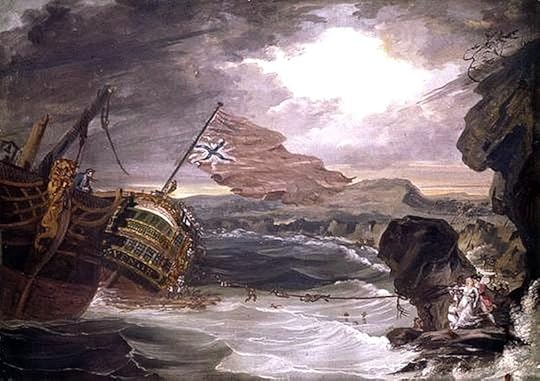
The Grosvenor was one of the finest East Indiamen of her day, but she ran aground on the treacherous coast of south-east Africa. An astonishing number of her crew and passengers, including women and children, reached the shore safely, but the castaways found themselves hundreds of miles from the nearest European outpost - and utterly ignorant of their surroundings and the people among whom they found themselves. Drawing upon much new research, Stephen Taylor pieces together this extraordinary saga, sifting the myths that became attached to The Grosvenor from a reality that is no less gripping. Taking the reader to the heart of what is now the Wild Coast of Pondoland, he reveals the misunderstandings that led to tragedy, tells the story of those who escaped, and unravels the mystery of those who stayed.
A good book about the harrowing tale of the Indiaman Grosvenor which ran aground off the coast of Wild Coast in South Africa. The author starts the story well by giving good background on the region, the people in the story and the voyages of Indiamen at this time. The story of the Grosvenor is really one of where fate was against the ship and it's crew and passengers from the beginning where they were delayed time and again to sail out of season and under the command of someone who was not a great sailor, nor leader. Things started coming apart early on when after only a few days most of the crew abandoned the officers and passengers of the ship in striking out towards salvation on the way to the Cape Colony, which the captain wrongly guessed were closer that the Portuguese colony of Delagoa Bay. Hours after this the captain and the rest of the crew left, went on their way as well and left the women and children to their own devices. What follows is an epic trek by groups and later individuals trying to save themselves where we find bravery mixed with cowardice all the way to the frontier. Only 13 out of the 140 on board survived and they were the strong youths from the crew, and the stories of what they had to endure are the stuff of nightmares.
Where this book loses it's 5th star for me, is towards the end where too much speculation takes place as to the fate of the women passengers and children left behind by the crew when they started their march to salvation. Well written and researched and very recommendable to anyone who likes a good survival story.
It was a ship full of passengers who had paid good money for the greedy captain to take them home from India. The ship was considered one of the strongest of the 18th-century East India Company ships, but the captain was more experienced in fleecing men and women of the majority of their money than in maritime knowledge. Delayed by the anger of Lord McCartney, who didn't appreciate the captain's demanding ways, the ship left late in the season, missing the standard accompaniment of other East Indiamen vessels. Left alone to determine the way home (not the captain's strength), the ship was doomed from the beginning.
The standard path home meant skirting the dangerous coast of southern Africa. The trick was to determine the location and to sail north toward the coast, then west round the Cape and into the south Atlantic. Alas, the captain left one of his supporters in charge one night, who blithely disregarded the warnings of the true seamen, the outcome being the Grosvenor sailing straight into the continent of Africa. The wreck was just off the rocks of the beach, allowing for the majority of the crew and passengers to survive.
The captain was as useless on land as on sea, allowing for his crew to break off into separate groups to make their separate ways to safety. Eventually, the captain also abandoned the women and children, leaving them to the terror of the strange wilderness, baying beasts, and the unfamiliar natives. The tale of the Grosvenor really begins at this point with the telling of the adventures of each group of survivors and their outcomes.
This was a page-turner for me, although most books about shipwrecks usually are. Stephen Taylor focuses on each group, their different paths, and their different results. It was all very fascinating as I tried to imagine the desperation of the formerly pampered passengers. Defenceless women, abandoned children. Treacherous coasts, deathly deserts, warlike tribes. It must have been like landing on the moon.
It is the fate of the survivor to be doubted, perhaps because nobility and self-sacrifice seem inherently less natural in extremity than deceit and selfishness.
The research is very good, leading up to the present day. The Indian Ocean off South Africa has taken many a ship to its grave, full of rogue waves and sudden squalls. The Grosvenor is one of just a handful that made it to land, but the horrors were just as bad.
Eighteenth century travel between India and Britain, going around the Cape of Storms (i.e. the Cape of Good Hope) can be rather hazardous, more so, if the Captain of the ship you are on bought his commission, is better at being a merchant and accountant than any type of leader, and it rather clueless about sailing and navigation in particular. This is the story of one such ship, the Grosvenor, its crew, and its passengers.
What should have been a moderately fast paced story of survival and endurance ended up being something of a long-winded, dense slog, with run-one sentences filled with commas, that would have made Charles Dickens proud. The book is well researched, but really could have used an editor. Taylor starts off with background information, the people involved, voyages at the time, and extra (and to me irrelevant information) about political intrigues and floods of names that had nothing to do with the narrative that followed. The good stuff only starts at around Chapter 5, when the Grosvenor runs aground somewhere off the Wild Coast of South Africa in 1782. Instead of being a tale of ship wreck survivors coming together to make the best of a horrible situation, this is a story of serial abandonment. Taylor follows each group as they make their way down the coast to where they hope they will find salvation at a Dutch settlement (or with any local tribe that will take them, in as the case may be). This sort of narrative structure ended up being very disjointed, especially when it was all repeated in the last portion of the book that discussed belated rescue attempts. At the end, on 13 out of the 140 on board survived to return home - those that were young and strong. A fair portion of the book is given to speculation (sometimes too much) on what happened to the women and children passengers that had been abandoned by the crew.
This is an interesting story that was marred by too much irrelevant information and a long-winded writing style.
The story of the Grosvenor, an English ship that sank off the west coast of Africa in 1782, is fascinating. Most of the officers, passengers, and crew made it to shore, where they decided to walk down the coastline towards a Dutch settlement.
It didn't take long for many of the younger, stronger survivors to leave those less able to fend for themselves behind, including several women and children. As the castaways headed south, they broke into ever smaller groups as they faced natural barriers, hunger, sickness, and native tribes. Less than 20 of the 150 people aboard the ship were ultimately rescued.
This is a detailed, well-researched book full of evocative descriptions. The writing style can feel dense and overdone though, which makes it less accessible than it could be.
It's also full of a lot of extra information. While I appreciated the idea of starting before the Grosvenor left India, the flood of names and political intrigues didn't fit with the narrative that followed. This sense of disjointedness comes up again in the final sections, when the book circles repetitively through the rescue efforts and their aftermath.
Part of the ending is devoted to what might have happened to the women and girls left on the beach and how their loss was viewed by people at the time. The author juxtaposes romanticized tales of male castaways with a society that would prefer a dead Englishwoman to a survivor living among Africans, but he never quite follows that thread all the way.
That might be for the best, because the ending already felt too drawn out, considering that it traces possible descendants of the castaways, goes over both treasure-hunting frauds and the ship's recovery, and then shares some of the author's personal experiences in the area.
There have been many shipwrecks on the coast of southern Africa over the centuries, but only four stick in my mind -the wreck of the Grosvenor on the Pondoland coast in 1782, the Birkenhead just east of Cape Town in 1852, the Dunedin Star on the coast of Namibia in 1942, and the Oceanos in 1991, a little south of where the Grosvenor was wrecked. I learned about the first two at school -- they made it to the history books as being among the most famous shipwrecks on the southern African coast. The wreck of the Birkenhead was famous for establishing the principle of "women and children first", and the wreck of the Oceanos was famous for the abandoning of that principle.
All aboard the Dunedin Star and the Oceanos were rescued. Many of those aboard the Birkenhead died, but their fate was known. But the wreck of the Grosvenor became the stuff of legend, because the fate of the majority of its passengers and crew remains unknown to this day, nearly 240 years later. And that is what Stephen Taylor explores in The Caliban Shore -- what happened to the ship and the people in August 1782. In doing so he reveals some interesting facets of the history of India, southern Africa, and the UK.
The fascination of the story is partly in the mysteries. We quite enjoy watching the TV series Air Crash Investigation, where the interest is in the search to discover what happened and why. It is a puzzle to be solved. Was it a mechanical error or a human error, or an event outside human control, like weather, or a volcanic eruption? If it is a human error, it is sometimes caused by human relations -- what were the relations of the crew members? It can also be poor training and skill. These issues are explored in the TV series in a formulaic way, but in the case of the wreck of the Grosvenor, Stephen Taylor does it much more thoroughly.
We learn something about the economics of India, and especially of the trade between India and the UK, which the British East India Company sought to monopolise, but though it dominated the trade, it did not control it completely. We learn, for example, that of the 740 tons of cargo that the ship could carry, the Captain was entitled to use 58 tons for his own personal trade. The Captain also decided who could be passengers, and how much they should pay.
In addition to the mystery of what led up to the fate of the ship, there is the mystery of missing persons. The fate of the majority of people on board remains unknown. The nearest port where they could hope to get a ship to continue their journey to Britain was Cape Town, 800 miles (1290 km) away, measured by modern roads, but in those days there were no roads for about half the distance. There were young children, pregnant women and sickly old people among the survivors of the wreck, and most of them did not survive the journey, or else gave up.
[author Stephen Taylor] examines all the known remaining records of the event to trace the lives and careers of those who were aboard to ship, to try to piece together what happened to each. Some are known to have died on the journey. Others were abandoned by their fellows in circumstances where they were assumed to have died. The route to Cape Town passed through a war zone; it was the beginning of the 100 Years War between the Xhosas and the Cape Colony, though history usually divides it into nine "Frontier Wars". And the Dutch who controlled the Cape Colony were at war with the British, so British ships did not call there. A few of the survivors managed to get on Danish ships. But some decided to stay put and settle where they were, among the local Pondo people, others may have done so, but it is not certain who they were, or where they settled.
The books explores the history, the legends and the rumours, and tries to establish, as far as possible, what actually happened. So there is history, an investigation into a shipwreck, a survival story, and a search for what happened to missing persons as well.
In 1781 the East Indiaman of 741 tons was sailing the India Ocean off the southern coast of Africa when she encountered a storm and sank. This is the story leading up to the tragedy and of the struggle of the survivors to reach civilization. It gives an insight to conditions in Africa during the Eighteenth Century as well what occurs in a struggle to survive a disaster in a hostile environment. It was easy to read and I found it interesting.
I was immediately impressed by Taylor's recounting of the Grosvenor. He is an excellent writer with a concise style that was never too erudite or long-winded. He sets the story up beautifully depicting 18th century India and the system there, as well as listing the passengers. I'm familiar with a lot of British India, and at this time it was a private enterprise dream under 'John Company....the east India Company. The perils and boredom of ocean travel are recounted, and the shipwreck is sad and almost depressing to tell, since Coxon, the captain, is shown to be a less than stellar captain. The world the castaways wash up on is Pondo land, and are immediately besieged by the natives...not in hostile ways, but the natives are hungry for metal and grab what they can, and Coxom proves an ineffectual commander and is unable to organize the shipwrecked into any kind of defensive or coherent order. Discipline breaks down, and the sailors take off on their own to Capetown, a journey that kills most of them. Taylor gives a very good account of their trek, as well as the natural barriers of South Africa at that time (and in an epilogue, he shows how much of the rugged terrain is still formidable). The real tragedy is how the men abandoned the women and children, and Taylor captures very well the social mores of that era, before Victorian sensibility took over. He recalls stories that some of the surviving women were incorporated into the local tribes. Here, he has to deal with legend more than facts, but Taylor does a good job of trying to present an accurate account of what may have occurred. Certainly, one feels more anger at the 'civilized' powers and leaders who simply ignored the refugees, then the natives, and Taylor also presents a quick sketch of Pondo/Zulu/Xhosa politics and rivalries of then. Good descriptions of many of the individuals in the story are well-drawn. It is a very thorough and approachable book, and I really couldn't put it down.
The Grosvenor was a three masted ship, belonging to the East India Trading Company. The ship went underway in March of 1782, under the command of Captain John Coxon. While underway near the Cape, several crew members reported seeing lights, but dismissed them as a weather phenomenon. A while late, another crew member reported seeing land, but everyone dismissed that as well, believing they were on a different course. The reports were correct, brushfires were indeed burning on land that was in their path. The ship ultimately ran aground, with ninety one of the crew and seventeen of the passengers surviving that incident. I will not spoil the book by going into any details about what happened to the survivors of the shipwreck, though I will say they went through it.
I picked this book up at my favorite local used bookstore a while back for a couple of dollars. I would say that this book was certainly worth the price I paid for it. I had never heard of this particular shipwreck, and just grabbed it because it was in the world disaster section. This tragic tale was told in an informative and respectful way, even though it was hundreds of years ago. I appreciated the descriptions of life aboard ships like this, as well as the definitions of certain things. I like a book that teaches me things, and this one did. It was also just over 200 pages, so it didn't take long to get through at all, which is helpful for meeting my reading challenge.
(This review was written after reading the book in its paperback edition - titled The Caliban Shore)
When the Indiaman, the Grosvenor, ran on to rocks and sank on the east coast of Africa in August 1782 there were more than a hundred survivors. They were officers and men of the ship's crew as well as a range of passengers, men, women and children. At the time of the wreck, the captain had believed his position to be 300 miles out to sea. His next mistake was to try to lead his motley band south towards the nearest Dutch settlement 600 miles away; much nearer refuge was available had he chosen to go north. A series of individual dramas - many of them tragic - ensued.
Stephen Taylor has done a remarkable job in piecing together the various elements and relating them with the control of a natural story-teller. His approach is scrupulously fair. Where facts are sparse or non-existent, he resists fantasising, making speculation perfectly clear for what it is. He resists romanticising, pointing out that of the handful who returned to England none were heroes. There are many surprises, not least those concerning the women who may or may not have been "assimilated" into native tribes, and a conclusion which rounds out the tale satisfactorily without denying the loose ends which will always remain.
I would give this book a clear 5, but for the fact that I think it would have been better for a map charting the journeys the main groups of castaways took from the Grosvenor wreck. That, and a 'cast of characters' especially those who reach some kind of safe haven in the end. There is impressive detail in this account and I salute Stephen Taylor for his exhaustive research and scholarly approach. He cleverly takes the reader from the site of action or struggle, to a chapter of background, and then back again. The suspense is artfully controlled and there is no sensationalism in his tone, although the story becomes a horrific epic. I will never be able to visit the Wild Coast again without imagining the terrors and trials of those Grosvenor passengers. A case in the end of survival of the youngest and fittest males. There is intriguing overlap in this book with the more recent 'Sunburnt Queen' by Hazel Crampton, in which she contends that the little white girl from an earlier wreck who became assimilated as a 'queen' was 'Bessie'. But most of all, for a long time to come I shall be haunted by the mystery of what befell the gentlewoman Lydia Logie and her unborn child. Unthinkable and never to be solved. 4,5
Not the greatest shipwreck book I've read lately. The prose is a bit dry and I'd guess the author is S. African as there were a few Afrikaans terms he used that I had to look up. Still, it's amazing to think about the world back when it was so much larger. There really is no equivalent today unless you look forward to space exploration.
Memorable. Entirely riveting - could not put it down. Huge fan of this sort of lit. Although I read it a couple of years ago I can easily bring to mind vivid details of this incredible true story. Rates up there with "In the Heart of the Sea" by Nathaniel Philbrick for its descriptive, nail-biting account.
This is the saddest book I've read in recent memory, perhaps ever.
I suppose I wasn't prepared for this story. It reminds me of when I read "The Perfect Storm" many years ago (as a young, dumb teen). I assumed it was told by the survivors. I was stunned when the Andrea Gail sank and they all died. WTFudge?
Same here - the book description clearly states that most of the crew and passengers (I believe it was around 90%) survived the shipwreck. I took this to mean that they survived period, not that most of them died horribly.
There's some interesting background about the British East India Company and its internal and external politics. Pretty much, it wouldn't take much to piss off the wrong people and suddenly find yourself desperate to cash out your assets and leave. You'd then have to prepare to get fleeced for home passage, as poor William Hosea did. The inept, nasty John Coxon, captain of the Grosvenor Indiaman ship, charged him twice the already 4x inflated price (so 8x the rate) and then twice that for his luggage, all for a small make-do cabin of canvas walls. Oh, and Mr. Hosea was traveling with his wife (who'd just given birth and had to leave her newborn behind - she wrote a letter to the baby's caretaker saying "Kiss my infant a thousand times for me") - and a 7 year old friends' child. To boot, the ship actually left without the Hoseas and they had to catch up, leaving some luggage behind including their food stores and books. This meant they spent the next 7 months eating the ship's bland food and without a page to read to pass the time. I'd have gone insane.
There were other passengers, including a lawyer named Charles Newman and two "nabobs" who'd survived years of tough journeys and were ready to enjoy the fruits of their labors. Including little Francis Hosea, there were 7 children on board. The crew was comprised of a couple of Coxon's cronies and a number of men ranging from cabin boys to beloved old salts.
Navigation maps were pretty much a crapshoot, and it's thought that Coxon had the ship turn west too soon and quite literally crash into the coast of southern Africa. He of course ignored the desperate pleas of the 3rd mate to turn but didn't take action till too late. Though most survived the crash, within a few days Coxon and his officers abandoned the passengers in their care.
Natives drew the line at murder - with two notable exceptions - but at best just ignored the survivors. They apparently collected scrap metal and watched with mild interest as the survivors desperately tried to reach shore and didn't help. This was part of shipwreck culture the world over, plus locals had good cause to be nervous of Europeans. There were a number of intra-Euro wars in place that devastated locals, plus it was during a mean season in which there was little food. Tribes had to protect their livestock and was little grain stores they had.
The survivors splintered off into groups, with some eventually rejoining. The older passengers and crew were left behind. The two nabobs were murdered, forever scarring survivor William Haberney, a young crew member who tried to save them. An experienced colonel was left to die alone on a hillside. As if that was not heartbreaking enough, perhaps the most gutwrenching story is that of little Robert Law, a passenger who became so attached to a crew member that said member refused to leave without him, carrying the little guy hundreds of miles until he died. The crew member died two days later, presumably because once the child he cared for like a son died, he had no will to live (Charles Dickens was apparently overcome with emotion about this).
Eventually some of the crew were taken in by friendly tribes (some permanently!) and healed enough to proceed to a Dutch settlement, where they had to get jobs on the next ship.
It was just too much. I couldn't turn the pages sometimes because I kept thinking about how William Hosea must have felt as he watched his wife and children in his care suffer. I know times were hard back then and survivors were darned if they did, darned if they didn't. One reason natives were hostile is that the group was large. Only in smaller numbers did anyone try to assist. But, had they all stayed together, they could have potentially survived long enough to recover and eventually send messengers for a rescue party.
The one small glimmer of hope is that some of the children, particularly the female children, and at least one female passenger may have survived and assimilated into a local tribe. There are many tales of explorers meeting Europeans living amongst African tribes who declined offers of "rescue" as they'd married and had children. Some of the tales are touching, such as that of a tribe offering to help a British regiment defend themselves because they were proud of their English grandmother's heritage and wanted to protect her people.
The book's writing is gorgeous and while not as easy read, it's worth the effort. The author is talented. I enjoyed a section he writes where he describes his research into the shipwreck and how dangerously close this story came to never being told - a professor had William's account of the wreck published, which was imperative because the journal was later lost.
If you can get past the tragedy, the small tidbits of human kindness in the worst of times will get you through.
Stephen Taylor's excellent grasp of the English language was a little difficult to wade through. The first part of the book chronicles the Grosvenor's journey from India and subsequent wreck off the southeastern shore of Africa in the 1780's. The sheer number of passengers made it hard to follow as characters are concerned. The second part attempts to piece together what became of the survivors and the third part relies on the first two parts to retell the story through court documents after an investigation was conducted. So by that time you've read it all before. I quickly got bored and didn't finish the last 30 pages.
A really interesting in depth examination into the circumstances of the wreck and the aftermath .... But it took me an age to read as it was so detailed that your mind needs to be clear and fully into taking in the detail, and this isn't the best year for that! A very good piece of non-fiction it could however have been more compelling if some of the lesser characters didn't have such well expounded back histories. The best non-fiction pulls you along as rapidly as fiction does, and this didn't achieve those heights, but would make a cracking piece of fiction with the right author at the helm.
The tale of an East India Company shipwreck on the south east coast of what is now South Africa, Caliban's Shore is a beautifully written history that reads at times like a thriller. The research, though limited by the scant availability of sources, is exhaustive, and Taylor's story telling whips along at a pace one would not expect from such a subject. It seemed at some points that certain characters had been forgotten, but back they came to surprise me and complete a very good account of a fascinating tragedy.
The author obviously did a great deal of research to relate this sad tale of a shipwreck gone terrible wrong. This is not a heroic story, like that of Shackleton and the crew of The Endurance. My only problem with it is that I had a hard time keeping the names straight, who was who, particularly when he got into the names of African people and tribes but that's because I'm so unfamiliar with the languages.
Very thoroughly researched, but the huge cast of characters and the very long timelines - including the background prior to the voyage, during the voyage, during the wreck, the descendants, the subsequent treasure hunt scams etc - lost my interest at times.
Interesting book, quite well written but felt that, like the castaways, it wandered a little towards the end. Took longer than usual to read as I had a break from it whilst on holiday
The heart of “Caliban’s Shore” is interesting, the Grosvenor shipwreck and the survival story of its passengers and crew, but the chapters preceding and following the shipwreck, parts 1 and 3 of the book, become a little tedious. In part one, it is important to show the riches and luxurious lifestyle of the British official “Resident” William Hosea and his family in British colonial India as a dramatic contrast to the desperate situation to which they soon descend after their ship, the Grosvenor, runs aground on the Wild Coast of southern Africa, but his character and his life in India are not compelling enough to keep my attention for 5 chapters.
One of the best chapters of the book is the 1st chapter of Part 3, “African Crusoes,” which describes the survival strategy of two Grosvenor castaways, a British soldier, John Bryan, and a Brit sailor, Joshua Glover, who decide to cast their lots, separately, with different native umzis (Homesteads) of the Pondo, and quickly encounter the friendly nature of the Nguni-speaking tribes in the area and integrate well into tribal life. We get to learn fascinating cultural details, such as, the courting and marriage customs of the Pondo. During a spring fertility ritual, John Bryan starts to court a local virgin woman named Sipho and is instructed in “ukumetsha,” a kind of sexual foreplay described as external intercourse. He helps the village and Sipho’s father, Ntlane, the chief (“inkosi”), by building a rudimentary iron forge and making iron utensils and assegai heads. After a year(?) he offers Sipho’s father “lobola of ten cattle” (201) to marry his daughter. She was bathed in “the contents of a cow’s gall bladder”(201), and they had a wedding feast with the remainder of the animal. Then she was delivered to her husband’s newly built umzi (homestead), where they had 2 children and lived until Sipho was kidnapped by Zulu raiders.
Less is known about Joshua Glover, but he too integrated well into the tribal society. He became a carpenter and carved wooden figures for the children. He was known as a praise-singer for the tribe- like a “griot”. Most of the other castaways from the Grosvenor did not fare as well as Bryan and Glover- especially those who were led by Captain John Coxon, who viewed the local natives as “savages” (162). He and all of his 47 charges perished.
The rest of the chapters in part three are about the quests to find any survivors of the Grosvenor shipwreck focusing on the female and child castaways. The British press and public were far more interested in the female castaways in the clutches of “savage brutes” than they were in the male castaways. The official Dutch rescue team commanded by Jan Holthausen finally reached Lambesi, the site of the wreck, on November 15, 1790 – 8 years, 3 months after the Grosvenor ran aground. In Jacob van Reenen’s official report he writes, “their mission to discover whether any of the English women of the ship were still alive had resulted in failure: We found no one there, and one can rest assured that nobody from that ship is still alive.” (223)
The rest of the chapters of part three describe the many sightings over the years of white women and light-skinned peoples on the Wild Coast of South Africa and all of the circumstantial evidence of white castaways living in the wild among local tribes. Some of it is interesting and possible, but it is all speculative and becomes a little tedious. The last chapter details what happened to the 13 known survivors (out of 140 on board the Grosvenor) after their return to London or other places, which was a prosaic and anti-climatic end to the book.
Overall the book is interesting and very well researched and documented. The middle of the book, that takes place in Africa, grabs my attention- the dynamics of the white passengers and crew members interacting with each other in their struggle to survive in this dire situation and the suspense that creates. I also enjoyed the cultural information about the African tribes of the Pondo, the Zulu and the Xhosa.
The Caliban Shore accompanies the survivors of the East India Company’s schooner, Grosvenor, after she was wrecked on the south-east African coast in August 1782.
The story starts in India as passengers and crew make preparations to leave the country and return to England – some having made their fortunes, some under a cloud, and others in an unseemly hurry. We follow the trail of events that lead to the Grosvenor sticking the rocks at on the shores of the Wild Coast, and the miraculous escape of 123 passengers and crew (out of 150), including women (one heavily pregnant) and children, the youngest only a toddler. After a few days taking stock, most of the men abandon the women and (all but one of the) children to their fate, and head for what they wrongly believe to be the nearest European settlement, nearly 400 miles south. Constantly splitting, re-grouping, and splitting again, they struggle against exposure, malnutrition, and disease, not to mention the intrusively curious (and sometimes aggressive) locals. Three months later, the first survivors reach safety, but even after two rescue missions, only eighteen survivors made it home. This might seem like proof of Darwin’s survival of the fittest, but over subsequent decades reports began trickling out of the north: a whole tribe – hundreds strong – descended from a castaway Englishwoman.
Written with wonderful attention to detail, and obviously supported by thorough research, in The Caliban Shore, Stephen Taylor has produced a gripping story, and one I found hard to put down.
Pondoland and colonialists. POSTED BY ME AT AMAZON 2008 This is a very engrossing story, and I did not have much of a problem reading additional information (not directly related to the tragedy of castaways) about the careers of those who came to grief in Pondoland in 1782, the society in England and Bengal/Calcutta from which they were drawn, and the culture of local Africa's clans with which they interacted and came into conflict. History of the first Dutch settlement in Cape Town area is also interesting, shedding some light on early beginning of South Africa country. Positively, this historical book is in the same league as "Skeletons of the Zahara" and "Wreck of the Medusa". How different were dwellers of the East Coast from the mean tribes in the West Coast of Africa where slavery was not unknown even before arrival of English slave ships! Author points out several times about general hardship of the seamen in this Nelson's era, when they preferred to be forced/enlisted on Indiaman or slave ship instead of being drafted by British Navy. Very good read and not because of the bargain price.
I loved this book! Taylor writes fluidly and his detail is what grabbed me from the start. Obviously he researched his subject well, not only the lives of those who were shipwrecked which he follows from start to finish, but also, more generally, the details of sailing at the time: the East Indiaman ship itself, and the routes which sailors had to follow in rounding the Cape from India, the difficulties in establishing longitude in those days, the dangers in the winds and seasons. I gained far more than the story of the Grosvenor castaways. Instead the book extended my knowledge of what was required to sail in those days. How hard it was to get crew, how many died (horrifying), how many different nationalities among the crew members and so on. Fascinating. Then the story of the survival trek. A gripping read.
As tragic a ship wreck is hat's off to Stephen Taylor in making Grosvenor and it's crew and passengers come to life. This is not a fluid read, somewhat confusing at times compared to other readings on shipwrecks. India to Africa to Great Britan was the background just at times overwhelmed with too many characters in a story line that lacked transgression and fluidly to keep a readers interest at heart.
Had the potential to be interesting, but never quite delivers. Whilst I appreciate the researches were not able to establish all the details of the events, the writing was a bit dry. I must admit that I skip read the second half.
A thoroughly researched and very well-written account of what happened to a group of castaways after their ship was wrecked off the coast of South Africa in 1782.
I have read a lot of shipwreck stories and this is not one of my favorites; perhaps because there were so many characters and concurrent stories it became more of a chore to read.