

What do you think?

X-Men (1991-2001) #14-16
X-Men: X-Cutioner's Song
An assassination attempt on Professor X by Cable sets in motion the events of this 12-part story involving the two X-Men teams, the government-sponsored X-Factor, and the paramilitary X-Force--formerly the New Mutants--against Stryfe, Apocalypse, and Mr. Sinister.
Includes Uncanny X-Men #294-296, X-Factor #84-86, X-Force #16-18, and X-Men #14-16
Includes Uncanny X-Men #294-296, X-Factor #84-86, X-Force #16-18, and X-Men #14-16
280 pages, Paperback
First published April 1, 1994
About the author
Scott Lobdell
1,647 books235 followersScott Lobdell (born 1960) is an American comic book writer.
He is mostly known for his work throughout the 1990s on Marvel Comics' X-Men-related titles specifically Uncanny X-Men, the main title itself, and the spin-off series that he conceived with artist Chris Bachalo, Generation X. Generation X focused on a number of young mutant students who attempted to become superheroes in their own right at a separate school with the guidance of veteran X-related characters Banshee and Emma Frost. He also had writing stints on Marvel's Fantastic Four, Alpha Flight, and The Adventures of Cyclops and Phoenix mini-series with artist Gene Ha. He wrote the script to Stan Lee's Mosaic and an upcoming film from POW Entertainment featuring Ringo Starr. He also participated in the Marvel Comics and Image Comics (from Jim Lee's WildStorm) crossover mini-series WildC.A.T.s/X-Men.
He is mostly known for his work throughout the 1990s on Marvel Comics' X-Men-related titles specifically Uncanny X-Men, the main title itself, and the spin-off series that he conceived with artist Chris Bachalo, Generation X. Generation X focused on a number of young mutant students who attempted to become superheroes in their own right at a separate school with the guidance of veteran X-related characters Banshee and Emma Frost. He also had writing stints on Marvel's Fantastic Four, Alpha Flight, and The Adventures of Cyclops and Phoenix mini-series with artist Gene Ha. He wrote the script to Stan Lee's Mosaic and an upcoming film from POW Entertainment featuring Ringo Starr. He also participated in the Marvel Comics and Image Comics (from Jim Lee's WildStorm) crossover mini-series WildC.A.T.s/X-Men.
Ratings & Reviews
Friends & Following
Create a free account to discover what your friends think of this book!
Community Reviews
Displaying 1 - 30 of 57 reviews

January 5, 2017
Adventures in ye olde tyme comix continues.
Three and a half stars rounded down.

Ooh, Jeff! Where are we going now?
To 1992, Goodreader and it’s an X-Men crossover hullabaloo.
Which X-Men are in this one?
All of them. It’s a veritable clown car event.

It makes you feel downright giddy at the thought, no?
The core X-titles at the time are involved: The Uncanny X-Men, X-Men, X-Factor and X-Force.
The basic story is this: During a Lila Cheney concert in Central Park, while creepy Gambit tries to put the moves on Storm, Charles Xavier gives a nice little speech about peace, brotherhood, acceptance and unicorns. He’s roundly jeered by non-mutants proving the old adage: Humanity sucks!
He’s also allegedly shot by Cable(!?!), who’s allegedly supposed to be a good guy.
Jinkies!

At virtually the same moment (i.e. a page turn away), Scott Summers (Cyclops) and Jean Grey are kidnapped by some of Apocalypse’s rogue Horsemen. As Xavier lies at death’s door for the fifty-third time, the X-Men and X-Factor (mutants who work for The Man) hunt down the rogue X-Force (formerly The New Mutants), who are led by Cable and greases the way for some hero-on-hero action.

And of course things aren’t what they seem.
They never are.
Why you should read this?
- A lot of crap was published by Marvel in the ‘90’s, and the X-titles were not immune, but this crossover is fairly coherent, focused and briskly paced and due to some of the writers involved (David and Nicieza) leavened with a decent amount of humor. It also avoids the plethora of unrelated subplots that Chris Claremont and other X-writers liked to invest in these titles.
- The villains: Stryfe, leader of the Mutant Liberation Front, is Cable’s clone (before that concept lost most of its luster in the Spider-Man Clone Saga).
Okay, all of its luster.
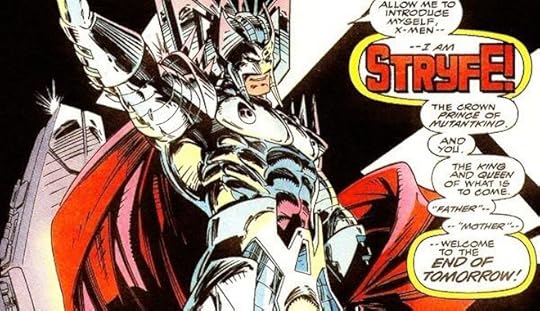
It turns out he’s behind abducting Jean Grey and Cyclops. His motivation: a little quality time with Mom and Dad.
Mom and Dad?
It’s a long, long story, bub.
So, get set for some hero-on-clone action.
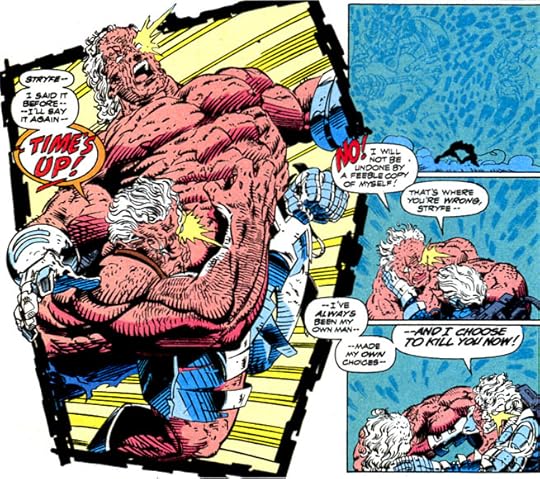
Mr. Sinister, Apocalypse (Cyclops: “Apocalypse? How can that be? I watched him die.” Sucker!) and an army of mooks round out the bad guys.

Why you should avoid this?
- The Art. Did I mention this is the ‘90’s? A lot of the worst elements of comic book art are front and center. Anatomically impossible women (and men). Panels that make the action particularly hard to follow – Is that a battle? Louis Pasteur? Jubilee baking cookies? Dark, brooding art work that grinds the pacing to a halt as the reader struggles to figure out what’s happening. Jae Lee.
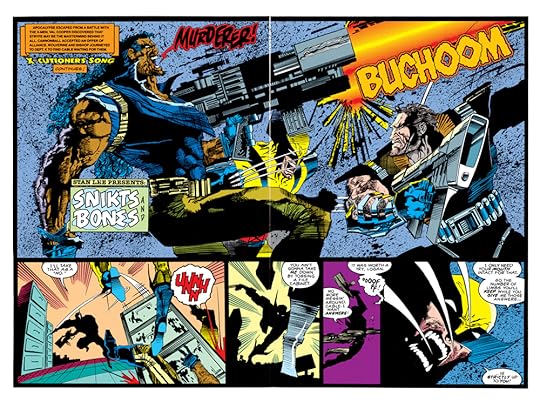
- The Cyclops/Jean Grey relationship, for me, ranks down near the bottom of the superhero couples list. It wasn’t until Wolverine made this a menage a tois, that anything resembling an iota of interest was garnered.
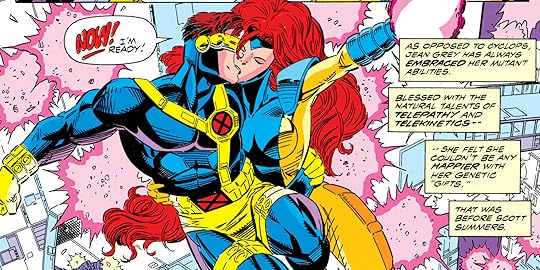
They get married. Eventually. *yawn*
Beyond the occasional “I know what you’re thinking” I get from Mrs. Jeff, having a girlfriend/wife who could read minds, would kind of put a damper on things.
- Clones. clones. CLONES. Nuff Said.
What’s the takeaway? In order to avoid future strife, hug the clone of your kids; otherwise, they’ll grow up to become villains with an army of henchman and kidnap you just to monologue you with obtuse sentiments about missed teddy bears and toy trains and cookies.
And hugs.
Bottom Line: In spite of my caveats, this was a decent read. Anyone who has an interest in the X-Men should definitely check out one of their better storylines from the not-too-distant past.
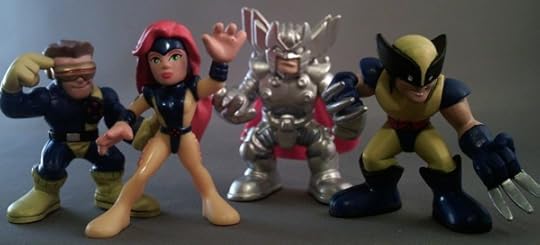
Something reasonably cute for the Trish:
Three and a half stars rounded down.
Ooh, Jeff! Where are we going now?
To 1992, Goodreader and it’s an X-Men crossover hullabaloo.
Which X-Men are in this one?
All of them. It’s a veritable clown car event.
It makes you feel downright giddy at the thought, no?
The core X-titles at the time are involved: The Uncanny X-Men, X-Men, X-Factor and X-Force.
The basic story is this: During a Lila Cheney concert in Central Park, while creepy Gambit tries to put the moves on Storm, Charles Xavier gives a nice little speech about peace, brotherhood, acceptance and unicorns. He’s roundly jeered by non-mutants proving the old adage: Humanity sucks!
He’s also allegedly shot by Cable(!?!), who’s allegedly supposed to be a good guy.
Jinkies!
At virtually the same moment (i.e. a page turn away), Scott Summers (Cyclops) and Jean Grey are kidnapped by some of Apocalypse’s rogue Horsemen. As Xavier lies at death’s door for the fifty-third time, the X-Men and X-Factor (mutants who work for The Man) hunt down the rogue X-Force (formerly The New Mutants), who are led by Cable and greases the way for some hero-on-hero action.
And of course things aren’t what they seem.
They never are.
Why you should read this?
- A lot of crap was published by Marvel in the ‘90’s, and the X-titles were not immune, but this crossover is fairly coherent, focused and briskly paced and due to some of the writers involved (David and Nicieza) leavened with a decent amount of humor. It also avoids the plethora of unrelated subplots that Chris Claremont and other X-writers liked to invest in these titles.
- The villains: Stryfe, leader of the Mutant Liberation Front, is Cable’s clone (before that concept lost most of its luster in the Spider-Man Clone Saga).
Okay, all of its luster.
It turns out he’s behind abducting Jean Grey and Cyclops. His motivation: a little quality time with Mom and Dad.
Mom and Dad?
It’s a long, long story, bub.
So, get set for some hero-on-clone action.
Mr. Sinister, Apocalypse (Cyclops: “Apocalypse? How can that be? I watched him die.” Sucker!) and an army of mooks round out the bad guys.
Why you should avoid this?
- The Art. Did I mention this is the ‘90’s? A lot of the worst elements of comic book art are front and center. Anatomically impossible women (and men). Panels that make the action particularly hard to follow – Is that a battle? Louis Pasteur? Jubilee baking cookies? Dark, brooding art work that grinds the pacing to a halt as the reader struggles to figure out what’s happening. Jae Lee.
- The Cyclops/Jean Grey relationship, for me, ranks down near the bottom of the superhero couples list. It wasn’t until Wolverine made this a menage a tois, that anything resembling an iota of interest was garnered.
They get married. Eventually. *yawn*
Beyond the occasional “I know what you’re thinking” I get from Mrs. Jeff, having a girlfriend/wife who could read minds, would kind of put a damper on things.
- Clones. clones. CLONES. Nuff Said.
What’s the takeaway? In order to avoid future strife, hug the clone of your kids; otherwise, they’ll grow up to become villains with an army of henchman and kidnap you just to monologue you with obtuse sentiments about missed teddy bears and toy trains and cookies.
And hugs.
Bottom Line: In spite of my caveats, this was a decent read. Anyone who has an interest in the X-Men should definitely check out one of their better storylines from the not-too-distant past.
Something reasonably cute for the Trish:

January 28, 2008
In 1992, the biggest Marvel artists—primarily from X-Men—went on to form the creator-owned company that was Image Comics.
Only a year after rebooting the franchise, they just abruptly left. Jim Lee, Rob Liefeld, Whilice Portacio, Marc Silvestri, and more. Many of their storylines were still unconcluded, without much closure.
(It’s also worth noting, though these creators did have a point about labor rights and economic exploitation, they didn’t take any writers with them on this exodus. Those early Image comics were not really… good.)
So it was that replacements were needed, and I’d argue that the X-Men line actually improved from hereon. Andy Kubert started rough but soon became the best artist there for many years since, with a stylized approach that was superior to Jim Lee in my humble opinion. Greg Capullo was far better than Liefeld in X-Force as well, obviously.
And it was at this time that begot the first big crossover of the era: The X-Cutioner’s Song. It had its flaws, but in many ways this was when the new post-Chris Claremont status quo really started to work. Written by Fabien Nicieza trying to be more ‘edgy’, and Scott Lodbell over in Uncanny trying to imitate Claremont’s heart, the great Peter David was in there too.
So, Professor X had been shot by Cable! This was the inciting incident that led X-Factor to team up with all the X-Men to take down X-Force. There was a lot happening, with Mr. Sinister looming in the background as arch-villain Apocalypse was resurrected and returned to the scene. Revelations about Cable’s origins as Cyclops and Jean Grey’s (clone) child were finally uncovered, and somehow they made Liefeld’s terrible supervillain Stryfe a compelling antagonist.
There was still work to be done to make all this coherent. But the writers and editors were getting better at taking all those elements of a bloated continuity, those too many cooks who ran out without even finishing, and making an interconnected universe that was fun to read. And it was satisfying to find all the issues and read in order, why I remember a neighbor kid in the suburbs who had collected the whole thing.
It was a pretty good start, probably overblown by the end, which is as good a representation of 90s X-Men comics as any. Definitely essential reading. I recommend get the graphic novel, don’t worry too much about the backstory, and just enjoy the ride for what it is. The next two or three crossover events will only get better.
Only a year after rebooting the franchise, they just abruptly left. Jim Lee, Rob Liefeld, Whilice Portacio, Marc Silvestri, and more. Many of their storylines were still unconcluded, without much closure.
(It’s also worth noting, though these creators did have a point about labor rights and economic exploitation, they didn’t take any writers with them on this exodus. Those early Image comics were not really… good.)
So it was that replacements were needed, and I’d argue that the X-Men line actually improved from hereon. Andy Kubert started rough but soon became the best artist there for many years since, with a stylized approach that was superior to Jim Lee in my humble opinion. Greg Capullo was far better than Liefeld in X-Force as well, obviously.
And it was at this time that begot the first big crossover of the era: The X-Cutioner’s Song. It had its flaws, but in many ways this was when the new post-Chris Claremont status quo really started to work. Written by Fabien Nicieza trying to be more ‘edgy’, and Scott Lodbell over in Uncanny trying to imitate Claremont’s heart, the great Peter David was in there too.
So, Professor X had been shot by Cable! This was the inciting incident that led X-Factor to team up with all the X-Men to take down X-Force. There was a lot happening, with Mr. Sinister looming in the background as arch-villain Apocalypse was resurrected and returned to the scene. Revelations about Cable’s origins as Cyclops and Jean Grey’s (clone) child were finally uncovered, and somehow they made Liefeld’s terrible supervillain Stryfe a compelling antagonist.
There was still work to be done to make all this coherent. But the writers and editors were getting better at taking all those elements of a bloated continuity, those too many cooks who ran out without even finishing, and making an interconnected universe that was fun to read. And it was satisfying to find all the issues and read in order, why I remember a neighbor kid in the suburbs who had collected the whole thing.
It was a pretty good start, probably overblown by the end, which is as good a representation of 90s X-Men comics as any. Definitely essential reading. I recommend get the graphic novel, don’t worry too much about the backstory, and just enjoy the ride for what it is. The next two or three crossover events will only get better.

August 15, 2015
Every story has a story and this comic is no different. When I was a kid there wasn't a comic book store nearby so I only got comics at the mall about 30 minutes away when my family would occasionally head to the mall. So as a kid I got one issue of this massive crossover event and of course it wasn't the first one so I had nearly no clue what was happening, but it had Wolverine, Cable, and Bishop in it so I was happy overall. Jump forward to my early 20's and I'm in a bookstore and see the collected works of the X- Cutioner's Song. Although I hadn't read a comic in nearly a decade, little kid me insists I have to get it so I did and I must say I was happy I did.
So the X-Cutioner's Song revolves around an assassination attempt on Professor X from what appears to be the most unlikely of individuals Cable. Cable's team X-Force is hunted down for information on Cable and X-Factor assists as well. The problem is it wasn't Cable who did it, well not exactly.
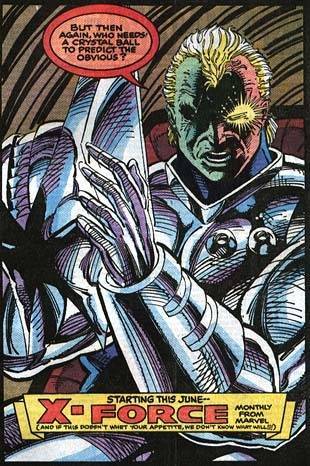
It was in fact Stryfe a clone of Cable (there is a long elaborate back story) who happens to be confused.
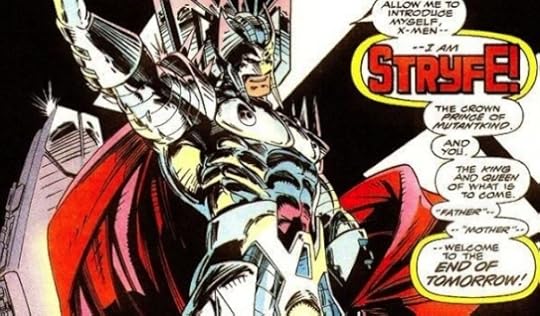
He believes he's the real deal and Cable is his clone. The consequences of his confusion lead to dire circumstances that pull three X-titles, Apocalypse, Mr. Sinister, The Dark Riders, and the Four Horsemen in as well.
I know not everyone loves crossover events, but for those who like them X-Cutioner's song is not one to be missed.
So the X-Cutioner's Song revolves around an assassination attempt on Professor X from what appears to be the most unlikely of individuals Cable. Cable's team X-Force is hunted down for information on Cable and X-Factor assists as well. The problem is it wasn't Cable who did it, well not exactly.
It was in fact Stryfe a clone of Cable (there is a long elaborate back story) who happens to be confused.
He believes he's the real deal and Cable is his clone. The consequences of his confusion lead to dire circumstances that pull three X-titles, Apocalypse, Mr. Sinister, The Dark Riders, and the Four Horsemen in as well.
I know not everyone loves crossover events, but for those who like them X-Cutioner's song is not one to be missed.

August 12, 2019
A bit too long and drawn out; this would have been fine at about half of its length. Oddly enough, my favorite part was the epilogue, where we get some sweet moments between some of the X-Men.
January 31, 2020
Wow i thought it might get to 4 stars in the end but it screwed up so badly and gives so little closure that it dropped to 2 instead.
Mostly its fine, some of the ideas are quite good but not implemented very well.
The context of the event is far more problematic than the work itself. One of the major characters is Stryfe, a villian only in the X-Force comics who therefore means nothing to 3/4's of the heroes. In fact even in those X-Force comics he was largely forgotten about by this point as the writer only has one story trick they use which is the mystey villian.
So you had Stryfe, the government agents hunting cable, the guy who deadpool works for and the X-ternals, all of which are relying on mystery to make them compelling. I thought finally we would get answers to one of these plot lines in this crossver but no.
Also minor problem, jean and cyclops are all lovei-dovei in this throwing aside the intresting rift in their relationship being caused by cyclops having the hots for psylocke.
Anyway... on its own its decent enough except for the completely empty conclusion.
Mostly its fine, some of the ideas are quite good but not implemented very well.
The context of the event is far more problematic than the work itself. One of the major characters is Stryfe, a villian only in the X-Force comics who therefore means nothing to 3/4's of the heroes. In fact even in those X-Force comics he was largely forgotten about by this point as the writer only has one story trick they use which is the mystey villian.
So you had Stryfe, the government agents hunting cable, the guy who deadpool works for and the X-ternals, all of which are relying on mystery to make them compelling. I thought finally we would get answers to one of these plot lines in this crossver but no.
Also minor problem, jean and cyclops are all lovei-dovei in this throwing aside the intresting rift in their relationship being caused by cyclops having the hots for psylocke.
Anyway... on its own its decent enough except for the completely empty conclusion.

April 30, 2018
Μου λέγανε ότι το X-Cutioner's Song είναι καλό, και εγώ απαντούσα "μα είναι crossover των X-Men".
Βέβαια, σε αντίθεση με τα προηγούμενα, αυτό έχει μία ομάδα ικανών συγγραφέων και ταλαντούχους σχεδιαστές στις αρχές της καριέρας τους (άρα όχι ντίβες) και καταφέρνει να δέσει πολλά storylines, να παραμείνει εντός της πλοκής και, παρά τα όποια χαζά, πχ στα όσα κάνει ο κακός της ιστορίας, να είναι ένα πολύ ικανοποιητικό και χορταστικό crossover, ισορροπώντας δράση, πλοκή και εξέλιξη χαρακτήρων.
Βέβαια, σε αντίθεση με τα προηγούμενα, αυτό έχει μία ομάδα ικανών συγγραφέων και ταλαντούχους σχεδιαστές στις αρχές της καριέρας τους (άρα όχι ντίβες) και καταφέρνει να δέσει πολλά storylines, να παραμείνει εντός της πλοκής και, παρά τα όποια χαζά, πχ στα όσα κάνει ο κακός της ιστορίας, να είναι ένα πολύ ικανοποιητικό και χορταστικό crossover, ισορροπώντας δράση, πλοκή και εξέλιξη χαρακτήρων.
October 31, 2024
Rereading back catalog of xmen TPB. This arc not as good as I remember it. Cable is a product of his time, the 90s. Story is confusing and disjointed. Must have been convinced in my youth that this was heavy stuff. It isn't. But the end with Jubilee and Prof X is pretty great.

August 22, 2018
Scott Lobdell, Peter David, and Fabian Nicieza run head this massive crossover that is the height of early 90s X-madness: Jae Lee and Kubrick stand out as artists here. There is a background to shift and some of the awkwardness: Jim Lee and Rob Liefeld had increasingly driven sells at Marvel, and had taken over increasingly plot direction from the X-team writers. However, Image is founded and these artistic-creators leave Marvel for even more editorial freedom. So, with the exception of Peter David's run on X-Factor, writers had previously been marginalized, which led ultimately to Claremont and other X-team classic writers leaving the line after a decade in some cases. Here, in this crossover, while the house style of X-men, with the exception of Jae Lee's work on X-factor, had been unquestionably altered by Jim Lee's art and the some of Lobdell and Nicieza still feel like they are mimicking the purple narrative prose of Claremont, it is a return to more classic writing.
Now this was is a nostalgia read for me: it was better than I was expecting given how much this seen as the height of 90s crossover excess, but it was also not as good as I remembered. Yes, it is unwilling, you have four X-teams and tons of characters to keep up with. Sometimes heroic teams are fighting each other, other times villain teams are realigning, and even villains aid the main hero. The Summer's family nonsense and the five or six alternate time-lines intersecting with multiple X-men characters from completely different time lines poised over stopping the death of Professor X.
Originally, Stryfe's files were included as trading cards in the sealed bags, and that is how I got this as young teen in 1992, and the info from these cards is included in this trade at the end. It's enjoyable, bloated, convoluted, and probably more relevant to those who remember the early 90s instead of those whose X-men was written by either Claremont (earlier) or Wheedon and Morrison later.
Now this was is a nostalgia read for me: it was better than I was expecting given how much this seen as the height of 90s crossover excess, but it was also not as good as I remembered. Yes, it is unwilling, you have four X-teams and tons of characters to keep up with. Sometimes heroic teams are fighting each other, other times villain teams are realigning, and even villains aid the main hero. The Summer's family nonsense and the five or six alternate time-lines intersecting with multiple X-men characters from completely different time lines poised over stopping the death of Professor X.
Originally, Stryfe's files were included as trading cards in the sealed bags, and that is how I got this as young teen in 1992, and the info from these cards is included in this trade at the end. It's enjoyable, bloated, convoluted, and probably more relevant to those who remember the early 90s instead of those whose X-men was written by either Claremont (earlier) or Wheedon and Morrison later.

June 1, 2015
This 12 part arc took place in the early 90's. X-Force has recently been established out of New Mutants, Scott and Jean were soon to be married, Wolverine still had his adamantium... ahhh the comic days of my youth...
The story revolves around Cable being framed for the murder of Professor X, which turns out to not be a murder, but an infection of the techno-organic virus, AND it not being Cable who did it, but a clone from the future turned evil, calling himself Stryfe. Secondary stories involve a battle between X-Men, X-Factor, and X-Force when searching for Cable, and an arc with Apocalypse, which is still very early in his development as a character.
Overall, this story is a little drawn out, but that is common for all comic stories of that era, but the nostalgia of reading something I haven't since I was a kid, eventually got me through it. I'm trying to fill the gaps in my knowledge of major X-Men storylines, and this was next. Excited about the next story: Fatal Attractions. Good memories of that one.
This story, recommend, but only if you enjoy early 90's X-Men tales.
The story revolves around Cable being framed for the murder of Professor X, which turns out to not be a murder, but an infection of the techno-organic virus, AND it not being Cable who did it, but a clone from the future turned evil, calling himself Stryfe. Secondary stories involve a battle between X-Men, X-Factor, and X-Force when searching for Cable, and an arc with Apocalypse, which is still very early in his development as a character.
Overall, this story is a little drawn out, but that is common for all comic stories of that era, but the nostalgia of reading something I haven't since I was a kid, eventually got me through it. I'm trying to fill the gaps in my knowledge of major X-Men storylines, and this was next. Excited about the next story: Fatal Attractions. Good memories of that one.
This story, recommend, but only if you enjoy early 90's X-Men tales.

February 9, 2023
Uno de los crossover mutantes que más me ha gustado. A menudo se dice que la época de los 90 fue floja pero es que veniamos de unos años brutales para la patrulla. Este cómic junta a la patrulla con cable y Fuerza x y soy muy fan de este grupo así que es normal que me encante. Mucha acción y el tono bestia que le dio Liefeld a Fuerza X también estan aquí presentes. Me ha divertido más incluso que la caida de los mutantes que se me acabo haciendo largo.

July 15, 2014
I’m not a fan of crossovers. At the core, what is a giant comics crossover other than simply an attempt to get you to buy more comic books? If done right, I suppose, a crossover might also be a chance to bring different characters together and spin a story that spans a couple universes or intertwines a few storylines, but honestly—I don’t think I’ve ever seen a crossover done well. (The Great Fables Crossover was certainly a disappointment, and I’m viewing Dark Cybertron as an unwelcome interruption in my favorite regularly-scheduled comic book.)
There’s so much that can go wrong. Crossovers often have the feeling of being written by a committee and then being put together on the page by a subcommittee, or an entire handful of subcommittees. And this is often I imagine exactly how it’s done. Because each comic title has its own writers and artists, usually with their own vision for the feel of the series and where the stories are going, the pacing and how they’re developed, and oftentimes slamming them together ends up just feeling like a train wreck. Now imagine trying to do that with something as huge and unwieldy as the various X-People Marvel lines, in their early-90s heyday. That’s pretty much exactly what you get with X-Cutioner’s Song.
There’s one reason I bought this volume: nostalgia. I picked it up at a Marvel-themed gift-shop at Universal Studios as a teenager because as a kid I had been on the ground-floor of the launch of Marvel’s second X-Men title. I think I still have issue #1 of that “mutant milestone” floating around somewhere. As a young reader though, I was the primary target of this, the first major crossover involving the title, which was engineered solely to get a kids like me to shell out money for not just the normal X-Men comics but also the Uncanny X-Men, X-Factor, and X-Force. (They were doing the same thing with Spider-Man titles at the same time, calling it Maximum Carnage, and I remember a few of my friends scrambling to piece together the story through Amazing Spider-Man, Web of Spider-Men, and whatever other Spider-titles were running then.) Of course I couldn’t do this, and so there were always holes in the narrative. I wondered what had happened to my characters during their appearances in the other issues. And I had lost many of the issues I had managed to collect anyway, so I bought the volume.
I re-read it again this summer for the same reason: nostalgia. That’s really the only reason there is to pick up this particular collection. The train wreck analogy actually works quite well here. In fact, I think I may have stumbled onto the solution for the X-Men’s faltering transition to the big screen: get Michael Bay to make this into a movie. Everything is ready for him: the thin veneer of plot involving Cyclops and Jean Grey getting kidnapped, Xavier being nearly assassinated, no one knowing what's going on, and a confrontation between Cable and his clone Stryfe. Pieces of information are dangled but never really resolved. (We learn pretty much nothing about the origins of Cable and Stryfe, though they dance around it the entire book.) The lurching narrative is liberally interspersed with wild melees in which X-Factor fights X-Force, X-Men fight X-Force, X-everyone fights various villains, and Cable and Stryfe fight each other. Apocalypse and Mr. Sinister make random, fairly inexplicable appearances and disappearances. Women (and men!) wear spandex. Cable, Wolverine, and Bishop hang out on a space station. Listing all these things actually makes it sound like more fun than it was.
I think part of the problem with the various X-Men titles is that there’s just so much backstory that at some point it gets nearly impossible to keep track of it all. I looked up the entries for Cable and Cyclops on Wikipedia after reading this, for example, to see if I could answer the questions that this volume did not. It was dizzying. There’s something very compelling to such a Byzantine history, but it also makes it largely inaccessible. It also makes something like X-Cutioner’s Song incredibly unsatisfying as a stand-alone piece. (Though at the end of the day, this is what comic book companies want, right? Because otherwise you might not buy the next issue.) This volume was especially maddening as it didn’t even tie up the crossover pieces that it developed. The story “began,” for instance, with the X-Force on the run because X-everyone-else though that the X-Force leader, Cable, had assassinated Xavier. X-Force, which consists of the younger, next generation of mutants, go head to head with some of their former mentors and trainers. This wrinkle was actually kind of compelling. There was also some good tension as the X-Force de facto leader, Cannonball, accompanied the X-Men to carry out missions while the rest of his team languished in captivity.
But you know what? The volume ended with absolutely no resolution on this score at all. Some of the heroes end up on the Moon to witness the final Cable/Stryfe confrontation, and then that’s it. We don’t even get a hint or an afterword or something explaining what happens to the kids in X-Force (or why Cable had abandoned them in the first place or what happens to them after he disappears). There’s a distinct impression that the compilers simply did not care enough to tell us. Another indication of this lack of care: a table of contents to help keep all the different issues in this volume straight and then the omission of page numbers from any page in the volume.
If there’s a bright spot in this volume (besides the nostalgia for trading comic books on the playground and creating our own X-characters during recess), it’s the art in the X-Factor issues. I don’t know who was drawing those issues and I don’t care enough to wade through all the names to find out, but it’s a marked departure from the generic (though not bad) comic book art throughout the rest of the book. I remember that as a kid though it drove me nuts. It was almost too noir, definitely not as realistic as the artwork in the other X-titles (using the term realistic, of course, very loosely). Looking back though, it seems the freshest and most original part of the book.
I wonder what happened to those characters after this chapter was complete. Because on the one hand that’s the appeal of long-running comic titles like these: you know the stories keep going on and on and on. On the other hand though, that’s the problem: the stories go on, but the characters never change, not really. Wolverine will always be the exact same person. Apocalypse will always come back. We’ll go through the same variations of the same stories over and over again, but—since (in some respects) I’m no longer twelve—I find I don’t have the patience to play.
There’s so much that can go wrong. Crossovers often have the feeling of being written by a committee and then being put together on the page by a subcommittee, or an entire handful of subcommittees. And this is often I imagine exactly how it’s done. Because each comic title has its own writers and artists, usually with their own vision for the feel of the series and where the stories are going, the pacing and how they’re developed, and oftentimes slamming them together ends up just feeling like a train wreck. Now imagine trying to do that with something as huge and unwieldy as the various X-People Marvel lines, in their early-90s heyday. That’s pretty much exactly what you get with X-Cutioner’s Song.
There’s one reason I bought this volume: nostalgia. I picked it up at a Marvel-themed gift-shop at Universal Studios as a teenager because as a kid I had been on the ground-floor of the launch of Marvel’s second X-Men title. I think I still have issue #1 of that “mutant milestone” floating around somewhere. As a young reader though, I was the primary target of this, the first major crossover involving the title, which was engineered solely to get a kids like me to shell out money for not just the normal X-Men comics but also the Uncanny X-Men, X-Factor, and X-Force. (They were doing the same thing with Spider-Man titles at the same time, calling it Maximum Carnage, and I remember a few of my friends scrambling to piece together the story through Amazing Spider-Man, Web of Spider-Men, and whatever other Spider-titles were running then.) Of course I couldn’t do this, and so there were always holes in the narrative. I wondered what had happened to my characters during their appearances in the other issues. And I had lost many of the issues I had managed to collect anyway, so I bought the volume.
I re-read it again this summer for the same reason: nostalgia. That’s really the only reason there is to pick up this particular collection. The train wreck analogy actually works quite well here. In fact, I think I may have stumbled onto the solution for the X-Men’s faltering transition to the big screen: get Michael Bay to make this into a movie. Everything is ready for him: the thin veneer of plot involving Cyclops and Jean Grey getting kidnapped, Xavier being nearly assassinated, no one knowing what's going on, and a confrontation between Cable and his clone Stryfe. Pieces of information are dangled but never really resolved. (We learn pretty much nothing about the origins of Cable and Stryfe, though they dance around it the entire book.) The lurching narrative is liberally interspersed with wild melees in which X-Factor fights X-Force, X-Men fight X-Force, X-everyone fights various villains, and Cable and Stryfe fight each other. Apocalypse and Mr. Sinister make random, fairly inexplicable appearances and disappearances. Women (and men!) wear spandex. Cable, Wolverine, and Bishop hang out on a space station. Listing all these things actually makes it sound like more fun than it was.
I think part of the problem with the various X-Men titles is that there’s just so much backstory that at some point it gets nearly impossible to keep track of it all. I looked up the entries for Cable and Cyclops on Wikipedia after reading this, for example, to see if I could answer the questions that this volume did not. It was dizzying. There’s something very compelling to such a Byzantine history, but it also makes it largely inaccessible. It also makes something like X-Cutioner’s Song incredibly unsatisfying as a stand-alone piece. (Though at the end of the day, this is what comic book companies want, right? Because otherwise you might not buy the next issue.) This volume was especially maddening as it didn’t even tie up the crossover pieces that it developed. The story “began,” for instance, with the X-Force on the run because X-everyone-else though that the X-Force leader, Cable, had assassinated Xavier. X-Force, which consists of the younger, next generation of mutants, go head to head with some of their former mentors and trainers. This wrinkle was actually kind of compelling. There was also some good tension as the X-Force de facto leader, Cannonball, accompanied the X-Men to carry out missions while the rest of his team languished in captivity.
But you know what? The volume ended with absolutely no resolution on this score at all. Some of the heroes end up on the Moon to witness the final Cable/Stryfe confrontation, and then that’s it. We don’t even get a hint or an afterword or something explaining what happens to the kids in X-Force (or why Cable had abandoned them in the first place or what happens to them after he disappears). There’s a distinct impression that the compilers simply did not care enough to tell us. Another indication of this lack of care: a table of contents to help keep all the different issues in this volume straight and then the omission of page numbers from any page in the volume.
If there’s a bright spot in this volume (besides the nostalgia for trading comic books on the playground and creating our own X-characters during recess), it’s the art in the X-Factor issues. I don’t know who was drawing those issues and I don’t care enough to wade through all the names to find out, but it’s a marked departure from the generic (though not bad) comic book art throughout the rest of the book. I remember that as a kid though it drove me nuts. It was almost too noir, definitely not as realistic as the artwork in the other X-titles (using the term realistic, of course, very loosely). Looking back though, it seems the freshest and most original part of the book.
I wonder what happened to those characters after this chapter was complete. Because on the one hand that’s the appeal of long-running comic titles like these: you know the stories keep going on and on and on. On the other hand though, that’s the problem: the stories go on, but the characters never change, not really. Wolverine will always be the exact same person. Apocalypse will always come back. We’ll go through the same variations of the same stories over and over again, but—since (in some respects) I’m no longer twelve—I find I don’t have the patience to play.
April 30, 2026
Questa saga mi è piaciuta, l'unica cosa il finale mi è sembrato un pò tagliato
July 6, 2015
This is one ginormous, bloated crossover event that threw in pretty much every X-character and team of the time (save for Excalibur) and mixed them altogether in a messy, crazy, complex story. Some people have said those qualities make this book a chore to read for those who aren't very knowledgeable of pretty much all things X-Men related, but to me, it epitomizes a lot of the best qualities of 90s comics, too, rather than just longwinded super villain speeches (Stryfe), plenty of shouting, scores of characters that most fans wouldn't be able to name, etc. What made this storyline a lot of fun for me was that it DID bring in all the major players -- Apocalypse, Mr. Sinister, and Stryfe are three of the most iconic X-Men villains, and they each had their own agendas that were intriguing, especially since one of them ended up temporarily on the X-Men's side. X-Force, X-Factor, and both X-Men strike teams all had big parts in the battles that took place, including some infighting between the groups based on a misunderstanding over who had shot Professor Xavier (oops, should I have mentioned that part from the get-go?). Cyclops and Jean Grey are major players in the story's goings-on, as is Cable, and those three, along with Stryfe, are really at the heart of what makes the X-Cutioner's song, well... sing.

February 14, 2016
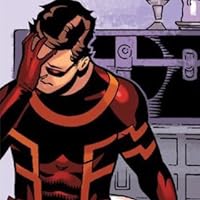
I read this book for one reason and one reason only: because Cable makes a pun about having an evil clone. And, honestly? That was literally the only good thing about this story. Sure, it set up a lot of things that came after it throughout the 90s right up until Grant Morrison took over with New X-Men 114 in the early 00's but on its own NOTHING HAPPENS!!! For 12 issues everyone just sort of faps about and then it's over. That said, it's a really great pun.

Also, can we talk about how 90s that panel is? So many muscles and guns and POUCHES!!!
Also, can we talk about how 90s that panel is? So many muscles and guns and POUCHES!!!

May 21, 2018
It's been a long time since I've read an X-title and had to make sense of the events leading up to this one. In fact, I only read this because a podcast that I was listening to has an episode about it.
Anyway, apart from my initial confusion, it was an okay read for me. It's has a convoluted plot devised by Stryfe--whose existence is also another convoluted story--filled with excessive (and a few of it needless, in my opinion) fight scenes, that all boils down to mommy and daddy issues. In which "mommy" and "daddy" still have no freakin' clue why "son" was having a tantrum that has devastating effects on others. In fact, this cross-over only gave more questions than answers given the premise that "fans will finally know Cable's origin story in this".
Anyway, apart from my initial confusion, it was an okay read for me. It's has a convoluted plot devised by Stryfe--whose existence is also another convoluted story--filled with excessive (and a few of it needless, in my opinion) fight scenes, that all boils down to mommy and daddy issues. In which "mommy" and "daddy" still have no freakin' clue why "son" was having a tantrum that has devastating effects on others. In fact, this cross-over only gave more questions than answers given the premise that "fans will finally know Cable's origin story in this".
June 1, 2014
It was so much fun to pull out this graphic novel and take a trip down the memory lane of mid-90's X-Men stories. So much fun in fact that I was inspired to sort through my huge bins of comics to get the individual Phalanx Covenant issues together and read those again for the first time in 20 years. I'm half tempted to start reading Generation X all over, too! Anyway, this is a great nostalgic story with the complex Summers family history at its core. I was surprised that my mind had held on to certain panels after all this time.

January 25, 2010
I feel like in 1983 I'd have loved this arc. Lot's of interesting stuff going on, but I kind of know the direction it's heading and instead of the story resolving anything I know about these characters it kind of has an extensive climax that just ends.

May 14, 2013
Se me hizo laaaaaaaargo. Y eso que tiene buenos guionistas como Nicieza y David y buenos dibujantes como unos Jae Lee y Greg Capullo principiantes pero con un talento ya visible. Pero estar trescientas páginas para terminar sólo insinuando que Cable es el hijo de Cíclope me parece demasiado.
July 25, 2013
i read a few of these issues when they came out, thought it might make sense all gathered in one volume. terribly written and illoed. marvel did the artists, writers and editors a favor by putting the isbn on the spine rather than their names.

August 20, 2009
Too much going on and only so-so art.
August 9, 2017
Better than the last X-Men crossover, although still stuck in the spirit of the 90s X-Men comics, where everything was a mystery and nothing could be completely set in stone.

August 26, 2023
Cable has shot Professor Xavier?! The X-Men factions are going to war over it? Meanwhile Cable claims his own innocence, how is that possible? This answer can only be found in X-Cutioner's Song (1992).
X-Cutioner's Song (1992) is a 13-issue crossover event that includes all the X-Men related titles at the time (Uncanny X-Men, X-Factor, X-Men, and X-Force) that involves a tale of betrayal and intrigue that will have you unravelling its mystery piece by piece and slowly showing just how deep the conspiracy goes. All that on top of the fact that it introduces a fan-favorite X-Villain that is very much a product of the 90's, STRYFE THE CROWN PRINCE OF MUTANTKIND (or so he claims). While he may seem a little goofy by today's design standards, but I would implore you to give him a chance as he will not only be a plot device that you will probably find most intriguing but he will also likely lead any reader to ask themselves some very serious hard hitting questions of themselves and their own beliefs when it comes to humanity. That is all I will talk about that because it would be nothing less of a crime to spoil any part of this amazing story for you.
Now, what did I like about the comic? The art is absolutely amazing in it, and I will provide a couple examples below. To many readers over the decades, the 90's is often considered the pinnacle of X-Men art and X-Cutioner's Song (1992) is a great example of that take. Some of the splash pages left me in a state of awe and I found myself admiring every detail drawn into them. The other thing I liked I have made pretty obvious at this point in the review, but the story is amazing. As a fan of the Summers family in X-Men stories, a story centered around Cable was a welcome addition to my collection and I was not disappointed by the quality of the writing. Another big plus is that this story planted several seeds for the future X-Men centered events that will come to be known as the Messiah Saga (including the 2007 and 2009 events Messiah CompleX and Messiah War) that we will review at a later point and point out the various connections between the three events.
The biggest downside is the pacing of the story. The first issue is very quick to pick up and be exciting, and after part 4 the story picks up and never lets up. However, the parts 2 through 4 can be seen as slow to some readers, especially after the very fast and high paced start of part 1, but if you see it through this will be a very small problem that you will not really think about once you reach the end of the story.
Overall, if you are trying to read the hits from the X-Men over the years or if you are a big fan of Cable, then this story is a must read for you. As always if you have any questions or just want to talk about this story, please feel free to leave a comment here or let me know on Twitter.
Overall rating:9/10
https://rayburnreading.blogspot.com/2...
X-Cutioner's Song (1992) is a 13-issue crossover event that includes all the X-Men related titles at the time (Uncanny X-Men, X-Factor, X-Men, and X-Force) that involves a tale of betrayal and intrigue that will have you unravelling its mystery piece by piece and slowly showing just how deep the conspiracy goes. All that on top of the fact that it introduces a fan-favorite X-Villain that is very much a product of the 90's, STRYFE THE CROWN PRINCE OF MUTANTKIND (or so he claims). While he may seem a little goofy by today's design standards, but I would implore you to give him a chance as he will not only be a plot device that you will probably find most intriguing but he will also likely lead any reader to ask themselves some very serious hard hitting questions of themselves and their own beliefs when it comes to humanity. That is all I will talk about that because it would be nothing less of a crime to spoil any part of this amazing story for you.
Now, what did I like about the comic? The art is absolutely amazing in it, and I will provide a couple examples below. To many readers over the decades, the 90's is often considered the pinnacle of X-Men art and X-Cutioner's Song (1992) is a great example of that take. Some of the splash pages left me in a state of awe and I found myself admiring every detail drawn into them. The other thing I liked I have made pretty obvious at this point in the review, but the story is amazing. As a fan of the Summers family in X-Men stories, a story centered around Cable was a welcome addition to my collection and I was not disappointed by the quality of the writing. Another big plus is that this story planted several seeds for the future X-Men centered events that will come to be known as the Messiah Saga (including the 2007 and 2009 events Messiah CompleX and Messiah War) that we will review at a later point and point out the various connections between the three events.
The biggest downside is the pacing of the story. The first issue is very quick to pick up and be exciting, and after part 4 the story picks up and never lets up. However, the parts 2 through 4 can be seen as slow to some readers, especially after the very fast and high paced start of part 1, but if you see it through this will be a very small problem that you will not really think about once you reach the end of the story.
Overall, if you are trying to read the hits from the X-Men over the years or if you are a big fan of Cable, then this story is a must read for you. As always if you have any questions or just want to talk about this story, please feel free to leave a comment here or let me know on Twitter.
Overall rating:9/10
https://rayburnreading.blogspot.com/2...

March 25, 2024
Back in the 90s I got my first Uncanny X-Men issue, #295, Part 5 of this storyline. I had never read any other X-Men comic before, and this was the 5th part of a 12-part epic steeped in continuity and lore reaching back a decade and more. I had no idea what was going on, but I was enthralled by these strange heroes with soap-operatic problems and lots of action.
Flash-forward to today in 2024. I finally have gotten my hand on all the individual issues, including two epilogues and the Stryfe's Strike Files one shot. And, it was so much fun to read!
This is the height of 90s excess! It has everything: bombastic storylines, dense continuity, lots of battles, dozens of characters fighting for page space, epic one-liners delivered in stylistic fonts, and an ending that doesn't tie anything up at all!
This is an important X-Men storyline--it introduces the concept of Cable/Stryfe as Cyclops' son who was sent to the future and now returned. It introduces the Legacy Virus storyline (on one ominous Epilogue page). It brings all the X-teams back to the fold in time for the Fatal Attractions storyline approaching and the character arcs to come. There is a LOT going on here. Every other page seems to be a new storyline, just as the 90s comics liked it.
Reading it with a 2024 lens, you can really see how the Krakoa era pulled inspiration from all eras including this storyline. Apocalypse and Sinister in an ambiguous middle area of hero/villain. Moira trying to save a dying Charles with an urgency that makes even more sense now.
Artwise, we were eating for sure. Greg Capullo on X-Force! Andy Kubert starting an iconic X-Men run! Jae Lee on X-Factor interiors?! Funny enough, the flagship title, Uncanny, was in a spot of transition, but Peterson holds his own admirably enough among these emerging titans.
The writing is fun. Absolutely, this storyline barely makes sense. But, it is wholly "X-Men." Lobdell is what he is, but he gets the characters. Nicieza is firing on all cylinders here. I never realized at the time how funny he is. How he sneaks some great, ironic lines in at the best moments. He reminds you that, no matter the in-story stakes, this is still a comic book and you should have some FUN with it.
In the end, this was a huge nostalgia trip, yes. But, it does flow fairly well despite having 3 different writers over 4 titles, and the art is distinct in each issue yet makes sense.
I don't recommend that you start with Part 5 and then figure out what's going on from there anymore. (Although at least now the Internet could fill in info gaps! I never had that!) But, if you want to expand your X-Men lore, this was a bonkers 90s tale in all its glory.
Flash-forward to today in 2024. I finally have gotten my hand on all the individual issues, including two epilogues and the Stryfe's Strike Files one shot. And, it was so much fun to read!
This is the height of 90s excess! It has everything: bombastic storylines, dense continuity, lots of battles, dozens of characters fighting for page space, epic one-liners delivered in stylistic fonts, and an ending that doesn't tie anything up at all!
This is an important X-Men storyline--it introduces the concept of Cable/Stryfe as Cyclops' son who was sent to the future and now returned. It introduces the Legacy Virus storyline (on one ominous Epilogue page). It brings all the X-teams back to the fold in time for the Fatal Attractions storyline approaching and the character arcs to come. There is a LOT going on here. Every other page seems to be a new storyline, just as the 90s comics liked it.
Reading it with a 2024 lens, you can really see how the Krakoa era pulled inspiration from all eras including this storyline. Apocalypse and Sinister in an ambiguous middle area of hero/villain. Moira trying to save a dying Charles with an urgency that makes even more sense now.
Artwise, we were eating for sure. Greg Capullo on X-Force! Andy Kubert starting an iconic X-Men run! Jae Lee on X-Factor interiors?! Funny enough, the flagship title, Uncanny, was in a spot of transition, but Peterson holds his own admirably enough among these emerging titans.
The writing is fun. Absolutely, this storyline barely makes sense. But, it is wholly "X-Men." Lobdell is what he is, but he gets the characters. Nicieza is firing on all cylinders here. I never realized at the time how funny he is. How he sneaks some great, ironic lines in at the best moments. He reminds you that, no matter the in-story stakes, this is still a comic book and you should have some FUN with it.
In the end, this was a huge nostalgia trip, yes. But, it does flow fairly well despite having 3 different writers over 4 titles, and the art is distinct in each issue yet makes sense.
I don't recommend that you start with Part 5 and then figure out what's going on from there anymore. (Although at least now the Internet could fill in info gaps! I never had that!) But, if you want to expand your X-Men lore, this was a bonkers 90s tale in all its glory.

December 22, 2020
The 3 X-teams team up against Stryfe, Apocalypse, Mr. Sinister, Acolytes, the MLF, and more... all while Xavier lays dying after getting shot with a techno virus. This one was a rollercoaster of an event folks.
This storyline is when I really started reading the X-Men. I just remember as a kid seeing all the madness that is the lives of the X-Men and being so blown away. I think there is a big nostalgia factor in reading this for me, and to be honest I was pleasantly surprised by how good it is when rereading it.
So this reveals the true origins of Cable and Stryfe and how closely their lives are intertwined with Scott and Jean. Stryfe is the would be assassin of Professor X, and he nearly succeeds if not for Apocalypse helping him (yes that's right APOCALYPSE) to purge the techno virus from his body. The origin of Cable and Stryfe is such an example of comic book craziness, but it makes for great fodder for the 90's X teams. I think one of the great thing about the 90's is how the three teams: X-Men, X-Force, and X-Factor, really started crossing over and intertwining for events like this. This type of dynamic is something that still happens to this day.
The art is... hit and miss for me. It's of course, very 90's - plenty of pouches and giant non-sensical guns around- but still the art fits the tone well - for the most part. It's a product of it's time, with fan favorites like Jae Lee, Greg Capullo, and the first Marvel works of Andy Kubert ( who's art is awesome in this by the way). Besides Kubert however, Lee and Capullo are still developing their style, so don't expect to see their signature art in this one (but mullets a plenty!).
Overall - pretty batshit insane storyline that perfectly sums up the 90's X-Men. And if you can follow along with the insane quasi-scientific reasons they give for situations that happen in this crossover, or just have a bit of nostalgia to help you through, then this wont disappoint.
This storyline is when I really started reading the X-Men. I just remember as a kid seeing all the madness that is the lives of the X-Men and being so blown away. I think there is a big nostalgia factor in reading this for me, and to be honest I was pleasantly surprised by how good it is when rereading it.
So this reveals the true origins of Cable and Stryfe and how closely their lives are intertwined with Scott and Jean. Stryfe is the would be assassin of Professor X, and he nearly succeeds if not for Apocalypse helping him (yes that's right APOCALYPSE) to purge the techno virus from his body. The origin of Cable and Stryfe is such an example of comic book craziness, but it makes for great fodder for the 90's X teams. I think one of the great thing about the 90's is how the three teams: X-Men, X-Force, and X-Factor, really started crossing over and intertwining for events like this. This type of dynamic is something that still happens to this day.
The art is... hit and miss for me. It's of course, very 90's - plenty of pouches and giant non-sensical guns around- but still the art fits the tone well - for the most part. It's a product of it's time, with fan favorites like Jae Lee, Greg Capullo, and the first Marvel works of Andy Kubert ( who's art is awesome in this by the way). Besides Kubert however, Lee and Capullo are still developing their style, so don't expect to see their signature art in this one (but mullets a plenty!).
Overall - pretty batshit insane storyline that perfectly sums up the 90's X-Men. And if you can follow along with the insane quasi-scientific reasons they give for situations that happen in this crossover, or just have a bit of nostalgia to help you through, then this wont disappoint.

August 5, 2020
Nostalgia vs. reality - it's pretty hard to grade the things that we loved when we were younger, when we began to discover the things that we'd later be passionate about...
X-Cutioner's Song feels like it was written in a very specific period of Marvel comics history, and definitely within the history of the X-Men. There are illustrations in this comic that stick out clear as day in my memory, and specific lines that jump off of the page - but the writing itself is vague and really just props up a flurry of combat: a battle royale of X-Force, X-Factor, X-Men, and a bunch of randos - it's tough to care deeply about what is going, aside from the technovirus inflicted upon Xavier. Lots of action sequence artwork - some of it is quite good. The writing... well.
That being said, there were lasting consequences to this series, and I remember being fairly affected by it at the time of publication.
I've always identified X-Men as one of those comics that is so far up it's own ass about superpowers and invincibility and machoism, and comics that this really remind me of why. The way characters like Cable, Wolverine, and Bishop were written are so typical of a specific image portrayed as manly at the time... it's kind of fun to look back and remembering that Wolverine was a chainsmoker, and wondering why I ever idolized him - the crude, mindless berserk was never anything I could particularly identify with. Or one could hope?
Lots of thoughts on this one, not much that is articulate. Much nostalgia. I'll always love the X-Men, and always wonder why I didn't notice when the writing wasn't great!
X-Cutioner's Song feels like it was written in a very specific period of Marvel comics history, and definitely within the history of the X-Men. There are illustrations in this comic that stick out clear as day in my memory, and specific lines that jump off of the page - but the writing itself is vague and really just props up a flurry of combat: a battle royale of X-Force, X-Factor, X-Men, and a bunch of randos - it's tough to care deeply about what is going, aside from the technovirus inflicted upon Xavier. Lots of action sequence artwork - some of it is quite good. The writing... well.
That being said, there were lasting consequences to this series, and I remember being fairly affected by it at the time of publication.
I've always identified X-Men as one of those comics that is so far up it's own ass about superpowers and invincibility and machoism, and comics that this really remind me of why. The way characters like Cable, Wolverine, and Bishop were written are so typical of a specific image portrayed as manly at the time... it's kind of fun to look back and remembering that Wolverine was a chainsmoker, and wondering why I ever idolized him - the crude, mindless berserk was never anything I could particularly identify with. Or one could hope?
Lots of thoughts on this one, not much that is articulate. Much nostalgia. I'll always love the X-Men, and always wonder why I didn't notice when the writing wasn't great!

June 16, 2019
I remember getting these comics individually when they first were released in the fall of 1992. It’s a very 90s X-men story, heavy in continuity from comics from years before, that if you’ve been reading this whole time, it makes sense and is very intriguing but if you’re coming on to this for the first time it’s a bit of a mess.

April 7, 2023
I liked this more than usual for an X-title crossover event, mostly because I could actually follow the damn plot.
I loved every issue drawn by Jae Lee - I think his were the X-Factor issues. His panels and artwork were just fabulous on many places, and a welcome change from the improbably steroid-ripped muscles that pervade this era (1992) of X-comics.
I loved every issue drawn by Jae Lee - I think his were the X-Factor issues. His panels and artwork were just fabulous on many places, and a welcome change from the improbably steroid-ripped muscles that pervade this era (1992) of X-comics.

August 5, 2026
My first X-Men crossover event when I started reading them in the 90's, just pre-cartoon.
The pencils artist for X-Men was Brandon Peterson who is from my hometown of Stevens Point, WI and he threw in background shouts to the Point Beer and Galaxy Hobby - home town brewery and the main comic shop around.
The pencils artist for X-Men was Brandon Peterson who is from my hometown of Stevens Point, WI and he threw in background shouts to the Point Beer and Galaxy Hobby - home town brewery and the main comic shop around.

May 13, 2018
This was all about style for me, and I love this early 90s X-book stuff. You get to see all of the X-teams from that time mix it up with many cool villains. There are a couple surprises, too. I thought it was awesome.

October 6, 2018
Not my favorite X-Men out there. I find I enjoyed Chris Claremont's Uncanny X-Men more than Scott Lobdell's. But that's just personal preference. I still liked this series though and I can recommend this as part of the X-Men universe as a must read.
Displaying 1 - 30 of 57 reviews