

What do you think?

Three Philosophical Poets: Lucretius, Dante, Goethe
2009, Hardcover with dust jacket, 174 pages
192 pages, Hardcover
First published January 1, 1953
About the author
George Santayana
468 books357 followersPhilosopher, poet, literary and cultural critic, George Santayana is a principal figure in Classical American Philosophy. His naturalism and emphasis on creative imagination were harbingers of important intellectual turns on both sides of the Atlantic. He was a naturalist before naturalism grew popular; he appreciated multiple perfections before multiculturalism became an issue; he thought of philosophy as literature before it became a theme in American and European scholarly circles; and he managed to naturalize Platonism, update Aristotle, fight off idealisms, and provide a striking and sensitive account of the spiritual life without being a religious believer. His Hispanic heritage, shaded by his sense of being an outsider in America, captures many qualities of American life missed by insiders, and presents views equal to Tocqueville in quality and importance. Beyond philosophy, only Emerson may match his literary production. As a public figure, he appeared on the front cover of Time (3 February 1936), and his autobiography (Persons and Places, 1944) and only novel (The Last Puritan, 1936) were the best-selling books in the United States as Book-of-the-Month Club selections. The novel was nominated for a Pulitzer Prize, and Edmund Wilson ranked Persons and Places among the few first-rate autobiographies, comparing it favorably to Yeats's memoirs, The Education of Henry Adams, and Proust's Remembrance of Things Past. Remarkably, Santayana achieved this stature in American thought without being an American citizen. He proudly retained his Spanish citizenship throughout his life. Yet, as he readily admitted, it is as an American that his philosophical and literary corpuses are to be judged. Using contemporary classifications, Santayana is the first and foremost Hispanic-American philosopher.
Ratings & Reviews
Friends & Following
Create a free account to discover what your friends think of this book!
Community Reviews
Displaying 1 - 15 of 15 reviews

Read
December 24, 2019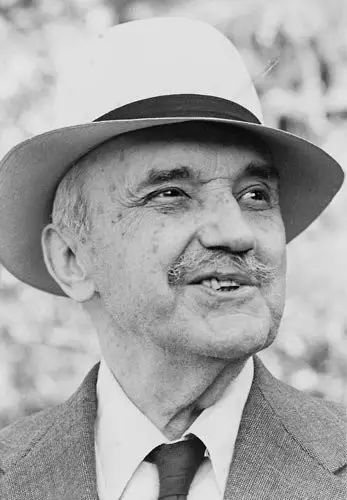
George Santayana (1863-1952)
A philosopher, social and literary critic, poet, novelist and essayist, Jorge Agustín Nicolás Ruiz de Santayana y Borrás - better known as George Santayana - once a household name in his temporarily adopted homeland America,(*) has fallen between the cracks and largely disappeared from view. Apolitical scholar-aesthetes are no longer welcome in an increasingly politicized age of rabid Know-nothingism; and what room is there now for his five volume magnum opus of moral philosophy The Life of Reason: The Phases of Human Progress? Reason! One can only scoff in Trump's America and pull the fiery red MAGA cap lower over one's eyes.
Late in his life Santayana said in an overview of his voluminous work "It aspires to be only a contribution to the humanities, the expression of a reflective, selective, and free mind." Free indeed from the fear either of embracing simultaneously the materialism of Democritus, Epicurus and Lucretius and the view that beauty was an end in itself, or of writing philosophy with a poet's sensibility and poetry with a philosopher's mind.
The perfect union of his philosophical-poetic-critical nature is to be found in Three Philosophical Poets (1910), where he meditates upon the work of Lucretius, Dante and Goethe, each of whom he viewed as "typical of an age" and together as "sum[ming] up all of European philosophy" in that they were the "unmatched" poets of "naturalism", "supernaturalism" and "romanticism". Aside from the tendentious choice of the term "supernaturalism", one can nod one's head in some kind of general agreement, but Santayana's view of Romanticism is rather more Nietzsche than Goethe:
Their will summons all opportunities and dangers out of nothing to feed its appetite for action; and in that ideal function lies their sole reality. Once attained, things are transcended. Like the episodes of a spent dream, they are to be smiled at and forgotten; the spirit that feigned and discarded them remains always strong and undefiled; it aches for new conquests over new fictions.
But then the Goethe at the center of Santayana's attention is not the Goethe of the West-östlicher Divan but the Goethe of Faustus, particularly of the posthumously published portion. Taken together with De rerum Natura and Comedìa one sees Santayana had ambition when composing this slim volume.
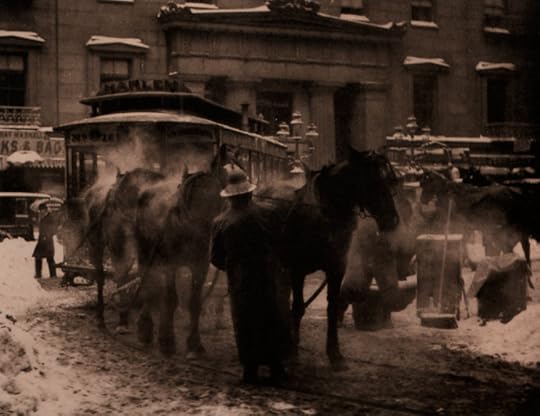
Alfred Stieglitz (1864-1946)
In his characteristically clear and delightful prose Santayana commences his chapter on Lucretius by summarizing his philosophical forebears' - Democritus and Epicurus - positions and rightly emphasizing Epicurus' asceticism and flight from the world but incorrectly describing him as a "timidly sensual" humanitarian or his moral philosophy as hedonism. There is nothing timid or sensual about Epicurus' central goal of attaining the state of ataraxia and nothing hedonistic in his philosophy of renunciation.(**) But then Santayana's focus in this chapter is Titus Lucretius Carus, or, better said since we know next to nothing about the man, his absolutely unique epic poem On the Nature of Things. If he doesn't quite do Epicurus full justice, how does he handle Lucretius?
Well, he gives Lucretius his full due as an imaginative poet who captures the reader with vivid details and masterful rhetoric, and if one hasn't read De rerum natura before, this chapter will provide the motivation to do so. But Santayana quickly focuses in on the process at Nature's heart: death arising from life and life from death. And for the materialist there can be no comforting stories about the resurrection and eternal life of any individual (to stand in as example of the many, many stories humankind tells itself to hold back the dark). "Therefore Lucretius, who is nothing if not honest, is possessed of a profound melancholy."
Perhaps my reading of Lucretius is distorted by the harrowing century that separates the composition of this review from that of Three Philosophical Poets, but I find more than melancholy in many passages of his poem, profound or not. Though there is joy in the text, there are passages of black pessimism. Indeed, the poem as it has come down to us closes with a rhetorically rich meditation on pestilence and drought, finishing up with the great city of Athens succumbing to a vicious plague. Granted, it is likely that the ending either disappeared or Lucretius wasn't able to finish the poem, but this is the text we have, and Santayana's speculation about an ending in which Venus and Mars appear - they are Lucretius' embodiments of the creative and destructive portions of Nature's cycle - to re-balance the text somehow is at this point just wishful thinking.
Though ancient Greek philosophy certainly tried to be rational,(***) when Santayana writes
… yet if we consider in Greek religion its characteristic tendency, and what rendered it distinctively Greek, we see that it was its unprecedented ideality, disinterestedness and aestheticism.
it is clear that he has no idea of the revolutionary paradigm change coming with E.R. Dodds' The Greeks and the Irrational, where the cold silence of the temples of Apollo and Athena yields to the wild processions and the magical, dark caverns of Dionysus where mind-altering substances were employed to heighten the communion with the Divine and probably also to facilitate the total abandonment of hesitation in the accompanying orgies. In fact, come to think of it, Santayana clearly had some familiarity with Nietzsche's work, but he apparently overlooked Nietzsche's exultant praise of the Dionysian over the Apollonian (which he viewed as degenerate) in Greek culture, particularly in Die Geburt der Tragödie aus dem Geiste der Musik.
Pleasantly surprising are the pages where Santayana contrasts Lucretius with two other, very different poets of Nature - Shelley and Wordsworth - and with another Epicurean poet - Horace - which cast an illuminating light on all four poets. This chapter is certainly thought-stimulating, even when protest and not accedence is brought forth from the reader.
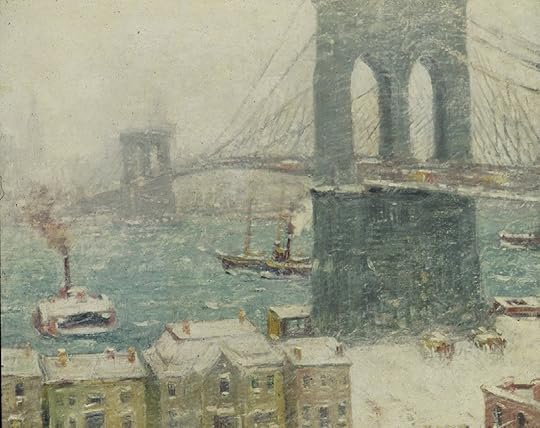
Guy Carleton Wiggins (1883-1962)
Turning now to Durante di Alighiero degli Alighieri - better known as Dante - I must admit that I have never finished the Divine Comedy; as impressed, and even moved, as I was by the diction and imagination of the poet, I was thrown out of my thrall to Dante's words each time a Christian belief I simply don't accept showed up, even garbed in Dante's radiant robes. I find the Inferno horrifying (viewed solely as an act of imagination, it is magnificent) and the Paradiso only slightly less so, since I have a certain empathy for the desire to meld with the Godhead (the final pages of Hesse's Siddhartha always draw tears from me). The theology of the Purgatorio leaves me cross-eyed. This to signal that I am not going to try to quibble with Santayana in this section.
Though an atheist in adulthood, Santayana was raised in Mediterranean Catholicism, which marked him for life. He seemed to view Protestantism (which marked me for life) as a Teutonic aberration and, aesthete that he was, revelled in the beauties of the Catholic rites and beliefs. (I grant that some of those beauties are quite appealing to me as well.) So he is at home in Dante's worldview, not least because that worldview contained Neoplatonism and Aristotelian ethics in the form to which Thomas of Aquinas gave his blessing. True, Santayana does reproach Dante for his egoism, which made the entire transcendent experience that of his alter ego; ditto for the revelations. He also accuses said alter ego of timidity. But he asserts "Here, then, we have the most complete idealization and comprehension of things achieved by mankind hitherto."
Fascinating to me are the pages in which Santayana sketches the rise of Christian theology (and Dante's intellectual context) from its roots in Neoplatonism and Jewish theology as well as the political setting in which Dante was working. He felt that the Pope had betrayed his spiritual calling, the French king aided by his Florentine compatriots had betrayed the Holy Roman Emperor, and that his own exile and poverty were due to the machinations of evil persons. "They helped to pour forth the intense bitterness of his heart with the breath of prophetic invective. … His political passions and political hopes were fused with a sublime political ideal [the universal religion and the universal, God ordained empire - my comment] ; that fusion sublimated them, and made it possible for the expression of them to rise into poetry." Further: "On the other hand, the sting of Dante's private wrongs, like the enthusiasm of his private loves, lent a wonderful warmth and clearness to the great objects of his imagination."
Finally, Santayana's view of the Divine Comedy is admirably expansive:
Thus, throughout the Divine Comedy, meaning and meaning lurk beneath the luminous pictures; and the poem, besides being a description of the other world, and of the rewards and punishments meted out to souls, is a dramatic view of human passions in this life; a history of Italy and of the world; a theory of Church and State; the autobiography of an exile; and the confessions of a Christian, and of a lover, conscious of his sins and of the miracle of divine grace that intervenes to save him.
So expansive that I will have to make yet another go at it...
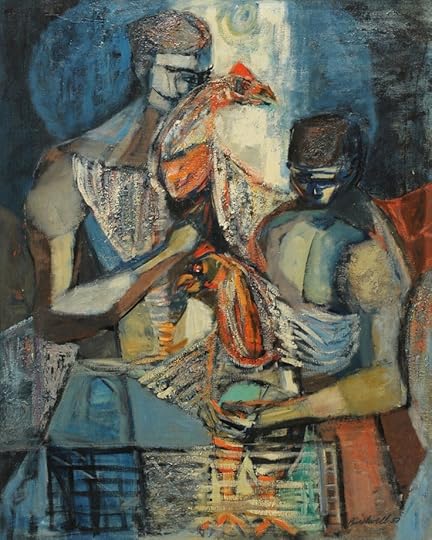
Robert Birdwell (1924-2016)
On to Johann Wolfgang von Goethe, an iconic figure in one of the European cultures I am most familiar with and whose work I have read rather broadly, though far from completely. For Santayana in this text Goethe is solely the author of the verse plays Faustus (I and II), and, for a change, he doesn't reproach him with timidity. On the contrary.
After reviewing the historical and cultural background of the figure of Faust, which arose in an apparently real person who lived during the Renaissance but who became legendary shortly after his death, motivating the Church propagandists to pelt him figuratively with offal and Christopher Marlowe to turn him into a somewhat reluctant martyr for the values most prized by the Renaissance. The great Spanish dramatist Pedro Calderón de la Barca reclaimed him for the church in El mágico prodigioso, while Goethe, in another age, shoveled the Renaissance figure out of the orthodox dungheap to show the spirit of the Renaissance liberating the soul and "bursting the bonds of traditional faith and traditional morals."
Not unexpectedly (and not unjustifiably), Santayana focuses on the naturalistic cycle of creation and destruction and how it plays itself out in Faustus. In the earlier version of the play the impatiently striving Faust summons the Earth-Spirit, which duly appears and is much more than the human being can cope with: it is the unbound energy of Nature itself encompassing both creation and death, sweeping all before it remorselessly, indeed disinterestedly. In the later Faustus Mephistopheles is the Earth-Spirit's servant embodying the destructive portion of Nature's flow. Goethe's Mephistopheles is a zealot who strives to return Creation to the pre-Creation state of nothingness. By performing evil he creates a good by eliminating the greater evil of Life. In Santayana's memorable words: "He is the cruel surgeon to the disease of life." To my mind Goethe's zealot is more memorable, almost admirable, than Milton's prideful Satan, not the least because he knows he is still only Nature's servant, that while his scythe reaps, behind his back the seeds of life are being taken by the wind.
Goethe's Mephistopheles is ancient, knows and despises everything, sourly opposes all of Faust's silliness and romanticism. But Faust hungers for all that can be experienced, without fear or hope, while Mephistopheles, who has been everywhere and done everything, snorts and enables. Unlike the original Renaissance legend, Faust does not trade pleasure here for torments later; not unlike the original "sin" in the fabled garden, Faust wants to know, not in the abstract but in experience. And Goethe/Mephistopheles takes him through a rich series of experiences I falter to describe, unlike Santayana. Finally, Faust grows old and weary, having if not drained the cup, then certainly emptied some of its vastness. Goethe/God reaches in while Mephistopheles is vainly readying his nets for Faust's soul and declares that to live as Faust did is to live as one should, that in so doing he was God's servant all the while. The aged Goethe writes a final scene: Faust's apotheosis.
In a Conclusion Santayana contrasts these three very different poets from rather empyrean heights. It is best if you ponder his words in situ, for the brief summary I wrote just won't do. And then - stimulated, aggravated, inspired - return to the remarkable originals.
(*) with a best selling memoir, a Pulitzer Prize nominated novel, and a Time magazine cover story, not to mention a professorship at Harvard, where he contributed significantly to what is called the Golden Age of the Harvard Department of Philosophy
(**) I have discussed Epicurus' system at some length in an earlier review:
https://www.goodreads.com/review/show...
(***) I exclude from this claim the later Neoplatonists, whose magical Idealism so influenced the formation of theology in the early Christian church (Santayana gives an idea of some of that influence in the section on Dante) and who remind me of the more popular (and in my view degenerate) form of Taoism that competed so ruthlessly with Buddhism during the T'ang dynasty.

March 25, 2008
This book is foul. Not the text especially but its self. It literally makes me sneeze it's so grotty and old. I read some article in the Berkeley Philosophy Journal Qui Parle a while back which sort of pegged George Santanyana as a politically indifferent Bourgeois Classicist, and maybe he is. I really don't think any sort of direct critique of thought or people or anything is very interesting anyway, as if Nature's true meaning can be just 'had out' by some yapping grad-student.. Just look at language itself the word Writan which meant 'scratch' and gives us writing written backwards damn near gives you Nature, and Nature written backwards gives you 'Ruttin' or perhaps Ratan.. at any rate,
there are far too many variables in Nature for human thought
to become anything other than another level of irony in that final reckoning whatever sublimely horrible decoction that will be. In 3 philosophical poems, GS not only grapples with each of these figures, but takes the time to dig up the criticism which has been done and basically offers "mediated encounters" and subsequent meditation. Sometimes you think the critic is right, at first, until further hermeneusis by George on the text which amounts to him gargling some wine and spitting it in your face.
Ha! This books is actually not even a book, but a kind of delirious wine tasting by one of the great modern Epicureans!
I like George Santanyana precisely because he is unpopular, and a bit wrong-headed and goes on about 'chaste folds' and innocent marbles far too long to take seriously, which I absolutely do!

January 5, 2011
I guess one could fairly call Santayana a kind of bougie hedge-artist, and I guess that would be sort of correct. He's concerned with aesthetics, definitely, and the metaphysics of creating, and if he preferred to tie his tie on and contemplate Dante on a yacht instead of politicizing his arguments, well, it certainly doesn't endear him to me personally, but nor does it make his work any less important or engaging.
Santayana's apolitical aesthetic sense is unfashionable nowadays but has its defenders-- I see something like it in Elaine Scarry's delicate and fierce 'On Beauty and Being Just'-- and, I think, has its place as well. His sort of peculiar naturalism allowed that beauty is worth striving to as an end in itself as well as a clearer lens through which to examine social conditions. Although this seems naively idealistic nowadays, it makes a gentle approach towards Foucault's apparatuses that's sort of downplayed by a lot of commentators. The point being, I like Santayana, I think he's underappreciated, and I think this book in particular is a lost classic.
In brief, he looks at three poets as paragons of three distinct philosophical methodologies. Lucretius is his icon of materialism (and its here that his moral sympathies seem to coincide the most), Dante as a religious poet, and Goethe as the poet of the Romantic mentality. I appreciate the attention he pays to the second part of 'Faust,' in favor of the perhaps overly favored first part. Do I agree with him? No, not in the big picture, although his readings are acute and sensitive, and argued with a bright and comradely conviction. What I think it most valuable about the book is the spirit it was written in, its function as an artifact of a brief and optimistic crest in American thought.
Santayana's apolitical aesthetic sense is unfashionable nowadays but has its defenders-- I see something like it in Elaine Scarry's delicate and fierce 'On Beauty and Being Just'-- and, I think, has its place as well. His sort of peculiar naturalism allowed that beauty is worth striving to as an end in itself as well as a clearer lens through which to examine social conditions. Although this seems naively idealistic nowadays, it makes a gentle approach towards Foucault's apparatuses that's sort of downplayed by a lot of commentators. The point being, I like Santayana, I think he's underappreciated, and I think this book in particular is a lost classic.
In brief, he looks at three poets as paragons of three distinct philosophical methodologies. Lucretius is his icon of materialism (and its here that his moral sympathies seem to coincide the most), Dante as a religious poet, and Goethe as the poet of the Romantic mentality. I appreciate the attention he pays to the second part of 'Faust,' in favor of the perhaps overly favored first part. Do I agree with him? No, not in the big picture, although his readings are acute and sensitive, and argued with a bright and comradely conviction. What I think it most valuable about the book is the spirit it was written in, its function as an artifact of a brief and optimistic crest in American thought.

June 26, 2021
And so I begin with this book my yearlong study during the 700th anniversary of the death of Dante Alighieri, one of the greatest of poets. Santayana, who gave these lectures in 1915, does a very good job of contrasting Lucretius' naturalism, Dante's spiritualism and Goethe's romanticism. While the language is a little stilted Santayana's ideas are still quite relevant. A good start to my Dante year.

December 5, 2019
Santayana wants a synthesis of (romantic) experience, (naturalist) world, and (supernatural) ideals.

April 25, 2025
I had heard mention of Santayana for many years but never taken the time to read him. I'm glad I finally took that time. Unfortunately, my first attempt was The Life of Reason which I quickly realized I would not comprehend. Thankfully, I had also picked up the Three Philosophical Poets and understood right away why Santayana's writing is held in high esteem - it's beautiful - it's poetic - it's erudite. Admittedly, I struggled at times. The writer isn't simple in his explanations and my knowledge of Goethe is minimal. However, after finishing, I realized there was much to be taken. A bit paradoxically I came to appreciate what Lucretius and Dante lacked. Especially with these two Santayana helped me place their poetry within a category of philosophy and appreciate how significant their individual concept of life and the cosmos is to a broader understanding of life.
Santayana has much to say about many things and I'll close with a very short excerpt not directly speaking to the three philosophical concepts but still insightful: "And so, to explain the unexpected flaws in a creation which they thought essentially good, they put back at the beginning of things an experience that they had daily in the present, namely, that trouble springs from bad conduct." I smiled after reading the lines.
Santayana has much to say about many things and I'll close with a very short excerpt not directly speaking to the three philosophical concepts but still insightful: "And so, to explain the unexpected flaws in a creation which they thought essentially good, they put back at the beginning of things an experience that they had daily in the present, namely, that trouble springs from bad conduct." I smiled after reading the lines.
December 31, 2025
Brilliant framing and brilliant writing. Whenever a book remains relevant and prescient many decades into the future, there is no further question needed to its success

September 2, 2011
I have only read the introduction and the third of the book that is about Dante; but it is excellent. I knew very little about Santayana, other than the famous quote about being doomed to relive history; but he was apparently very well known for his artful prose and his witty quotes. He does not fail to deliver in this book. He makes fun of Plato's insistence on emphasizing final causes for objects found in the real world, saying that it leads to ideas like: the reason we have very long intestines is so that we don't have to eat constantly and as a result can spend more time in philosophical contemplation. Hmmmm. I'm working hard on Lucretius right now, and once I've made it all the way through, I look forward to reading Santayana's critique of that poet--an ancient Roman materialist with whom he apparently had a lot in common.

January 13, 2014
Refreshingly good read. The chapter on Lucretius is masterful. The invocation of the future master poet, who will synthesize the sentiments and visions of the three discussed philosopical po, is gripping.

November 2, 2021
This book is based on six lectures that Santayana, himself a philosopher-poet, gave on three towering figures, Lucretius, Dante, and Goethe. These three epitomize, for Santayana, the supreme expression, in turn, of Naturalism, Supernaturalism, and Romanticism. Yet in what makes them great, he says, they are compatible. Taken together, they sum up all of European philosophy.
Why are poets the exemplars and not philosophers? Santayana explains that, while the reasonings and investigations of philosophy are arduous, the vision of philosophy is sublime, imaginative. So it’s not only possible for a poet to be a great exponent of philosophy, but it is advantageous. What Santayana calls the impotence of the arts in his day lies in their assumption that theory can’t be poetic. “The life of theory is not less human or less emotional than the life of sense; it is more typically human and more keenly emotional.”
What follows is less a review than a summary of some of Santayana’s main points.
The nature of the genius of Lucretius is its power to lose itself in its object. “We seem to be reading not the poetry of a poet about things, but the poetry of the things themselves.” He is also the poet of constant elements in flux. He takes over the pair of forces, love and strife, to which Empedocles ascribed this process of gathering and disruption but substituted Venus and Mars for these two terms. For Lucretius, “they are not moral forces,” but the mechanism itself. Arm in arm, “they rule the universe together.”
Life is not matter; it is an event. As a living being, the poet is pictured arriving on the scene at the top of a wave and can only observe and describe its fall. “His philosophy must be a prophecy of death.”
Santayana reminds us that for Lucretius, “nature” was not scenic landscapes (something he was little interested in describing), but “the principle of birth or genesis, the universal mother, the great cause, or system of causes, that brings phenomena to light.” I found this helpful to keep in mind when reading Lucretius and reading one who learned from him, Spinoza.
When he turns to Dante, Santayana presents Dante’s supernaturalism as the full development of a revolution foreseen by Plato: the sole principle of understanding must be the question of the better or worse. Dante, he says further, incorporates two strands of thought: the Hebraic, which saw the great themes of creation, fall, and salvation as historical events (therefore occurring once), and the Greek view. The result, via the four-fold sense of scripture in which Dante was schooled, fires his imagination. “Sacred history acquired for Dante a new importance. . . . Every episode became the symbol for some moral state or some moral principle.”
Santayana lauds Dante’s greatness as a poet yet also points out some of his weaknesses. Dante often wrote “with a passion not clarified into judgment.” His love, on the other hand, is too restrained, expressed too much in fancy. Dante also talks too much about himself, and the “personality thrust forward so obtrusively is not in every respect worthy of contemplation.” It is very proud and very bitter, yet curiously timid.
Goethe, according to Santayana, was simultaneously a naturalist and pantheist in the tradition of Spinoza and an exponent of the transcendental idealism current in Germany (the view of the world as the expression of a spiritual endeavor). Moreover, Santayana detects a second way Goethe combines two strains: northern European romanticism and the new paganism coming from Greece via Italy.
While not a philosophical poem, Faust offers a solution to the moral problem of existence as truly as do the poems of Lucretius and Dante. “The vital straining towards an ideal, definite but latent, when it dominates a whole life, may express that ideal more fully than the best chosen words.” Further, unlike Dante, Goethe never depicts the object his hero is pursuing; “he is satisfied with depicting the pursuit.” To “have an ideal to strive for, and, like Faust, never to be satisfied, is itself the salvation of man.”
Santayana concludes with a comparison of the three. Goethe presents experience in its immediacy, without ground, while Lucretius is the poet of substance. Experience appears to be not as each man comes upon it in his own person but as the scientific observer views it from without. Dante also shows us experience in its totality, but the external point of reference is moral, not physical. What interests him is “what experience is best, what processes lead to a supreme, self-justifying, indestructible sort of existence.” Lucretius is the poet of nature, Dante, of salvation. “Goethe gives us what is most fundamental, — the turbid flux of sense, the cry of the heart. . . .”
A “truly philosophical or comprehensive poet” would unite the insights and gifts of all three; Santayana asserts such a union would not be impossible. He distinguishes two directions for rational art: it may buttress a particular form of life (as does science and any other discipline that informs us about our conditions and equips us for life). Or it may come to express life, that is, the ideal “towards which we would move” under improved conditions. Santayana calls for a poet of “double insight,” one who would “reconstitute the shattered picture of the world.”
The lectures are closely-reasoned, peppered with apposite quotations from the texts. They are also marked by felicity of expression; I highlighted many more passages than I’ve quoted here. Someone who has not read any of the poems Santayana treats might not get much out of it. These are not so much introductions to the works as appreciations and analyses. I’ve read two of them, but only once each; they would repay repeated reading. I’m also eager to tackle the poem I haven’t yet read, The Nature of Things, by Lucretius.
Why are poets the exemplars and not philosophers? Santayana explains that, while the reasonings and investigations of philosophy are arduous, the vision of philosophy is sublime, imaginative. So it’s not only possible for a poet to be a great exponent of philosophy, but it is advantageous. What Santayana calls the impotence of the arts in his day lies in their assumption that theory can’t be poetic. “The life of theory is not less human or less emotional than the life of sense; it is more typically human and more keenly emotional.”
What follows is less a review than a summary of some of Santayana’s main points.
The nature of the genius of Lucretius is its power to lose itself in its object. “We seem to be reading not the poetry of a poet about things, but the poetry of the things themselves.” He is also the poet of constant elements in flux. He takes over the pair of forces, love and strife, to which Empedocles ascribed this process of gathering and disruption but substituted Venus and Mars for these two terms. For Lucretius, “they are not moral forces,” but the mechanism itself. Arm in arm, “they rule the universe together.”
Life is not matter; it is an event. As a living being, the poet is pictured arriving on the scene at the top of a wave and can only observe and describe its fall. “His philosophy must be a prophecy of death.”
Santayana reminds us that for Lucretius, “nature” was not scenic landscapes (something he was little interested in describing), but “the principle of birth or genesis, the universal mother, the great cause, or system of causes, that brings phenomena to light.” I found this helpful to keep in mind when reading Lucretius and reading one who learned from him, Spinoza.
When he turns to Dante, Santayana presents Dante’s supernaturalism as the full development of a revolution foreseen by Plato: the sole principle of understanding must be the question of the better or worse. Dante, he says further, incorporates two strands of thought: the Hebraic, which saw the great themes of creation, fall, and salvation as historical events (therefore occurring once), and the Greek view. The result, via the four-fold sense of scripture in which Dante was schooled, fires his imagination. “Sacred history acquired for Dante a new importance. . . . Every episode became the symbol for some moral state or some moral principle.”
Santayana lauds Dante’s greatness as a poet yet also points out some of his weaknesses. Dante often wrote “with a passion not clarified into judgment.” His love, on the other hand, is too restrained, expressed too much in fancy. Dante also talks too much about himself, and the “personality thrust forward so obtrusively is not in every respect worthy of contemplation.” It is very proud and very bitter, yet curiously timid.
Goethe, according to Santayana, was simultaneously a naturalist and pantheist in the tradition of Spinoza and an exponent of the transcendental idealism current in Germany (the view of the world as the expression of a spiritual endeavor). Moreover, Santayana detects a second way Goethe combines two strains: northern European romanticism and the new paganism coming from Greece via Italy.
While not a philosophical poem, Faust offers a solution to the moral problem of existence as truly as do the poems of Lucretius and Dante. “The vital straining towards an ideal, definite but latent, when it dominates a whole life, may express that ideal more fully than the best chosen words.” Further, unlike Dante, Goethe never depicts the object his hero is pursuing; “he is satisfied with depicting the pursuit.” To “have an ideal to strive for, and, like Faust, never to be satisfied, is itself the salvation of man.”
Santayana concludes with a comparison of the three. Goethe presents experience in its immediacy, without ground, while Lucretius is the poet of substance. Experience appears to be not as each man comes upon it in his own person but as the scientific observer views it from without. Dante also shows us experience in its totality, but the external point of reference is moral, not physical. What interests him is “what experience is best, what processes lead to a supreme, self-justifying, indestructible sort of existence.” Lucretius is the poet of nature, Dante, of salvation. “Goethe gives us what is most fundamental, — the turbid flux of sense, the cry of the heart. . . .”
A “truly philosophical or comprehensive poet” would unite the insights and gifts of all three; Santayana asserts such a union would not be impossible. He distinguishes two directions for rational art: it may buttress a particular form of life (as does science and any other discipline that informs us about our conditions and equips us for life). Or it may come to express life, that is, the ideal “towards which we would move” under improved conditions. Santayana calls for a poet of “double insight,” one who would “reconstitute the shattered picture of the world.”
The lectures are closely-reasoned, peppered with apposite quotations from the texts. They are also marked by felicity of expression; I highlighted many more passages than I’ve quoted here. Someone who has not read any of the poems Santayana treats might not get much out of it. These are not so much introductions to the works as appreciations and analyses. I’ve read two of them, but only once each; they would repay repeated reading. I’m also eager to tackle the poem I haven’t yet read, The Nature of Things, by Lucretius.
August 30, 2018
A refreshing text.
October 15, 2025
This is the Troy of purple prose.

August 2, 2020
"It is the continual digestion of the substance supplied by the past that alone renders the insights of the past still potent in the present and for the future."! I Love this quote beautiful raison d'etre, Living criticism, genuine appreciation, is the interest we draw from year to year on the unrecoverable capital of human genius. In this book, Santayana fuses a wonderful thesis from the three poets styles, strengths, and weaknesses. Lucretius (materialism in natural science, humanism in ethics) sums up the world as one great edifice by summing up all the genius early Greece devised. Dante furthers the Plato's insights, and puts them into a grand Catholic narrative, "If the donna gentile is philosophy, the donna gentilissima, Beatrice, must be something of the same sort, only nobler. She must be theology, and theology Beatrice undoubtedly is. Her very name is played upon, if not selected, to mean that she is what renders blessed, what shows the path of salvation." Goethe's Faust is salvaged by his unending pursuit of an ideal, "The worth of life lies in pursuit, not in attainment; therefore, everything is worth pursuing, and nothing brings satisfaction—save this endless destiny itself." Santayana concludes that art may choose buttress or express a particular form of life (the worldly/material/intellectual) or it may shed light on an ideal that would improve life under reality, Each object/entity has its own soul & inner workings, even a purpose (and life span) extending beyond its worldly bounds. "Who shall be the poet of this double insight? He has never existed, but he is needed nevertheless."
This entire review has been hidden because of spoilers.

January 12, 2013
The book adds absolutely nothing to my understanding of the three poets, beyond what I could gather by just reading the original texts on my own. Adds no value to the canon.
September 24, 2010
Fairly heavy reading.
Displaying 1 - 15 of 15 reviews