

What do you think?

Partition Voices: Untold British Stories - Updated for the 75th anniversary of partition
UPDATED FOR THE 75TH ANNIVERSARY OF PARTITION
'Puri does profound and elegant work bringing forgotten narratives back to life. It's hard to convey just how important this book is' Sathnam Sanghera
'The most humane account of partition I've read ... We need a candid conversation about our past and this is an essential starting point' Nikesh Shukla, Observer
________________________
Newly revised for the seventy-fifth anniversary of partition, Kavita Puri conducts a vital reappraisal of empire, revisiting the stories of those collected in the 2017 edition and reflecting on recent developments in the lives of those affected by partition.
The division of the Indian subcontinent in 1947 into India and Pakistan saw millions uprooted and resulted in unspeakable violence. It happened far away, but it would shape modern Britain.
Dotted across homes in Britain are people who were witnesses to one of the most tumultuous events of the twentieth century. But their memory of partition has been shrouded in silence. In her eye-opening and timely work, Kavita Puri uncovers remarkable testimonies from former subjects of the Raj who are now British citizens – including her own father.
Weaving a tapestry of human experience over seven decades, Puri reveals a secret history of ruptured families and friendships, extraordinary journeys and daring rescue missions that reverberates with compassion and loss. It is a work that breaks the silence and confronts the difficult truths at the heart of Britain's shared past with South Asia.
'Puri does profound and elegant work bringing forgotten narratives back to life. It's hard to convey just how important this book is' Sathnam Sanghera
'The most humane account of partition I've read ... We need a candid conversation about our past and this is an essential starting point' Nikesh Shukla, Observer
________________________
Newly revised for the seventy-fifth anniversary of partition, Kavita Puri conducts a vital reappraisal of empire, revisiting the stories of those collected in the 2017 edition and reflecting on recent developments in the lives of those affected by partition.
The division of the Indian subcontinent in 1947 into India and Pakistan saw millions uprooted and resulted in unspeakable violence. It happened far away, but it would shape modern Britain.
Dotted across homes in Britain are people who were witnesses to one of the most tumultuous events of the twentieth century. But their memory of partition has been shrouded in silence. In her eye-opening and timely work, Kavita Puri uncovers remarkable testimonies from former subjects of the Raj who are now British citizens – including her own father.
Weaving a tapestry of human experience over seven decades, Puri reveals a secret history of ruptured families and friendships, extraordinary journeys and daring rescue missions that reverberates with compassion and loss. It is a work that breaks the silence and confronts the difficult truths at the heart of Britain's shared past with South Asia.
352 pages, Paperback
First published July 11, 2019
Ratings & Reviews
Friends & Following
Create a free account to discover what your friends think of this book!
Community Reviews
Displaying 1 - 30 of 87 reviews

September 10, 2020
Partition Voices is probably, for me, one of the most important books I’ve read.
My grandparents had previously told me stories about how the partition affected their lives and their families, and yet it was only after I read this book that I realised how directly this also affected me, as a Pakistani living in Britain.
British involvement in the Indian subcontinent can be traced back further than 1858, but it was only in 1608 that an exploitative relationship (under the guise of a “trade-based relationship”) began to surface. Eventually, in 1947, Britain’s colonisation of the subcontinent came to an end and the subcontinent was divided into separate nation states. This led to one of the greatest migrations in human history, and over 10 million people were displaced and uprooted from their homes.
It’s easy to perceive this in a historical, dispassionate perspective, viewing the partition line as a border of division and not much else.
This is why Puri’s book is so important. ‘Partition Voices’ is a testimonial of emotion - it brings together real stories from those that were directly affected by this event in history, highlighting tales of love, friendship and unity, but also those of hardship, loss and a sense of confused identity. These raw and engrossing stories are vivid and compelling, and struck me deeply.
I definitely see this as essential reading. The stories and messages within Partition Voices are incredibly important and the book itself is a stunningly written account of an important event in history - one which directly involves Britain but is still completely overlooked in school history classes and mandatory learning.
I highly recommend this book!
My grandparents had previously told me stories about how the partition affected their lives and their families, and yet it was only after I read this book that I realised how directly this also affected me, as a Pakistani living in Britain.
British involvement in the Indian subcontinent can be traced back further than 1858, but it was only in 1608 that an exploitative relationship (under the guise of a “trade-based relationship”) began to surface. Eventually, in 1947, Britain’s colonisation of the subcontinent came to an end and the subcontinent was divided into separate nation states. This led to one of the greatest migrations in human history, and over 10 million people were displaced and uprooted from their homes.
It’s easy to perceive this in a historical, dispassionate perspective, viewing the partition line as a border of division and not much else.
This is why Puri’s book is so important. ‘Partition Voices’ is a testimonial of emotion - it brings together real stories from those that were directly affected by this event in history, highlighting tales of love, friendship and unity, but also those of hardship, loss and a sense of confused identity. These raw and engrossing stories are vivid and compelling, and struck me deeply.
I definitely see this as essential reading. The stories and messages within Partition Voices are incredibly important and the book itself is a stunningly written account of an important event in history - one which directly involves Britain but is still completely overlooked in school history classes and mandatory learning.
I highly recommend this book!

November 18, 2023
This was phenomenal and I’m struggling to put my thoughts and feelings into words. I would just say, if you want to understand Partition better, you absolutely need to read this book.
I loved the personal narratives and each chapter was a new perspective. I’ve always been curious about Partition; how it came to exist and what it meant for India but I feel like I’ve learnt so much more. I learnt about the mass-migration on the eve of Independence and the roughly drawn border that didn’t take into consideration the share of cultures, languages and holy sites. I learnt that even in times of crisis, there are small pockets of kindness and compassion and that these shouldn’t be forgotten, especially when Partition conjures pictures of violence.
What sticks with me most is what Independent India was meant to look like. Lots of people thought it meant independence from the British and a united country but what resulted was the split of India into India, Pakistan and Bangladesh. There was an overlap of languages and cultures but the religious differences became the most prominent and things really changed overnight.
As someone who has grappled with their identity, I felt this on a visceral level. I consider myself as British-Indian-Tanzanian but Indian only because of my descendants. Both sets of my grandparents moved from Tanzania to the United Kingdom but I am eager to learn more about the Indian connection and whether it dates back to Partition. I am also aware that, with having recently lost my paternal grandfather, I may not have as much time with my grandparents and would love to learn more about them before it’s too late. They’re key to understanding how we came to be in the United Kingdom and why I’m a British-Indian-Tanzanian.
I also feel a need to learn my mother tongue; Gujarati to be able to communicate better with my family. I want to hold onto as many parts of my heritage and culture as I can and maybe even have the chance to pass it onto my kids. I was learning Swahili and I think I might pick it up again to better understand my Tanzanian roots.
Lots of this book will stay with me for the rest of my life and I feel so immensely glad to have read it.
I loved the personal narratives and each chapter was a new perspective. I’ve always been curious about Partition; how it came to exist and what it meant for India but I feel like I’ve learnt so much more. I learnt about the mass-migration on the eve of Independence and the roughly drawn border that didn’t take into consideration the share of cultures, languages and holy sites. I learnt that even in times of crisis, there are small pockets of kindness and compassion and that these shouldn’t be forgotten, especially when Partition conjures pictures of violence.
What sticks with me most is what Independent India was meant to look like. Lots of people thought it meant independence from the British and a united country but what resulted was the split of India into India, Pakistan and Bangladesh. There was an overlap of languages and cultures but the religious differences became the most prominent and things really changed overnight.
As someone who has grappled with their identity, I felt this on a visceral level. I consider myself as British-Indian-Tanzanian but Indian only because of my descendants. Both sets of my grandparents moved from Tanzania to the United Kingdom but I am eager to learn more about the Indian connection and whether it dates back to Partition. I am also aware that, with having recently lost my paternal grandfather, I may not have as much time with my grandparents and would love to learn more about them before it’s too late. They’re key to understanding how we came to be in the United Kingdom and why I’m a British-Indian-Tanzanian.
I also feel a need to learn my mother tongue; Gujarati to be able to communicate better with my family. I want to hold onto as many parts of my heritage and culture as I can and maybe even have the chance to pass it onto my kids. I was learning Swahili and I think I might pick it up again to better understand my Tanzanian roots.
Lots of this book will stay with me for the rest of my life and I feel so immensely glad to have read it.

August 18, 2022
An incredibly important, powerful and brilliantly written recount of the countless ways in which partition affected, devastated and changed so many lives for generations.

March 14, 2020
Puri takes us through the stories of hardship, identity, language, love, unity, and division. I, a mere ghost observing history through the lens of these stories, riding the wave of emotions these folks have gone through during the time of partition.
On my recent trip to Kolkata, a Bengali man said "I was born in Kolkata, but my parents were born in East Bengal (current Bangladesh) and had to move to India... I still yearn to travel to Bangladesh... but I never seem to have the time". It was an eye-opening moment for me as a Bangladeshi-American and part of the South Asian diaspora.
Bari, Desh, Basha... These are the Bengali terms for 'home', each having a different temporal significance. Bari has a sense of permanence, Desh is the land of ones ancestors, and Basha for ones present location. We see how one swift decision of partition, morphed the meaning of 'home' for the people who experienced it.
On my recent trip to Kolkata, a Bengali man said "I was born in Kolkata, but my parents were born in East Bengal (current Bangladesh) and had to move to India... I still yearn to travel to Bangladesh... but I never seem to have the time". It was an eye-opening moment for me as a Bangladeshi-American and part of the South Asian diaspora.
Bari, Desh, Basha... These are the Bengali terms for 'home', each having a different temporal significance. Bari has a sense of permanence, Desh is the land of ones ancestors, and Basha for ones present location. We see how one swift decision of partition, morphed the meaning of 'home' for the people who experienced it.
May 3, 2023
I started this book sceptical, I wasn’t sure where the stories would go and whose they would be. My hesitations were proven very wrong though, never have stories of partition been recorded in such a way, or at least that I have come across. I appreciated that the stories came from different regions and religions and that the author did not conflate the stories with their own views.
I could only read a little at a time as every chapter is heartbreaking in a different way but also hopeful too. It made me long for what had been, a land where Sikhs, Hindus and Muslims had lived peacefully alongside each other for generations without borders. Their connection to the land and those of different communities torn.
The stories at the start of White British people living in India at the time are shocking when compared. Although there was a connection with the land, their privilege meant they had easy escapes from the chaos that their regime had caused.
This book and South Asian history should be mandatory for everyone to study, like it says in the book, South Asian history is also the story of Britain. We did not just arrive here but rather our migration was largely the result of the extraction and upheaval the British caused in South Asia.
It answers the question of why we are here and the stories that inform that are heartbreaking and tear-jerking.
I could only read a little at a time as every chapter is heartbreaking in a different way but also hopeful too. It made me long for what had been, a land where Sikhs, Hindus and Muslims had lived peacefully alongside each other for generations without borders. Their connection to the land and those of different communities torn.
The stories at the start of White British people living in India at the time are shocking when compared. Although there was a connection with the land, their privilege meant they had easy escapes from the chaos that their regime had caused.
This book and South Asian history should be mandatory for everyone to study, like it says in the book, South Asian history is also the story of Britain. We did not just arrive here but rather our migration was largely the result of the extraction and upheaval the British caused in South Asia.
It answers the question of why we are here and the stories that inform that are heartbreaking and tear-jerking.

January 20, 2024
Astonishingly, millions of people had no idea at the moment of freedom whether they were in India or Pakistan, as the boundary lines in the provinces of Bengal and Punjab had not yet been made public. This uncertainty aggravated the chaos and panic. Sir Cyril Radcliffe, the British lawyer tasked with demarcating the boundary line, had never previously been to India and was given a mere forty days to decide on the border. He spent much of his time in the confines of the Viceroy's House in Delhi, surrounded by maps, submissions and reports. He did not once visit the actual communities he was dividing.
The border was not announced until two days after independence on 17 August. Nobody in India will love me for my award about the Punjab and Bengal,' Radcliffe wrote to his stepson a few days earlier, 'and there will be roughly 80 million people with a grievance who will begin looking for me. I do not want them to find me." Following the announcement, Radcliffe promptly got on a plane back to England, apparently burned all his papers, and never returned to India. [81–2]

October 17, 2022
What struck me about the book was that it is written in a very journalistic style, with stories told – not judged or commented upon – each chapter is essentially a transcript. Therefore, I think it's a very honest book and does not attempt to apply the author’s judgement or interpretation to any story. This book has done an extremely good job of documenting each story and the author has done a wonderful job of capturing some of the emotions and trauma. Emotions are clearly raw and it's striking that seven decades later, there is such vivid and moving retailing of the stories.
However, this journalistic style, also meant that the stories lost a bit of the impact. Admittedly, I can't imagine a mere transcription bringing the depth of the trauma to life. Perhaps, bringing the depth of the trauma to the surface would have entailed the author bringing her own imagination, her own phrases and her own interpretation to each story ... something the author has definitely avoided, and rightly so. It is only in the Epilogue that the author does a “meta-interpretation” (if I may coin a phrase) and add-in some analysis.
The book covers a variety of stories – of Hindu refugees from the now Pakistan, of Muslim refugees from the now India, as also one Parsee story and stories of Brits who lived in India during the partition. To this extent, the book has done a great job of trying to cover varied facets of the trauma. The two or three segments I'm missing are Hindus who stayed in India (the impact on them when people came flooding in from the “other side”) and, analogously, the Muslims who stayed in Pakistan (and the impact on their lives because the influx of people from the “other side”). I know (from stories told to me by my elderly relatives) about those days, of the insecurity and concerns that Hindus in Mumbai or Hindus in Gujarat had when other Hindus from the “other side” came over and started occupying vacant properties (one of my uncles lost his garage and half of his garden in Mumbai, then). Those times were unsettling for everyone.
However, I realise that the author is based in the UK and therefore had easier access to people who had migrated to the UK. So, to that extent, this is understandable. However, this also means that the author had met and spoken to people who had been through trauma of partition migration which, as the author recognises in the Epilogue to be a forced-migration (without any choice) and also had experienced the migration for a better future (migration out of choice). Consequently, each storyteller has been able to contrast their experience during the partition with their migration-by- choice-experience. It may be important to recognise that people who did not do the by-choice migration (and stayed in the now Pakistan or now India) may have had very different perspective of the partition and not come from a compare-contrast perspective.
As a new migrant to the UK myself, cutting across all stories, I am struck by the thread of racism that migrants must have faced in the UK when they migrated in the late 60s, 70s or 80s. This is also something that I've been hearing from friends of South Asian origin in the UK.
As a person who has choice-migrated out of India, I find it striking that there is a question of identity that comes up with even someone like Veena. I can understand Veena’s mother’s generation since they had been through so many shifts in places after being rooted in South Asian culture. But, Veena is born in the UK. Perhaps, I wonder (and I would love to hear other points of view) if the search for identity is influenced by the “western” discourse on identity? The reason why I am bringing this up is because in India, (I think) people would see identity as pretty much a “given” and people do not think about it as much. Perhaps (and I may be wrong,) the debate has recent origins. I personally believe – and I do not have any great research to back my claim – that Indians, whether Hindu, Muslim, Christian or Parsee, of whatever caste for that matter, never really thought about identity. It is taken as a “this is what I am” and then, in that context, how do I live my life, how do I progress/ forge a better future for my family, etc. Probably, survival and progress is far more important to the Indian than Identity? Also, with all the global discourse about casteism, racism, etc., even today in India, few would think twice about figuring out the identity of another person. The first thing we do is ask the person’s name and surname and that would automatically place the person in a “slot”. What I mean is, based on the name and surname, I would automatically “slot” this person as a Hindu or a Christian, or Maharashtrian or Assamese or Bengali or Punjabi as also caste. Yes, there would be some stereotypes attached to each of these “slots” but, what the hell, these are mental simplifications for people to deal with complexity of the various kinds of people that one comes across. Perhaps I am pushing my luck with this statement, but I am wondering whether the labels (“racist” or “classist” “ageist” or “sexist”) that we now started attaching are unnecessarily harsh. Yes, it is not acceptable to be insulted by someone based on these criteria... but it is also the reality of what we are. So, if someone was to call me fat, so be it - that's the way I am and if I can’t accept it, I need to change that myself (no point bemoaning “body shaming”- if I am shamed by that epithet, I must lose weight!). Anyway, this is probably an unpopular and unacceptable statement for many and send me the brickbats!
I found Veena’s perspective of “repotting the plant” a really important perspective. This is where I see the identity issue being addressed directly by Veena and given its rightful place as a “so be it” situation rather than self-flagellating oneself with identity questions.
By far the most interesting part of the book for me was the Epilogue. The author makes a lovely point (that I referred to earlier) about the difference between refugee and migrant – the refugee being a person who migrates without a choice/is forced to migrate and therefore there is a sense of transience and impermanence in the refugee’s mind. Those who migrate out of choice, on the other hand, probably have a sense of hope and desire for improvement of their `state of being’ (this is my thought, not explicitly expressed by the author).
One of the observations the author makes is that among refugees, this transience and impermanence results in insecurity which fuels the British South Asian’s obsession with owning property, getting better marks at school, becoming a doctor, etc. I am not so sure about this connection. To my mind, this is a deeply cultural issue everywhere in the East (i.e. in places like Singapore China Korea Japan). Owning property is perceived better than renting, the emphasis on getting better education, getting into better, more respectable professions (as distinct from skilled labour or trades) is also deeply embedded even in developed economies of the East such as Japan or Singapore. Consequently, I would hesitate to trace these values back to the impermanence or transience attached to refugee mindsets.
In the epilogue the author also talks about the need talks about the need to tell this these stories so that the second and third generation of migrants can understand and appreciate their roots and know their identity and understand their parents’ history. I am not so sure that the second and third generation migrants will benefit much from knowing their roots or history. They may be better served my taking their current status as a “given” and forging their way ahead in the society that that they are already embedded in rather than wallowing in history. This relates back to my earlier question of identity or “who am I” that important?
The author however makes an extremely good point about teaching about the Empire the partition etc. to the British child (native British as well as 2nd, 3rd and 4th generation migrants) so that they understand the impact of history and, more importantly, how their deeds today are likely to impact the rest of the world tomorrow. This may substantially reduce racial tensions and racism within UK of today and tomorrow.
Towards the end of the epilogue the author expresses the hope that such visceral stories will be heard by more people in the subcontinent and by those from the subcontinent (now living outside the subcontinent) and in the process foster peace in the long run. While I too hope that is true, I am a bit sceptical, given (1) the divide between Hindus and Muslims has been there for generations and, as each story tells us, before the partition they were living peaceably among themselves without mixing too much; and (2) the divide that was caused by the divide and rule philosophy of the Raj institutionalised by the 1905 Partition of Bengal, had already deeply divided the then unified India across religious lines.
Further, even after these 75 years, there have been wars, conflicts and enough causes for mistrust between the two countries (I am leaving out Bangladesh from this list since Bangladesh has no major conflicts with India or Pakistan). I firmly believe that the people of the two countries will be able to live peacefully with each other if and only if there is broad and deep recognition that there is economic and social benefit in living peaceably – regardless of religion.
To my mind economics drives ideology rather than the other way around.
Finally, I was stunned to know about the Hitchin Cathedral memorial set up my Canon Ronan. I am certainly going to make a trip down to Hitchin to see that memorial.
However, this journalistic style, also meant that the stories lost a bit of the impact. Admittedly, I can't imagine a mere transcription bringing the depth of the trauma to life. Perhaps, bringing the depth of the trauma to the surface would have entailed the author bringing her own imagination, her own phrases and her own interpretation to each story ... something the author has definitely avoided, and rightly so. It is only in the Epilogue that the author does a “meta-interpretation” (if I may coin a phrase) and add-in some analysis.
The book covers a variety of stories – of Hindu refugees from the now Pakistan, of Muslim refugees from the now India, as also one Parsee story and stories of Brits who lived in India during the partition. To this extent, the book has done a great job of trying to cover varied facets of the trauma. The two or three segments I'm missing are Hindus who stayed in India (the impact on them when people came flooding in from the “other side”) and, analogously, the Muslims who stayed in Pakistan (and the impact on their lives because the influx of people from the “other side”). I know (from stories told to me by my elderly relatives) about those days, of the insecurity and concerns that Hindus in Mumbai or Hindus in Gujarat had when other Hindus from the “other side” came over and started occupying vacant properties (one of my uncles lost his garage and half of his garden in Mumbai, then). Those times were unsettling for everyone.
However, I realise that the author is based in the UK and therefore had easier access to people who had migrated to the UK. So, to that extent, this is understandable. However, this also means that the author had met and spoken to people who had been through trauma of partition migration which, as the author recognises in the Epilogue to be a forced-migration (without any choice) and also had experienced the migration for a better future (migration out of choice). Consequently, each storyteller has been able to contrast their experience during the partition with their migration-by- choice-experience. It may be important to recognise that people who did not do the by-choice migration (and stayed in the now Pakistan or now India) may have had very different perspective of the partition and not come from a compare-contrast perspective.
As a new migrant to the UK myself, cutting across all stories, I am struck by the thread of racism that migrants must have faced in the UK when they migrated in the late 60s, 70s or 80s. This is also something that I've been hearing from friends of South Asian origin in the UK.
As a person who has choice-migrated out of India, I find it striking that there is a question of identity that comes up with even someone like Veena. I can understand Veena’s mother’s generation since they had been through so many shifts in places after being rooted in South Asian culture. But, Veena is born in the UK. Perhaps, I wonder (and I would love to hear other points of view) if the search for identity is influenced by the “western” discourse on identity? The reason why I am bringing this up is because in India, (I think) people would see identity as pretty much a “given” and people do not think about it as much. Perhaps (and I may be wrong,) the debate has recent origins. I personally believe – and I do not have any great research to back my claim – that Indians, whether Hindu, Muslim, Christian or Parsee, of whatever caste for that matter, never really thought about identity. It is taken as a “this is what I am” and then, in that context, how do I live my life, how do I progress/ forge a better future for my family, etc. Probably, survival and progress is far more important to the Indian than Identity? Also, with all the global discourse about casteism, racism, etc., even today in India, few would think twice about figuring out the identity of another person. The first thing we do is ask the person’s name and surname and that would automatically place the person in a “slot”. What I mean is, based on the name and surname, I would automatically “slot” this person as a Hindu or a Christian, or Maharashtrian or Assamese or Bengali or Punjabi as also caste. Yes, there would be some stereotypes attached to each of these “slots” but, what the hell, these are mental simplifications for people to deal with complexity of the various kinds of people that one comes across. Perhaps I am pushing my luck with this statement, but I am wondering whether the labels (“racist” or “classist” “ageist” or “sexist”) that we now started attaching are unnecessarily harsh. Yes, it is not acceptable to be insulted by someone based on these criteria... but it is also the reality of what we are. So, if someone was to call me fat, so be it - that's the way I am and if I can’t accept it, I need to change that myself (no point bemoaning “body shaming”- if I am shamed by that epithet, I must lose weight!). Anyway, this is probably an unpopular and unacceptable statement for many and send me the brickbats!
I found Veena’s perspective of “repotting the plant” a really important perspective. This is where I see the identity issue being addressed directly by Veena and given its rightful place as a “so be it” situation rather than self-flagellating oneself with identity questions.
By far the most interesting part of the book for me was the Epilogue. The author makes a lovely point (that I referred to earlier) about the difference between refugee and migrant – the refugee being a person who migrates without a choice/is forced to migrate and therefore there is a sense of transience and impermanence in the refugee’s mind. Those who migrate out of choice, on the other hand, probably have a sense of hope and desire for improvement of their `state of being’ (this is my thought, not explicitly expressed by the author).
One of the observations the author makes is that among refugees, this transience and impermanence results in insecurity which fuels the British South Asian’s obsession with owning property, getting better marks at school, becoming a doctor, etc. I am not so sure about this connection. To my mind, this is a deeply cultural issue everywhere in the East (i.e. in places like Singapore China Korea Japan). Owning property is perceived better than renting, the emphasis on getting better education, getting into better, more respectable professions (as distinct from skilled labour or trades) is also deeply embedded even in developed economies of the East such as Japan or Singapore. Consequently, I would hesitate to trace these values back to the impermanence or transience attached to refugee mindsets.
In the epilogue the author also talks about the need talks about the need to tell this these stories so that the second and third generation of migrants can understand and appreciate their roots and know their identity and understand their parents’ history. I am not so sure that the second and third generation migrants will benefit much from knowing their roots or history. They may be better served my taking their current status as a “given” and forging their way ahead in the society that that they are already embedded in rather than wallowing in history. This relates back to my earlier question of identity or “who am I” that important?
The author however makes an extremely good point about teaching about the Empire the partition etc. to the British child (native British as well as 2nd, 3rd and 4th generation migrants) so that they understand the impact of history and, more importantly, how their deeds today are likely to impact the rest of the world tomorrow. This may substantially reduce racial tensions and racism within UK of today and tomorrow.
Towards the end of the epilogue the author expresses the hope that such visceral stories will be heard by more people in the subcontinent and by those from the subcontinent (now living outside the subcontinent) and in the process foster peace in the long run. While I too hope that is true, I am a bit sceptical, given (1) the divide between Hindus and Muslims has been there for generations and, as each story tells us, before the partition they were living peaceably among themselves without mixing too much; and (2) the divide that was caused by the divide and rule philosophy of the Raj institutionalised by the 1905 Partition of Bengal, had already deeply divided the then unified India across religious lines.
Further, even after these 75 years, there have been wars, conflicts and enough causes for mistrust between the two countries (I am leaving out Bangladesh from this list since Bangladesh has no major conflicts with India or Pakistan). I firmly believe that the people of the two countries will be able to live peacefully with each other if and only if there is broad and deep recognition that there is economic and social benefit in living peaceably – regardless of religion.
To my mind economics drives ideology rather than the other way around.
Finally, I was stunned to know about the Hitchin Cathedral memorial set up my Canon Ronan. I am certainly going to make a trip down to Hitchin to see that memorial.

January 31, 2023
“We will always curse the authorities, the British or Indians, the politicians who made this mess. I will never forget these tragic events.”
One of my reading goals this year is to read more literature pertaining to South Asia, particularly around the 1947 partition. Aside from family stories, documentaries and academic texts, Partition Voices: Untold British Stories is the first book I’ve picked up on the topic that centres the experiences of British South Asians that witnessed the horrors of partition, as well as Anglo-Indians that once lived in the land during the British Raj.
This work contains a series of short interviews with men and women residing in Britain. By and large, interviewees whose families were forced to flee during the partition did not realise the extent of their displacement. In fact, before leaving, some handed their house keys over to neighbours for safekeeping until their return. Most, as we know, never stepped foot in their homes again.
The interview that moved me the most was My Faith in Humanity is Shaken, the story of Gurbakhsh Garcha, a man from Dhandari Khurd, a small, then largely-Sikh village in Punjab. Gurbakhsh’s story is interesting in that it captures both the spontaneity with which villagers turned against each other, despite their centuries-long coexistence and shared culture, as well as how they fiercely protected their fellow villagers that were of the religion that was to be expelled.
Partition Voices is an important work that illuminates a recent piece of history that many are unfamiliar with or do not know much about. A South Asian Muslim, Hindu or Sikh, will largely only be familiar with the stories and tragedies of their own people, and so it’s interesting (and devastating) to hear stories from individuals of different faiths, cultures and villages.
One of my reading goals this year is to read more literature pertaining to South Asia, particularly around the 1947 partition. Aside from family stories, documentaries and academic texts, Partition Voices: Untold British Stories is the first book I’ve picked up on the topic that centres the experiences of British South Asians that witnessed the horrors of partition, as well as Anglo-Indians that once lived in the land during the British Raj.
This work contains a series of short interviews with men and women residing in Britain. By and large, interviewees whose families were forced to flee during the partition did not realise the extent of their displacement. In fact, before leaving, some handed their house keys over to neighbours for safekeeping until their return. Most, as we know, never stepped foot in their homes again.
The interview that moved me the most was My Faith in Humanity is Shaken, the story of Gurbakhsh Garcha, a man from Dhandari Khurd, a small, then largely-Sikh village in Punjab. Gurbakhsh’s story is interesting in that it captures both the spontaneity with which villagers turned against each other, despite their centuries-long coexistence and shared culture, as well as how they fiercely protected their fellow villagers that were of the religion that was to be expelled.
Partition Voices is an important work that illuminates a recent piece of history that many are unfamiliar with or do not know much about. A South Asian Muslim, Hindu or Sikh, will largely only be familiar with the stories and tragedies of their own people, and so it’s interesting (and devastating) to hear stories from individuals of different faiths, cultures and villages.

November 22, 2020
An interesting topic that deserves much more attention and scrutiny. Unfortunately, this book can be quite repititive and glosses over some of the harsher historical narratives. A lot of this might be explained by the fact that the book emerged from a radio series, where people might only tune in for some episodes. Still, when adapting it as a book, a lot of that repeated information and simplified structure shoudl maybe have been cut. To compare her to the emotionally wrecking oral accounts in Alexeivitch's books would be unfair, but I couldn't help but miss a certain depth and truthfulness to the accounts. More often than not, the author is narrating the people's stories, rather than letting them tell it themselves. The author mentions that a lot more men volentueered to be advertised which explains the male bias but is still a regrettable fact. Overall, I would have appreciated more depth and research in this book.
October 21, 2021
Partition Voices.” By Kavita Puri
I was pained and overwhelmed on reading this book. Finally, some of those who lived through the horrors of partition were able to voice their sorrow, hidden and buried for decades. But they were able to do so only in the evening of their lives. The book is a recollection of memories of all those who lived through the partition as very young boys and girls and witnessed first hand the violence which erupted in the borders of India and Pakistan. They fled their home, after partition, in an attempt to leave behind those horrors and forge a meaningful life for themselves and their family in a new homeland.
I was struck by a common refrain running through these memories; almost all those who fled at that time believed Freedom from British rule was possible without Partition. Independence should have been gained without dividing the country into India and Pakistan. They are unable to forgive Mahatma Gandhi for agreeing to this plan.
The pain of partition has been obliterated from the history of India's independence. Those who suffered feel doubly let down. Suffering and pain ought to have been addressed. Sadly, from a historical perspective, no effort has been made to remember and record the horrific fallout of the Partition of India.
I was pained and overwhelmed on reading this book. Finally, some of those who lived through the horrors of partition were able to voice their sorrow, hidden and buried for decades. But they were able to do so only in the evening of their lives. The book is a recollection of memories of all those who lived through the partition as very young boys and girls and witnessed first hand the violence which erupted in the borders of India and Pakistan. They fled their home, after partition, in an attempt to leave behind those horrors and forge a meaningful life for themselves and their family in a new homeland.
I was struck by a common refrain running through these memories; almost all those who fled at that time believed Freedom from British rule was possible without Partition. Independence should have been gained without dividing the country into India and Pakistan. They are unable to forgive Mahatma Gandhi for agreeing to this plan.
The pain of partition has been obliterated from the history of India's independence. Those who suffered feel doubly let down. Suffering and pain ought to have been addressed. Sadly, from a historical perspective, no effort has been made to remember and record the horrific fallout of the Partition of India.

October 21, 2020
This book contains short stories or rather accounts of the horrendous event in our history which was the India Pakistan Partition of 1947. These are unheard stories by the British Contemporaries that were born in India before 1947 or grew up there. I implore you all to read this but mind you there are some difficult descriptions of brutality of that time by people from both sides and how it affected these lives and still continues to do so.
I would definitely recommend to pick this one up but this isn't an easy read.
I would definitely recommend to pick this one up but this isn't an easy read.

May 16, 2020
My review of 'Partition Voices' in The Book Review Literary Trust.
https://thebookreviewindia.org/of-rec...
https://thebookreviewindia.org/of-rec...
February 2, 2023
Awesome read.

March 20, 2021
Insightful and haunting memories of partition.
May 1, 2025
Very interesting to find out so much about events not very widely known
July 10, 2022
It took me a while to get through the book as I needed to take a break at times due to the intensity of the material; many times I was in tears while reading it. The writing is not the most elegant or sophisticated but the information was too important for me to be put off by that. The stories are also told in the interviewees own words and that gives an informal, conversational style to the book.
Like many South Asians, I come from a family who doesn't talk much about this part of their history and so in reading this, I felt I was learning about my own family history. It filled in many gaps and shattered my own myths, and I am grateful for that. It got me thinking about my grandparents and other family members and what they may have been going through at the time.
Puri takes an objective stance overall, and it's fascinating to hear the different opinions and experiences of those who lived under British colonialism and then were suddenly thrust into the chaos of partition. It helped me to understand the culture of silence and secrets that seems to exist on an intergenerational level in my community and helped me to ponder how the seeds for that were planted. Reading about the physical and sexual violence against women (from all sides) and mass suicides was heart wrenching and also disappointingly familiar in how women become objectified pawns in war and conflict everywhere. As others have said, it was shocking and sobering to read about how people that were neighbors one day, could turn against each other so quickly. The book caused me to reflect a lot on human nature, nationalism, religion, and the emotional undercurrents associated with them which can be so easilystoked by those in power. It helped me to reflect on the trauma that still lives in my family and community and pieces which I also inherited.
I feel everyone should read this book, this is such recent history and yet so unknown.
Like many South Asians, I come from a family who doesn't talk much about this part of their history and so in reading this, I felt I was learning about my own family history. It filled in many gaps and shattered my own myths, and I am grateful for that. It got me thinking about my grandparents and other family members and what they may have been going through at the time.
Puri takes an objective stance overall, and it's fascinating to hear the different opinions and experiences of those who lived under British colonialism and then were suddenly thrust into the chaos of partition. It helped me to understand the culture of silence and secrets that seems to exist on an intergenerational level in my community and helped me to ponder how the seeds for that were planted. Reading about the physical and sexual violence against women (from all sides) and mass suicides was heart wrenching and also disappointingly familiar in how women become objectified pawns in war and conflict everywhere. As others have said, it was shocking and sobering to read about how people that were neighbors one day, could turn against each other so quickly. The book caused me to reflect a lot on human nature, nationalism, religion, and the emotional undercurrents associated with them which can be so easilystoked by those in power. It helped me to reflect on the trauma that still lives in my family and community and pieces which I also inherited.
I feel everyone should read this book, this is such recent history and yet so unknown.

maybe
June 26, 2019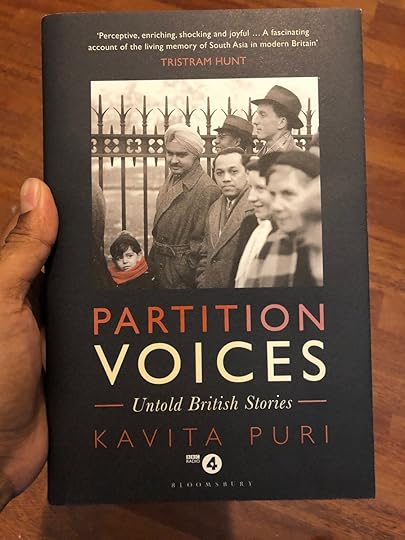
History as a constellation of stories, not a single authoritative narrative, allowing for a greater width of experience and greater depth of sadness - Vinay Patel

January 3, 2020
A great book to start 2020 with, Partition Voices is a stunning account of South Asians and their histories tied to Britain. Accounts of such horrors, and hardships, that have been unspoken. It has given a voice to those affected by partition, unable to speak.

January 5, 2023
Excellent book which provided me new historical background about this event and also gave me a way to understand what my own father experienced.

July 5, 2022
What an amazing book and why are we not taught about this part of British history in schools. Are we too ashamed?
The book is a transcription of the oral histories collected by the author from members of the British South Asian community talking about their horrific memories of partition. The stories show a country where people of different religions happily coexisted until whipped up for political purpose which led to the partition of India and the mass migration of people from their homes into the unknown, severing their roots for generations to come. The brutality, rape, mutilation and murder that accompanied it makes a hard read. I lived amongst members of the South Asian community in London and I had no idea how much the families of some of my friends might have suffered. I wish I had known this many years ago.
The book is a transcription of the oral histories collected by the author from members of the British South Asian community talking about their horrific memories of partition. The stories show a country where people of different religions happily coexisted until whipped up for political purpose which led to the partition of India and the mass migration of people from their homes into the unknown, severing their roots for generations to come. The brutality, rape, mutilation and murder that accompanied it makes a hard read. I lived amongst members of the South Asian community in London and I had no idea how much the families of some of my friends might have suffered. I wish I had known this many years ago.
March 23, 2024
‘We - the British and those of South Asian heritage - have a shared history, as do the different groups within the South Asian community.’
Moved by the true stories of this book. I’m so emotional as I’m writing this review as some of the stories really resonated with me. I hope I can do this book justice in my dissertation.
Moved by the true stories of this book. I’m so emotional as I’m writing this review as some of the stories really resonated with me. I hope I can do this book justice in my dissertation.

Read
January 5, 2022Painful testaments of the experiences and emotions following up to and during the partition, I don't believe I can rate this book given these are personal accounts on trauma.

May 13, 2024
I know very little about Partition, other than that was how modern India and Pakistan came about, and that a lot of lives were lost in that period.
Reading this, I was able to better understand at the individual level what the experience of Partition was like for all groups. There was some background as to why Partition came about but if you came to this hoping for a more detailed look, it's best to look somewhere else. The strength of this book is in giving voice to the ordinary people, though for almost all of them, ordinary would not be what I would call them. They were survivors, extraordinary at that, in their luck at avoiding death at the hands of ranging fanatical mobs on both sides. They were also migrants, who found themselves in the UK ultimately, but always with a longing for the land that they were born in, and were forced to leave.
The stories told were all poignant, and in some instances horrifying in terms of the violence that was encountered. And already, the subjects had already gave as brief an account as possible on such matters. Yet the awfulness of what were done to the victims was staggering in their cruelty and viciousness. All because they came from a different religion. Sikhs, Muslims, and Hindus - all groups were as responsible as they were victims. Religion was but a sordid justification - the true awfulness was the tribal mentality that permeated the mobs that meted out violence and cruelty.
At blame too, though were the British. I don't know enough but from the book, I gathered that Lord Louis Mountbatten and Viscount Cyril Ratcliffe have to bear responsibility for how Partition took place.
What struck me most though was how neighbours who had co-existed peacefully for most of their lives, could simply turn on each other on account of each having different religions. People whose houses they visited, and festivals celebrated - whatever neighbourliness seemed tohave disappeared the moment Partition was announced. Some were willing to turn on long-time neighbours and community members, which resulted in much death. At the same time though, there were also accounts of Muslims helping Hindus, Hindus sheltering Muslims, Sikhs ensuring the safety of Muslims. In the darkness that was Partition, there were shards of light, where their common humanity triumphed over the evils of tribalism and religious fanaticism. But these were too few, and certainly not enough.
Coming from Singapore, I think I better understand why the Singapore state polices the inter-ethnic and inter-cultural space so tightly. Partition is but just one in the latest of sick episodes of man's inhumanity against fellow man. Perhaps a strong state commited to policing all ethnic and religious groups equally and fairly may be the only thing that stands between barbarity and civilisation? But then again the state too can be used as a tool to perpetuate genocide. I have no answers, just a lot of questions. But I do know I need to read more about this tragic event.
Reading this, I was able to better understand at the individual level what the experience of Partition was like for all groups. There was some background as to why Partition came about but if you came to this hoping for a more detailed look, it's best to look somewhere else. The strength of this book is in giving voice to the ordinary people, though for almost all of them, ordinary would not be what I would call them. They were survivors, extraordinary at that, in their luck at avoiding death at the hands of ranging fanatical mobs on both sides. They were also migrants, who found themselves in the UK ultimately, but always with a longing for the land that they were born in, and were forced to leave.
The stories told were all poignant, and in some instances horrifying in terms of the violence that was encountered. And already, the subjects had already gave as brief an account as possible on such matters. Yet the awfulness of what were done to the victims was staggering in their cruelty and viciousness. All because they came from a different religion. Sikhs, Muslims, and Hindus - all groups were as responsible as they were victims. Religion was but a sordid justification - the true awfulness was the tribal mentality that permeated the mobs that meted out violence and cruelty.
At blame too, though were the British. I don't know enough but from the book, I gathered that Lord Louis Mountbatten and Viscount Cyril Ratcliffe have to bear responsibility for how Partition took place.
What struck me most though was how neighbours who had co-existed peacefully for most of their lives, could simply turn on each other on account of each having different religions. People whose houses they visited, and festivals celebrated - whatever neighbourliness seemed tohave disappeared the moment Partition was announced. Some were willing to turn on long-time neighbours and community members, which resulted in much death. At the same time though, there were also accounts of Muslims helping Hindus, Hindus sheltering Muslims, Sikhs ensuring the safety of Muslims. In the darkness that was Partition, there were shards of light, where their common humanity triumphed over the evils of tribalism and religious fanaticism. But these were too few, and certainly not enough.
Coming from Singapore, I think I better understand why the Singapore state polices the inter-ethnic and inter-cultural space so tightly. Partition is but just one in the latest of sick episodes of man's inhumanity against fellow man. Perhaps a strong state commited to policing all ethnic and religious groups equally and fairly may be the only thing that stands between barbarity and civilisation? But then again the state too can be used as a tool to perpetuate genocide. I have no answers, just a lot of questions. But I do know I need to read more about this tragic event.

May 12, 2026
Had this book for years and finally decided to read it in honor of AAPI Heritage Month. The author, however, is not from the States (British) but all the same I decided to read it because the Partition is obviously something that affects more than one country, etc. In any case, I was previously unfamiliar with the author anyway so I did not know this would be a series of essays of the experiences of people forced out of India and Pakistan because of the Partition.
Each person tells their story: Muslims, Hindus, Sikhs, and some who don't fit any of the above. They were living their lives when the Partition came and the experience ranged widely: some were completely unprepared (which was a common experience), some had more warning/had a feeling, some could leave more easily being British. The stories are harrowing: many were forced to flee with only the clothes on their backs to a life of uncertainty and precariousness.
And in some cases, those were the "lucky" ones. Many cases of rape of women from men of other religious followings to the point where women and girls were killed by their own families to prevent this. People were beaten, robbed, murdered. One's existence could simply vanish overnight: loss of your home, your neighbors disappeared and your other neighbors are ones can't trust. Everyone from the teacher of your children to the neighborhood fruit seller to the banker down the street? Gone, dead, someone you can't trust or speak to anymore. It was deeply sad to read the many cases of separation: families, friends, neighbors, colleagues. Childhood playmates gone, classmates who knows where.
It's also clear that this remained with everyone the author spoke to. Simply forced to give up their lives and homes that never left them. Some adjust, but many speak of wanting to go home, of finding a friend or what happened to that house, etc. But never being able to find peace.
To be fair, though, there are several lives who do end up well considering the circumstances. People find their footing, get married, have kids, see their families prosper, etc. in Britain. Many are accomplished in their fields, awarded recognition by the Queen, retire after long successful careers, etc. And many acknowledge of being able to come to some place like Britain (so it has to be acknowledged that certain groups were able to survive and arguably thrive but there millions who will never have this voice).
I took my time to read this one because it was so sad in many ways and I wanted to give them their due. Most of the stories are well-written, some did not click with me. But this was definitely a worthwhile read and I think might help people understand the Partition of India. It is probably not for everyone but even if you only read one or two of these accounts it is definitely worth it.
I bought this and that was fine, although I'm not sure how widely available it is in the US. Would recommend if you have an interest in the subject or if you'd like a reference.
Each person tells their story: Muslims, Hindus, Sikhs, and some who don't fit any of the above. They were living their lives when the Partition came and the experience ranged widely: some were completely unprepared (which was a common experience), some had more warning/had a feeling, some could leave more easily being British. The stories are harrowing: many were forced to flee with only the clothes on their backs to a life of uncertainty and precariousness.
And in some cases, those were the "lucky" ones. Many cases of rape of women from men of other religious followings to the point where women and girls were killed by their own families to prevent this. People were beaten, robbed, murdered. One's existence could simply vanish overnight: loss of your home, your neighbors disappeared and your other neighbors are ones can't trust. Everyone from the teacher of your children to the neighborhood fruit seller to the banker down the street? Gone, dead, someone you can't trust or speak to anymore. It was deeply sad to read the many cases of separation: families, friends, neighbors, colleagues. Childhood playmates gone, classmates who knows where.
It's also clear that this remained with everyone the author spoke to. Simply forced to give up their lives and homes that never left them. Some adjust, but many speak of wanting to go home, of finding a friend or what happened to that house, etc. But never being able to find peace.
To be fair, though, there are several lives who do end up well considering the circumstances. People find their footing, get married, have kids, see their families prosper, etc. in Britain. Many are accomplished in their fields, awarded recognition by the Queen, retire after long successful careers, etc. And many acknowledge of being able to come to some place like Britain (so it has to be acknowledged that certain groups were able to survive and arguably thrive but there millions who will never have this voice).
I took my time to read this one because it was so sad in many ways and I wanted to give them their due. Most of the stories are well-written, some did not click with me. But this was definitely a worthwhile read and I think might help people understand the Partition of India. It is probably not for everyone but even if you only read one or two of these accounts it is definitely worth it.
I bought this and that was fine, although I'm not sure how widely available it is in the US. Would recommend if you have an interest in the subject or if you'd like a reference.

September 10, 2023
Okay, if you know me, then you'll know that horrors of wars and incidents of violence intrigue me - not because I'm a potential serial killer or anything, but because it's unfathomable to me that people indulge in senseless violence for imagined ideals of nationalism, identity, and whatnot. Also, mostly, I like learning about how hope and love shine through even during the darkest of times.
So, naturally, I have read my fair share of books documenting various kinds of violence - from gendered violence during times of war to ethnic genocides. And that brings me to Partition Voices. PV, as the title notes, is a novel recounting stories of South Asians who have migrated to Great Britain. Puri narrates the stories of those who have either themselves experienced the horrors of partition first-hand or have heard the tales of their elders who lived through those times.
Valiant effort has been expended by Puri to document these stories to ensure that voices across various religions are heard and to showcase the common thread in all - a sense of displacement and sadness. Though Puri's narrative and emotions at times overpowered the stories of the persons she interviewed, however, by and large, I commend her for the sensitivity she displayed while listening to them. There was never an attempt to place herself at the center of the story, which I feel happens sometimes with authors who conduct such exercises.
When I started reading the book, I initially felt like there was nothing new that was being stated by Puri that others had already not done so, but it was only in the last chapter of the book (which I believe is an addition on account of the 75th independence anniversary) that I realized the reason behind her exercise. Britain does not take ownership of the violence they unleashed or any accountability for the role that they played. Unlike Germany and the Holocaust, there are no memorials in Britain commemorating victims of the partition, or even a chapter in the school curriculum noting the history. There is outright denial and attempts to bring out Britain's role have been met with staunch opposition.
It's truly saddening and, when seen from the prism of ensuring that the people of Britain are made aware of their own history and their importance in South Asian history, PV assumes significance. However, from an Indian perspective, I wouldn't say that there is anything in the stories that you may not have otherwise heard or read. No harm in picking this up and giving it a shot though!
So, naturally, I have read my fair share of books documenting various kinds of violence - from gendered violence during times of war to ethnic genocides. And that brings me to Partition Voices. PV, as the title notes, is a novel recounting stories of South Asians who have migrated to Great Britain. Puri narrates the stories of those who have either themselves experienced the horrors of partition first-hand or have heard the tales of their elders who lived through those times.
Valiant effort has been expended by Puri to document these stories to ensure that voices across various religions are heard and to showcase the common thread in all - a sense of displacement and sadness. Though Puri's narrative and emotions at times overpowered the stories of the persons she interviewed, however, by and large, I commend her for the sensitivity she displayed while listening to them. There was never an attempt to place herself at the center of the story, which I feel happens sometimes with authors who conduct such exercises.
When I started reading the book, I initially felt like there was nothing new that was being stated by Puri that others had already not done so, but it was only in the last chapter of the book (which I believe is an addition on account of the 75th independence anniversary) that I realized the reason behind her exercise. Britain does not take ownership of the violence they unleashed or any accountability for the role that they played. Unlike Germany and the Holocaust, there are no memorials in Britain commemorating victims of the partition, or even a chapter in the school curriculum noting the history. There is outright denial and attempts to bring out Britain's role have been met with staunch opposition.
It's truly saddening and, when seen from the prism of ensuring that the people of Britain are made aware of their own history and their importance in South Asian history, PV assumes significance. However, from an Indian perspective, I wouldn't say that there is anything in the stories that you may not have otherwise heard or read. No harm in picking this up and giving it a shot though!

December 8, 2022
And now I need to hear from all the voices who do not live in the UK.
I think that Puri makes such a good point in her Epilogue where she talks about how partition is as much a story of the UK as it is for India, Pakistan and Bangladesh. This is absolutely something which needs to be taught as part of the curriculum - as it's a hugely important part of British Empire history and a hugely important part of the history of Britain today.
What shocked me the most in reading Partition Voices was not the violence and the upheaval, but the fact that all these people opted to move to the UK, despite the British government having been the direct cause of the violence and upheaval.
OK, the British weren't (as far as I'm aware) contributing to the rape and murder of communities, but I lay the blame solely at the feet of Lord Mountbatten who rushed through the border plan and initiated the separation of the countries far too early and too fast for anyone to have possibly been able to handle the changes. It's hardly surprising that a hugely complex nation with a variety of cultures, languages, religions and castes reacted with confusion and fear at what was happening. Partition Voices is full of stories of families and individuals not knowing which country they would "end up in" and being prepared to leave at incredibly short notice. It boggles my mind how on earth the British didn't predict the outcome of a rushed-through partition.
While Puri's book doesn't go much into the politics behind the decision but focuses on the personal stories, the political reasons behind the division are read as undercurrents throughout each of the narratives.
If you are already an expert on partition (who is?!) then this book might be a nice accompaniment to your other literature on the topic and is a quick read, but if you don't know much about partition I'd recommend that you do some basic research first to really understand the context. While the book is incredibly well written and is easy to read, it is very much focused on the personal stories and not on the broader context. I am a fan of social history and so for me, this book was perfect, and some of the information - particularly the crimes against women - was new and surprising to me but it should definitely be read alongside some deeper dives into the "plan" for partition.
I think that Puri makes such a good point in her Epilogue where she talks about how partition is as much a story of the UK as it is for India, Pakistan and Bangladesh. This is absolutely something which needs to be taught as part of the curriculum - as it's a hugely important part of British Empire history and a hugely important part of the history of Britain today.
What shocked me the most in reading Partition Voices was not the violence and the upheaval, but the fact that all these people opted to move to the UK, despite the British government having been the direct cause of the violence and upheaval.
OK, the British weren't (as far as I'm aware) contributing to the rape and murder of communities, but I lay the blame solely at the feet of Lord Mountbatten who rushed through the border plan and initiated the separation of the countries far too early and too fast for anyone to have possibly been able to handle the changes. It's hardly surprising that a hugely complex nation with a variety of cultures, languages, religions and castes reacted with confusion and fear at what was happening. Partition Voices is full of stories of families and individuals not knowing which country they would "end up in" and being prepared to leave at incredibly short notice. It boggles my mind how on earth the British didn't predict the outcome of a rushed-through partition.
While Puri's book doesn't go much into the politics behind the decision but focuses on the personal stories, the political reasons behind the division are read as undercurrents throughout each of the narratives.
If you are already an expert on partition (who is?!) then this book might be a nice accompaniment to your other literature on the topic and is a quick read, but if you don't know much about partition I'd recommend that you do some basic research first to really understand the context. While the book is incredibly well written and is easy to read, it is very much focused on the personal stories and not on the broader context. I am a fan of social history and so for me, this book was perfect, and some of the information - particularly the crimes against women - was new and surprising to me but it should definitely be read alongside some deeper dives into the "plan" for partition.
September 9, 2020
At a time when immigration, once again, is making UK headlines, and there are some people who want to return to some golden age of Empire, this book makes essential reading.
The partition of India in 1947 marked the beginning of the end of the British Empire and resulted in the deaths of over 1 million British subjects and the raping and abduction of tens of thousands of women as religions, previously living relatively harmoniously together, were set on each other.
Kavita Puri’s book uses the voices of individuals caught up in Partition to tell the stories of families and communities torn apart both before, during and after the separation of India into India and Pakistan. This is a bloody history, sensitively and humanely told. It is often too easy to read newspaper reports of mass killing in civil wars that we become almost blasé. By focusing on individuals who find themselves in the most dreadful of situations through no fault of their own is immensely powerful, and this book is both shocking and enlightening.
These Partition Voices tell of horrors, resilience, the protection of family above all, the love of homeland, overcoming adversity, the untold damage that can be done by mismanaged politics and the senselessness of religion-incited hatred.
“My father recalls that the Muslim family and their beautiful daughters at the end of the road were slaughtered by Sikhs…..He saw ‘poor innocent babies snatched from their mother’s lap and they were killed in front of them.”
One of Kavita’s ‘voices’ recounts conversations she has had with racists in the UK, in 2015, typical of the Xenophobia that exists post-Brexit referendum:
‘She was on an industrial estate in Teesside, Middlesbrough, asking the general public questions, when a man came up to her and said: ‘When are you all going to go home?’’….These experiences make her think that if people knew the history of where her parents came from they would understand why there is a large South Asian population in Britain. That Britain was once the centre of an empire, and migration happened.’
To understand where we are now, we need to understand our history and this sincere and heartfelt collection of accounts is one of the best places to start.
The partition of India in 1947 marked the beginning of the end of the British Empire and resulted in the deaths of over 1 million British subjects and the raping and abduction of tens of thousands of women as religions, previously living relatively harmoniously together, were set on each other.
Kavita Puri’s book uses the voices of individuals caught up in Partition to tell the stories of families and communities torn apart both before, during and after the separation of India into India and Pakistan. This is a bloody history, sensitively and humanely told. It is often too easy to read newspaper reports of mass killing in civil wars that we become almost blasé. By focusing on individuals who find themselves in the most dreadful of situations through no fault of their own is immensely powerful, and this book is both shocking and enlightening.
These Partition Voices tell of horrors, resilience, the protection of family above all, the love of homeland, overcoming adversity, the untold damage that can be done by mismanaged politics and the senselessness of religion-incited hatred.
“My father recalls that the Muslim family and their beautiful daughters at the end of the road were slaughtered by Sikhs…..He saw ‘poor innocent babies snatched from their mother’s lap and they were killed in front of them.”
One of Kavita’s ‘voices’ recounts conversations she has had with racists in the UK, in 2015, typical of the Xenophobia that exists post-Brexit referendum:
‘She was on an industrial estate in Teesside, Middlesbrough, asking the general public questions, when a man came up to her and said: ‘When are you all going to go home?’’….These experiences make her think that if people knew the history of where her parents came from they would understand why there is a large South Asian population in Britain. That Britain was once the centre of an empire, and migration happened.’
To understand where we are now, we need to understand our history and this sincere and heartfelt collection of accounts is one of the best places to start.

November 18, 2022
Partition Voices - Untold British Stories - by @kavpuri
“Across Punjab, in both directions, millions of refugees fled not only by train but also on foot. This mass of humanity – caravans of people - could be many miles long. Gurbakhsh was a witness to one of the largest mass migrations the world had ever seen. He saw these lines of exhausted people, travelling together for safety, with their bullock carts and whatever possessions they were able to grab before they left their homes. He saw how they would sleep on the road, some camping in his family's groundnut fields, the same place he would play and help on his grandfather's farm.”
Before getting into my review for this book, I would like to take the liberty to recommend this book to each and everybody. This is an eye-opening, heart-wrenching book, but a very unique and interesting document about the partition or the shared history of Britain and India.
This book has been divided into three parts. In part one, “End of the Empire” the author subtly explains the termination phase of British Rule in the Indian subcontinent and how partition became inevitable. Part two, “Partition” explains stories of what happened before and after the partition, and also demonstrates the political and social tensions at play during this time. These stories are so neutral and the author distances herself from any sort of inclination towards any particular religion, country or caste, instead offering a true account. The au tried and includes the stories of people belonging to diverse castes and communities including Hindus, Muslims, Sikhs, Parsis etc. Hence, this book is a perfect document to understand the contemporaneous socio-political conditions. Part three, “Legacy” explains the South Asian population in today's Britain.
Conclusion: It's a short and very readable book putting the history of Partition on a very personal level from different viewpoints of those who and their parents witnessed the events of Partition.
.......continued in the pinned comment
“Across Punjab, in both directions, millions of refugees fled not only by train but also on foot. This mass of humanity – caravans of people - could be many miles long. Gurbakhsh was a witness to one of the largest mass migrations the world had ever seen. He saw these lines of exhausted people, travelling together for safety, with their bullock carts and whatever possessions they were able to grab before they left their homes. He saw how they would sleep on the road, some camping in his family's groundnut fields, the same place he would play and help on his grandfather's farm.”
Before getting into my review for this book, I would like to take the liberty to recommend this book to each and everybody. This is an eye-opening, heart-wrenching book, but a very unique and interesting document about the partition or the shared history of Britain and India.
This book has been divided into three parts. In part one, “End of the Empire” the author subtly explains the termination phase of British Rule in the Indian subcontinent and how partition became inevitable. Part two, “Partition” explains stories of what happened before and after the partition, and also demonstrates the political and social tensions at play during this time. These stories are so neutral and the author distances herself from any sort of inclination towards any particular religion, country or caste, instead offering a true account. The au tried and includes the stories of people belonging to diverse castes and communities including Hindus, Muslims, Sikhs, Parsis etc. Hence, this book is a perfect document to understand the contemporaneous socio-political conditions. Part three, “Legacy” explains the South Asian population in today's Britain.
Conclusion: It's a short and very readable book putting the history of Partition on a very personal level from different viewpoints of those who and their parents witnessed the events of Partition.
.......continued in the pinned comment
September 29, 2025
Kavita Puri’s Partition Voices: Untold British Stories is not just a book of history—it is a book of heartbreak, memory, and survival. With tenderness and quiet strength, Puri collects the voices of those who lived through the Partition of 1947, when millions were displaced and hundreds of thousands lost their lives. These are voices that had remained silent for decades, buried under the weight of trauma and the reluctance to reopen old wounds.
What makes the book so powerful is its intimacy. We are not reading abstract accounts of political decisions or distant statistics; we are listening to a grandmother recalling the day she left her childhood home forever, or a man remembering how his family walked for days with nothing but hope. Each story is raw and human, filled with pain but also resilience. In between the horror of massacres and the anguish of separation, there are glimmers of extraordinary kindness—neighbors protecting one another, strangers offering food to the displaced. These moments remind us that even in the darkest hours, humanity can shine through.
Puri writes with empathy, allowing her narrators to guide the story. She does not impose judgment but creates space for truth and healing. Reading these testimonies feels like sitting in a quiet room, listening to elders who had long locked away their grief. One cannot help but feel both sorrow for their suffering and gratitude that these memories have finally been shared.
This is not just a book about India or Pakistan; it is also about Britain, where these survivors built new lives while carrying invisible scars. By bringing their voices forward, Puri ensures that Partition is no longer a forgotten chapter, but a living memory that connects generations.
Partition Voices is a deeply moving reminder that history lives in people’s hearts—and that listening is itself an act of justice.
What makes the book so powerful is its intimacy. We are not reading abstract accounts of political decisions or distant statistics; we are listening to a grandmother recalling the day she left her childhood home forever, or a man remembering how his family walked for days with nothing but hope. Each story is raw and human, filled with pain but also resilience. In between the horror of massacres and the anguish of separation, there are glimmers of extraordinary kindness—neighbors protecting one another, strangers offering food to the displaced. These moments remind us that even in the darkest hours, humanity can shine through.
Puri writes with empathy, allowing her narrators to guide the story. She does not impose judgment but creates space for truth and healing. Reading these testimonies feels like sitting in a quiet room, listening to elders who had long locked away their grief. One cannot help but feel both sorrow for their suffering and gratitude that these memories have finally been shared.
This is not just a book about India or Pakistan; it is also about Britain, where these survivors built new lives while carrying invisible scars. By bringing their voices forward, Puri ensures that Partition is no longer a forgotten chapter, but a living memory that connects generations.
Partition Voices is a deeply moving reminder that history lives in people’s hearts—and that listening is itself an act of justice.

November 8, 2020
Since learning about the Partition of India, I've always wondered about how a country so unified in it's rejection of the British Raj and with a history of religious harmony (broadly speaking) could violently splinter in a few months, leaving ~1M dead.
Partition Voices doesn't aim to answer this vast question. It does, however, act as an invaluable biography of the lives of some of those who lived through partition.
I'm a big fan of Kavita's writing: it's honest and evocative. She talks to many who were involved in one way or another: British colonists, Raj officials, mothers caught up in the violence, refugees fleeing from their homes, Hindu and Muslim nationalists, and the children of the above. Through her sensitive interviews, she describes the terrible events in the words of it's witnesses, and adroitly shows how the pain of partition is now deeply interwoven into their identity.
Profoundly moving to read, I personally found this very valuable in helping me understand the broader Indian diaspora. Ultimately a book that raised more questions than it answered (I still struggle with my first question).
My only hesitant criticism is that the arc of the book itself was hard to follow - it seemed to be grouping of testimonies with some surrounding historical commentary.
For those interested in a "preview", I can recommend the companion Radio 4 series. There's also an excellent and short primer on partition on the BBC, and a review of reviews by Will Dalrymple in the New Yorker.
Partition Voices doesn't aim to answer this vast question. It does, however, act as an invaluable biography of the lives of some of those who lived through partition.
I'm a big fan of Kavita's writing: it's honest and evocative. She talks to many who were involved in one way or another: British colonists, Raj officials, mothers caught up in the violence, refugees fleeing from their homes, Hindu and Muslim nationalists, and the children of the above. Through her sensitive interviews, she describes the terrible events in the words of it's witnesses, and adroitly shows how the pain of partition is now deeply interwoven into their identity.
Profoundly moving to read, I personally found this very valuable in helping me understand the broader Indian diaspora. Ultimately a book that raised more questions than it answered (I still struggle with my first question).
My only hesitant criticism is that the arc of the book itself was hard to follow - it seemed to be grouping of testimonies with some surrounding historical commentary.
For those interested in a "preview", I can recommend the companion Radio 4 series. There's also an excellent and short primer on partition on the BBC, and a review of reviews by Will Dalrymple in the New Yorker.
Displaying 1 - 30 of 87 reviews