Jump to ratings and reviews
Rate this book

The White Darkness

Rate this book
When her uncle takes her on a dream trip to the Antarctic wilderness, Sym's obsession with Captain Oates and the doomed expedition becomes a reality as she herself is soon in a fight for her life in some the harshest terrain on the planet.

373 pages, Hardcover

First published September 1, 2005

84 people are currently reading
3847 people want to read

About the author

Geraldine McCaughrean

349 books327 followers
Geraldine McCaughrean is a British children's novelist. She has written more than 170 books, including Peter Pan in Scarlet (2004), the official sequel to Peter Pan commissioned by Great Ormond Street Hospital, the holder of Peter Pan's copyright. Her work has been translated into 44 languages worldwide. She has received the Carnegie Medal twice and the Michael L. Printz Award among others.

Ratings & Reviews

What do you think?
Rate this book

Friends & Following

Create a free account to discover what your friends think of this book!

Community Reviews

5 stars
1,060 (24%)
4 stars
1,231 (28%)
3 stars
1,157 (26%)
2 stars
637 (14%)
1 star
299 (6%)
Displaying 1 - 30 of 745 reviews
Profile Image for kwesi 章英狮.
292 reviews743 followers
July 27, 2011
Do you have any idea how to live in a freezing dessert called South Pole? Or have you tried reading thousands of books regarding South Pole and the failed expedition of Captain Oates? What if you fall in love to an imaginary character just by watching an old film about South Pole? This book is sympathetically all you need to live in the South. No need for maps or self-help books and most of the entire journey is effortless.

I never wished to go to the South and I don’t have any idea how to fall in love to an imaginary character. This thing only happened to social declined people, I’m not insulting but that’s how the book described the character. When I was young, I never have an imaginary friend to play with all I have are real kids who wants to play karate and Power Rangers.

Imagine how old I was when those types of games were still on its peak, now kids have to sit and play with their play station or PSP. Life is too short guys, why not enjoy it outdoor? Scared of the sun? Well, go to the South and play with Sym Wates who enjoyed clinging with her imaginary boyfriend.

The White Darkness is the story of Sym Wates who enjoyed watching and reading books related to South Pole, and have a relationship with an imaginary character. Quite disgusting for a lady character and interesting for a 14-year-old girl who enjoyed that kind of stuff. Because of her love to her uncle Victor, who taught her everything she needed to survive in the cold and taught her everything about books, she was mesmerized of her opportunity to go to the South because of her uncle’s stupidity about Inner World.

When they arrived to the South Pole, life turns upside-down, everything changed into frozen dreams. Sym’s beliefs will change forever as the story progress, until she knew the true meaning of oneself and the true meaning of love. Love not only to benefits others but to posses the power of judgment. Whatever happened to her in the end, I never cared to know it anymore.

The true motif of this book is to portray the abuse and the deception that her Uncle did to her since she was young, imagine she was forced to dream like him, she was fooled about her parents and lastly she was planned by her uncle to destroy her father. In this way her dillusional problem about her imaginary boyfriend was applied in the story and most of the children who have abused have this kind of psychological disorder.

The thing that did not work for me is that this book is to disgusting, okay, I’m not here to judge the characters. But I can’t imagine having a relationship with an imaginary boyfriend. Second, the sentences, the words and her style did not work well. It was like talking to yourself than to know the true essence of the book.

It took me hours or more than what I expected to finish this book. You have to read it well, read it slowly to understand it. The book also mentioned the true meaning of the title, although it was vividly explained, I can’t still get the whole point. But describing it as the mist of the South Pole and the treacherous natural characteristic of the place which I don’t have any idea since I never been there before.

This book was awarded by Printz Award in 2008 and so far I did not appreciate this. I recommend this book to young readers who enjoyed reading South Pole related stuff. This can be also enjoyed by mystery and adventure book lovers and lastly, those kids who have the same boyfriend like Sym. Enjoy reading!


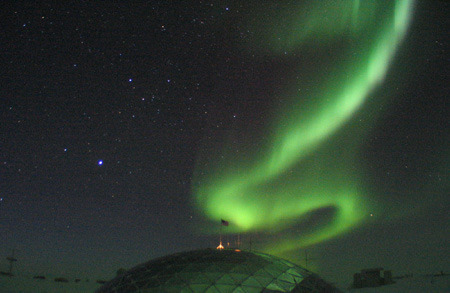
The aurora australis snakes across the South Pole sky in 2002 in displays whose beauty awed researchers spending the winter there. (Photo courtesy of the U.S. Antarctic Program)


Review posted on Old-Fashioned Reader .

Rating: The White Darkness by Geraldine McCaughrean, 3 Sweets

Challenges:
Book #205 for 2011
Book #120 for Off the Shelf!
This entire review has been hidden because of spoilers.
Profile Image for R.J..
Author 16 books1,476 followers
November 27, 2008
I wavered over whether to choose "I really liked it" or "It was amazing" for this one, but I went with the four stars in the end because it's such a dark book in so many ways that I'm not sure I'd want to read it again. On the other hand, I might just to pick up on all the details I'd missed.

The gorgeous yet narrator-appropriate language in this book, the amount of research that must have gone into it about Antarctica, just staggers me. It is possibly the weirdest book I have read all year, and I'm quite sure it has a large number of people who hate it with a rabid passion just because of that, but I didn't find Symone difficult to care about or sympathize with even when she seemed almost impossibly strange and naive, and I definitely wanted to know what Uncle Victor was up to (the author does a very good job, I think, of giving you an ominous squirming feeling right from the beginning that something is Not Quite Right with this whole scenario), so I kept reading.

Oh, yeah, and of course I was shipping Symone/Titus. If you don't buy into Titus then you are not going to like this book, but I could readily believe that Symone could retreat into her own head to the degree that Titus became real to her, and yet be intelligent and aware enough not to deep down TRULY believe in his existence (and there are ample clues to that throughout the book -- she really does know better).

One possible flaw is that the circumstances in which Symone finds herself, and the characters who surround her, are almost too wildly eccentric to seem real -- and yet it seems like such a quintessentially British approach to storytelling, and I've seen it done so many times even with real people (Gerald Durrell's MY FAMILY AND OTHER ANIMALS comes to mind, or the works of James Herriot) that after a little while I gave up being skeptical and went with it. Your mileage may vary.

Anyway, it's weird and brilliant and drives me to total despair when I think of my own attempt at writing a psychologically complex novel with an emotionally repressed heroine, so I have to say I admire it.
This entire review has been hidden because of spoilers.
Profile Image for Abby Johnson.
3,373 reviews355 followers
January 29, 2008
So many people have loved this book... I think it's just not my thing. After the death of her father, 14-year-old Symone, excruciatingly shy hearing-impaired geek with an imaginary friend, is whisked away on a surprise trip to Antarctica by her Uncle Victor. From the start you can sense that something's not right here. Victor's acting fishy, lying to Sym about their destination, stealing her mother's passport so she can't come with them... and things just get bleaker and bleaker as the journey goes on.

My frustration is that Sym is so blinded by admiration for her Uncle (who's actually just a close family friend, not a blood relative), that she can't see that things are horribly wrong. I kept waiting for her to take charge and save the day (or at least save herself), but she just kept going with the flow as things got worse and worse... Also, the fact that Sym is so shy and the "person" she talks to most is a dead historic figure who only exists insider her head... well, it's a very odd perspective.

I will say that there is some great writing in this book, though. The plot and characters just didn't do it for me.
Profile Image for Candice M (tinylibrarian).
455 reviews140 followers
February 18, 2008
When I think about this book, all I want to do is sigh. Sigh because it was a frustrating read, sigh because of the main character's situation throughout most of the book, and sigh that it won the Printz.

I read it, and I read it fast. I stayed up all night to finish this mother. I was *so* worried about this girl's retarded fate that I couldn't sleep! I needed to find out what happened! So in that sense, yes, it was excellent. In the sense that the story traps you like you've gotten snowed in while you're on holiday in the wilderness. There is no choice. You have to finish. You have to survive.

However, I hated myself for caring. I hated myself for my inner optimism which compelled me to keep reading. And maybe that is really where its brilliance lies. That you can hate everything about it but still feel as if you have to finish it.
Profile Image for Kara Babcock.
2,115 reviews1,595 followers
May 10, 2013
I really am not an adventurous person. Moving to England—having never lived on my own before—aside, I’m not the sort of person who enjoys embarking on “expeditions”. I took a trip up to Edinburgh back in October, and that was adventurous enough for me for a few months. These days, a train to Norwich is about as much adventure as I can muster. I read National Geographic and watch the Discovery Channel and soak up all these stories of adventure and exploration vicariously—but I cannot imagine actually doing such things myself. I can’t imagine journeying to Antarctica, struggling to survive in a land of endless night and blinding snow … so reading about the plight of Sym Wates was a mixture of shock and awesome.

The White Darkness fulfilled a hunger in me I wasn’t even aware I had. Thanks to the lucrative Twilight and Hunger Games series, it seems like every other young adult novel is some type of escapist, fantasy or science fiction story. I’m the last person who would complain about this. But it’s nice to have an example of a novel that is escapist and fantasy without actually being escapist or fantasy. That is to say, everything in The White Darkness is possible (if slightly implausible). At the same time, it is in the vein of escapism, and it has elements of a fantasy in the way it allows imagination to take over.

Geraldine McCaughrean’s writing is also amazing. With her simple but elegant descriptions, she manages to create the voice of a fourteen-year-old girl who is isolated but not particularly depressed. McCaughrean’s diction and description communicate a sense of remove from the surrounding world. Sym is bookish and academically inclined; she has friends but is not among the fastest-moving of them. She is a romantic who lives so much in her head that a romantic is about all she can be. Above all else, Sym is interested in polar exploration—so much so that she hears the voice of the late Lawrence “Titus” Oates in her head.

Sym joins her honourary “Uncle” Victor in a trip to Paris. Her mother can’t join them at the last moment—her passport mysteriously goes missing—so they go to Paris alone. Then—improbably, unlikely, bizarrely—this short trip away from home turns into an expedition to Antarctica, the one place in the world Sym would love to visit. As far away from home, friends, and family as Sym could possibly be, she finds herself among a group of strangers at the edge of the world—and her uncle might just be the most strange of them all.

From the beginning, McCaughrean insinuates something untoward about Victor’s relationship with Sym. It’s both delicious and unsettling at the same time, because we experience everything from Sym’s perspective of innocence and naivety. Mom can’t come—no passport. Victor eats the SIM card in their mobile phone as a “joke”. He takes Sym shopping for over-priced clothes that make her look more grown-up. As the evidence mounts, McCaughrean lets us draw our own conclusions about what Victor plans to do on this trip to Paris. Is he kidnapping Sym? Is he going to abuse her? Will she manage to figure it out and escape? But at each turn, McCaughrean twists away from the obvious answer.

It turns out that Victor’s designs on Sym are quite different from the more ordinary tale of sexual abuse at the hands of a family friend. No, though Victor is still guilty of abusing Sym, it’s an abuse that functions on a much more sophisticated level, something that has stretched back far into the past—beyond Sym’s birth, even, to his friendship with her late father. Their unannounced trip to Antarctica is the culmination of Victor’s plans—his schemes, if you will—the confirmation of the conspiracy theory that has captured his mind.

I love books where some of the most bizarre elements, the elements that you think have to be fictional because they are so outrageous—or just so specific, so convincingly told that they have to be lies—turn out to be the truth. Such is the case with the particularly nineteenth-century flight of fancy that powers the plot of The White Darkness. McCaughrean draws on names, like John Cleeves Symmes, that are probably obscure to the average reader, but are real enough to those with the right interests. She uses real historical people, places, and events to create a backstory, and from there she creates a plot that is fictional—both for us and, sadly, for Sym and her uncle.

As everything comes crashing down around Sym—both her faith in her uncle and her own certainty in the order of her world—she finds a sudden need to develop agency. Indeed, the first part of the book suffers only in that Sym is a passive protagonist. She just goes along trustingly with Victor, never gainsaying him, never wondering if she shouldn’t find a way to contact her mother. This is frustrating, and I suppose McCaughrean wants it to be that way so that we feel a growing sense of dread as we contemplate what Victor has in store for Sym. Nevertheless, the book doesn’t really come into its own until it lets Sym start acting instead of reacting.

From that point, The White Darkness turns into a story of survival. Though not my favourite genre, this transition worked for me because of the faith I had built up in Sym, and my need to see Victor laid low. McCaughrean delivers an ending that is satisfactory, albeit somewhat succinct for my tastes. Sym undergoes a crisis both physical and mental, enduring a level of deprivation that I doubt I would ever be able to tolerate.

It’s possible her imaginary Oates is what helps her through. Oates’ voice runs throughout The White Darkness like an authorial counterpoint, commenting upon events and providing a subconscious voice with which Sym can debate. Oates is funny and charming, warm and prone to reminiscing without being immodest. He is probably the type of adventurer Sym imagines herself being, if she were a man and alive at the turn of the twentieth century…. As it is, Oates becomes the only crutch she can lean on as everything else falls to pieces around her. It’s an interesting, very narrative way of externalizing the ways that people process emotional trauma and abuse.

The White Darkness doesn’t have zombies, or vampires, or giants or werewolves or angels. It doesn’t have a smooth-talking wizard, a mysterious goblin king, or even a Jesus allegory lion. It’s a skilled, highly satisfying combination of a (sadly) ordinary story of obsession and abuse coiled around the extraordinary tale of exploration, survival, and a quest for something that could never be.

Creative Commons BY-NC License
Profile Image for McNeil.
93 reviews
March 7, 2009
A gorgeous book. Shocking when someone pure and innocent--not just because she is young--many of her peers are far more worldly-wise than she--is manipulated by those she trusts--she has no idea what is real and what is not. Her whole existence, the whole story she's been told is just based on other people's manipulation of the facts. I'm still not certain whether those who manipulated the facts were conscious that they were doing so. It is yet another great example of the ills of fanaticism, no matter what a person is being fanatical about. Fanaticism blinds people and convinces them they are doing the "right" thing even when they are hurting people left and right. They can justify the most heinous behavior, and in this book they sure try. The beautiful and terrifying journey to her truth about her self and her world--to be discovered in the wastes of Antartica, of all places--is one you will not want to miss. The language is wonderful, the character of Sym is so sweet and strong, you will love her and feel with her, and the plot is very exciting. The play of reality vs. imagination is fun, the history lesson is great, and the whole package earns five stars for me, and no reservations in recommending it to youngsters. Probably a PG rating. An example quotation: "It's true: Everyone needs a reason to stay alive--someone who justifies your existence. Someone who loves you. Not beyond all reason. Just loves you. Even just shows an interest. Even someone who doesn't exist, or isn't yours. No, no! They don't even have to love you! They just have to be there to love! Target for your arrows. Magnetic Pole to drag on your compass needle and stop it spinning and spinning and tell you where you're heading and...Someone to soak up all the yearning. That's what I think. That's what I deduce."
Profile Image for Cheryl.
1,146 reviews
August 11, 2017
This book was better than I thought it would be. Set mostly in Antarctica, it starts out like a typical YA novel, with 14 year old Sym telling us how she's bullied at her school in England, is shy, and doesn't fit in. Obsessed with Antarctica and the doomed 1911 expedition, she frequently confides in her imaginary friend, Captain Oates, who was one of the explorers.

But when her uncle Victor takes her on a trip to Antarctica, it soon turns into something more horrible than she ever suspected it would be. There were times I thought Sym was a bit too naive, even for 14. However, I think she had to be so that the plot would progress. And maybe she did want to think the best of those around her. (I was pretty cynical at 14, myself.) The story got pretty dark towards the end, and had a realistic ending. An unusual YA read.
Profile Image for Jessica.
Author 26 books5,919 followers
August 17, 2015
Vivid, harrowing, and highly unusual. Sym is a strange sort of heroine: locked up in her own head, where she converses constantly with Titus Oates, the romantic and tragic army man of Scott's expedition to the Antarctic. Sam's Uncle Victor regularly assures her that she is not bright, not charming, but he still takes her along on the trip of a lifetime to the Antarctic. But Sym is not what Uncle Victor says, and neither is he. Or anyone, really.

Fascinating and strange, and very, VERY stressful!
Profile Image for Stephanie.
343 reviews9 followers
March 11, 2008
I have a friend who says she can tell if she’ll love a movie with the first ten minutes. And I can often say the same for a book; I can tell I love it within the first twenty pages or so. But The White Darkness took me until page 73 to get really hooked. And then I couldn’t put it down. It’s about a teenage girl, Symone, who gets her dream vacation: a trip to Antarctica. She is obsessed with Antarctica and one of its brave explorers, Captain Oates from Scott’s doomed expedition to the South Pole. She always has been. And her Uncle Victor has always supported her. But there’s something off about Uncle Victor. He’s even more obsessed with Antarctica than Sym. This is a devastating explosion of a plot that delivers aftershock after rolling aftershock.
Profile Image for P. Kirby.
Author 6 books83 followers
November 18, 2018
This novel gave me frostbite by proxy.

Much younger me loved the cold, but somewhere along the road of life, my inner heater started failing, and now 60-degrees F gives me chilblains. Thank the dear and fuzzy wuzzy lord for intrepid explorers and filmmakers who bring visions of Antarctica into the warm comfort of my living room. Because no place is gorgeous enough to justify skin freezing on contact with the air.

Fourteen-year-old Sym is in love with an older man--sort of--Titus Oates, a member of famous explorer's Captain Robert Falcon Scott's doomed Antarctic trip. Titus, who froze to death on the 1911 trip, along with the rest of the team, has captivated Sym's imagination and as an imaginary friend, fends off her loneliness. Painfully shy, hard-of-hearing and wearing hearing aids, Sym is friendless and a target for bullies. A few years before, her father, who she believes never liked her anyway, died of a mysterious infection that destroyed his sanity. Sym and her mother survive financially through the benevolence of her father's friend, Uncle Victor. Victor, an eccentric, is a nutter who believes that lost civilizations, more advanced than ours, live in Earth's hollow depths beneath Antarctica.

Sym and Victor's adventure begins with an innocuous trip to Paris. Sym's mother is supposed to come along, but at the last minute, before boarding the train, finds her passport is missing. It seems innocuous enough, but an astute reader will quickly start to smell a rat--a rat named Uncle Victor.

After a day or so in Paris, Victor announces that their trip will extend farther south. Sym assumes this means the Mediterranean, perhaps. Instead, it turns out Victor has booked them passage with an expensive travel outfit that takes people on short trips to Antarctica.

But for Uncle Victor, simply being in Antarctica isn't enough. Through a series of unfortunate events, he acquires/steals an arctic Humvee-vehicle and drags Sym on a grueling, life-threatening trek across the bleak ice in search of a portal into the Earth's hollows. What follows is a brutal journey, physically and emotionally, through a landscape inhospitable to nearly all life, and death to humans. As the trip unfolds, Sym, who worships her Uncle almost as much as imaginary Titus, learns how misplaced her admiration is and how deeply a person can be betrayed.

My reactions to the story vacillated between irritation at Sym's naivete and then fury at Victor's lunacy and abuse. Sym's unflagging belief in Victor's intelligence is annoying, and yet, realistic for a sheltered, awkward child.

The thing is, people, even adult people, will often believe that someone is the strongest, smartest, most wonderful person, if the person brags enough. Case in point, one of my husband's co-workers. The man, let's call him Bob, is mediocre at best. But he carries on and on, telling everyone how busy he is, how much he does for the company. And...a number of employees believe his narrative, agreeing that his inability to get promoted is "unfair" and the result of cruel biases against Bob. (Unfortunately for Bob, he's too dimwitted to sell his greatness to management, so his fan club consists of fellow technicians and admin staff.)

Point is, if Bob can get adults to believe his narrative of greatness, it's no surprise that a child would fall for the same from a "respected" adult/parent-figure.

The White Darkness seems to be a love or hate-it book, but my reaction is solidly centrist. The journey across the ice is enthralling; the lack of significant romance, a relief; and the emotional landscape just as brutal as Antarctica's. I never felt manipulated, but I never really got the "feelz," either.

36 stars. (Bumping up to four stars because the story's original premise and locale are memorable.)

(Library book)
Profile Image for Stephanie.
355 reviews9 followers
July 18, 2016
A young girl named Symone is taken without her mother's permission by her "uncle" on a trip to the Antarctic. Uncle is obsessed with the idea of a world or worlds within the Earth and is convinced that the access portal to these worlds lies at the South Pole. Sym is a whole lot naive and completely too trusting of this uncle but as the story goes on she becomes more and more aware of how crazy her uncle is. The trip is dangerous with hazards you can't even imagine and is driven by the obsessed madman and fed into by some con men who think Uncle is rich. What they don't know is that he's spent every penny on this last chance to find "Symme's Hole". Young Sym has to find a way to save herself and her crazy uncle in the middle of the Antarctic plateau.
Profile Image for Alex.
542 reviews18 followers
January 25, 2008
In this brilliantly crafted story of madness and despair comes the story of teenage Sym who is whisked away from her normal teenage anxieties to face the bleak desolation of Antarctica and her uncle's obsession. Sym is a normal British teen, unpopular boys and the butt of many jokes with her friends. Her father has died rather tragically, but Sym finds solace by insulating herself in a fictional world where her principal friend is an incarnation of Captain Lawerence Oates, who lead an ill-fated expedition to the South Pole. Titus, as Sym lovingly refers to him, is her constant and only companion in her journey to bottom of herself and to the bottom of the earth. At no point do any of doomed characters warrant sympathy, yet this sad story is completely compelling in it's wonderful description of the slow self-destruction of the obsessed mind.
It is very rare that I quote a passage of the book, but so sharp is the writing in this book, which captivates the reader, that I find myself lost in the words. From page 81 on, "Why, when we overflew the coast, were there turquoise sculptures of ice rolling over and over in waves of indigo? It terrifies me, the sea. I know it would kill me if it could. I think this whole continent would kill us if it could once sink its teeth into us... And yet,I've never seen anywhere so beautiful, so marvelous. "
Consumed by her demented uncle's vision, Sym finds herself slowly self destructing as the world she knows slips away from her fingers. This reminds me of the amazing movie, Mosquito Coast, in which Harrison Ford's character is so hell-bent on escaping the confines of the modern world, that he drags his family along his descent into self-preservation and ultimately madness.
Equally challenging and engaging, you never know where this story is going, much like the Life of Pi from a few years ago. Take the time to emerge yourself into this amazingly dark, yet blindingly white world.
Profile Image for Julia.
452 reviews29 followers
February 27, 2009
This was a very good book from a literary standpoint. It is however, not a "fun" read. It is a Printz award winner for the best book of the year for young adults, and deservedly so.

It is a tale of a teen from England who gets taken on a surprise trip to Antartica with her uncle. Symone's (Sym) story quickly turns into a survival tale, as she deals with an increasingly manic uncle.

What helps Sym get through is her imaginary relationship with a long dead artic explorer. This character is more real to her than most of the people she is traveling with.

Sym is (justifiably) very naive about what is acutally happening during this trip. She fails to question her "genius" uncle when the spontaneous trip to Paris (which her mother missed because of a lost passport) turns into an Antartic expidition. She blindly accepts all the assurances of her uncle, even as they become more suspect to a reader. On one hand, Sym's cluelessness is irritating. On the other hand, as we learn more about how Sym's uncle has manipulated her all of her life with an increasingly disturbing series of lies, her ignorance and the choices she makes because of it become plausable.

Eventually, pulling on strength she didn't know she had, Sym opens her eyes to her uncle's maniacal plans. She is able to resist him, and more importantly, survive the Antarctic expidition.

In many ways, Sym's uncle is one of the most disturbing characters I've encountered in a long time. Sanity of all the characters is in question throughout the tale. It's an excellent read, but not one to pick up in a blue mood.
Profile Image for StarMan.
765 reviews17 followers
March 29, 2020
REVIEW: Adventure Danger in Antarctica. Shy, imaginative, memorable teen protagonist (Symone). Adult characters are useless, demented, or dangerous. Will Sym survive?

VERDICT: Rounded up to 3 stars since I am not a Young Adult.
Breakdown: 4 stars for Sym, 0.5 stars for the idiot adults, 3.75 stars for the writing. Averages to ~2.75 stars.

BONUS POINTS FOR: .
Profile Image for Eilonwy.
904 reviews223 followers
May 5, 2015
14-year-old Symone Wates is more than a bit socially awkward (her obvious hearing aids don't help). But thanks to her obsession with the doomed Scott Antarctic Expedition, she's got a pretty solid relationship with Lawrence "Titus" Oates, a member of the team -- even if he does exist only in her head. When family friend "Uncle" Victor, who shares her obsession, takes Sym on a surprise trip to actual Antarctica, her knowledge of the geography and what it takes to survive will be put to the test as she finds herself in circumstances more terrifying than she ever imagined.

I have mixed feelings about this book.

The Good: I really liked Sym, and found both her voice and her awkwardness entirely believable; her isolation and social discomfort felt genuine rather than like a mere plot device (as in too many other books). The balance between her relative immaturity and her curiosity about the more adult things her schoolmates were growing into rang absolutely true. Her internal relationship with Titus was very well done, as well, as she's able to feel safe in a sort-of-close friendship with a man who is clearly too old for her and a bit distant about the whole thing himself. The writing is both beautiful and gripping, and the story moves at a good pace. I can see why this book got rave reviews when it was published (2005) and won the Printz Award.

The Not-So-Good: Some of the twists are a little too obvious from an adult perspective. Younger readers might find some of the revelations to be a surprise, but I didn't (except for one, which was very creepily brought to light; the minus is that I don't quite believe it). And when Uncle Victor's actual reason for the Antarctic trip was revealed, I nearly threw the book across the room because I found it far too preposterous. But I kept reading, and I think it was worth it.

The Warning: This is one of those books which casts doubt on trusting other people, so it might not be a good match for any kid who already worries about that sort of thing or has a vivid imagination. And in light of that, I found the very ending to be just a tad too rosy.

Overall, this was a captivating, vivid read, so if you're in the mood for a sort of adventure/suspense novel, I would recommend it, with the reservations noted above.
Profile Image for Krista.
80 reviews13 followers
April 21, 2008
Fourteen year-old Sym seems to be trapped in her own mind, her deafness, shyness, and social naiveté make her an outcast at school. Her father's death has made her mother distant and invited her eclectic uncle into bring the family out of a financial burden. However, when her uncle, who feeds her love for all things about Antarctica, encourages the family to take a trip, Sym gets whisked away from her mother and thrown into a dangerous adventure in the icy continent with her uncle. His drive for fame and an uncertain "hole to the center of the earth" forces Sym to confront painful memories and rethink herself, her beliefs, and her future.

The themes of isolation, power, and manipulation, as well as similar plot developments, make the work a modern day companion to fellow British author Joseph Conrad's Heart of Darkness. However, the lack of character development, and the disappointing flat dimension of both the protagonist and antagonist do not elevate this novel to the greatness of Conrad's work. While the stream of conscious formula may be alluring to teen readers, the uses of flashbacks provide little in the way of interesting or significant context towards the novel's current action.

Definitely not a book for a reluctant reader. The slow pacing and the repetitive nature of the prose make for an infuriating struggle to remain attentive to the already complex novel. I don't understand how or why the novel is award worthy, especially considering that in the resurrected popularity of Pullman's The Golden Compass, this novel's plot seems entirely unoriginal. The only positive comment I can make about the novel is the description of the Antarctic setting. Its monotony can make one understand how the characters were driven to madness.
Profile Image for Gracie Classon.
15 reviews1 follower
July 13, 2016
This was on the required reading list for YA Lit. This was the worst book I read all semester, and I'm sad that this is the last book on my list. I might have to squeeze another book into my schedule just to get the taste out of my mouth before the end of the semester. End on a good note. This book was long and boring. The author used 370 pages when 200 would have been fine. I kept waiting to get into it or to care at all for the story or the characters, but it just never happened. I started to like Sigurd, but then his character completely flip-flopped and started acting lame in the last 10% of the book. When the book wasn't boring, it was confusing. A lot of the dialogue was clipped and vague, and I found it hard to follow. The book was also scattered with RANDOM plot-twists that didn't really change anything. I also found the uncle unbelievably unbelievable.

The one redeeming quality of the book was some of the figurative language the author used. Great metaphors and similes for the surroundings. I would not really recommend this book to anyone. Someone who enjoys polar landscapes and evil uncles might get into it, but I'm sure I could find a better option out there.

Warnings:

Sex: talk of "love-making", sex, and f***ing and the difference. Sym also has a lewd friend who talks openly about sex.
Drugs: light alcohol
Language: very few swear words
Violence: murder (poisoning), lengthy description of how to murder someone with a pickaxe, leaving people for dead in the frozen tundra,
Other: death through natural causes, descriptions of frozen corpses, conspiracy, crazy and creepy uncle

Profile Image for 4cats.
1,018 reviews
October 7, 2020
I absolutley love this book. Yet again Geraldine Mccaughrean has produced a book for the young adult market which surpassess anything else on the reading shelves. Sym is a teenage girl going through teen things until her uncle decides to take her to Paris or so she and everyone elso thinks, that is until she arrives in the antarctic. To help her on this trip is her soul companion who lives in her head and just so happens to be Captain Lawrence(Titus) Oates who was on the fateful Scott expedition and who so memorably walked out of the tent leaving a note saying "I maybe some time". Can Titus help save our intrepid heroine? I would recommend reading it to find out not only about Sym but also about the Arctic and Titus Oates. This is an absolutely fabulous read and will stay with you forever.
Profile Image for Julie.
911 reviews19 followers
May 24, 2008
Hmm. I just could not get into this. I went the obligatory 50+ pages, but then I left it at home when I went away for 3 days and found I had no desire to go back to it. The narrator seemed way too naive about her uncle, and I couldn't get into the Arctic exploring aspect or the discussions with the long dead explorer.
Profile Image for Cheryl.
13k reviews483 followers
xx-dnf-skim-reference
June 23, 2021
Not for me. I wish that I could say more, but I read first bit, skimmed a couple of bits in the middle, read ending, and it's just, erm, no. It'd give me the kind of nightmares that spicy pizza eaten just before bed would.... I used to like spicy pizza but now I need more comfort, joy, hope.... Dnf June 2021
Profile Image for Kati.
324 reviews12 followers
December 8, 2008
Really excellent YA novel about a girl who is obsessed with Antarctica, and the uncle who kidnaps her and takes her there.
Profile Image for Martin Jones.
Author 5 books5 followers
December 26, 2020
The White Darkness is a book about the way people live in their own worlds, and see what they want to see. Fourteen year old Symone has an uncle who believes some very strange things about the structure of the Earth. He finds “evidence” for his beliefs on the fictional website thoughtisfree.com, and proceeds to drag Symone to Antarctica in a wild attempt to prove his theories. And since adults are supposed to know more than children, Symone has to go through her own journey of discovery towards confidence in her understanding of the truth.

This scenario, of course, reflects an age old problem, which has only become more acute. People have always tended to see what they want to see, and the rise of the internet has made it easier for people to fall down their holes, confining themselves solely to information which supports their individual opinions, no matter how outlandish they might be.

But don’t go thinking that The White Darkness is a simple morality tale. Symone has to escape the delusions that her uncle drags her into, and only finds the strength to do so, by drawing on an imaginary friendship with long dead polar explorer, Lawrence Oates. Sym’s own delusions are an undeniable source of strength for her; and in feeling this support, she is actually in good company. Polar explorer Ernest Shackleton, seeking rescue for his shipwrecked crew, had a similar experience:

When Shackleton poled up on the wrong side of South Georgia and had to walk all the way across it—two of them! Exhausted! Lost! Half dead from rowing a thousand miles. They both said afterwards they could sense a third person was with them!

We are talking about a novel here, which is, in effect, a long, carefully constructed delusion. If a novel reveals any truth, it only does so through the medium of a supportive, imaginary friend walking with you.

So I think The White Darkness is an excellent book, where a particular teenage point of view shows the complex way truth works in general, for people young and old. This is a YA novel which deserves a general audience.
Profile Image for Caroline.
142 reviews4 followers
July 30, 2017
Interesting plot twists and an author who really likes poetic justice. Still a lot of wandering around freezing to death, but not as dry as I expected because Sym is a complex character. It does seem a little unbelievable that the girl who couldn't speak a coherent sentence becomes vindictive and even flirty within the course of a week. Not sure if I'd give it any awards, but a decent read.

"Everyone needs a reason to stay alive - someone who justifies your existence. Someone who loves you. Not beyond all reason. Just loves you. Even just shows an interest. Even someone who doesn't exist, or isn't yours. No, no! They don't even have to love you! They just have to be there to love...someone to soak up all the yearning."
Profile Image for Sanja_Sanjalica.
988 reviews
November 27, 2020
This is a book about a weird and unexpected journey. Phyisical to Antartica, emotional and psychological to the mind and the core of human existence. All of this packed into a story Hollywood wouldn't hesitate to adapt (is there a movie, I don't know, but there should be). So many twists and turns. The naïve protagonist shows the power of denial and blind trust in those we love may change our life forever.
One of the characters is Antartica itself, almost an alien world indifferent to human struggle. One star less for some Hollywood twists, but all the stars for a wonderful rendition of Antartica and all its glory and horror.
Profile Image for Professor Boba.
28 reviews
June 4, 2024
As much as I hate cliches, the one about not judging a book by its cover is true. I did that here, basing my expectations on the summary, and accordingly went in anticipating a delightfully weird guilty-pleasure romp about a quirky protagonist who’s not like other girls; she’s in love with a polar explorer who was twice her age when he died a hundred years ago! (While I can confirm that amateur polar historians do sometimes get rather emotionally attached to a particular explorer, we’re not like this, I swear. At least when I say I love one of my cold boys I mean it in a still-connected-to-reality way.) In addition, I thought this would be geared towards middle grade and early teen readers. I soon realized this was young adult, though. One could argue that the contrast between the idealized version of Oates that Symone created in her head and the real explorer symbolizes how the book creates expectations for the reader and then delivers something totally different, but I don’t think that was intentional.

As to the actual book rather than my expectations of it, suffice it to say I haven’t yelled at a protagonist this much since I read Frankenstein, and it wasn’t in a fun way. I found Symone too needy and dependent, whether it was on her “uncle” Victor, her imaginary friend Oates (the aforementioned polar explorer she’s in love with) or on the real boy she has an abbreviated romantic subplot with. I thought her passivity was laying the ground for later character development, but that barely happens. Combined with this, her unreliability as a narrator just made her seem pathetic and helpless, to the point where struggled to sympathize with her. I do love a good unreliable narrator story, and I liked this one up to a point, but I felt it eventually became overwrought. I think if the revelation of Symone’s unreliability had been slightly more gradual rather than becoming obvious on literally the second page I would have enjoyed that aspect more rather than wanting to smack both narrator and author. Yes, it’s written for a young adult audience, but kids, especially teenagers, aren’t oblivious. They can pick up on subtlety if given the chance.

The main things I noticed about the writing itself were the comparisons and the allusions. At one point, the (fourteen-year-old) narrator says that having to talk to people makes her feel “like Skippy the Kangaroo asked to count by hopping up and down on the spot.” But just four pages later, the same fourteen-year-old narrator references Moby-Dick. The juxtaposition of childish analogies with allusions to classic literature and mythology could have been an effective way to characterize Symone, but instead it felt like the author wasn’t sure whether to make her character more childish or mature and tried to do both at once.

I’ll be blunt and say I didn’t like the ending. The religious undertones that started to appear in the final third and then became more explicit at the very end caught me off guard. While I’m not a particularly religious person, I admire religion and religious people, and I’ve often enjoyed religious fiction. But you can’t just introduce a major theme in the third act with little foreshadowing laid beforehand. Also, the thing with “all the guys trying to work up the courage to ask (Symone) out” felt uncomfortable (given that, again, she’s 14 and these are grown men we’re talking about) and seemed like something an author writing a self-insert would do.

What did I like? There were a couple moments when I smiled or exhaled out of my nose in an amused sort of way, and I genuinely liked seeing Titus helping Symone survive after Victor’s death (though I did think he should have vanished after that for character development, as I discussed when I talked about her being too dependent on others). An unintentionally hilarious bit I didn’t know where else to discuss was where Victor “arranged the cups in alphabetical order,” which made me think of this: https://www.youtube.com/watch?v=2NGno....

Now we get to errors! There could very well be more, but these were the ones that really jumped out at me.
1) This doesn’t impact the plot at all, but I would like to call to your attention the time the BRITISH narrator, written by a BRITISH author, calls soccer “soccer” instead of “football.”
2) In the afterword where the author provides a biography of the real Oates, she gets his birthday/date of death wrong, stating March 16 instead of March 17. Maybe I’m being petty, but I feel that if you’re going to include a section on the facts behind your historical (or history-inspired) fiction, it’s important to make sure the information you’re presenting is factually accurate.
3) Edit: I originally let this slide when I thought it was a one-off thing, but upon going back into the book to add an annotation, I realized that the author consistently misspells Apsley Cherry-Garrard’s name with only one r in “Garard”, and that sort of belongs under this point.

I suppose I don’t really have any right to complain too strenuously, though, since this was the push I needed to get out of my reading slump. I have so many more thoughts, but this review is already longer than my forthcoming one for This is How You Lose the Time War, and I value what little is left of my sanity. (In all honesty, though, this was fun, albeit in a “what even is this book” kind of way).
This entire review has been hidden because of spoilers.
Profile Image for Doueye  Brisibe .
36 reviews1 follower
April 5, 2024
I just finished reading this book for the second time and I thoroughly enjoyed it just as much as I did the first time.
The characters are so well detailed and the plot is really good. I highly recommend this book.
Profile Image for Linda Martin.
Author 1 book97 followers
August 9, 2020
I read this so long ago I cannot remember what year I read it - maybe 2011 or 2012? I do remember it is a YA book and I enjoyed it very much. I love that it is set in Antarctica!
Profile Image for Eden Burrow.
96 reviews3 followers
December 26, 2023
This was craaaaaaaaayzayyyyyy NEVER let me go to Antarctica with my uncle who isn’t my uncle bruh
Displaying 1 - 30 of 745 reviews

Can't find what you're looking for?

Get help and learn more about the design.