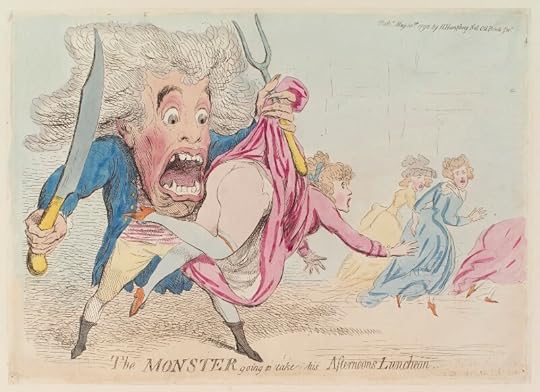
"The facts in this case are so bizarre that no novelist would have dared to invent them," said the Philadelphia Inquirer . Indeed. A century before Jack the Ripper haunted the streets of London, another predator held a "vulgar-looking man" who slashed at female pedestrians with a knife while uttering profanities with a "tremulous eagerness" -- over fifty victims during a two-year crime spree. The city was gripped with fear, outrage, and "Monster mania." The latter was abetted by a -- reward and by the circulation of bawdy prints that capitalized on the Monster's tendency to slash his victims' buttocks. Armed vigilantes roamed the streets, and fashionable ladies dared not walk outdoors without first strategically placing cooking pots under their dresses. Finally, in June 1790, one Rhynwick Williams was arrested. After two long and ludicrous trials (at one of which he was defended energetically by the eccentric Irish poet Theophilus Swift), Williams was convicted. Was he guilty? Or just unlucky enough to fall into the hands of authorities when they needed someone to pay? Drawing on contemporary evidence and reinterpreting Monster mania in the light of historical and modern instances of mass hysteria, Jan Bondeson recounts with dry wit a tale that occupies a unique place in criminal history and imagination.
Outside of his career in medicine, he has written several nonfiction books on a variety of topics, such as medical anomalies and unsolved murder mysteries.
Bondeson is the biographer of a predecessor of Jack the Ripper, the London Monster, who stabbed fifty women in the buttocks, of Edward 'the Boy' Jones, who stalked Queen Victoria and stole her underwear, and Greyfriars Bobby, a Scottish terrier who supposedly spent 14 years guarding his master's grave.
He is currently working as a senior lecturer and consultant rheumatologist at the Cardiff University School of Medicine.
It's late at night in the dark, hazy streets of 1790 London. You are a young woman walking home after a party, with only another female companion – a sister, perhaps, or a maidservant. Suddenly, from out of the darkness emerges a tall figure in black, who follows you, making obscene and shocking remarks. So far, I guess, so familiar. But then he yells, ‘Blast your eyes, you damned bitch, I will murder you, and drown you in your blood!’ And then he pulls something sharp from his coat, and slashes at your dress. Your clothes are shredded, your legs and buttocks cut and bloody. He stands there, staring composedly into your face. Then saunters calmly away.
The figure, who may have attacked more than fifty women during a two-year period, became known as the London Monster, and for a while in 1790 was the center of a huge moral panic, generating impromptu vigilante groups, denunciatory pamphlets and stage plays, offers of huge rewards, dozens of false accusations, and a frantically bumbling early police force.
The Monster stalked the streets of London a hundred years before Jack the Ripper, and was frankly a hundred times less scary, since he never killed anyone. Nevertheless there is something very creepy about his modus operandi – the shocking language, the calm demeanour, and the rococo methods he employed to attack his victims: at times he strapped blades to his knees so that he could slash people hands-free, and at other times he invited them to smell a nosegay in which he had concealed a sharp pin.
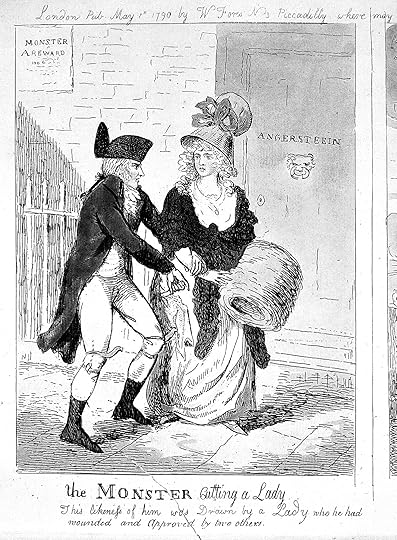
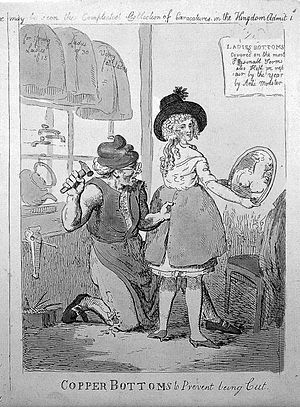
The Bow Street Runners – London's only professional police force, though there were only eight of them – were completely overwhelmed. In the absence of any official action, citizens took matters into their own hands: vigilante groups patrolled the streets, while women had their dresses fitted with cork or metal to guard against blades. If you didn't like someone, you could shout ‘Monster!’ at them in the streets, and watch a mob pull them limb from limb. As always, with so many false accusations flying around, some people seemed more concerned with the poor innocent male victims than with the women who had actually been attacked: ‘The whole order of things was changed,’ wrote the banker JJ Angerstein, who was offering a £100 reward for the Monster; ‘It became dangerous for a man to even walk the streets alone…unless under the protection of a lady.’
Isaac Cruikshank, "The monster cutting a lady" and "Copper bottoms to prevent being cut". On the left, the Monster claims another victim; on the right, a woman is fitted for a copper petticoat to protect her from attacks
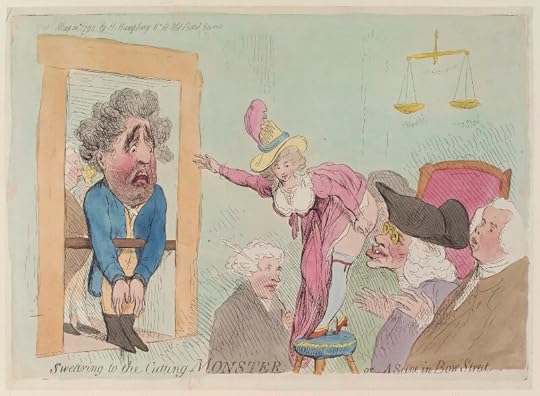
A culprit had to be found, and duly was: a Welsh artificial florist by the name of Rhynwick Williams, who lived in a run-down doss house and was certainly known to have harassed several women in the streets. But he had a pretty good alibi for most of the assaults, and his legal defence was ludicrously mismanaged – in his second trial, he was represented by the ‘eccentric’ (read: mental) writer Theophilus Swift, whose defence strategy consisted mainly of suggesting that all the ladies speaking as prosecution witnesses were whores. A transcript of this trial, Bondeson says, ‘reads like an episode of Blackadder III’.
James Gillray, "Swearing to the Cutting-Monster". Gillray took the trial as a source of ribald humour, as in this print where he satirises the court's eagerness to see Miss Porter's injuries
In the event, Williams was locked up in Newgate for six years, and the panic died down. Although the Monster scare did not have quite the same stakes as the Ripper scare a century later, it does offer an intriguing prelude which highlights a lot of the same themes in terms of public panic, media reaction and psychological impact on a population. Bondeson draws these links explicitly, and also makes useful comparisons (including touching on psychiatric data) with other contemporary slashers, such as the piqueurs of Paris and the Mädchenschneider of Augsburg, both around the turn of the nineteenth century.
Bondeson brings out the relevance to the Monster scare of contemporary events (like the French Revolution and the antislavery movement) extremely well, and has done a great job in tracking down references to this strange six-month panic in diaries, newspapers and pamphlets of the time. Anyone interested in the period, or in true crime narratives generally, should find plenty to get stuck into here.
I recently re-read this book, having given my 1st copy away to a sex-crimes detective. This is perhaps the best book written on Piquerism, a Paraphilia involving the sexual gratification taken by stabbing, pricking or otherise puncturing somebody with a needle. Bondeson covers the entire London Monster Affair in careful detail, but also goes into the paraphilia itself as well as other historic cases involving similar crimes. The issue was of interest to me since I lived through the Needle-Prick Terror in NYC during the late 1980s.
That incident involved young women sticking older women whom they perceived to be "Upper Class" with hypodermic needles and sometimes running away yelling "Now you got AIDS!" The Needle-Sticking flap was not confined to those few female perpetrators; rather it began on the subways by males who mentioned nothing of AIDS nor were the cops even sure what was being used to "prick" the victims but trust me, the Lexington Avenue Line was a ghost train for a few weeks and women put away their Minks.
Overall, any Bondeson book about Major High Weirdness will be a pleasant surprise. He doesn't go for the shock value of his chosen topics, instead, he delves deeply into the social issues at play in addition to reporting the facts of the crimes, "flaps" or strange happenings. Curiosity may draw you to a book like this one, but you will come away with a more thorough lesson in history and the cultural forces that shape us than you might expect. The London Monster is perhaps the best example of this. DO read it. It has bearing on the Jack The Ripper Media Flap that eventually followed and if THAT interests you, you need to begin with this book.
The London Monster was written to be popular and sensationalist, but despite that, it is a well-written and well-researched book about an odd series of crimes in London in 1790. (I have nothing against books being written for a "popular audience," except that that so often means sloppy research and careless writing. Sensationalism is just unnecessary.)
The London Monster was a man (or men) who attacked respectable women on the streets of London, cutting their buttocks and thighs, or their arms, or stabbing them in the face with a knife concealed in a nosegay. It is inevitable, apparently, in reading about crimes committed before 1900, that there will be doubts expressed about the workings of justice. I'm not entirely sure whether that's a legitimate comment on the justice system of preceding centuries or whether it's simply the fashion in criminological historiography. Certainly, Bondeson follows the pattern, and I can't deny that I agree with his assessment: if we accept the eye-witness statements (which are all we have to go on), there must have been at least three London Monsters working at the same time (one man was extremely tall by the standards of the time, and one seemed to like inventing Wolverine-esque contraptions to cut his victims with), and only one of them was brought to trial. Bondeson even seems to doubt that Rhynwick Williams was one of the Monsters at all, suggesting that he was simply a creepy little stalker who made a good scapegoat. I'm not sure I want to go that far, but The London Monster is a good cautionary tale about the malleability of eye-witness testimony.
Bondeson's tale is a stranger-than-fiction account of the "Monster," a savage serial stabber in 1790s London, who preyed upon unaccompanied young women by with a "tremulous eagerness," accompanying his attacks with shockingly foul and indecent language. Although the Monster (or perhaps, Monsters) employed a variety of sinister stratagems of assault, including stabbing unsuspecting maidens in the face using a knife hidden inside a bouquet of artificial nosegays, and tearing at women's exposed arms with some sort of metal claw, his preferred method of attack was to slash at his victims' thighs and buttocks, inspiring fearful aristocratic women to wear copper petticoats, and lower class women to hide frying pans under their skirts.
All told, the Monster attacked somewhere between 15-30 women, causing mass hysteria and vigilante mob action, before a local pervert and malcontent, artificial flower-maker Rhynwick Williams, was brought to trial and ultimately convicted (although both then and now, doubts remain about his guilt), essentially ending the slew of attacks and putting an end to the witch-hunt.
The book is largely an exploration of the panic caused by these stabbings, as well as the popularity of the subject in the media (the book contains ribald poetry, bawdy newspaper cartoons, and descriptions of various Monster plays from the period), as well as the bizarre circumstances of the two trials.
Jan Bondeson turns his usual meticulous research, logical thinking and clear-headed arguments to the case of the London Monster, who was as sensational in 1790 London as he is obscure today. This criminal approached random women on the street, made lewd remarks, slashed their clothes and tried to stab them in the thighs and buttocks. A man was eventually convicted in the attacks, but his guilt is doubtful at best.
This was a thorough account of the case, and concludes with some discussion of other "moral panics" throughout history. I did not find The London Monster as intriguing as Bondeson's books about medical phenomena, however.
Very informative with some interesting discussion at the end around justice, corruption, misogyny, and mental health. Let down by tasteless writing and some grimy comments about female victims of sexual assault.
This book is a good social history of London at the times of the French Revolution. It primarily concerns the case of The Monster, a sexual sadist who stabbed women’s buttocks, the hysteria that arose around this figure, and the resulting trials of the man who was identified as The Monster. It also provides some interesting psychological history and some criminological analysis of the case as well as similar cases (such as that of Jack the Ripper a century later, which Bondeson concludes was the product caused by different killings and the hysteria that ensued). The book was worth the read.
Predating Jack the Ripper, the Monster was a vile criminal or the conjecture of mass hysteria. Either way he influenced London in ways far beyond his few actual attacks. Bondeson describes the phenomenon in detail and then debates whether any of it was real or if the victims were merely collateral damage from bad pick-pocketing tactics. As for the poor chap who was railroaded by "justice", it is very surprising he wasn't hung for such heinous crimes, but perhaps those in power knew he was innocent.
Lively retelling of the strange case of a man who prowled London, stabbing women in their behinds, terrifying thousands into wearing soup pots and tea-trays under their bustles. A hilarious cast list is provided by the author at the beginning of the book, as if it were a play instead of a true story, summarizing the character flaws of everyone involved. That section alone is worth the price of admission.
This was totally up my alley - strange, unknown, murderous evil lurking in the streets of 19th century London. Never really caught...it gives you such a close sense of what life was like at that time and at the beginning of sexual predators. A great read for history buffs.
Brilliant read from start to finish. Jan Bondeson is a great modern story teller. I hadn't heard of this fascinating episode of London's history prior to acquiring this book, and one of Jan's gifts seems to be seeking out quirky history, which I love!
A good read. I read quite a bit about Britain and particularly London, and -- though I am by no means an expert -- I can't believe I never before ran across any mention of the London Monster or the events of 1790.