Politics Parliamentarians' Top Books for Christmas 2021 'A must read for political geeks' - Saqib Bhatti
There was a huge upsurge of global interest in US politics during the Trump presidency, culminating in the November 2020 election, the victory of the Democrat candidate Joe Biden and the subsequent, horrifying response in the storming of the US capitol. American politics is likely to remain deeply divided during the coming years, and also the focus of global attention - with Trump mobilising his base for 2024. But the transatlantic fascination with the role and office of the US President isn't new at all, and in fact reaches all the way back to the birth of the United States itself.
The Presidents features essays, written by a range of academics, historians, political journalists and serving politicians, on all 46 American Presidents who have held the office over the last 230 years - from George Washington to Joe Biden. Each contributor has been carefully chosen based on expert knowledge of their subjects and personal connections, providing analysis of their subject's successes, failures and influence. Any hagiographical writing is shunned in favour of a 'warts and all' perspective on each President and the impact they've had on US politics - past, present and future.
A great read, hypnotically interesting, and hardly a single dull page in the whole 500. You skitter through the whole of American history through these 10 page biographies of all the presidents (up to and including Joe Biden) and it becomes really compelling, like a great novel, full of what-happened-next moments, and, of course, crammed full of astonishing characters, some vile, some weird, and some just wonderful.
Because you are reading the story of one guy who was the previous president’s VP or deadly opponent, you get overlapping and repeating, echoing situations and events in the chapters before and after. When you read through the whole book, it creates a very pleasurable refracting effect, like seeing the same event simultaneously from three or four slightly different perspectives. Now, it must be said that there are a handful of dullard presidents who seem to have spent their years in the White House fretting about whether to buy more silver for the Treasury or not (this, mysteriously, could be quite controversial way back when). But mostly, events happened with exhausting rapidity to these 46 guys. Actually 45 guys, because Grover Cleveland gets counted twice.
MOST EXTRAORDINARY STORY IN THE WHOLE BOOK
Teddy Roosevelt finished his second term in 1909 but he was back campaigning for a third party (called the Bull Moose Party – don’t ask) in 1912. He was in Milwaukee leaving a hotel to make a big speech when he was shot at close range.
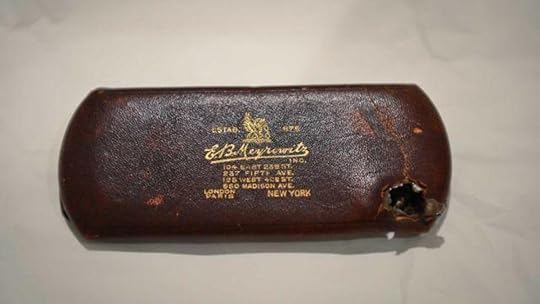
The bullet penetrated TR’s thick overcoat, steel glasses case, and the manuscript of a fifty-page speech folded over twice, before lodging in his chest, a quarter of an inch from his heart. Roosevelt, on seeing that he was not coughing any blood, decided that the bullet had not penetrated his lungs and so decided to continue and give his speech before going to hospital. He spoke for eighty-four minutes, revealing his bloodstained shirt to the audience and telling them “It takes more than that to kill a bull moose”
This is the glasses case
SOME RANDOM FACTOIDS, ANECDOTES AND QUOTES THAT JUMPED OFF THE PAGES FOR ME
Three presidents were born after their father died, the last being Bill Clinton – i didn’t know that!
Grover Cleveland was the only president to serve as a public executioner.
Theodore Roosevelt was the first president to invite an African American to dine at the White House (Booker T Washington in September 1901).
THE EXTRAORDINARY FECUNDITY OF JOHN TYLER
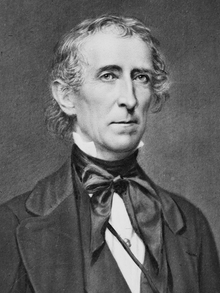
He has to be one of the more obscure presidents, but he has a crazy claim to fame. In two marriages he fathered 15 children, the last one being born when he was 70, in 1860. And at the time of writing [2021] his last surviving grandchild was still alive, 231 years after Tyler was born, a year after Washington was inaugurated. !!!
THE REMARKABLE INAUGURATION OF CALVIN COOLIDGE
On 2nd August 1923 Warren Harding died. That day his VP Coolidge was staying with his family in their house in Plymouth Notch, “a remote hamlet in Vermont”.
The news was brought to Coolidge by telegram, since there was no phone in the house. Nor was there any electricity, so his father, a local notary, swore his son into office at 2:47 AM by the light of a kerosene lamp. (If it was in a movie you’d say – huh, the usual Hollywood romantic twaddle.)
THE HORRIBLE TRAGEDY OF FRANKLIN PIERCE
Children : Three : Franklin Junior (died in infancy), Frank Robert (died of typhus as the age of four), Benjamin (died in a train crash at the age of eleven). Just to compound the horror, in the train crash Benjamin was with his parents. They survived, he didn’t. After this Pierce was convinced that God was punishing him for something, and for this reason, he refused to use a Bible for his swearing-in. Pierce’s wife hated politics so much she didn’t attend his inauguration.
ANDREW JACKSON ON WHETHER IT WAS RIGHT TO DRIVE NATIVE AMERICANS OFF THEIR LANDS
What good man would prefer a country covered with forests and ranged by a few thousand savages to our extensive republic, studded with cities, towns and prosperous farms?
SOME LINCOLN
More that sixteen thousand books have been written about Lincoln
his mastery of language was such that he could have made the proposition that Texas and New Hampshire should forever be bound by a single post office sound like something out of Genesis
He never directly identified himself as a Christian
FROM THE SUBLIME TO THE RIDICULOUS : RUTHERFORD HAYES!
Hayes made very little impact on world affairs. The only thing he seems to have done is to arbitrate in a border dispute between Argentina and Paraguay. “This constitutes a rather thin international legacy.”
A CATTY REMARK
Chester Arthur was the closest thing to Jacqueline Kennedy that Washington would see until Jacqueline Kennedy
A FINAL POINT FROM A BRITISH PERSON
One thing that always stuck in my head was that I heard someone once on the radio saying that the American presidents look at the British prime ministers in total envy, because the prime ministers have way more power than the presidents. This same point is made on p 193 so I think it must be correct. (When we say power here, we mean over the country, not throughout the world.) It happens because the prime minister is only prime minister because he or she is leader of the party which has the majority in the House of Commons. Therefore any legislation they wish to put forward will get approved. Not so with the American president. He (so far always a he) is not head of his party, and his party may not and often doesn’t have a majority in the Senate. Logjams all around! Tears and gnashing of teeth in the Oval Office!
What this means is that if the British majority party thinks that their prime minister/leader has gone mad, like Liz Truss recently did, they will throw them out immediately and get a new one. Alas, American parties can’t throw out mad presidents.
Lacking any new tricks, Ian Dale has regurgitated the same approaches for The Presidents that made his The Prime Ministers so disappointing. He's corralled together as authors a disparate bunch of British and American politicians, writers, or historians, many of whom have no knowledge of their subjects beyond reading a couple of biographies and some desperate Googling. Dale appears to have done all the editing during a two-minute break in one of his radio interviews.
Each chapter provides a fairly standard and relatively short history of each President, with none of the essays having the type of basic errors that marred the otherwise superior Gimson's Presidents. Most chapters rarely move beyond the mundane and, not being produced by professional historians, they lack the expertise and historical overview provided in Lamb and Swain's far more rigorous The Presidents.
There are some gems among the gravel. Brian Klaas's James Polk gives British readers a solid introduction to a President who achieved all his promises and hugely expanded US territory. Sue Cameron does a similarly valuable job for Chester Arthur, albeit without mentioning the intriguing story of how mysterious letters from a lady in New York encouraged Arthur to become the reforming President few thought he could be. Robert Waller deserves pass-marks if only for noting that a province in Paraguay and its capital are named after Rutherford Hayes.
Other essays have far fewer commendable qualities. None are quite as badly written and edited as the Campbell-Bannerman essay in Dale's The Prime Ministers, but Anne Alexander's James Garfield almost gets there with a chapter that is as badly organised as the doctors who botched Garfield's recovery after he was shot. Sir Simon Burns continues the urban myth that JFK's win over Nixon was partly down to TV viewers of their debate, while questionably avoiding any salacious digging in to the seamier side of JFK's Camelot. Thankfully, Mitchell Reiss is the only author unable to resist comparing his subject to Trump. George Washington's character speaks for itself without needing to crowbar in the 45th President.
Too many authors attempt to personalise their pieces. David Blanchflower's essay on Harry Truman is the essay for you if you want to know how long Blanchflower worked at NBER, where Blanchflower's office is in New Hampshire, and where Blanchflower was visiting in the US just before the pandemic. George Osborne's otherwise well-judged Lyndon B Johnson transparently uses LBJ's issues in Vietnam to justify the ex-Chancellor's own position on Iraq. David Torrance's stories of his travels in Buffalo spoil an otherwise solid case for William McKinley as one of the better Presidents. Most amusingly, David Owen's piece on Jimmy Carter is little more than a transparent attempt to position Owen as the best President the USA never had. Every American would be living in a land of milk, honey, and unlimited pumpkin pie if only Carter had a quarter the political acumen of Owen.
As often in these compilations, the best essays are those that challenge popular conceptions. Freddie Gray jumps in with an admirably argued defence of Richard Nixon, reminding the modern reader that Nixon did much to embed LBJ's progressive policies. Having drawn the short straw, Justin Webb gets to grips with Donald Trump and provides a nuanced, fair, but critical view of perhaps the most polarising President. George W Bush's chapter gives him a surprisingly sympathetic hearing, albeit that this is not so surprising given the author is Sir Christopher Meyer, the UK's ambassador to the States for part of W's presidency. It is no coincidence given Dale's politics and his selected authors that all these cases are rehabilitating Republican presidents.
The biggest shame is that it would not have taken much effort to make this a worthwhile collection, just some clear guidance to the authors and a modicum of editing. The story of US Presidents is a compelling story of how America has prospered sometimes because of her presidents but, more often, despite them. If you think Trump is an anomaly you don't need to delve back in history further than the post-war trifecta of Kennedy-Johnson-Nixon to see broadly comparable levels of womanising, lying, and corruption. And the lying and corruption isn't all down to Nixon.
If you're looking for an entertaining romp through presidential history go with Gimson. If you're looking for proper history, go with Lamb and Swain. If you're looking for a missed opportunity, go with Dale.
A strong summary of all of the Presidents of the US. The different essay styles made the book engaging to read despite major overlaps between the careers of the presidents.
My only gripe was that not all of the biographies felt entirely impartial, despite that being the stated aim of the book. Overall enjoyed though, an interesting companion to Dale’s book on British PMs.
I have finished reading “The Presidents: 250 Years of American Political Leadership” by Iain Dale.
This book, edited by former Tory MP Iain Dale, is a complete history of all of the US Presidents. There is one chapter for every President in chronological order each by a different author.
What makes a good President or even a great one? Of course, much of it is subjective, but there seem to be common trends among many of those identified as such by the authors. In terms of having foresight for the role President George Washington set a standard, eschewing partisanship and having the dubious honour of starting the controversial tradition of “Executive Privilege”. Others have articulated grand visions for the country that have inspired the American people, such as Teddy Roosevelt’s ‘Square Deal’ which aimed to bring Robber Baron industrialists to heal.
This book’s chapters being written by different authors is a unique feature. Each of their perspectives are different, mostly in a way that keeps the narrative interesting. Very occasionally though there are authors with very obvious ideological axes to grind, which can be off putting. Perhaps telling, considering who the editor is, the ideological biases tend to lean more on the right than the left. That said you still learn something new from even these chapters.
There is some historical overlap among the chapters, given the multiple authors. While this is takes some getting used to, I eventually found this quite useful in getting a sense of how the USA grew and developed as a country.
Overall, I found this book very enjoyable. The authors did well in particular to provide colour to the otherwise somewhat colourless mid to late 19th century presidents in particular. I found it especially fascinating seeing how their working styles influenced how the White House was ran. From the calm and relaxed delegating extraordinaire Calvin Coolidge, to the workaholic LBJ to the chaotic showmanship of Trump.
I did notice a few sobering trends through this history. The first is the advancement of partisanship and it’s growing preoccupation with political point scoring. The other is the sad drift of the presidency away from the ideals on which it is founded on, and the hopes of the people for whom it was created to serve.
This entire review has been hidden because of spoilers.
I desperately wanted to give this book four or five stars but unfortunately there are a number of reasons I cannot.
The authors of the early Presidents outside of George Washington feel like they have just googled X and have copied the entries from Wikipedia. An exception has to be Simon Marks entry in Andrew Jackson.
Secondly, the tone of this book is more deferential to the Presidents than the previous book edited by Iain Dale on the Prime Ministers. That could be down to many of the essay authors being American and perhaps they still have a deference to authority that we in the UK have lost. With deference comes a lack of constructive criticism.
That being said, the strongest essay by a country mile was Roy Hattersley concerning Woodrow Wilson. George Osborne (it hurts me to say), Simon Heffer and Christopher Meyer also make significant contributions in their essays.
There is something missing in this book of essays but it is still an interesting read nonetheless.
This was a mixed bag. Every President up to and including Biden has a short chapter, each from a different author, as they assess the presidency.
Some are better than others, so Simon Heffer on Reagan and Julia Langdon on Lincoln are fascinating, while David Owen on Carter seems to be more about the author than the subject. Some chapters are full of interesting facts and others are a bit dull.
Terrific book with a short biography - each by a different writer - of every US President. Essential reading if, like me you are fascinated by American politics. Very much looking forward to reading the first book in this 'series,' The Prime Ministers, and the upcoming Queens & Kings.
A concise summary of every US president. I really enjoyed this book especially the chapters on the lesser known presidents who came after Andrew Jackson and before Lincoln.
Listened to this one on everyone’s favorite audiobook platform: Spotify. Really enjoyed it. Chapters aren’t too long and essays are easy to understand for any level of history readers. This will be my new go to Rec for those who want an easy reader on all the presidents.
Having enjoyed the author's similarly formatted book (the chapter on each office holder is written by a different contributor, so this should really be authors) of British Prime Ministers from the commencement of the office in the 18th century until today, I was looking forward to this book, and it did not disappoint. My knowledge of the US Presidents prior to FDR was rather shaky, and this book filed in many gaps, while for the more recent holders of the office, the authors provided good colour as to their life and presidency while retaining the pace and brevity that makes the book so enjoyable.
Very hard to give anything other than five stars, I'm not sure what more readers could want from this. It's a compact (if needlingly long) book but every chapter lives up to expectation in some form or other. Some chapters are better than others but I think that comes down to some Presidents being more interesting than others. I was impressed by the equality given to all in terms of page numbers/ word counts. For example, one would have expected JFK to be given a larger section than (for example) Fillmore or Hayes, but that's not the case; everyone gets a similar sized chapter, on average about 12 pages each. It's also very precisely about their political careers with personal details ironed out. For example, Randy Taborelli's outstanding "The Secret Life Of Marilyn Monroe" goes into greater detail of Kennedy's private personality than this does - here is a policy-only affair. The three chapters I least liked were all towards the end; The Biden chapter was bafflingly short and dismissive. The Trump chapter hasn't aged at all well with a tone of "at least it's all over now", oblivious to the second term which would come after. And the G.W Bush chapter seemed like author Christopher Meyer spent more time speaking about his own role as UK Ambassador back in those days whilst brushing aside some rather important events like the global financial crisis and hurricane Katrina, both of which are mentioned but only fleetingly. But ultimately for anyone looking for a concise, historic collection of all US presidents, this does what you'd expect of it and it's very, very good.
I’m new to this genre so I don’t feel comfortable rating this book, but it appears to me that there are two things that makes this particular presidential run-down unique: it’s compiled using entries from a different contributor for every president, and many of those contributors aren’t American. Honestly, I’m not sure either of those traits is serving this book in a great way. But like I said, this is my first time reading a book of this nature — so what do I know? I do think the book does exactly what it sets out to do and stands as a great introduction to the U.S. presidents, but I will say that despite the author who spearheaded this project claiming that he urged his team to remain unbiased in their presentations of the presidents, from time to time (especially as the presidents became more modern) I caught a whiff of a bias coming through from a contributor. There were moments when I could tell that a contributor was writing about a president’s obvious wrong-doings with a sense of allegiance as well as times where a contributor was writing about a president’s accomplishments or attributes with a bitter aftertaste in their mouth. I don’t think this quality should be present anywhere in a book like this even if it was just a couple times, but all in all, it was a good speed-run through introducing the histories of America’s leaders. I enjoyed the closing chapter about ranking the presidents, that was a nice touch.
As with any compilation book, the quality of each entry and it's appeal to me varied. Some I really liked, and would have comfortable given 5 stars. Others brought the average down.
Over all, the collection helped plug some of the gaps in my US history knowledge, and gave me a sense of the office and the men occupying it have changed. I did get a sense that bit by bit (with a few exceptions) each the quality of both the leaders and the political atmosphere has dropped. It seems as though most of the early leaders were capable, principled, well-intentioned people working in an atmosphere where it was possible to cooperate across party lines. The more recent presidents seem to stand on shakier moral ground, and be more committed to their parties, their pockets or their personal neurosis than their citizens, while the whole political system seems designed to ingrained party prejudices and create extremes.
Having read The Prime Ministers, I the inversion the trajectory of power in the two countries is really noticable. The British leaders took over an enormously powerful empire, and bit by bit the empire shrank and the nations power shrank with it. By contrast the American leaders started out with very relatively little power, and expanded until modern leaders not only control the US but are hugely influential all over the world.
I had to DNF at Nixon. I really enjoyed the first half of chapters up until about Lincoln - I learnt a lot and they were pretty engaging, and felt fairly impartial. Slowly but surely after, the conservative bias becomes glaringly obvious. I draw the line at calling Trump a ‘moderate’! At that line I immediately put the book down. The first half are written by a wide range of people but the more modern ones are almost all done by Tory MPs who, shockingly, write boring, biased, and overall bad quality essays. The audiobook is shockingly bad: it’s clear Dale insisted on doing it himself and as a result it is stunted and awkward, and there are countless mistakes which he seemingly just didn’t bother to rerecord. Dale’s editing is also lazy! The essays frequently repeat information from their surrounding sections and don’t really have any coherence in terms of themes or structure. I picked this book up in the library not knowing anything about Dale so I was overall quite disappointed with this book, but upon learning about his own political affiliations I wasn’t surprised he would come out with such a lazy and biased work.
America is a land that, in some ways, has changed utterly in the last 250 years. In other ways, it has hardly changed at all. Tracking that change through an exploration of each of the 47 presidents of the United States is an enjoyable exercise.
I did not read the chapters on Theodore Roosevelt or LBJ as I am currently reading biographies of the two men and did not wish for spoilers.
Whilst there is some level of bias that is visible in some of these 46 essays, by and large, an objective appraisal of each president can be obtained via reading this book. It is a good way to become acquainted with a personality that one may wish to explore further. It is also a useful way to understand the office of the presidency, how it has changed, and why.
Many different men have been president of the United States. Yet, over and over, the same characteristics can be seen - work ethic, optimism, overcoming failure, dogged determination. Clear evidence that these characteristics will take you far in life.
Contains the best (only?) essay on Millard Fillmore I've ever read, which highlights its strengths: forcing modern authors to make some case, one way or another, on presidents most readers may not know that much about. But outside of Washington and Lincoln, I found some of the essays on better known presidents -- especially the more recent ones -- to be a little lacking (especially Carter's). But that might just be kind of the double edged-sword of assigning a mostly British pool of writers to write about the American presidency. It offers some fresh perspectives, but also leads to an essay about Eisenhower without a single mention of Earl Warren or the Little Rock Nine, and malapropisms like "Californian" and "the University of Berkeley"
The same style as The Prime Ministers. Think the quality of each entry is higher than previously, probably because US presidents are more widely studied. There were only a handful of cases where I didn't get a good feel for the man they were tasked with writing about. Essays on Lincoln and Bush JR where particular disappointments. George Osborne's on LBJ was excellent and I was laughing out loud at the analysis of Trump.
I will say this for Iain Dale, he has stocked my interest in history again. Role on the Kings and Queens.
⭐️⭐️⭐️✨ Book 76 of 2023. “The Presidents” by Iain Dale.
This book is a series of essays on the 45 individual Presidents of the United States by various people; covering reporters, commentators, academics, and political insiders.
Each essay is 10 - 15 pages and lays out the bare details of the president’s early life and then a summary of their presidency, with key details delved into a little bit.
By its nature, it’s not an in-depth look at any President but has given more some more context on Presidents that aren’t looked at as much as others.
After reading 'The Prime Ministers' a few years back and enjoying it, my partner bought me the follow up 'The Presidents' edited by Iain Dale. Essentially, these books are a breakdown of every leader all written by a different person, often a journalist or a political figure. I found this immensely enjoyable and hope that Dale branches out to cover a different country such as China or Russia next, or perhaps even the British monarchy.
I highly recommend this book as it full on enriched information about the life's of the US President as it is the author follow up to his previous book on the UK Prime Minister. A great handy book for pub quiz and to read if you are a contestants on that tv show who wants to be a millionaries I highly recommend it. Best wishes Sean
I learned a lot from this - and it was especially interesting to read about presidents I had never heard about. It was great that each president had a whole chapter dedicated to him, written by different authors in very different styles and focuses. I also warmly recommend the podcast that went with the book.
An excellent introduction to the lives and achievments of each President inturn. I enjoyed reading the progression of the presidency and how it developed and expanded over time. I also learnt alot about the underlying source to events from decisions sometimes taken years before. The accompanying podcast is also excellent
A snapshot of every US President from George Washington right up to Joe Biden. The book is a compendium of essays by different authors summarising the life, presidential achievements and legacy of every holder of the post - I hadn’t even heard of some presidents! The book is an excellent introduction to US history since independence.
Having lived through the Eisenhower administration until now, I wanted a condensed version of how our Presidents ran out unique country. I found this a great introduction to the all.
Thoroughly enjoyed this companion set to The Prime Minister's. Having studied them as a student and as a teacher, the President's fascinated me. This was an excellent dip and read book. Looking forward to Kings and Queens.
So much of this is fantastic. Lots of varied authors writing about some unusual characters. It became less interesting with more contemporary presidents written by those who were involved. At that point it sometimes became more about the author than about the president in question.
I really enjoyed this book. I understand more about why the likes of Washington, Lincoln and Truman are thought so highly of. Also interesting to see how Trump was not the first of his type in the White House. Nothing new under the sun.