Jump to ratings and reviews
Rate this book

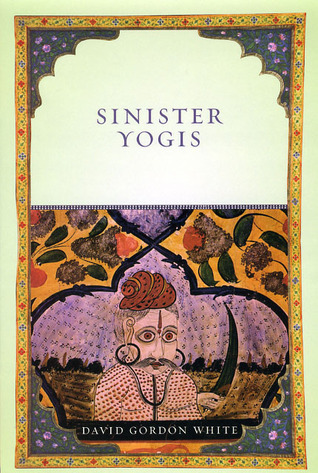
Sinister Yogis

Rate this book

Since the 1960s, yoga has become a billion-dollar industry in the West, attracting housewives and hipsters, New Agers and the old-aged. But our modern conception of yoga derives much from nineteenth-century European spirituality, and the true story of yoga’s origins in South Asia is far richer, stranger, and more entertaining than most of us realize.

To uncover this history, David Gordon White focuses on yoga’s practitioners. Combing through millennia of South Asia’s vast and diverse literature, he discovers that yogis are usually portrayed as wonder-workers or sorcerers who use their dangerous supernatural abilities—which can include raising the dead, possession, and levitation—to acquire power, wealth, and sexual gratification. As White shows, even those yogis who aren’t downright villainous bear little resemblance to Western assumptions about them. At turns rollicking and sophisticated, Sinister Yogis tears down the image of yogis as detached, contemplative teachers, finally placing them in their proper context.

352 pages, Hardcover

First published January 1, 2009

25 people are currently reading
310 people want to read

About the author

David Gordon White

22 books52 followers
David Gordon White received his Ph.D. (with Honors) from the Divinity School at the University of Chicago in 1988. He also studied Hinduism at the École Pratique des Hautes Études in Paris, France, between 1977-1980 and 1985-1986. A specialist of South Asian religions, he is the J. F. Rowny Professor of Comparative Religions at the University of California, Santa Barbara, where he has been teaching since 1996. Prior to coming to Santa Barbara, he taught at the University of Virginia between 1986 and 1996. There, he founded the University of Virginia Study Abroad Program in Jodhpur, India in 1994. White is the sole foreign scholar to have ever been admitted to the Centre d’Études de l’Inde et de l’Asie du Sud in Paris, France, where he has been an active Research Fellow since 1992.

He is the author of five monographs, four published by the University of Chicago Press: Myths of the Dog-Man (1991); The Alchemical Body: Siddha Traditions in Medieval India (1996); Kiss of the Yoginī: “Tantric Sex” in its South Asian Contexts (2003) and Sinister Yogis (2009). He also edited Tantra in Practice (Princeton University Press, 2000): his introduction to that volume is considered to be the most comprehensive definition of the multi-faceted tradition known as Tantra published to date. Myths of the Dog-Man was listed as one of the “Books of the Year” in the 1991 Times Literary Supplement’s end-of-year edition; Kiss of the Yoginī was on the cover of the same journal’s May 20, 2004 edition. Sinister Yogis received an honorable mention at the 2009 PROSE awards and was listed as a book of note by CHOICE in 2011. A Japanese edition of Myths of the Dog-Man was brought out by Kousakusha in 2001; Italian (Edizioni Mediteranee) and Indian (Munshiram Manoharlal) editions of The Alchemical Body appeared in 2004. His two most recent books are published with Princeton University Press: Yoga in Practice (November 2011) and The Yoga Sutras of Patañjali: A Biography (2013).

White has been the recipient of several research fellowships and grants, including a John Simon Guggenheim Foundation Fellowship (2007-2008) and three Fulbright Research Fellowships for India and Nepal. A panel to honor his scholarship was part of the program of the annual meeting of the American Academy of Religion, held at Chicago on November 1, 2008.

Ratings & Reviews

What do you think?
Rate this book

Friends & Following

Create a free account to discover what your friends think of this book!

Community Reviews

5 stars
21 (32%)
4 stars
26 (40%)
3 stars
13 (20%)
2 stars
2 (3%)
1 star
2 (3%)
Displaying 1 - 13 of 13 reviews
Profile Image for Cain S..
232 reviews32 followers
January 30, 2015
White's book is textually rich, and manages to convey the essence of the diverse varieties of historical yogic doctrines and praxis. His central thesis is that today's multimillion dollar industry of eclectic yoga has little to do the "historical", "doctrinal", and "soteriological" yoga of ancient India, and in fact it is a product of Swami Vivekananda's poor understanding and unbounded enthusiasm about yoga philosophies.

Essentially, yoga had nothing to do with enhancing one's health, or losing weight right until the 1930's when there appeared a string of ill informed proponents, from Swami Vivekananda to Madam Helena Blavatsky, who collectively created an atmosphere where idiosyncratic "yoga" systems with their emphasis on postures, breathing, and meditation became the norm. Paramhansa Yogananda's mission of unifying yoga with Western theological traditions, in his own syncretic and unified view, also went a long way in encouraging developments like California yoga, designer yoga etc.

The practice of yoga historically was about the ability to possess others' bodies at will, read others' minds, possess and enliven corpses for personal gain, and ascend to the sun in ritual apotheosis as a warrior ascetic. During yoga's formative development, as a local response to Brahmanism, yogis were looked upon with general unease: they were infamous for their sexual exploits, one reportedly sinister sage would multiply himself into six identical bodies, and copulate with six women simultaneously because of his yogic powers as a "mahayogi".

A particularly brilliant incident detailed in the book pertains to Emperor Akbar, who during his long phase of religious experimentations became enamoured by magician yogis. According to one report, which White documents, once a famous "jougee" came to visit the emperor as he had learned of his interest in the discipline.

Akbar asked him for a demonstration, to put his soul into a fawn which was in the palace, the yogi did this and then put the emperor's soul back in his own body. Then, his interest awakened, Akbar asked the jougee to put his soul into his body, and asked that the jougee's soul to be allowed to enter his own. This too the jougee performed, and then put the emperor's soul back in his own body. Now the emperor was convinced of this man's supernatural power, and he promised him his patronage. But, secretly he was afraid of this man's insane abilities and he ordered his soldiers to decapitate him as he prepared to leave. This the soldiers did.

But, the ministers, and courtiers then noticed that Emperor Akbar was a totally changed man. He did not have any memories of his own life, and took to his harem with renewed and unseemly voluptuousness, and his manners had changed noticeably. The writer, a traveler, gives an account of the local opinion of Akbar's courtiers and ministers: they were convinced that the jougee had divined Akbar's plan to assassinate him and had switched souls with the emperor before he was decapitated.

Profile Image for Aparna.
13 reviews10 followers
June 16, 2015
Excellent, objective work on the yogic tradition, surfing easily over it's new age and neo-saffron reclamation. This is how this book is useful to those who practice and love yoga: to understand the troubled history of this practice to foreground it's super capitalistic at present. One can choose to retain what is good for personal practice.
Profile Image for Phil.
Author 39 books233 followers
March 16, 2012
David Gordon White’s Sinister Yogis (University of Chicago Press 2009, h/back, 336pp – also available in paperback and for Kindle) is third part of a “triptych” (the previous two books were Alchemical Bodies and Kiss of the Yogini.) Of the three, I would say that Sinister Yogis is the most accessible, although like the other two, it is not exactly a page-turner either.

According to White, the majority of scholarly approaches to Yoga have oriented themselves around the “philosophical yoga” tradition (commonly known as “Raja Yoga” or “classical yoga”) of which Patanjali’s Yoga Sutras is a foundational text. White says that: “it has been the equation of yoga with meditation or contemplation that has been most responsible for the skewed interpretations that have dominated the historiography of yoga for much of the past one hundred years.” (p42) White says that this focus has had the effect of marginalising earlier (and later) developments and so, as a counter, Sinister Yogis focuses on the Yogi – the practitioners, and examines accounts of practitioners within a wide variety of literary genres spanning a period of over a thousand years; ranging through the Vedas, Epics and Puranas, to early traveller accounts of Yogis, colonial reports; narratives from Hindi, Sanskrit and Persian sources, which depict yogis behaving in extraordinary and yes, sometimes “sinister” fashion, but largely not depicted in terms of the practices familiar from “classical yoga” – assuming postures, restraining breath and senses, meditating or realising transcendent states of consciousness. White asserts that, in contradiction to the majoritarian view of Yoga practice, the yogis in these narratives are not introspective or inward-turning.

In countering the familiar image of the yogi as “holy man” – detached from the concerns of the everyday world and spurning the acquisition (and use) of siddhis – magical powers such as the ability to enter another person’s body, raising the dead and so forth, White makes the radical claim that this image of the yogi is not historically correct, and he gives a lengthy examination of “the science of entering another body” (which can be likened to a form of possession) and how this relates to Indian models of perception and modes of personhood:

“Before it was closed off from the world to ensure the splendid isolation of spirit from matter, or the vacuum necessary for the “hydraulic” practices of hatha yoga, the yogic body was conceived as an open system, capable of transacting with every other body – inanimate, animate, human, divine, and celestial – in the universe” (p166).



Moreover, White examines how scholarly representations of the yogic body in terms of it being a microcosmic “miniature” of the wider cosmos is a mis-step (see some related discussion here); rather, he says, it would be more accurate to understand the yogic body as “a self-magnifying self that has become fully realized by the magni-ficent universe” (p175).

In addition, Sinister Yogis examines portrayals of yogis as power-brokers, ascetic warrior-mercenaries and traders; and the British criminalisation of yogis in the nineteenth century. He presents a critique of the popular, unreflexive assumption that the figure in Sir John Marshall’s so-called “Pasupati Seal” is seated in a yogic posture, and argues that the “lotus position” was originally associated with royal sovereignty – and later became extended to yogis due to the relationship between yoga and sovereign power.

Sinister Yogis is without doubt a ground-breaking approach to the historical representation and understanding of yoga traditions and aims. It overturns much of what is considered canonical in terms of how we think about yoga and yogis.
Profile Image for R.J. Gilmour.
Author 2 books26 followers
August 1, 2014
Not at all what one expected. Far too much esoteric information about yoga and yogis.
Profile Image for Erin.
175 reviews
March 18, 2021
Very academic look at the meaning of the word “yogi” and “yoga” over time. Also includes some fascinating stories.
Profile Image for David.
Author 26 books187 followers
April 9, 2019
White's yogis were, for the most part, not all that villainous nor was the book all that engaging. In fact, Sinister Yogis is marketed, somewhat incorrectly, as a rollicking and sophisticated narrative but it is actually a very academic and contemplative work geared in language and style for other academics.

In the end, the book was informative, as are most University of Chicago books, but not engaging or particularly enlightening about the history of the yogi in Asia.

One of the most disappointing aspects of the book was the Kindle formatting. Readers cannot change the font and font sizes jump from the slightly too small to be comfortable to the legally blind with a single tap. It appears the Amazon file format overlays an old htmlz format that is a very poor choice for ebooks today. Be aware of this criticism if you are intending to buy the Amazon Kindle book.

Rating: 3 out of 5 stars.
Profile Image for David Emil.
9 reviews1 follower
January 15, 2021
Way above my expectations. Could you pass the popcorn please ?
Profile Image for Kristian Petersen.
23 reviews6 followers
April 6, 2013
A classic text, the Mahabharata, reports, “Yogis who are without restraints [and] endowed with the power of yoga are [so many] masters, who enter into [the bodies of] the Prajapatis, the sages, the gods, and the great beings.” Finding this passage was one of the inspirational moments that motivated David Gordon White, J. F. Rowny Professor of Comparative Religion at the University of California, Santa Barbara, to pursue an investigation into the development of yogic practices. Wondering, “If these be yogis, then what is yoga?,” White tackled the history of yoga by focusing on those individuals who were called yogis in his latest book, Sinister Yogis (University of Chicago Press, 2009).

This approach challenges many of the preconceived Western notions of yoga. There is little meditation, breathing, exercise, impossible contortionism, etc. that is often associated with the practice. Further, it offers an alterative reading of histories of the philosophical development of yogic teachings, which are based primarily on the Yoga Sutras of Patanjali. What we are presented with is possession, shape-shifting, and creation of multiple selves, among other things. Overall, yogis, were defined as such, when they entered into or took over the bodies of others. White examines this history in a variety of contexts and across a vast expanse of history. Sinister Yogis continues White’s earlier work, Kiss of the Yogini: ‘Tantric Sex’ in its South Asian Contexts and The Alchemical Body: Siddha Traditions in Medieval India, and foreshadows his upcoming projects, Yoga in Practice and The Yoga Sutras of Patanjali: A Biography. Altogether, White’s research is rich and detailed but thoroughly readable, as he is a skilled storyteller. One will discover this with delight already on the first pages, which recount White’s encounters with yogis (or maybe the same yogi) from the mountains of Kathmandu to the parking lot of Los Angeles’ Trader Joe’s.
http://newbooksinreligion.com/2011/11...
Profile Image for David.
56 reviews4 followers
September 2, 2013
Overall, not an easy read by any means but I found it worth the effort. I came across more new words while reading this book than in all of my reading over the past few years! And that's aside from the Sanskrit transliterations. Chapters 1,2 and especially 6 are relatively straightforward and enjoyable. Although chapters 3,4 and 5 stretched my reading ability and focus, I found a few gems therein. Below is a passage concerning three well-know 20th century yogis taken from chapter 6:

In order to demonstrate his own yoga program to Yogananda, Krishnamacharya had the young Iyengar undertake a difficult posture called the hanuman asana. "His eyes fell on me" Iyengar relates, "and he asked me whether I would accompany him to America". Krishnamacharya would not permit his pupil to depart; however shortly after Yogananda's departure-and perhaps inspired by Yogananda's example-the master demonstrated the "Tibetan" techniques that he had theretofore hidden from even his own disciples to two foreigners. Two French doctors placed electrodes on the body of Krishnamacharya, who proceeded to stop his heartbeat, change the rhythm of his pulse and hold his breath for as many as five minutes. "The encounter", writes Elizabeth Kadetsky "burst open Iyengar's world...Like the visit from the swami[Yogananda], it pulled him from his mentor."
Profile Image for Carol Horton.
Author 7 books15 followers
February 14, 2013
David Gordon White is one of the foremost scholars of medieval yoga in the world. And this book is on a super-interesting topic: that is, the "dark side" of Indian yoga history, where instead of being revered purified icons of Light, yogis are feared magicians with important but dangerous powers.

Unfortunately, I find all of White's books very hard to read. His writing style is super-dense and exceptionally academic. I have a Ph.D. in political science and a high degree of tolerance for this sort of writing, but even I find that his writing style really gets in the way of connecting with the substance of what he has to say - which is a shame.
Profile Image for Rick.
220 reviews7 followers
May 10, 2014
Needlessly wordy in the worst academic way. Nonetheless, interesting enough: a survey of two thousand years of cultural representations of the yogi. The book neatly categorizes different threads stretching through religious, historical, and popular texts and weaves together a mostly coherent portrait of its subject. Historically, those yogis were nasty.

At times, I was a bit out of my depth given my limited knowledge of South Asian religious texts and pre-colonial Indian history. But I still gleaned plenty and didn't waste my time.
Profile Image for Richard.
726 reviews31 followers
June 13, 2020
Second read through, first since reading the Betel stories.
Very good.
Displaying 1 - 13 of 13 reviews

Can't find what you're looking for?

Get help and learn more about the design.