Evan Shelby Connell Jr. (August 17, 1924 – January 10, 2013) was a U.S. novelist, poet, and short-story writer. His writing covered a variety of genres, although he published most frequently in fiction.
In 2009, Connell was nominated for the Man Booker International Prize, for lifetime achievement. On April 23, 2010, he was awarded a Los Angeles Times Book Prize: the Robert Kirsch Award, for "a living author with a substantial connection to the American West, whose contribution to American letters deserves special recognition."
Connell was born in Kansas City, Missouri, the only son of Evan S. Connell, Sr. (1890–1974), a physician, and Ruth Elton Connell. He had a sister Barbara (Mrs. Matthew Zimmermann) to whom he dedicated his novel Mrs. Bridge (1959). He graduated from Southwest High School in Kansas City in 1941. He started undergraduate work at Dartmouth College but joined the Navy in 1943 and became a pilot. After the end of World War II, he graduated from the University of Kansas in 1947, with a B.A. in English. He studied creative writing at Columbia University in New York and Stanford University in California. He never married, and lived and worked in Sausalito, California for decades. (Wikipedia)
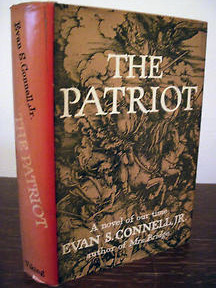
A beautifully written novel that follows the progress of a young man who decides to become a Naval Aviator in the wake of the Japanese attacks on Pearl Harbor. Connell takes us through each stage of his training, in the process of which our hero becomes disenchanted with the Navy and its propaganda-drenched regimentation. We also see the young man's fraught relationship with his father, a typical upper middle class American who buys every distortion and every outright lie his government tells to justify its militaristic behavior. Slowly and painfully, the young man breaks with both his family and his government. In his refusal to let his own sense of reality be warped by political and societal pressures, he becomes "the patriot" of the title. The book is remarkable for its beautiful writing (a hair-raising section dealing with a prolonged flight that ends in a crash is perhaps the best "action scene" I've ever read) and for its courageous portrayal of the hypocrisy at the heart of America's fear-based militarism.