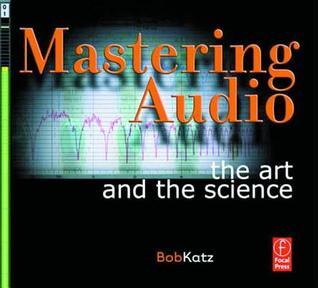
Mastering Audio explains leading-edge audio concepts in an easy-to-grasp, holistic manner, including an ear-opening investigation of the mysteries of jitter, dither and wordlengths, high sample rates, distortion, headroom, monitor calibration, metering, depth perception, compression and expansion, equipment interconnection and much more. Mastering Audio is for everyone who wants to increase their mastery of digital and analog audio: musicians, producers, A&R, mastering, recording and mixing engineers, and students.
Having gone to school for audio production, I'd say that much of the information in this book was not imparted in classes, but is essential to understanding how to make good audio. Katz has a lot of knowledge and experience with producing and mastering professional audio and that information can be used by you no matter what equipment you work with to make audio recordings. Whether you're in a band, a budding producer, or a podcaster, if you want to know how a professional does it, you want to read this book.
It also doubles as a decent reference book. He's heavily Mac based, but if you understand audio production software, transposing the information to your application should be trivial. He doesn't get into specifics, but you'll see lots of Mac screenshots. However, this book isn't for the beginner. If you haven't ever recorded multitrack audio, done post-production work, attempted to master a recording for delivery, you might want to look for other books and wait to read this one.
No doubt this is essential reading for those wanting to get into the subject of audio mastering and the knowloedge that Bob Katz has about the subject is undeniable. However, this book having been published in 2002 is also quite outdated at times. There's been a myriad of technological changes and advances ever since, which renders a lot of what's discussed here as a hisotircal document about the state of the art at the time, but not a very accurate representation of today's picture. Not that that's the author's fault, but just giving a heads up for future readers. Still, it's a very worthwhile read to those who are interested in the craft and also interested on how it has evolved over time.
What a great book, Bob is a very generous guy, had a chance to meet him in person and didn't hesitate to spend his valuable time with me to answer some questions I had in mind after reading this book. The book has a lot of detailed information on it, very in depth material. I'm a mastering engineer and I kept this book in my mastering studio(https://www.mavenmastering.com) since the day I bought it. Bob even gives some plugin recommendations for digital mastering. Expensive analog mastering equipment isn't something everybody have, so him vauching for some good quality plugins could be valuable for a lot of sound engineers.
This is a fantastic book for mastering, but really it's great information for anyone dealing with recording, mixing, OR mastering music (or any kind of audio). I didn't read the whole thing because some parts are outside of my wheelhouse (mastering surround sound, for example) and some of the chapters apply to situations I don't find myself in (how to set up and calibrate speakers in a dedicated mixing room is a tough sell for a guy who mixes using headphones in the corner of his spare bedroom), but the information is definitely informed, detailed, and precise. I got it from the library, but it's a book I could see myself picking up a copy of to keep at some point in the future.
This treatise contains a wealth of information about not just mastering, but digital audio best practises in general. Therefore, it's a worthwhile read for any audio engineer whether involved in mastering or not. It doesn't contain a lot of ”quick and easy recipes” like so many other books on music production, but focuses on covering technical background. The ordering of topics isn't optimal and Katz lingers on some points longer than necessary, but those are minor quibbles.
This book made me appreciate digital audio more and understand the design problems behind it. I know it sounds like a "how to be a mastering engineer", but it's much more than that. I would not recommend this book to beginners though, you need to understand the basics of digital audio in order to grasp the concepts in the book. I really enjoyed it!
Unfortunately I got a hold of the 2007 edition, which is largely outdated with it's deep look into releasing to CD, the troubles of early DSP and such. Still, the non-technological portions of the book are pure gold. Katz is a true master of audio, and it's a testament that his K-system measurement for loudness is now seeing wide adoption. I might pick up and read a newer edition in the future.
Bob Katz demystifies digital audio, provides best practices and goes into much depth on the subject. An absolute must-read for anyone involved in audio, not just aspiring mastering engineers.
A rare, primary source of a successful music mastering engineer's detailed methodology. A fearless technical approach to the less-talked about aspects the mastering process. [currently 3rd edition]
An in-depth explanation of what a mastering engineer does and how he/she does it and how you can do it.
Explains the technology, science and how artistic sense comes into play when creating a good master. According to Katz, a mastering engineer must understand music the way a musician does as well as understand the deep science behind the process. Very complex, in-depth and thorough. This is a book that I will use as a reference for the rest of my audio life, and will probably re-read to fully understand everything Bob Katz writes about.
This book is highly recommended and essential reading for anyone recording music to be released to the public. Even though you may not understand everything Katz covers in this masterpiece of a book, being familiar with what he talks about will be of great help to yourself and any other engineers you may end up working with. I would also recommend this book to the purist audiophile or anyone else seeking to understand the science and art of creating great sounding audio.
So to make a long story short, last December, my indie rock band and I were rushing to get our EP release out by Christmas. Since neither of us were audio professionals, we decided to take the book reading approach to ingest as much knowledge as we could, while trying to get our recording sessions in during the weeks.
Upon reading this book, you get the sense that Bob Katz knows his stuff. In fact, there were sections that were way too technical for us that we unfortunately skipped over. Hopefully we will get back to them one day when we eventually know more about the mastering process, but fortunately, we learned enough to successfully deliver our release on time!
There's much to learn about mastering audio, especially now that virtually everything is digital. This book is a definite keeper in our library.
A great background for mixing and mastering - especially for those of us with a demand to do so but without proper training. Extremely technical, and not quite a reference text in that it's difficult to quickly find an answer to a particular problem. Usually audio is taught either in person or at least with a cd or something for everyone to be on the same page sonically - because sound is such a subjective experience, so difficult to pin down with words. It is therefore amusing to have only text to get across dynamics and timbre, including such descriptions as: "it was wimpy-loud, but not better." Or "sho-be-do-WAP vs. the compressed SHO-BE-DO-WAP." Exactly.
This is the bible of digital audio, and anyone working with audio should read it. The title is deceptive - it's not specifically about the "Mastering" process of making a record (a subject that held very little interest for me before I read this book), but rather about all aspects of dealing with sound in digital form. It's chock full of information that I haven't learned anywhere else, either personally or professional, and certain sections (such as properly gain-staging for ADC's and DAC's, or calibrating monitoring to the room) have completely revamped the way I work.
This isn't really a book that you read cover to cover, but a reference work for anyone with a strong interest in audio engineering. It is quite technical in content, and the reason for that is that audio engineering is a very technical subject. However, Bob does what he can to extract the bones out of each subject and to make them accessible to those without the technical background. It's a great, honest, well-researched book, by someone who has the experience and reputation to back it up. A very worthwhile investment.
This book is essential for anyone working in audio production. While not introductory level, it is the kind of book that will stretch your knowledge and you will refer back to it as your abilities increase. The only downside is Katz spends a bit of time near the end pushing his own K-12 system, but that is a very minor detraction.
CHAPTER 18: How to Achieve Depth and Dimension in Recording, Mixing and Mastering
To be honest, I still have a lot to read on this book, but as you stated to us in class Mr. Big Stu, this book is a reference to us, and I’ve got the feeling that this book will be my reference to almost everything I am doing in relation to audio form now on. I am already in love with it. The book, not only helps readers understanding better ways of recording, mixing, and mastering their songs as real professionals, but it also details what exactly should be done, when and how, in order to get the most out of the job. Just by reading this chapter 18th, I could have a very deep understanding on how sound is really perceived, and the best ways to manage its capture among any and all occasion I can imagine be into. For instance, learning how to place a mic and how many mics to use in a specific room, for a specific type of instrument, or instruments playing along in a concert hall or in a studio. Now I’ve got a much better understanding on how should a mic be placed regarding what I want to hear in a dead or in a live room, because the type of room I am working in will definitely play a huge role in the fullness of sound; when to use reverb or delays and when not to use. I also could understand that placing the mic must be done at the right place as it will differ every time depending on the room or hall, and how should the height and distance be applied to it; and that it must be pointing at the right direction, and most of all that the mic to be used must have the right pattern for the job in order to get what I want to hear. This chapter gave me a much better understanding about mic’ing techniques for instruments, and how it must be done on any orchestra. Moreover, it taught me how to get the most of the room acoustics; how to develop more depth into the sound for recording, mixing or mastering with frequencies; when and how to use mono and stereo, and the Haas delays for best sound reflections; know how to work with the distances for reverberation, being close or far away from the walls using it favorably, and much more. Another very important thing I’ve got from this chapter is that I must always pay attention to how each sound is being reflected towards the room in order to avoid masking instruments frequencies or amplitude by mistake. The distance of the instruments in the room and the difference on how each instruments sounds in the room have to be deeply known and understood if I want to avoid erroneous masking, because later on I may have some emptiness hole in the middle of the song, and will have to live with it. So, I must always work the best I can to make it sound natural, and after doing everything I can to capture the best sound naturally, if desired, and if I still need any more separation from one instrument to another, I must use the highest in technology resolution applying some artificial effects. This way I can avoid masking some frequencies that could be fighting over each other for a place in the melody. In conclusion, I just want to say that this book is already helping me improve my work, just for the amount of ideas I work in my head when I read something as clear as this I certainly have a much better understanding of the whole process, and a better development and creativity. I am pretty sure it will be my “right hand” from now on, as we say in Brazil, meaning that it will always be by my side giving me the strength of thoughts to decide how my approaches on what I do are going to be when I am working.
Articles and Demo’s for Part I: Technical Guidelines Use of Compressors
Main idea to take from this article is that if we do not know how to use it, don’t use it as simple as that. That’s the main reason why the mastering house session is there for, to help fix and bring a sound from the “almost there” to what we can really call the perfect and ready state of “there it is, ready and clear’. Compression is definitely one of my preferred tools, and I am almost sure that it is the same for every other engineer, but I must be careful because it isn’t just there to be used whenever I want to. I need to have some real reason and fundament to use it. I am not just supposed to get any track I have compressed just because I want to or feel like it, and most of all I can’t let my eyes guide me with the metering and numbers that are showing on screen. In my opinion, as far as I understood the passage on this article, and by mixing what it is saying with a little bit of what I’ve been learning until now, if the track is sounding good I don’t need to mess with any compressor, unless I need more room for any other reason, or if I want to make it louder or softer. Even though, that is not always the best choice. The article is very clear on giving us a technical guideline about compressors and how they work. Because, this tool is a lot of times misused by a lot of people in the industry, it is definitely important to know how it really works to be able to get what is needed on any track when recording, mixing or mastering. The rules are there for a simple reason, to be followed. So, if I want to succeed with my work I just need to follow them. And, the rules stated in this article are pretty clear and are going to be extremely helpful to me. I have already printed the whole page and stick right next to my screen. For me, this article is a mind opener, even if I have already experienced a lot of different uses of any kind of compression and limiting. The article helps me hit the same key over and over, and this is great for a simple reason, in my opinion is easy to get carried away in cases that I get too involved with some kind of song. I am still on the process of building my foundation with my mixing skills, and hopefully will keep building it for as long as possible, and new ideas attack me from everywhere and creativity also is running fast thru my veins, so is good for me to be able to read articles like this so I am always on track and get to build a strong foundation and great style. Each one of us has what it takes to succeed in the industry, just because we love it and have a huge passion doing it, but each one of us has a different taste and different approach regarding how things are pleasing us and making us happy. Happiness is the only, and most important, thing we could ask for in our lives, and so, if we are doing what we love, we can at least be happy for it. There is no doubt about that.