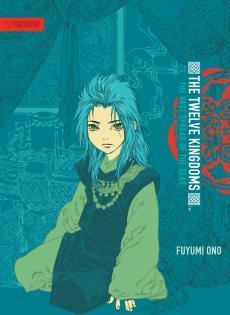
When only an eggfruit, the kirin of the En Kingdom, Rokuta, was transported to Japan for his own protection. But he was abandoned soon after birth by his surrogate parents, left to fend for himself in the mountains. It just so happened that at the same time, a young boy in the En Kingdom named Koya was also abandoned by his own parents, after which he was raised by demon beasts. Their similar circumstances aren't the only thing to bind these two boys, though. Twenty years after their abandonment, their destinies intersect, with potentially disastrous consequences for the En Kingdom.
Fuyumi Ono (小野 不由美, Ono Fuyumi) is a Japanese novelist who is best known for writing the Twelve Kingdoms (十二国記, Juuni Kokuki) series, on which a popular anime is based. Her name after marriage is Fuyumi Uchida (内田不由美, Uchida Fuyumi), but she writes under her maiden name.
Ono was born in Nakatsu, Ōita, Kyūshū in 1960. She graduated from Ōtani University in Kyōto with a degree in Buddhist Studies, and in 1988 was employed by the publisher Kōdansha. Her debut story is titled Sleepless on Birthday Eve.
Ono is married to Naoyuki Uchida (内田直行, Uchida Naoyuki), a mystery novelist who writes under the pseudonym Yukito Ayatsuji (綾辻行人 , Ayatsuji Yukito).
Before she started work on Twelve Kingdoms, Fuyumi Ono wrote The Demonic Child (魔性の子), a horror novel about a boy from another world. She later worked certain events from this novel into the Twelve Kingdoms series. Short stories set in the various kingdoms include: Kasho, Toei, Shokan, Kizan and Jogetsu. In February, 2008, the first new Twelve Kingdoms short story, Hisho no Tori (丕緒の鳥) was published in Shinchosha's Yomyom magazine.
According to an interview at the Anime News Network, she is "currently rewriting a girls' horror series (she) wrote long ago."
Three dudes have bummers of childhoods. THEN WORLDS COLLIDE and by "WORLDS" I mean "DUDES." And by "COLLIDE" I mean "INTERACT EMOTIONALLY AND POLITICALLY ACCORDING TO THEIR OWN DISPARATE MOTIVATIONS."
Number Three has been the most political so far. We know the Ever-King of En and his kirin Enki from the first book and this is the story of how they got started. Also, there's a whacked-out kid with a demon who just wants some human acceptance. He's a pretty big plot point, and I'm sure if I think a little he will also be symbolic of something, but not having sat down to do that thinking, he's just kind of there and the reader goes "Growed-up by a demon who didn't eated him? Wut? Tells me more!" and then nothing happens to satisfy that craving.
STILL I cannot resist a story about stuffy officials who underestimate their free-spirited King. I mean, WE know he's the dang Ever-King of Book One, so don't we giggle when they complain about his gamblin' and womanizin'?
Four stars only because the flashbacks were hella hamfisted.
I liked it! Please to give me more, English translators! Wikipedia says I have to wait until, like, March, so I guess I'll go read something educational. Paaaah.
THE SCORE SO FAR:
Book 1: Trust YOURSELF Book 2: Trust HEAVEN Book 3: Trust THE DANG EVER-KING OF EN
The Vast Spread of Seas: Book Three of The Twelve Kingdom Series.
After the telling the story of the Kirin of the Kingdom of Tai, Ono covers in her third book the tale of Enki of the Kingdom of En. I had some worries before starting this book, despite being a book one of my favorite series, for The Vast Spread of Seas and its predecessor; Sea of Wind, both deal with two characters of the same nature who share, more or less, the same history. Both Kirin were born in a world they didn't belong to, only to realize they have a major role they need to fulfill in another world that is beyond their imagination. I was afraid of duplication of events and recurrence of ideas; how the Kirin adjusts to the rules of the new world, and to his divine task of finding the one true king. Nevertheless, the story here discards that part of Enki's past, rushing through the events of his acceptance of being a Kirin, and focusing on the chain of events which occurred AFTER the King ascended the throne, with hints from his journey which allowed his to choose him despite his doubts of the illegibility of kings themselves. The Vast Spread of Seas, with its flows, is rich with benevolence, deception and politics. More of the Twelve Kingdom universe is introduced, within which the story of the fallen Kingdom of En and its struggle towards flourishing is magically told.
A great continuation to the series. Once again, the author gives us the story of another Kingdom. We get to return to En, which was introduced to us in the first book. We reunite with Enki and the King, Shoryu. This book focuses on how the two met, and how the prosperous rule under them began. We also get some great personal backrounds on each. Once again the author has done a wonderful job creating characters personalities, story line, and history. This story has yet to disappoint and while its length may seem intimidating, the book is actually an easy read. Action, history, politics and personal relations blend well together once more. I am eager to read the next one.
Amo a Enki y Shoryuu... ¡Pero el libro es súper aburrido!
Cronológicamente, este libro ocurre antes que el primero y el segundo, y nos cuenta el día a día del rey de En, mientras los flashbacks nos muestran como se conocieron Shoryuu y su Kirin. El libro se centra en la política y la burocracia de los países, los conflictos y la guerra desde un punto de vista administrativo.
Lo que más difrute del libro son las interacciones entre Enki y Shoryuu. ¡Los amo!
Y por supuesto las imágenes que vienen en la novela son tan preciosas como siempre. Con una calidad mucho más alta que el anime. Espero que el siguiente libro me resulte más ameno.
[shamelessly stealing the form of this review from Hannah]
In Short: I loved it. Mainly because of Enki, but there were many other things that made me truly enjoy this book!
[slight spoilers, nothing specific] In Detail:
THE MAIN CHARACTERS which I roughly identify as Enki/Rokuta and Shoryu/Naotaka are depicted wonderfully. Especially Shoryu's characterization was stunningly done, slow and barely scratching at the surface of his character at times, but in the end it became an in-depth insight into his character. Since much of the story was written from Enki's point of view, there was a lot of insight into his character from the start and I dearly loved that. He is stubborn and set in his ways, sometimes even to the point of being blinded by it, but in the end he learned a lot about himself and his king. It was wonderful to experience his growth.
THE STORY at first a little bit confusing, but I think that only adds to the reading pleasure, since you have to think a little and it is a lot of fun to put together the pieces of the story and learn where the different characters come from. The past and the present of the characters are woven together wonderfully, and I was never tired of the changes in point of view, setting or time.
THE CHARACTERS made me laugh, cry, want to hit them, extremely angry and love them. While reading I was fooled like Enki and suspicious like Ribi, extremely annoyed like Seisho and Itan as well asrelaxed and confident as Shoryu. I loved how Enki made me doubt the king and his capability as a ruler only for Shoryu to prove us so very wrong (although I had my doubts about Enki's seemingly irrevocable opinion). Most of all I was surprised by how Ribi seemed to be a minor and not really important character and then became extremely important and helped to give insights into the ruling mechanisms of the king. I also liked that this was accomplished efficiently without great proclamations or dragging explanations. I also liked the similarities in Enki's and Koya's histories as well as how the character of Atsuyu transformed from a benevolent regent to a self-absorbed tyrant, who is truly blind to the flaws of his own character. It was believable, albeit a bit fast.
The book did not introduce many new aspects about THE WORLD, but the world-building supplied a chapter of En's history that I was curious about. Ever since I saw the anime - which I do have to mention here, because I do not remember if this was the same in The Sea of Shadow - where Enki tells Youko about how he choose his king, I was interested in how he and Shoryu became as close as they were in Youko's story when Enki seemed to have hated kings so much at the beginning.
THE STORY TWISTS were nicely done. I was surprised when I should have been and while I doubted Enki's harsh judgement about Shoryu from the start, I did a lot of doubting Shoruyu myself and was pleasantly surprised with what was revealed throughout the story. The same is true for Atsuyu, just that it was the other way around ;)
I am sure there are some flaws I forget to mention here, because OVERALL I am so happy with The Vast Spread of the Seas that I seem to have forgotten all about them.
The Vast Spread of the Seas is the third book in the Twelve Kingdoms series, but chronologically it takes place before the first and second novel and can also be read as a stand-alone.
This time the story concerns the kingdom of En. Where book 1 was structured mostly like a standard epic quest fantasy and book 2 focused on the mythology, The Vast Spread of the Seas is very much a political fantasy. We witness the first years of Shoryu's reign and the development of his relationship with Rokuta, while their government faces a rebellion. Despite this situation, there is actually very little fighting and a large part of the story is about which political schemes they employ in order to avoid a war. The flashbacks to Shoryu and Rokuta's meeting take place in Japan during the beginning of the Warring States and paint a very dark picture of the country.
The other half of the novel concerns the characters, mainly Shoryu and Rokuta, but there are also some impressive side characters, like Ribi. Among the cast of The Twelve Kingdoms, Shoryu and Rokuta are probably my favorites, because they have very individual (chaotic) characters and their interactions are always so much fun. Therefore it was really nice to read their, sometimes funny and sometimes tragic, story.
I've always loved how Fuyumi Ono explores the psychology of the kirins (basically were-unicorns, how cool is that anyway?) and in this volume, we learn about Rokuta's sad past and his profound doubts and even denial concerning his role. I wouldn't have minded more insight into Shoryu as well, but Rokuta's development was rather endearing.
Overall, I really enjoyed The Vast Spread of the Seas. It is a very short and fast read. The large amount of political measures and intrigues will probably not appeal to everybody, but the character development and world-building should be able to make up for that. A definite recommendation if you are a fan of political fantasies like Attolia, Lumatere or Fire. A must read for anybody looking for a good Asian Fantasy and if you enjoy world-building with detailed mythology ... and unicorns.
Oh how I adore Shoryu! Probably my favorite type of character: carefree fool-cum-strategic mastermind! I just love how almost everyone was fooled by his seemingly nonchalant attitude to everything. Oh but not I! I knew Shoryu had this in the bag, of course! He's the freaking Ever-King of En, duh!
Haha jokes aside, not only is this novel a hefty bite of delicious political intrigue, (which I adore), it gives you some insight into just how Shoryu and Rokuta were able to build up the magnificent Kingdom of En you see in volume 1 from practically nothing. Suffice to say, I've enjoyed this volume the most so far out of the Twelve Kingdoms series!
a well-thought-out and interesting story, more focused on politics while ruling the kingdom of En. this time i did think the author was explaining things directly to the readers, giving the effect of info-dumping throughout, instead of concealing the explanations in a more natural way, such as in books 1 and 2. other than that, i enjoyed it quite a lot and liked learning about Shouryuu and Enki’s backstory !
Two worlds, two wars, and two young boys abandoned to die. Rokuta takes his place as the kirin of En, but he can never forget the war that drove his parents to abandon him. Koya is saved by a demon after his mother abandons him, but that same demon alienates him from everyone else. When the kingdom of En teeters on the bring of war, these two young men hold the power to save the country or destroy it.
This novel was the source of two arcs in the anime, which split out the two stories intertwined here of En's present war with Rokuta's past. I like how the book has them together better, because they play off of each other so well. Rokuta's hatred of kings clashes with his very nature as a kirin to choose a king, and En's current unrest seems to validate his beliefs that kings exist solely to make people miserable. Rokuta's unusual attitude towards his captivity adds to the drama; nothing much about this crime is typical, from the motive to the result.
Koya, alternatively, cares little for the people who hate him, even as he longs for someone to reach out to him. When Atsuyu befriends him, he wins Koya's undying devotion. But not even Atsuyu wants to get too close to the demon that has been parent and friend to Koya. Only Rokuta has shown no fear of it. Helping Rokuta means going against Atsuyu's wishes, but obeying Atsuyu could mean Rokuta's death.
The book reads very well for a translation. Sometimes the language is a little stiff, but the majority of the time the simple style highlights the increasingly complex story. There were a few typographical errors, but nothing major. The scattered illustrations are a nice addition, and accent key scenes.
Overall, this will be a familiar story to people who have seen the anime, but it is still worth reading for the additional depth of character. Although this is the third book in the series, its story follows a different kingdom and stands alone. I rate this book Highly Recommended.
Nếu phải liệt kê nhân vật nữ chính yêu thích của mình trong những truyện đọc gần đây (tất nhiên nhân vật nữ trong đó phải là trung tâm nữa) thì phải kể đến Hoàng Tử Hà trong bộ Trâm do Nhã Nam xuất bản vừa ra đến tập 3 mà mình chưa có tiền mua ;D và thứ 2 là bạn nữ chính Nakajima Youko trong series Thập nhị quốc ký này. Truyện và anime của Thập nhị quốc thì đã nghe danh từ mấy năm trước nhưng chỉ vì mỗi lần search thử lại thấy ngay hình bạn chính Youko chình ình giữa một đám trai đẹp mà bỏ cuộc (thật có lỗi với bạn Youko vì ban đầu đã tưởng bạn cũng thuộc tuýp nữ chính shoujo bánh bèo yếu đuối thiện lương, người gặp người thích =))). Rất may là sự nhầm lẫn tai hại này đã chấm dứt vào cuối tuần trước khi trong 1 phút xuất thần mình đã quyết định luyện cả bộ anime 45 tập này và tiến bước tiếp trên con đường lùng đọc novel. Cả novel và anime của Thập nhị quốc hẳn là phải được liệt vào list rất đáng khuyến nghị tìm đọc của mình, và trên thực tế bộ này đã rất nổi tiếng ở nước ngoài, mỗi tội không hiểu sao ở Việt Nam mình thấy không mấy người đọc lắm thì phải (thực ra mình suýt nằm trong nhóm này ;D).
Cơ mà cái này cũng không phải để PR truyện, mà cốt yếu để nói là cuốn 3 này là đã trở thành tập yêu thích nhất của mình trong series tính đến thời điểm hiện tại và cặp đôi chuyên bỏ nhà đi bụi anh vua En quốc Shouryuu và bạn kỳ lân Rokuta đã soán ngôi bạn Youko để trở thành cặp nhân vật ưa thích nhất trong bộ truyện của mình (rất xin lỗi bạn Youko lần 2 =))).
No encontré Hyouhaku más que en esta versión compartida con el libro completo. Pero igual....
Terminé Hyouhaku. Y pensé tendría problemas de volver a este universo por los complejos conceptos de gobierno chino, pero realmente el carisma de los personajes me la ha puesto tan fácil. Me he quedado un poco triste con algo que no ocurrió, pero la narración final entre los ministros me hizo olvidarlo fácilmente. Fue la mejor decisión volver con este libro, porque el reino de En, su emperador, su taiho y sus ministros siguen siendo mis personajes favoritos de toda esta saga.
Ya no hay vuelta atrás. Vamos con Tonan no Tsubasa.
1 page a day is all I'm allotting myself with this book, and the books that follow. They are that special to me. There are few books that have ever had the effect of bringing true tears to my eyes as the previous 2 did. I recommend this to anyone who enjoys anime and manga.
It was nice to read the story behind the Ever-King and Enki since in the previous books we've only seen them as rulers of the prosperous nation that En has become 400(?) years later.
Oh, how I regret giving the first book five stars, because now I can't put this one above it. Pretend I gave it 6/5 stars.
The story is a bit convoluted and I disliked the antagonist, his motives and actions seemed a tad messy, but that's not really important because he's just a plot device to allow us to see Enki and Shouryuu in the spotlight and what a pair they are.
This book shows the delicate balance a king and his Taiho must achieve to pull a kingdom into prosperity. The kirin's mercy is wonderful in concept, but it will lead to catastrophic ends if not contained. The king's actions can bend a kingdom to its breaking point, unless guided by a heart that put the people's well-being first.
This is how you show the logic behind a world you created. This is how you present the gentle push and pull of power. And the way the two stories this book tells are interwoven is masterful. You slowly unravel both past and present to get to understand the characters better, to readjust your view of them, and discard the prejudices the book gave you when you started reading.
What a masterclass in writing and worldbuilding, Ono-sensei! Hats off to you.
In The Twelve Kingdoms anime, Enki (Rokuta) was my favorite character, but we only see a small piece of his story. So I was delighted when I found a whole novel written about him the lively, insolent, kind-hearted Kirin. The novel showed his and his King's development in his reign's early years, and how Rokuta grew to understand the King, who acted like an irresponsible idiot, but knew exactly what he was doing. After reading this, I understand the relationship of mutual respect and annoyance, almost like an older and younger brother, between the King of En and his Kirin.
My favorite so far of the three. I enjoyed the way Ono went about revealing the Ever King's background to us in pieces concurrently throughout the main story. It flips your impression of him on its head and gives meaning to his actions in a big way. Also, between Enki this volume and Taiki last volume, it's not easy being a kirin and I sympathize with them. They definitely get the short end of the stick in a lot of ways.
What is there to say. No surprises for me since I watched the anime more than ten years ago. Very good story. It's hard to think of them as separate things since all of them are connected. Maybe for themselves they don't make a great book, but the whole collection is sure to give a wide view of the 12 kingdoms.
Finally! The volume about En-ou and Enki! Lots of things to ponder about power and authority in this volume. And it's 2026 and I'm still groaning, "Oh, come on, Atsuyu..."
Just a small note on the translation, 'Kai Gen' really confused the hell out of me. Who? Turned out they, for a reason I don't know what, decided to flip Genkai's name into Kai Gen. Just, why...
I love the relationship between the Ever-King and the Taiho. I would read a hole saga to know how they build the 500-year kingdom, but the taste of the beginning of it is so good.
I quite love this book as I expected. The story is captivating but the writing is quite pleasant to go on a journey as well. There's only one more book left and then it's all new stuff, I'm scareddd