

What do you think?
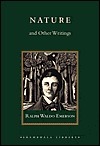
Nature and Other Writings
"The mind of Emerson," literary critic Harold Bloom once wrote, "is the mind of America." Indeed, Ralph Waldo Emerson's essays contain some of the most memorable and important expressions of American thought. Generations of readers have been stirred by Emerson's ideal of self-reliance, and his vision of nature as a manifestation of the divine spirit has profoundly influenced American naturalists and environmentalists from Thoreau's time to the present. Poets as diverse as Emily Dickinson, Robert Frost, and Allen Ginsberg were inspired by the transcendental flavor of Emerson's work. This volume brings together selections from Emerson's best-loved writings, particularly drawing upon his early work, which is some of his most poignant. Included are excerpts from Nature, the famous "Divinity School Address," "Self-Reliance," "The Over-Soul," "Compensation," "Spiritual Laws," "The Poet," and "Circles." Several of his most moving poems appear here as well.
160 pages, Hardcover
First published August 2, 2010
About the author
Ralph Waldo Emerson
3,306 books5,514 followersRalph Waldo Emerson was born in Boston in 1803. Educated at Harvard and the Cambridge Divinity School, he became a Unitarian minister in 1826 at the Second Church Unitarian. The congregation, with Christian overtones, issued communion, something Emerson refused to do. "Really, it is beyond my comprehension," Emerson once said, when asked by a seminary professor whether he believed in God. (Quoted in 2,000 Years of Freethought edited by Jim Haught.) By 1832, after the untimely death of his first wife, Emerson cut loose from Unitarianism. During a year-long trip to Europe, Emerson became acquainted with such intelligentsia as British writer Thomas Carlyle, and poets Wordsworth and Coleridge. He returned to the United States in 1833, to a life as poet, writer and lecturer. Emerson inspired Transcendentalism, although never adopting the label himself. He rejected traditional ideas of deity in favor of an "Over-Soul" or "Form of Good," ideas which were considered highly heretical. His books include Nature (1836), The American Scholar (1837), Divinity School Address (1838), Essays, 2 vol. (1841, 1844), Nature, Addresses and Lectures (1849), and three volumes of poetry. Margaret Fuller became one of his "disciples," as did Henry David Thoreau.
The best of Emerson's rather wordy writing survives as epigrams, such as the famous: "A foolish consistency is the hobgoblin of little minds, adored by little statesmen and philosophers and divines." Other one- (and two-) liners include: "As men's prayers are a disease of the will, so are their creeds a disease of the intellect" (Self-Reliance, 1841). "The most tedious of all discourses are on the subject of the Supreme Being" (Journal, 1836). "The word miracle, as pronounced by Christian churches, gives a false impression; it is a monster. It is not one with the blowing clover and the falling rain" (Address to Harvard Divinity College, July 15, 1838). He demolished the right wing hypocrites of his era in his essay "Worship": ". . . the louder he talked of his honor, the faster we counted our spoons" (Conduct of Life, 1860). "I hate this shallow Americanism which hopes to get rich by credit, to get knowledge by raps on midnight tables, to learn the economy of the mind by phrenology, or skill without study, or mastery without apprenticeship" (Self-Reliance). "The first and last lesson of religion is, 'The things that are seen are temporal; the things that are not seen are eternal.' It puts an affront upon nature" (English Traits , 1856). "The god of the cannibals will be a cannibal, of the crusaders a crusader, and of the merchants a merchant." (Civilization, 1862). He influenced generations of Americans, from his friend Henry David Thoreau to John Dewey, and in Europe, Friedrich Nietzsche, who takes up such Emersonian themes as power, fate, the uses of poetry and history, and the critique of Christianity. D. 1882.
Ralph Waldo Emerson was his son and Waldo Emerson Forbes, his grandson.
The best of Emerson's rather wordy writing survives as epigrams, such as the famous: "A foolish consistency is the hobgoblin of little minds, adored by little statesmen and philosophers and divines." Other one- (and two-) liners include: "As men's prayers are a disease of the will, so are their creeds a disease of the intellect" (Self-Reliance, 1841). "The most tedious of all discourses are on the subject of the Supreme Being" (Journal, 1836). "The word miracle, as pronounced by Christian churches, gives a false impression; it is a monster. It is not one with the blowing clover and the falling rain" (Address to Harvard Divinity College, July 15, 1838). He demolished the right wing hypocrites of his era in his essay "Worship": ". . . the louder he talked of his honor, the faster we counted our spoons" (Conduct of Life, 1860). "I hate this shallow Americanism which hopes to get rich by credit, to get knowledge by raps on midnight tables, to learn the economy of the mind by phrenology, or skill without study, or mastery without apprenticeship" (Self-Reliance). "The first and last lesson of religion is, 'The things that are seen are temporal; the things that are not seen are eternal.' It puts an affront upon nature" (English Traits , 1856). "The god of the cannibals will be a cannibal, of the crusaders a crusader, and of the merchants a merchant." (Civilization, 1862). He influenced generations of Americans, from his friend Henry David Thoreau to John Dewey, and in Europe, Friedrich Nietzsche, who takes up such Emersonian themes as power, fate, the uses of poetry and history, and the critique of Christianity. D. 1882.
Ralph Waldo Emerson was his son and Waldo Emerson Forbes, his grandson.
Ratings & Reviews
Friends & Following
Create a free account to discover what your friends think of this book!
Community Reviews
Displaying 1 - 6 of 6 reviews

August 2, 2022
2008 January 22 - I read this "Shambhala" mini-book, and even though Emerson is foundational to my religious movement (Unitarian Universalism), I found it pretty slow going. It might be because this book consists of abridged excerpts, but it all seemed too disjointed - as if each paragraph was its own essay, and they were collected together by no rhyme or reason. I did gain some better understanding of what Emerson's transcendentalism was like, but it was so much work to find that amongst the clutter!

December 6, 2012
The Shammbhala Library is the most eclectic publishing library ever concocted. Because of that, I can't well imagine that this particular collection of Emerson's writings will find its way into many American's homes, though it is very well done. That's rather beside the point, anyway, since just about any collection of Emerson will include the writings found here: "The Sphinx," "The Poet," "Bacchalus," "Circles," "Nature," "Self-Reliance," "The Divinity School Address," and a few others. Not every collection will intersperse poetry with the essays, so as far as collections go this is very good as a full representation of Emerson. The only problem with this collection, as with many collections of Emerson, is that it ignores Emerson's later writings claiming that they are not representative of Emerson. Better to say that the later writings are not representative of our perception of Emerson. I find that it is nice to follow a writer through changes in life and thought rather than pigeon-holing them. Oh well.
Since first reading Emerson in my early college days alongside Thoreau I have thought that the two Concordians (Hawthorne being just as great) were the best American products of the 19th century, and perhaps of the last two centuries combined. Reading Emerson this time around, only a few years after college, I find that I can no longer praise him as I once did. No matter what we conclude about Emerson I think we as Americans must appreciate him. For one thing, he has no doubt framed and influenced American thought and literature from the time of his birth. Emerson is also clearly insightful and provocative and writes artistically. But his homage to Plato and the ancient Greeks is a bit much.
Indeed, almost all of what Emerson has to say can be traced back, if he doesn't do so explicitly for you as he often does, to Plato's philosophy. More specifically to Neo-Platonism which adds the concept of The One to Plato's theory of the Forms and Ideas. Certainly there is nothing wrong with subscribing to this philosophy and I do not begrudge Emerson his passion. Yet I am quite frankly disappointed to discover that, a) I can no longer agree all that much with Emerson, and b) Emerson is not as original as I thought he was. If we grant, as we should, that Emerson's genius consisted in translating Platonism into a young Americanism, which included tidbits of Christianity, then we still cannot speak of originality. Oh well.
And when it comes to Emerson, you basically have to talk about his ideas. Though an artistic and articulate writer, Emerson's style does not admit smooth transitions or an easy flow. As a reader or as a listener the experience is much like being pelted with ideas over and over again. You cannot enjoy reading an Emerson essay unless you enjoy being in discussion with his ideas.
As for his poetry, well, no matter what any editor might say I think there's a reason why Emerson is not today well-known for his poetry. Unfortunately his poems are startlingly similar to his essays: all about the idea. I do not think there's much in terms of aesthetic quality here. Personally, too, I cannot appreciate the ubiquity of passive verbs in his poems. Even if Emerson used the passive tense on purpose, as I think he does to emphasize Nature's predominance in our life, rather than as a means to rhyme well, I'd still argue that his poetry is boring for that very reason. Don't get me wrong, however. Poetry should never be about the idea/s, but Emerson, as a naturally artistic writer, at least gets you to the point where you can appreciate whatever idea presents itself in the poem.
In sum, not as good as I once thought. And certainly I'd never recommend the majority of his philosophy to anyone--other than the striving for the greatness we can all attain. Regardless, Emerson should be read because he is a highlight of American literature, and as such I am proud that he is in my literary tradition.
Since first reading Emerson in my early college days alongside Thoreau I have thought that the two Concordians (Hawthorne being just as great) were the best American products of the 19th century, and perhaps of the last two centuries combined. Reading Emerson this time around, only a few years after college, I find that I can no longer praise him as I once did. No matter what we conclude about Emerson I think we as Americans must appreciate him. For one thing, he has no doubt framed and influenced American thought and literature from the time of his birth. Emerson is also clearly insightful and provocative and writes artistically. But his homage to Plato and the ancient Greeks is a bit much.
Indeed, almost all of what Emerson has to say can be traced back, if he doesn't do so explicitly for you as he often does, to Plato's philosophy. More specifically to Neo-Platonism which adds the concept of The One to Plato's theory of the Forms and Ideas. Certainly there is nothing wrong with subscribing to this philosophy and I do not begrudge Emerson his passion. Yet I am quite frankly disappointed to discover that, a) I can no longer agree all that much with Emerson, and b) Emerson is not as original as I thought he was. If we grant, as we should, that Emerson's genius consisted in translating Platonism into a young Americanism, which included tidbits of Christianity, then we still cannot speak of originality. Oh well.
And when it comes to Emerson, you basically have to talk about his ideas. Though an artistic and articulate writer, Emerson's style does not admit smooth transitions or an easy flow. As a reader or as a listener the experience is much like being pelted with ideas over and over again. You cannot enjoy reading an Emerson essay unless you enjoy being in discussion with his ideas.
As for his poetry, well, no matter what any editor might say I think there's a reason why Emerson is not today well-known for his poetry. Unfortunately his poems are startlingly similar to his essays: all about the idea. I do not think there's much in terms of aesthetic quality here. Personally, too, I cannot appreciate the ubiquity of passive verbs in his poems. Even if Emerson used the passive tense on purpose, as I think he does to emphasize Nature's predominance in our life, rather than as a means to rhyme well, I'd still argue that his poetry is boring for that very reason. Don't get me wrong, however. Poetry should never be about the idea/s, but Emerson, as a naturally artistic writer, at least gets you to the point where you can appreciate whatever idea presents itself in the poem.
In sum, not as good as I once thought. And certainly I'd never recommend the majority of his philosophy to anyone--other than the striving for the greatness we can all attain. Regardless, Emerson should be read because he is a highlight of American literature, and as such I am proud that he is in my literary tradition.

July 26, 2013
This is Emerson. This volumes alternates essay and poem. Of course, "Self-Reliance" is a highlight, but there are several other good essays, including "Compensation," "Spiritual Laws," and "The Poet," where he basically summons Walt Whitman into being. I didn't find his poetry to be as good as his essays were. But this is a good overview of his most influential work.

February 21, 2010
I'm giving this 5 stars because it includes the essay "Self Reliance," which I think it basically scripture.
His address to the Divinity College, and his essay on Compensation are pretty great.
The poems, I'd give two stars. Not really a fan of Emerson's poems.
His address to the Divinity College, and his essay on Compensation are pretty great.
The poems, I'd give two stars. Not really a fan of Emerson's poems.
June 21, 2008
I love Emerson. It's been a pleasure exploring where he lived in New England.

October 1, 2009
An odd collection of poetry and essays of Ralph Waldo Emerson. Great stuff in the essays, and highly recommended. Poetry not so much to my taste, but still good stuff.
Displaying 1 - 6 of 6 reviews