

What do you think?

Documents of Twentieth-Century Art
Philip Guston: Collected Writings, Lectures, and Conversations
This is the premier collection of dialogues, talks, and writings by Philip Guston (1913–1980), one of the most intellectually adventurous and poetically gifted of modern painters. Over the course of his life, Guston’s wide reading in literature and philosophy deepened his commitment to his art—from his early Abstract Expressionist paintings to his later gritty, intense figurative works. This collection, with many pieces appearing in print for the first time, lets us hear Guston’s voice—as the artist delivers a lecture on Renaissance painting, instructs students in a classroom setting, and discusses such artists and writers as Piero della Francesca, de Chirico, Picasso, Kafka, Beckett, and Gogol.
- GenresArtNonfiction
343 pages, Paperback
First published January 1, 2010
About the author
Philip Guston
57 books16 followers"Philip Guston (June 27, 1913 – June 7, 1980) was a painter and printmaker in the New York School, which included many of the abstract expressionists, such as Jackson Pollock and Willem de Kooning. In the late 1960s Guston helped to lead a transition from abstract expressionism to neo-expressionism in painting, abandoning the so-called "pure abstraction" of abstract expressionism in favor of more cartoonish renderings of various personal symbols and objects." - wikipedia
Ratings & Reviews
Friends & Following
Create a free account to discover what your friends think of this book!
Community Reviews
Displaying 1 - 12 of 12 reviews

March 11, 2011
when i read p. guston I feel fly like a g-6
September 4, 2026
In the painter’s speech one might recognize a subtle hesitance to cling to any certainty. He vacillates constantly. He could talk for hours, that is clear, but his talk circumambulates, it never reaches anything decisive. And yet, it is at once the concrete which takes him, which interests him above all; or, perhaps, what interests him is that the concrete is so much more difficult to grasp than the conceptual. He is obsessed with process, with material, rather than with concept, yet he confidently fails in reaching any sort of clarity about his work, instead merely wandering in the ambiguity of it all. This is what I have gathered from reading all his words: that his greatest fascination—and what most informed his art—was that, for him, the greatest abstraction was always to be found in what was most solid, most concrete, and apparently most simple, most natural. I could imagine him saying: "Life is abstract. Art cannot be. Art gives us a view of life's abstraction." A notion contrary to our typical ways of thought, even to our typical ways of seeing, but one which begins to make better and better sense the more you read. It may give some clarity to his infamous return to figuration in the late sixties.
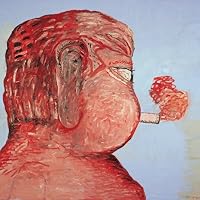
Much of Guston’s accomplished works of that period coerce from the picture plane an ambiguity between the matter and the idea. You look and you could name, perhaps, all the objects represented in the painting and yet quite rightly say “I do not know what I am looking at.” It is at once clear that what is before you is a canvas (a physical object) and that what is before you is a picture plane (i.e. an imaginary object). Similarly, the ambiguity—or to situate it in the figures themselves, you might call it an ambivalence internal to the idea of the figure—each representation seems to exhume, in that it suggests a real-world object while, and at the same time, hesitantly dissolving into a pure form, pure abstraction. Half-existing, half-breathing, half-baked ideas and half-dead materials, risen to half-life through painterly talent.
Guston speaks multiple times of the creation involved in painting—the creation of an image—essentially being a kind of destruction.—“Art is death.”—This I find trite—cliché. What he really means, I think, is that the painter is a kind of cleaner—like a window cleaner—but one which only creates what is to be seen through the window by also creating the mess which obfuscates it. In Guston’s art—and this is what makes him a great talent—the subject of the painting remains the window-glass, not what is seen through it. The objects of his paintings seem to shimmer in intense heat, as if they might evaporate and shift to air or return to the muteness of stone. They are not all there, and neither is the canvas which holds them, the canvas which appears to mutate—as one looks longer at the image—from material to imaginary surface and back. The glass of the window I speak of—to continue my little metaphor—is neither the picture plane nor the real canvas itself, it is what separates the two, what holds the real apart from the imagined and which, when “cleaned,” allows the picture plane and its objects to be seen through the canvas, allows the material of paint to turn from pure form into figurative idea. As Guston hones in on this thin lining, this supple cusp between dream and waking, the true abstraction is born: the ambivalence between matter and idea, between form and content, between life and art—this is what appears, this is what the image is of: this very ambiguity upon which the world is washed away and built again, by our eyes—in our minds. Reality exists here, but only hesitantly: inch by inch.
(In this sense, Guston’s figurative work is much more “abstract” than a Pollock or a Kline.)
…
“GUSTON: We were talking yesterday at the studio about the picture plane, and to me there’s some mysterious element about the plane. I can’t rationalize it, I can’t talk about it, but I know there’s an existence on this imaginary plane which holds almost all the fascination of painting for me… I’m convinced that it’s almost a key, and yet I can’t talk about it; nor do I think it can be talked about…
SYLVESTER: The matter giving a certain resistance so that we don’t go straight through it to the idea?
GUSTON: Exactly. In other words, without this resistance you would just vanish into either meaning or clarity, and who wants to vanish into clarity or meaning?”
…
“Would you be as interested in seeing men fly, unattached and free, as you would be in seeing a man with, I don’t know, two hundred pounds of cement strapped onto him and let’s see him get two inches off the ground?”
Much of Guston’s accomplished works of that period coerce from the picture plane an ambiguity between the matter and the idea. You look and you could name, perhaps, all the objects represented in the painting and yet quite rightly say “I do not know what I am looking at.” It is at once clear that what is before you is a canvas (a physical object) and that what is before you is a picture plane (i.e. an imaginary object). Similarly, the ambiguity—or to situate it in the figures themselves, you might call it an ambivalence internal to the idea of the figure—each representation seems to exhume, in that it suggests a real-world object while, and at the same time, hesitantly dissolving into a pure form, pure abstraction. Half-existing, half-breathing, half-baked ideas and half-dead materials, risen to half-life through painterly talent.
Guston speaks multiple times of the creation involved in painting—the creation of an image—essentially being a kind of destruction.—“Art is death.”—This I find trite—cliché. What he really means, I think, is that the painter is a kind of cleaner—like a window cleaner—but one which only creates what is to be seen through the window by also creating the mess which obfuscates it. In Guston’s art—and this is what makes him a great talent—the subject of the painting remains the window-glass, not what is seen through it. The objects of his paintings seem to shimmer in intense heat, as if they might evaporate and shift to air or return to the muteness of stone. They are not all there, and neither is the canvas which holds them, the canvas which appears to mutate—as one looks longer at the image—from material to imaginary surface and back. The glass of the window I speak of—to continue my little metaphor—is neither the picture plane nor the real canvas itself, it is what separates the two, what holds the real apart from the imagined and which, when “cleaned,” allows the picture plane and its objects to be seen through the canvas, allows the material of paint to turn from pure form into figurative idea. As Guston hones in on this thin lining, this supple cusp between dream and waking, the true abstraction is born: the ambivalence between matter and idea, between form and content, between life and art—this is what appears, this is what the image is of: this very ambiguity upon which the world is washed away and built again, by our eyes—in our minds. Reality exists here, but only hesitantly: inch by inch.
(In this sense, Guston’s figurative work is much more “abstract” than a Pollock or a Kline.)
…
“GUSTON: We were talking yesterday at the studio about the picture plane, and to me there’s some mysterious element about the plane. I can’t rationalize it, I can’t talk about it, but I know there’s an existence on this imaginary plane which holds almost all the fascination of painting for me… I’m convinced that it’s almost a key, and yet I can’t talk about it; nor do I think it can be talked about…
SYLVESTER: The matter giving a certain resistance so that we don’t go straight through it to the idea?
GUSTON: Exactly. In other words, without this resistance you would just vanish into either meaning or clarity, and who wants to vanish into clarity or meaning?”
…
“Would you be as interested in seeing men fly, unattached and free, as you would be in seeing a man with, I don’t know, two hundred pounds of cement strapped onto him and let’s see him get two inches off the ground?”

December 11, 2020
By far the most important book on art I have ever read. A life-changing book. Read it cover to cover, straight through, and you will find that it rewards you.
August 13, 2018
Required reading for anyone who wants to seriously consider what it means to engage in the act of making a painting
January 5, 2019
Brilliant guy, great artist.

December 30, 2019
There are so many wonderful bits underlined in my copy; and I´m sure I´ll be referring to this book again, and again. Guston, who is dear to me for many reasons, fought the good fight in painting.
March 23, 2011
5 stars doesn't even make sense. This is just absolutely essential.

August 24, 2011
There's a lot of there there, here. Painters (like Guston) should talk.
Read
October 12, 2015Wrambling odds and ends related to Philip Guston. He doesn't know.
December 31, 2024
Nice to read his description of painting process vs drawing. Drawing as more immediate, no layers of obscurity to hide behind. As well as the editing process.
September 18, 2012
A treasure trove of ideas on art, life and literature.

June 7, 2016
Favorite
Displaying 1 - 12 of 12 reviews