

What do you think?
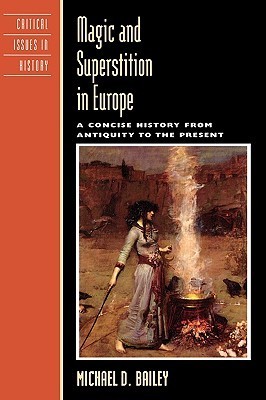
Magic and Superstition in Europe: A Concise History from Antiquity to the Present
The only comprehensive, single-volume survey of magic available, this compelling book traces the history of magic, witchcraft, and superstitious practices such as popular spells or charms from antiquity to the present day. Focusing especially on Europe in the medieval and early modern eras, Michael Bailey also explores the ancient Near East, classical Greece and Rome, and the spread of magical systems_particularly modern witchcraft or Wicca_from Europe to the United States. He examines how magic and superstition have been defined in various historical eras and how these constructions have changed over time. He considers the ways in which specific categories of magic have been condemned, and how those identified as magicians or witches have been persecuted and prosecuted in various societies. Although conceptions of magic have changed over time, the author shows how magic has almost always served as a boundary marker separating socially acceptable actions from illicit ones, and more generally the known and understood from the unknown and occult.
288 pages, Paperback
First published January 1, 2006
Ratings & Reviews
Friends & Following
Create a free account to discover what your friends think of this book!
Community Reviews
Displaying 1 - 11 of 11 reviews
March 12, 2018
A solid go-to and reference on the subject, but with nothing outstanding or unique that makes it stand-out. Its really worth comes from being a good one-stop study, with healthy portions devoted to the early periods, say up to 1500, and the development of both what magic meant (the most interesting part of all of this), who thought they could do it (a surprising amount of underused clerics), and the result (kill them all).
Bailey digs a bit further into the first point which is something a lot of folks studying this subject miss out, tending to focus on the persecutions rather than what they were persecuting against.
Bailey digs a bit further into the first point which is something a lot of folks studying this subject miss out, tending to focus on the persecutions rather than what they were persecuting against.

June 13, 2017
Just as the title says, it's a concise history. Like many English-speaking authors, he seems to think Europe is bounded on the east by the Elbe river, but one has to cut corners in order to survey a whole continent. What I like about it is that he puts witch-hunting in perspective and spends some ink to refute exaggerated claims about the extent of witch-hunting hysteria. Also, the history of magic doesn't stop at the Enlightenment: 20th-century magical revivals are given proper attention.

February 8, 2012
This is an impressive bit of work, reducing all of Magical (Western) history into a mere seven chapters. This writing style is elegant and easy to read, logically constructed and executed, while moving at a fast pace to rarely ever lull. His strengths are Medieval and Early Modern conceptions of magic, and while he gives fair dues to post-1500 expressions of superstitious arts, are not nearly as vibrant, albeit, interesting, especially the section on Occult practices with Nazi Germany. Well done.
June 27, 2024
As other reviews have said, this book is exactly what it says it is: A short history of magic in Europe. It is careful and the author tries to present things as accurately as possible while acknowledging the limitations of making this book concise. There are no groundbreaking arguments or conclusions in this overview. Yes, there is a piece towards the end regarding Nazi links to neo-paganism, but the author is quick to point out that most neo-pagans would be dismayed to learn of this connection. It's always unnerving when Nazis are brought up. I was bracing for the author to link neo-paganism with Nazism as a kind of hit against neo-paganism, but that didn't really happen. The author criticizes neo-pagan figures like Gardiner, Murray, and Starhawk as incorrect and possibly insincere, but the book stops short of calling them outright charlatans. The text also clarifies that neo-pagan movements are diverse and many have taken on a life of their own separate from inaccurate sensationalist histories.
May 12, 2021
A well researched book but not an engaging read. I appreciate the emphasis on clearing weighing the evidence on various historical disputes, especially on a topic that is overflowing with misinformation. Rigorous argument, however, need not come at the expense of such dry prose.

March 20, 2018
Dry but informative.

June 22, 2019
A very good book about the early historical recordings of magic. However it didn’t ever truly give the details I was looking for.

July 9, 2021
4.5 🌟 / 5
It's an amazing concise history of magic just like the title says
It's an amazing concise history of magic just like the title says

November 30, 2021
The chunk near the end on Nazi witchcraft is nuts.

April 25, 2013
A lot of interesting information, but it can be really dense and dry at times. Reading went pretty slowly. Definitely recommended for what it is, but it might take awhile to digest it all.

Read
March 26, 2018a really nice work of subtle scholarship. 'Magic is whatever the priests of other religions do' Magic has been a terminology used to convey fascination with the Other, the Abnormal, throughout the centuries even as people who consult it brandish their disgust of it. This book is divided into chronological chapters, studying magic and what it defined from Antiquity, to the Christian era, and through Renaissance and the Enlightenment.
Displaying 1 - 11 of 11 reviews