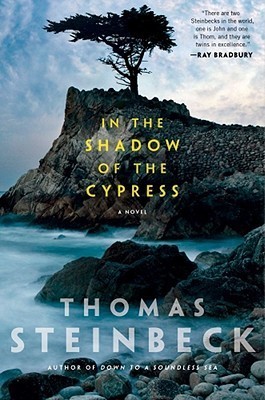
Thomas Steinbeck has been praised by Publishers Weekly for his stylistic brilliance and “accomplished voice.” Now, his enthralling novel In the Shadow of the Cypress blends history and suspense with literary mastery and brings vivid realism to California’s rich heritage. In 1906, the Chinese in California lived in the shadows. Their alien customs, traditions, and language hid what they valued from their neighbors . . . and left them open to scorn and prejudice. Their communities were ruled—and divided—by the necessity of survival among the many would-be masters surrounding them, by struggles between powerful tongs, and by duty to their ancestors. Then, in the wake of natural disaster, fate brought to light artifacts of incredible value along the Monterey an ancient Chinese jade seal and a plaque inscribed in a trio of languages lost to all but scholars of antiquity. At first, chance placed control of those treasures in the hands of outsiders—the wayward Irishman who’d discovered them and a marine scholar who was determined to explore their secrets. The path to the truth, however, would prove to be as tangled as the roots of the ancient cypress that had guarded these treasures for so long, for there are some secrets the Chinese were not ready to share. Whether by fate, by subtle design, or by some intricate combination of the two, the artifacts disappeared again . . . before it could be proved that they must have come there ages before Europeans ever touched the wild and beautiful California coast. Nearly a century would pass before an unconventional young American scientist unearths evidence of this great discovery and its mysterious disappearance. Taking up the challenge, he begins to assemble a new generation of explorers to resume theperilous search into the ocean’s depth . . . and theshadows of history. Armed with cutting-edge, moderntechnology, and drawing on connections to powerful families at home and abroad, this time Americans and Chinese will follow together the path of secrets that have long proved as elusive as the ancient treasures that held them. This striking debut novel by a masterful writer weaves together two fascinating eras into one remarkable tale. In the Shadow of the Cypress is an evocative, dramatic story that depicts California in all its multicultural variety, with a suspense that draws the reader inexorably on until the very last page.
Thomas Steinbeck was an American novelist, screenwriter, photographer, and journalist. He published numerous works of fiction, including short stories and novels. He was the oldest son of American novelist John Steinbeck.
In the Shadow of the Cypress is an unusual and engrossing read. The book is told from three points of view: that of Dr. Charles Gilbert, a professor at Stanford University in 1906, that of his contemporary, Dr. Lao-Hong, a Harvard-educated Chinese who takes an active role assisting the Chinese community, and that of Charles Lucas, a graduate student at Stanford in the present. At the center of the book is a mystery of unique Chinese artifacts that were first discovered in Northern California in 1906, at a time that Chinese immigrants are marginalized.
The novel begins with the narrative of Dr. Charles E. Gilbert, a professor of marine biology at Stanford. As Gilbert describes life in Northern California during the early 1900s, he sympathizes with the local Chinese as they face open discrimination and attacks on China Point. Gilbert learns about the discovery of unique Chinese artifacts and his fascination with the mysterious artifacts leads him to a great mystery.
Then the novel the impact that the artifacts have on the local Chinese community from the point of view of Dr. Lao-Hong, a contemporary of Dr. Gilbert's. Dr. Lao-Hong is a Harvard graduate and well respected member of the Chinese community. Born, raised and educated in America, Dr. Lao-Hong often shares a "semi-Western sensibility" and often feels torn between two cultures. In a society where family ties and connections are of critical importance, Dr. Long-Hong is fortunate in his family and clan; he is nephew to two highly respected directors of the powerful Three Corporations. As the representative of Three Corporations, Dr. Lao-Hong tasked with balancing conflicting claims over the artifacts that would respect the people and town where the artifacts were discovered, the local tongs and his clan, and the interests of Mainland China.
When as a student at Stanford, Luke comes across Dr. Gilbert's notes on the artifacts and he immediately recognizes the importance of this groundbreaking discovery. Luke tries to decipher the symbols and enlists the expertise of Robert Wu, a Chinese American PhD candidate. Working together and aided by cutting edge technology, Luke and Robert decipher the mysteries of the ancient Chinese artifacts.
Thomas Steinbeck's In the Shadow of the Cypress is a well-crafted and fascinating read. The mystery of the artifacts drew me in but I found the descriptions of Dr. Lao-Hong and the Chinese communities to be the best part of the book. Steinbeck weaves an intriguing tale and offers a sympathetic look at a hidden culture.
1439168253 - Hardcover $ 25.00 Publisher: Pocket (April 6, 2010), 256 pages. Review copy provided by the publisher.
For some reason, I have dragged my feet on writing this review. It's been a while, and the book wasn't incredibly memorable in the first place, so I doubt this review will have much relevance. Regardless, here it is...
I promised myself I wouldn't mention John Steinbeck in this review. The work of Thomas Steinbeck should stand on its own; even mentioning that he is his father's son seems unnecessary and insulting to the work of Thomas. Well, I lied.
It's hard not to think of John when Thomas' characters and situations continually remind us of his father. A marine biologist. Stanford. Just pull ten random words from a Steinbeck biography and you'll likely find one or two which apply to In the Shadow of the Cypress. And frankly, it's an unfair comparison. Nonetheless, it's what one should expect being the son of a Nobel and Pulitzer Prize winning author (or writer since Steinbeck didn't consider himself as an "author").
In the Shadow of the Cypress does fairly well when it comes to story. Although it is a bit slow, it carries its own as an intriguing historical mystery. Steinbeck shows that he knows his subject matter well and presents it in an interesting and unique fashion. What Steinbeck doesn't know, however, is his characters. I couldn't understand them, nor did I really want to. They were dry. What personality they did have didn't make sense--am I just stereotyping when I say I didn't find Charles Lucas' concern over a surfboard believable? Charles Lucas, PhD student and holder of one of the world's most historically significant artifacts, just wants to find "the perfect wave." Some of the best character moments happen after Lucas meets Robert Wu and the two develop a friendship which is believable and funny at times. Unfortunately, it doesn't last. Once Wu's father is brought into the picture, the relationship takes a back seat for no particular reason and the novel becomes bland once again.
Thomas Steinbeck might do okay as an author if he is marketed to the right audience. Fans of plot-driven historical mysteries may love his books--I don't know as I am not one of those "fans". As long as he is marketed as being THE SON OF JOHN STEINBECK, however, Thomas Steinbeck will be in the shadow of his own cypress; rather, he'll live in the shadow of the Giant Sequoia that was his father.
(On a side note, writing this review has put me in the mood to reread "To a God Unknown").
I have to admit that when I picked up a copy of this book that I was quite skeptical about what it would be like. After all, anyone who is the offspring of a world-renowned author has huge shoes to fill and high expectations to meet if they are to ever be viewed as anything other than someone setting out to ride their parent's coattails.
So, I started nibbling at the beginning of the book. Then I started to chew, and I found that the story was so interesting and engaging to me that I couldn't help but devour the rest.
To be completely up front, Thomas Steinbeck's story pulled me in initially because of the geographic setting and locales that he included in his tale. I am a marine biologist by training, and I carried out my PhD field work in the intertidal zone that is adjacent to the Hopkins Marine Station, Pacific Grove, CA, and I have a soft spot in my heart for the Monterey Bay Aquarium and all it stands for. I lived in Santa Cruz for five years and spent at least a few days each month in Monterey/Pacific Grove. I too have eaten a burger at McFly's (just along Cannery Row from the MBA)- and they do up a great burger! I am also familiar with the orient, having lived in Japan for a couple of years, but I claim no special knowledge or insights into China or the Chinese other than to realize that most oriental cultures are MUCH older than ours and tend to have a differnt outlook when it comes to culture, tradition, and even time.
Anyway, what this means is that I was pre-emptively biased in favor of the story as it unfolded. With that said, the author, in my opinion spun an engaging tale that had twists and turns enough to keep me on board all the way to the end...and even through the afterward, etc. I'm now ready to check and see what else he's written.
I liked the characters, their descriptions, and the way the author had them interact with each other. I found myself wishing that the book would run on for 500 or so pages instead of just under half that length.
Anyway, I found the book enjoyable and readable. It never wallowed in gratuitous foul language, sex, or violence, and was, to me, a joy! So no matter what others have said, I really liked it!
This book has been sitting around a while, waiting to be read. I finally got to it. I was underwhelmed and disappointed.
Although the basic premise of the story is interesting, it was Thomas Steinbeck's writing that made this a bit of a slog. A mystery story devoid of conflict and with minimal suspense isn't exactly an edge-of-your seat read. To make it worse, the younger Steinbeck, unlike his father, does not draw the reader into the lives of his characters. In fact, the characters are barely alive. This is due in large part to his tell-don't-show writing style, resulting in distance from the characters. His characters rarely speak, and when they do, it's in long infodumpy speeches. Worse, there's very little difference in how the characters talk. I never identified with any character because of the walls the author built between the reader and the characters with his heavily filtered language and lack of real characterization. Then the story ends with a dull conclusion that didn't directly involve the main character.
I was expecting to give this book three stars. Although the writing itself didn't really appeal to me, the story itself was interesting. But then he had to go and end it with one of my least favorite things that writers do, an infodump describing the lives of the characters after the story ends. I don't like this when I love the characters, but when the author never let me care about them in the story, I'm not at all interested in what they did after the story ended. So I deducted a star for that.
I really wanted to like this one and I stuck it out to the end hoping for something better in the end, but I didn't get it.
I think I liked this book best when it was an unread curiosity tugging at my interest.
This book starts out with Dr. Charles Lucas; Department of Marine Studies at the Stanford University reading a diary entry dated 1906 written by Dr. Charles H. Gilbert. Dr. Gilbert was a Stanford professor of Marine Biology. Readers are transported back in time through Dr. Gilbert’s diary entries to a time when the Chinese were considered outsiders but who had lots of mystery surrounding them. The Chinese had many priceless artifacts in their possession like jade. Dr. Gilbert shares about his discover of some of the wonderful items he uncovered but what happens later when the items are forgotten? Only the cypress tree knows the secrets…In the Shadow of the Cypress.
When I first read the summary for this book, I found it intriguing and then when I found out who the author was, I knew I had to check this book out. I have to admit that the only book I read of Mr. Steinbeck’s famous father’s work was Travels with Charley; a story about John Steinbeck taking a road trip with his full sized black poodle. I am in the middle of the road with this book. On the one hand I thought this book was interesting and at times read like poetry but on the other hand I found that it took my a little while to get into the story. The characters were alright but they were kind of like secondary to the story. This book is not character driven but more story driven. The switching between the past to present was a smooth progression for me. Mr. Steinbeck shows promise and talent with this debut novel. He shows that he can make a good name for himself like his father.
In first learning a son of John Steinbeck wrote a book called “In the Shadow of the Cypress” I suspected wow wanting to be a writer and your Dad is like the best writer ever, that’s gotta be tough, the book must be what he felt in this shadow. Instead it’s a layered concept of letters in the present, which was the past being forgotten, then people discovering them in the future which is now the present. The characters are not believable and it lacks a theme to define it from a hodgepodge of fun facts like a half ass Hardy Boy Adventure. It is a quick read that brings in some real life elements, but I wouldn’t take them without research, because I’ve never met a surfer who worries about sharks enough to stop surfing and there IS a beach called Asilomar still today! Did Thomas grow up with Mom in New York? It should be good, it’s mostly ok. J.S. work wrenches the soul, tall order to follow. The “Shadow” is a Steinbeck Jr. Freudian slip. Despite the Monterey Jack Cheese it took to wrap it up, it was fun to read and must for Steinbeck completists.
Enjoyed it, but it wasn't fantastic. I found it hard to believe that Dr. Gilbert's first journal entry was 54 pages long, but I enjoyed that section of the book the most. The modern-day section seemed to fall into place too perfectly; there were no real obstacles. Luke finds an expert in ancient Chinese texts very easily; he turns out to be the son of a wealthy business man who can provide them with all the money and resources they need, and also ends up being the grandson of Dr. Lao-Hung. That section read too much like a documentary for me. I didn't get any real feel for Luke's or Robert's characters.
Pretty impressive in places. Enjoyed the setting and the method of narration. Some sections seemed heavy-handed, but overall they held together well. Most enjoyed the ongoing connection between John Steinbeck and his son Thomas Steinbeck about the Chinese in CA (loved Lee in East of Eden).
Review: In The Shadow of The Cypress by Thomas Steinbeck.
This was another interesting story where Thomas Steinbeck combines history and suspense with creativity that gives vivid realism to California’s wealthy legacy. This is well written story and the characters were too developed and as a reader I found them predictable because of their history/culture of their traditional personality traits. After reading for years most readers assume what a person will do in a situation because of their custom.
The story is fascinating with the discovery of Chinese ancient artifacts embedded in the roots of a fallen cypress tree along the coast of California in 1909. By way of the story the reader finds out that years ago the Chinese also came to America and settled in an area of Monterey, California closed to the time Christopher Columbus set foot on the same soil. The plot to this story starts with an Irishman named Luke, who was clearing away the trees that had fallen during a powerful storm came upon a buried treasure that could overturn centuries of secrets and betrayals and reveal old historical mysteries.
Steinbeck takes the story back many years to the first discovery and the agreement that was made between the European’s and China about the artifacts. Then moving on to the tragedy of the artifacts ending up at the bottom of the ocean left both America and China at a loss. There was a reason that these artifacts were of interest. The jade seal on the two items may prove that the Chinese landed in America first before the Europeans even touched the wild and beautiful California….
This discovery of the Chinese ancient artifacts are described as a plaque and miniature statue with valuable significance because of a Chinese jade seal inscribed in a trio of languages of antiquity. Luke, who found the items, assumed they were something of value but hesitated to whom he should trust to tell. Luke does some research himself and finds out that they had disappeared over a hundred years ago. Supposedly, they were at the bottom of the ocean because of the steamboat with the artifacts caught fire and sank before it got to China.
What Luke does next is interesting and where technology brings us to the end of the disappearing mystery of the artifacts….
I picked this book up because the Historical Chinese background intrigued me.
Maybe I wasn’t in a reading mood, or maybe there were parts of this book that didn’t interest me, but it took me all the will to pick this book up again after a reading session. All in all, I ended up being invested in trying to figure out where the book was going.
Part 1: Dr. Gilbert will stay with me, maybe a little naive, but at heart a good man. Part 2: Dr. Lao Hong wasn’t my favorite. He got the boring part of the book (or so it seems till the end of the book and the plot is revealed). I really enjoyed the mentioning of his wife and how Steinbeck mentioned here and there the “girl power” the wives had on the male character. A little feminist. Part 3: Luke I really didn’t like. The toxic man. Liked the girlfriend leaving him moment (a sentence, but it made me laugh). The friendship with Robert seemed one sided for the most part and my sun in cancer cried a little for him ps. where did Skipper go?
I gave this book four stars because by the very end it made my jaw drop. Am I easily amused ? sure. Am I very bad at predicting plot twists ? for the most part.
Would recommend this book mainly to people that enjoy a bit of historical mystery, and that appreciate descriptive novels.
pps. I definitely will be reading the novella with Yung Lee, a definite power woman.
This entire review has been hidden because of spoilers.
When I started reading this book I thought it would be full of excitement, but after the first few chapters I started to get bored; I decided to finish the book anyway and I am so glad I did. The first half of the book gives all the details and can seem rather dry but keep reading and you find a gem within! The book is about who was first to find America and even though we know Columbus wasn’t the first on these shores, his is the first real documentation of settlers on America. This book tells about some Chinese artifacts that could prove they were here first but it doesn’t truly matter it just adds mystery to our origins of America. I really enjoyed the second half of the book and the end adds mystery and unasked questions that will leave you intrigued! Worth the time to read and enjoy!
With a name like Steinbeck (Yeah, that guy's son), maybe you tend to try too hard. Really pulled for him but, in the end, the book fell short. There were some pretty shaky foundations to the plot, too many perfect characters, and an extraneous bit toward the end left me a little disappointed. The book wasn't a total wash, well written at times.
I would not totally discount this Steinbeck, but there's got to be something else out there that he could do that doesn't have such a huge shadow over it.
I loved the subject of this book: exploring the possibility that the Chinese reached the west coast of North America first. Steinbeck narrates a beautiful tale with rich characters. I found the rare instances of dialogue stilted and unrealistic, but that did not detract from my enjoyment of a great story.
I took a break reading this book and it was at the best point to break, when I picked it up again it was the start of part two and really pulled me back in again for a great finish
I liked the 3 different time aspects to the story and enjoyed the book however it became a bit too heavy, lengthy, during the second section and my enthusiasm was dampened somewhat...
Excellent insights into cultural diversity of the past of early Monterey California and the central California coast. The story is intriguing and well written.
Absolutely dreadful. I kept listening for some resolution to the interesting underlying questions brought up in this historical novel, and didn't find them.
It's hard to write through a minefield, and the author deserves thanks for trying, but I'm afraid he ran afoul of the mines in the process.
The underlying story is about a Chinese fishing village in Monterey which was burned down, probably by local white residents or thugs hired by a railroad that wanted the land. The author is clearly sympathetic to the Chinese fishermen, but doesn't name any of them, have any of them speak a syllable, or describe them as individuals (even though he does make the local tong leader out to be exceptionally clever).
Also, the Chinese characters in the book are frequently described as "inscrutable." This is such an old-fashioned code word that I thought for a while that the author was using this ironically - to illustrate something about the people thinking this. However, the author also had his Chinese characters (the ones that spoke were, all but the Monterey tong official, college-educated elites) describe themselves and each other with the word. Picture a third-generation Chinese-American Stanford grade student in linguistics telling a white friend, "We Chinese are inscrutable," not once, but several times, and also his mega-rich father saying it or things much like it.
I might not have noticed the lack of irony as quickly if the author didn't also have a predilection for using other terms both ironically and unironically, and overusing them so much as to make the intention meaningless. You know how police spokespeople delicately refer to male suspects as "gentlemen," as in, "then the gentleman was seen beating another gentleman with a two-by-four." This book was full of that use of "gentleman," but without the context of police avoiding libel suits. It was just weird to have the author describing every male with anything ungentle about him as a "gentleman," as if avoiding criticism for noting that the described person had tattoos or something.
There was also nothing important in the book, in the end, possibly because the interesting people disappeared after the section ending in 1906.
On a positive note - and don't you dare read this as ironic - I did learn a lot about sumptuous banquets, fancy hotels, and what people can do with obscene amounts of wealth. Even if the appeal of this was lost on me, perhaps it found a happier audience with other readers.
Oh, and the voice actor doesn't know how to pronounce Chinese names. Did anyone at the publisher think to research how to pronounce Zheng He? Here's a start: it's not "zeng hay." Over. And. Over.
Ugh.
What a relief it was to reach the end of this book, and start listening to Gorky Park instead, and realize I was not imagining things, that there is a difference between awful writing and good, and although I may sound like a book snob (Hah! I'm a sci-fi geek and Philip Dick fan who reads manga and YA lit like they're going out of style, so there...), I really just want to save you the unhappy experience I had with this dragging, intellectually insulting, oddly ham-handed book.
And if I just panned your very favorite novel, please write to me and explain what I missed. It will make me feel much better.
For those who love well written and lyrical novels built around historical events, Thomas Steinbecks IN THE SHADOW OF THE CYPRESS will provide several hours of reading pleasure as well as a captivating and informative history lesson.
His tale begins with the recovery of ancient Chinese artifacts accidently unearthed in the vicinity of Monterey Bay, California circa 1906. This discovery provides the foundation for this illuminating chronicle that not only tells of the lives of Chinese immigrants of that era but also seems to indicate that the Chinese were visitors to U.S. soil in the early 1400’s, and preceded not only Columbus’s voyage but even his birth.
The discovery is duly recorded both photographically and via written documents by Doctor Charles Gilbert and stored at Stanford Universities Hopkins Marine Station in Pacific Grove.
Fast forward almost 100 years to 1998. Charles (Luke) Lucas, a student assigned to clean out an old storage vault at the University stumbles on the artifact documentation in an old trunk and with the assistance of Dr. Robert Wu begins an adventure of re-discovery.
I am relatively confident that Mr. Steinbeck is familiar with a 2003 novel written by retired British Royal Navy Captain named Gavin Menzies titled 1421: The Year China Discovered America because on pages 149-150 of his book he offers the following “One of the more interesting books Luke had ordered was authored by a retired British naval officer who made broad but well founded claims the Zhou Man had indeed visited the West Coast of North America”. This is only one portion of the paragraph and I mention Mr. Menzies book only to provide some additional documentation should you find this entire premise one you wish to pursue further.
In this reader’s humble opinion, Thomas Steinbeck’s novel is a shining example of thought provoking storytelling. He not only captures the essence of the Chinese beliefs and traditions, he also provides his readers with a great deal of food for thought. If I had one complaint it would have to be with the ending which seemed rather abrupt. After 200+ pages of build up, every aspect of the story from the disposition of the artifacts to the careers and personal lives of all the characters were wrapped up in about 10 pages. Nonetheless, it’s an enjoyable read.
In the Shadow of the Cypress is a two-part story. The first details the discovery of ancient artifacts that seem to show that the Chinese had actually arrived on California soil way before the Spanish did, with the fleet that the Ming emperor Zhu Di sent out to explore the world. The grand admiral heading this expedition is none other than Zheng He, whom I like to imagine is an ancestor in my family tree... Yes, I have a very active and fertile imagination! Now, to find someone who can look up and translate those ancestor lists...
The journal entries of a Dr. Charles Gilbert, a marine biologist at Stanford University's Hopkins Station in Pacific Grove, California, captures the initial discovery of the artifacts, albeit second-hand. The story then transfers into the purview of an American-born Chinese, Dr. Lao Hong, who is responsible for negotiating for custody of the artifacts on the behalf of a more important, more prestigious tong. Not only would they be better able to protect the artifacts, but ownership would amplify their prestige and power.
Part II of In the Shadow of the Cypress starts off with a Chinese Proverb: wisdom is not a birthright, it is a treasured inheritance. Can I say I love this? Ok, back on track. The second half takes place ninety-three years later, when young Charles Lucas (known as Luke) discovers Dr. Gilbert's trunk in the musty attic of the Hopkins Station. Upon reading Dr. Gilbert's journal, Luke is obsessed with finding out if the Chinese truly did make landfall before the Spanish did. He enlists the help of Dr. Robert Wu to translate the ancient Chinese characters, and the two form a close friendship.
We run into some coincidences here, with Robert's ancestor being none other than Dr. Lao Hong, and his father heading the modern incarnation of the Three Corporations, the tong that had paid for the artifacts back in 1906. And the story itself progresses quickly from conjecture to research to launching a search team. No, I'm not going to tell you how this ends. Read this for a nifty look at historical events that are likely true, but not taught as such.
IN THE SHADOW OF THE CYPRESS by Thomas Steinbeck was certainly an interesting read. First following an ancient discovery and then finding out how that impacts the lives of the researchers who come in contact with it, readers are taken through a whirlwind of events that leave the mind excited and energized.
If there is one thing I can say about Mr. Steinbeck’s writing, it’s that he really does seem to have a way of instilling life into this book. It’s easy to get bogged down in a complicated story, especially when the passage of time is involved. IN THE SHADOW OF THE CYPRESS, however, didn’t leave me feeling exhausted as so many long and complex stories do. Instead, it’s like this story woke me up and made me want to learn more. Perhaps that was Mr. Steinbeck’s purpose; perhaps he just wanted to write a really good piece of fiction. Either way, I think he accomplished his goals.
One of the aspects of the book that made it shine for me, was the development of the major players and their personalities. Dr. Charles Gilbert comes to us through his journal, his entries detailing the original discovery of ancient Chinese artifacts found on Californian soil possibly before the introduction of Spanish explorers. What could this mean for our history? The implications of this are immense and Mr. Steinbeck fully utilizes this to add tension and suspense to the story.
Mr. Steinbeck develops the story in a two-part fashion. The first part focuses on the discovery of the artifacts while the second part follows Luke and Robert through the discovery of Dr. Gilbert’s journal and their research to discover the truth. Could it be true? Did the artifacts arrive before the Spanish explorers? You’ll just have to read and find out.
The most addicting part of this book is the intrigue. As soon as you really get into Dr. Gilbert’s journal entries, it’s hard to remember that this is in fact fiction. Mr. Steinbeck has a great way of making the reader feel like a part of the story and this is what drew me in.
Author Thomas Steinbeck's "In The Shadow of the Cypress" shows him to be an outstanding heir to his father's literary legacy.
Steinbeck the younger presents a tale that starts in Monterey's Chinatown in 1906. Dr. Charles Gilbert, of the Hopkins Marine Station, writes a journal about some artifacts found buried at the base of a cypress: a carved jade seal with an imperial "chop" and a navigational tablet -- items which may just prove that the Chinese explored the West Coast before the Spanish. His inroads and efforts to learn about the objects take him through the inner workings of the Chinese culture in the area. Eventually, the local Chinese authorities decide that the artifacts are best preserved by selling them to one of San Francisco's Chinese family corporations. Gilbert makes some rubbings and takes photographs of the items prior to them being boxed up, carefully sealed in wax, and put on a steam ship to San Francisco (railroads had not yet been connected to San Francisco after the earthquake). The steam ship goes down after an explosion and the artifacts are lost.
Cut forward to 1998, when Charles Lucas is a marine biology student on an internship at the Hopkins Station. He finds Gilbert's papers and, with the assistance of his linguist and computer scientist friend Robert Wu, determines to solve the mystery of what happened to these valuable items. Wu translates the writing on the base of the seal while Lucas explores Gilbert's journals on the sly. He's been assigned to clean up the files at Hopkins Station, not start a treasure hunt.
Steinbeck draws you into the story with beautiful details and imagery. Like his father before him, he creates a scene filled with fascinating characters and interesting stories. Not to be missed by those who are interested in California history.
How odd-- a hidden treasure novel with no villain.
In the last third of the book, I was trying to figure out why the pacing seemed so strange. The plot was moving along, the events were interesting, but it still felt like nothing was happening. I then realized that we were straightforwardly moving towards the resolution of the puzzle, and no one was trying to keep this from happening!
I'm not sure that this is good or bad. It makes for a very intellectual plot, and there is no "thriller" aspect to the book. I found the early twentieth century Chinese-American politics interesting, the 21st century attempts for find a treasure lost 100 years earlier even more so.
There was one other noteworthy aspect to the book, at least for me. Each of the three sections of the book had a different viewpoint character, and a very different style of writing.
I was very worried as I read the first section-- the voice was extremely stuffy, with a very affected use of big words. It fit the character of the professor in the early 1900s perfectly. It just wasn't much fun to read. It wasn't difficult, just distracting. Luckily, the content kept me going.
In the next section, the voice was much smoother. The story started to slow down, but not enough to be a problem.
In the final section, I was interested in the main character, and the voice was readable. Even though we found out a lot about Luke, I never felt like I really knew him. I'm not sure if he was shallow, or if the portrait we had of him was.