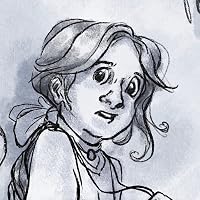
In the Middle Ages, people believed that insects were evil, born from mud in a process called spontaneous generation. Maria Merian was only a child, but she disagreed. She watched carefully as caterpillars spun themselves cocoons, which opened to reveal summer birds, or butterflies and moths. Maria studied the whole life cycle of the summer birds, and documented what she learned in vibrant paintings.
This is the story of one young girl who took the time to observe and learn, and in so doing disproved a theory that went all the way back to ancient Greece.
Margarita Engle is a Cuban-American poet, novelist, and journalist whose work has been published in many countries. She lives with her husband in northern California.
When I heard that there actually exists a picture book fictional (auto)biography of the girlhood of famous German naturalist and artist Maria Sibylla Merian (1647-1717), I immediately purchased a copy for my personal library. And while for the most part, I have quite enjoyed Margarita Engle's Summer Birds, I do and with considerable annoyance find that there is a rather problematic lack of historical accuracy portrayed at times. Maria Sibylla Merian lived in the 17th and early 18th century, and while there definitely was still quite a bit of rampant superstition especially regarding insects and other non vertebrates (and so-called spontaneous generation, with insects and worms supposedly generating out of mud and the like), there was also a great deal more openness than in, say, the Middle Ages (and why the Summer Birds book description actually places Merian in the Middle Ages, or at least seems to, I will NEVER even remotely understand and accept). For while Maria Sibylla Merian (indeed) was regarded with suspicion by some if not even many of her neighbours and acquaintances, she also did not have quite as tough and as problematic a time as portrayed either in the historical note or in the narrative itself (and actually had a very supportive family). Thus Margarita Engle's lack of textual accuracy and the at times over dramatisation of Maria Merian's issues and struggles with her suspicious neighbours and acquaintances is a bit of an annoying and frustrating turn-off for me (not a huge turn-off, as I still think Summer Birds is a lovely, informative and engaging account of a talented and inquisitive late 17th century German girl, but enough of a frustration for me to only award two and half stars for Summer Birds, well actually two stars, as half stars are not possible on Goodreads).
Now with regard to Julie Paschkis's accompanying illustrations, while they are bright and descriptive, I personally would MUCH RATHER see Maria Sibylla Merian's own illustrations utilised for at least the depictions of the butterflies (and personally, I think it is rather an insult to her talent and her legacy as an artist that they are not used, that no illustrations of her own work actually are included, are presented in Summer Birds). Furthermore, I also do tend to find that the physical depictions of Maria Merian herself make her look rather more Dutch than German (but that is a personal observation and feeling, others might not think thus, and the illustrations are truly a visual treat in many ways). Recommended, but with the caveat that historical accuracy might be lacking more than a bit (and the scope of the same cannot even be checked or verified, as Margaret Engle has also not included any lists of works cited and consulted, a serious academic shortcoming which rather majorly limits the teaching and learning scope and potential of Summer Birds, and is one of the main reasons that my two and half star ranking is rounded down to two stars and not rounded up to three stars).
"In the Middle Ages, people believed that insects were evil, born from mud in a process called spontaneous generation. Maria Merian was only a child, but she disagreed."
I love the idea behind this true story!* Maria was drawn to insects, especially butterflies, and couldn't believe that they were creations of the devil. (She also studied tadpoles and frogs.) She had to be very sneaky in capturing some to study because if people saw her doing it, she would be accused of witchcraft! She watched the caterpillars spin their cocoons and waited for them to transform into beautiful "summer birds" and she knew that the people who said they came from mud were wrong. But, being a child--and a girl, at that!--it would take a long time before she would be able to prove it to them. I was so happy to read the Afterward and find that she did! Hooray!
I'm not sure that the storytelling here really wowed me, but I'm glad Maria's story is available to younger readers. This is an important book not just because it shows a courageous early woman scientist but because it shares the message that we should not believe things to be evil simply because others say so; we must try to understand them ourselves and then decide.
The illustrations are noteworthy and have a distinctive Middle Ages flavor and really enhance the story, IMO. That said, some children might find them a little scary/creepy at times (the devilish creatures in the mud and whatnot) but I appreciated them.
*ETA: a comment made on my friend Lisa's review stated that Maria Merian actually lived in the late-17th century; a quick online search for her bio. revealed this to be true: she lived from April 2, 1647 – January 13, 1717. Hugely unfortunate that the advertising about this picture book biography places her in the "Middle Ages" and I really do not know why they chose to do so :-( That doesn't take away from the lovely illustrations or that Maria was still a very inspiring figure so just pay careful attention to the dates and not the "In the Middle Ages" that is so prominently displayed with regard to this book.
Contrary to the popular belief of those around her, thirteen-year-old Maria Merian - a seventeenth-century German girl with a talent for painting and an inquisitive mind - did not believe that butterflies and other insects were creatures "of the devil," spawned from mud in a process known as spontaneous generation. Having carefully observed these smaller creatures, from their larval through adult stages, and painstakingly documented them in her notes and drawings, Maria knew that they underwent an astonishing process known as metamorphosis, and that they were as harmless as they were beautiful.
Maria Sibylla Merian, a late seventeenth and early eighteenth-century artist and scientist, one who documented the life-cycle of one hundred and eighty-six insect species, and whose botanical illustrations are still beloved today, is a fascinating figure. Her travels to Suriname, and her documentation of the flora and fauna there, are astonishing enough for their time, but when one considers the restrictions placed on so many women during this period, they are all the more amazing! I am so glad that this picture-book "biography" (it's really more story than biography) is available, as both narrative and artwork are immensely engaging. I simply loved Julie Paschkis' gorgeous illustrations!
That said, a pretty glaring factual error prevents me from giving this the four stars it would otherwise deserve. No, contrary to the dust jacket blurb (and the book description found all over the internet), Merian did not live in the "Middle Ages!" I don't know where the editor was on that one, since the informational afterword gives her dates (1647-1717), and the medieval period is generally agreed to have ended in the fifteenth century! Such a misleading statement, in a book meant to inform young readers, is most unfortunate, and I therefore recommend Summer Birds only to children reading with an informed adult, who can point out this odd inaccuracy.
The historical note at the end really shows what an amazing girl and woman Maria Sibylla Merian was. While reading the book I thought a Middle Ages girl having her dreams wasn’t very realistic, but it turns out she fulfilled those dreams, and it showed me yet again that people are people, no matter when or where they live or have lived.
I have really mixed feelings about this book. I both greatly appreciated and felt lukewarm about the illustrations. Difficult to explain, but I was ambivalent.
The real story of this girl is inspiring, and I appreciate how it shows kids that kids can do unique things, if they study what interests them. Personally, I am not an insect fan; I’m not even a butterfly lover. So, I didn’t feel any amazing sense of awe about this book’s subject matter. But, I do think it’s a good book to teach kids about metamorphosis in the animal kingdom. And the way the story was told wasn’t scintillating for me, but I think I’d have liked it more as a child, and this book’s target audience is children. Despite its more advanced nature, I recommend that the historical note or its information be read/imparted to even younger listeners. I’d say this book is ideal for children ages 5-8. I was fascinated by butterflies, frogs, etc. when very young; my feelings of repulsion came much later, so thumbs up for nature and science loving kids.
But Maria and her supportive family, and the information about Middle Ages beliefs was all interesting.
3-1/2 stars
Edited to add: 1/2 star off. In fact, 2-1/2 stars, so really a full star off, but I'll leave it rated as a 3 star book. Please see the comments below, particularly the information Miriam gave me after I'd written this review.
Beautiful illustrations, full of color, texture, and detail.
The text is overly simplified and somewhat argumentative. "Everyone believes that these insects come from mud, as if by magic" - everyone? This seems an exaggeration since Jan Goedart and Francesco Redi were challenging spontaneous generation, publishing years before Merian's first book. We get "Everyone says insects are evil" on a later page. How about a little moderation?
The book is presented as though Merian is 13 years old, but it describes what and how she painted based on her later work. Sure, she was precocious, but are we to believe that nothing happened between 1660 (age 13) and 1675 when she first published (and there were even later important books)?
Sadly, no mention is made of Merian's deep religious faith (she became a Labadist in 1683, which led to her trips to South America where she stayed at a Labadist plantation - the author's note states that she and her daughter "went to South America alone" - which might imply a very different situation). For her, as for many scientists, there was no contradiction between faith and science. This is a message that seems to be regularly played down in modern times.
Summer Birds: The Butterflies of Maria Merian is a fine picture book, though I would have preferred a more in-depth look at the life of the inquisitive, intelligent title heroine. Fro a young age Maria Merian took keen interest in art and science, and her experiments as a kid paved the way for common knowledge about the larval origins of creatures such as butterflies. Her work contributed much to the field of science.
I should give special mention to Julie Paschkis's illustrations in this book. She mixes it up well with understated color tones and scenes of artistic depth, and I'm not surprised this book received a lot of Caldecott buzz in its year of release. As I see it, the greatest value of Summer Birds is as a nonfiction picture book explaining to young students the mechanism by which caterpillars morph into butterflies, and I would give it one and a half stars for its merits in that regard.
What amazed me when I read this book is that people could actually believe that insects and reptiles and amphibians could "spontaneously generate" from mud! Maria Merian was a 17th-century girl who painted and studied insects and small animals, observing their life cycles and noting that they were not born from mud. "Summer birds" refers to the medieval slang for butterflies, who seemed to appear during the warm months and disappear, seemingly into the mud, when it got cold. I wanted to give this book by award-winner Margarita Engle 4 stars, but I found the text a bit confusing. A note just before the story begins, about the medieval origin of the term "summer birds," leads you to believe the story will take place in medieval times. The simple clothing worn by the characters could indicate medieval through early 19th century, especially in a rural setting. The printing press toward the end of the story narrows it down to 16th to early 19th century. Julie Paschkis' illustrations are as colorful as the butterflies, but she uses medieval-style artwork whenever medieval ideas are mentioned (another false indicator of when the story takes place). It isn't until the note about Maria at the end of the book that we find out she lived in the 17th century, and in fact, that we even learn her (the narrator's) name. That aside, I found the book most interesting, and would love to read more about this person. Where does Engle come up with these obscure people? Recommended with the recommendation that the last page of biographical information about Maria be read first.
Hmmm…I am not quite sure what my reaction to this book is. I have always been fascinated with history, so that aspect of the book was interesting to me but overall, I just did not get into it the story. I didn’t really dislike the book either but I do think it is a bit odd that a book about this great artist would have so-so illustrations…I feel like if the illustrations could have captured the time period or showcased some of Merian’s actual art or just had some more inspiring illustrations, perhaps the concept would have felt more right…but it’s not entirely wrong either. Odd. I would recommend the book to others; I think it is just a personal preference issue.
Maria was a real live women, and after I read this book, I looked her up. Her botanical art was quite accomplished and beautiful, and I truly wish that some of it had been shown at the back of this book. Julia P's illustrations were stylized, but still reminiscent of Maria's more botanical style paintings, striking colors, and the book was very attractive.
I found the story to be oddly unsatisfying. I wanted more... more history, or more story about Maria's family. I didn't feel connected to the time period or the emotions of the girl. She looks like a peasant child, but she was a printer's daughter. I believe that would make her quite well-off. And I wondered who thought insects were devils or spawned from mud. Everyone? Or the masses?
Maria Merian is such an interesting historical figure to me - but I guess I would say that about most half (or fully...) forgotten female figures. So I guess the expectations were part of the death of this book to me. As many other children-oriented books about famous people (like Me . . . Jane or Mae Among the Stars), it doesn't cover what the people are actually famous for, instead it's about their childhood and how inquisite and special they were even then... and you know, these books are fine, but they are repetitive sometimes and so they had to get some feature to hook you. I'm not sure this book managed that. There was also something off about the illustrations for me, they weren't bad really, but... you know, the book missed the opportunity of using Merian's own images or their reproductions (like Frida Kahlo: An Illustrated Life does). The story had some good moments, but it overall could have been done better, I think... Maybe just watch this short animated video instead (if you are insect-phobic, proceed with care...): https://www.youtube.com/watch?v=3Wiwk...
Beautiful illustrations based on the life of a groundbreaking female botanical and biological illustrator. Note, however, that others had questioned spontaneous generation first.
This is a simple, but true, tale of a young girl who enjoyed studying creatures and nature and refused to accept the scientific beliefs of her time. The narrative is short and even younger children will appreciate the wonders of looking at caterpillars and butterflies, learning about the life cycles of these creatures. And our girls liked the fact that it was a young girl who discovered the truth.
The illustrations are very bold and bright and will appeal to children of all ages. I had never heard of Maria before, and after reading other reviews, I was surprised that she is so well-known in Europe and not here. I'm glad that we had an opportunity to learn about her fascinating life and adventurous spirit. We enjoyed reading this book together.
This is by far one of the most beautifully illustrated books I've read. This book is based on the true story of young thirteen year old Maria Sibylla Merian, who, in the middle ages dispelled the belief that butterflies were of the devil.
The theory that butterflies grew deep in the mud and were scornful, evil objects was a very popular myth. Called the summer birds, the thought was that these beast of the devil grew up from the depths of the dark.
Watching them intensely, Maria captured the caterpillar, beetles and dragonflies and observed their cycles. Keeping them in jars, and feeding them leaves, she documented the stages of growth.
Taking a gigantic risk, Maria could have been deemed a witch for dabbling in something of Satan. As she studied the moths from cocoon to the chrysalis process, she watched as the incredibly beautiful butterflies grew and then drank nectar from flowers.
Carefully painting the images she observed, she documented and disproved the long-held theory.
I enjoy this book so much that I will purchase a copy for my library of illustrated books.
I enjoyed this but didn't love it. My children and I did really enjoy the illustration right after she says "Sometimes I think that I am like a summer bird, waiting to fly..." Then on the next page she is pictured with butterfly wings and a sail boat is pictured with butterfly wings and so on...very beautiful and whimsical. I thought the story telling was interesting but not awe-inspiring and it is disappointing that her author's note was not more accurate. Maria Meridan lived in the late 1700's not the Middle Ages. Still worth reading and learning about her courage and scientific findings.
Very beautiful illustrations in this narrative biography of a German girl during the Enlightenment. Facts are expectedly light, but story is written in a way which makes the great scientific discoveries of a fifteen year old seem just as attainable today. A good introduction to the scientific method, too, for young readers.
This is a helpful picture book to illustrate observation and field research, as this is what Maria Merian did to prove that butterflies and frogs were not born instantly from mud, nor were they evil. Through careful study she was able to describe how their life cycle works, which helped folks to redefine their ideas of the “summer birds”.
First person biography. A good match to teach with Hungry. Caterpillar.
John Locke once said, "Curiosity in children is but an appetite for knowledge." As a child, we learn through our wonder and our investigative nature—at least that's the case for Maria Merien. Throughout this picture book biography, readers explore the young mind of a 17th-century girl curious about the summer birds she and many others in her community would see every year. Her curiosity came when people considered butterflies, moths, and insects as magical creatures of the devil. The danger of being deemed a witch did not stop her from keeping insects in jugs to study them. While the reader learns about historical events, they also learn about the life cycles of insects and butterflies. Simultaneously, the illustrations help elevate the story to bring the past to life. Even though Maria is seen in 17th-century clothing, the depiction of caterpillars eating leaves and butterflies on braches does not depend on an era to make them real. I rated this book a four because I share a similar passion for bugs as the main character does. To think that these little critters were considered evil at one point in history seems unbelievable to me, but society has come a long way since then. I also found this picture book to do justice to the biography genre for children. It is far from boring to read and moves readers away from the strict informational components biographies have.
In the Middle Ages, people believed that insects were evil, born from mud in a process called spontaneous generation. Maria Merian was only a child, but she disagreed. She watched carefully as caterpillars spun themselves cocoons, which opened to reveal summer birds, or butterflies and moths. Maria studied the whole life cycle of the summer birds, and documented what she learned in vibrant paintings.
This is the story of one young girl who took the time to observe and learn, and in so doing disproved a theory that went all the way back to ancient Greece.
A startlingly beautiful book and introduction to not only Maria Merian, but to the natural scientific thought process of all children who wonder why anything is as it is. I picked up this book after learning about its existence through the Mighty Girl group on Facebook. I am surprised by the number of reviewers saying they were not engaged in this story. I think perhaps if we all took the time to look at children's books the way a child might, we could be as moved as they are. This storyline is not for an adult nor a tween. It is a story to be read to a child who is becoming literate. A story for a child to pick up as she practices reading. It deserves to be judged for what it is and not what we think it ought to be.
As a celebration of a young woman who is a pioneer in the study of insects, this book provides a curious mind with a brief introduction to Maria Merian. I think many kids will want to know more about her after reading this book and I appreciate that a bok about curiosity can spark it in its readers.
For those reviewers who are not moved by these illustrations, even daring to call them dull, I do not see what you do. This book has some breathtaking illustration in a similar style to the botanical illustrations of the day. The use of light and dark produces images that pop off the page and are fitting tributes to the illustrations of Maria Merian herself. Perhaps what I like best about this book is that it is an introduction to the youngest reader that girls not only belong in science but are pioneers of it. That curiosity leads to passion and that societal norms are not always truths. This book is excellent for planting the seeds for young readers to become critical thinkers.
I look forward to passing this book along to the young ladies in my life who exemplify some of the same qualities as Maria. I think this will inspire them to keep wondering, exploring, and drawing.
Have you ever wondered why we think the transformation of caterpillars to butterflies are fascinating? Thank Maria Merian, the lady who discovered that caterpillars transform into beautiful butterflies or summer birds.
Summer Birds, written by Margarita Engle and illustrated by Julie Paschkis, tells the story of Maria Merian and her scientific findings, and how she changed the misconception on metamorphosis.
It all began when she noticed that certain organisms had certain migration patterns. In particular, she noticed how summer birds or butterflies as we call it, appeared only in the summer. She would catch the summer birds and examine them. During the time she lived, people believed that summer birds brought witch craft and were created by magic. This concept was highly frowned upon but it did not stop Maria. While she examined the summer birds, she realized they were harmless and were not created by magic. She then worked with lizards and frogs, and they also were harmless and were not created by magic. In the end, she disproved a theory that people believed in.
I love the illustrated paintings of the insects and other organisms. They are big, bold, and colorful. I believe pictures are a great way to explain a complex biography for younger readers. Towards the end of the book, there is an actual historical note that is helpful for teachers, parents, and librarians to understand who she is. Having a historical note, is a fast way to locate information on the person he or she is reading. Overall, I enjoyed the book.
Summer Birds: The Butterflies of Maria Merian by Margarita Engle, illustrated by Julie Paschkis is an inspiring historical biography with a strong focus on the childhood of a young German girl who observed and studied metamorphisis at a time when women rarely engaged in scientific study.
Maria watched caterpillars spin cocoons from which emerged summer birds, or butterflies and moths. Maria studied the life cycle of the summer birds, and documented what she learned in vibrant paintings. She disproved the idea of spontaneous generation, growing up to become a famous scientist, artist, and explorer.
The text was rather simple, though I did like the Historical Note at the end. Recommended for teaching metamorphisis and for biographies for younger readers.
Paschkis' illustrations are beautiful, including some rather fanciful ones. I would have preferred to have some of Merian's actual paintings included if only at the end. I did find Merian's paintings on the internet and they are impressive, particularly those from Surinam.
For ages 5 to 8, picturebook biography, metamorphisis, butterflies, moths, science, painting themes, and fans of Margarita Engle and Julie Paschkis.
**I really, really hate it when Goodreads eats my long, thoughtful comments.**
Interesting, beautiful book.
Lisa Vegan's review and follow up comments about this book sent me back to read it for a third time. The book opens by stating that "'Summer birds' was a medieval name for the mysterious butterflies and moths that appeared suddenly during warm weather and vanished in the fall." Except that the Historical Notes state that "Maria Sibylia Merian was born in Frankfurt, Germany, in 1647." That's not medieval. I hope that the author was using the term and providing this statement to give some context to Maria's background and doesn't mean that Maria in fact lived in Medieval times (since she didn't!).
Aside from this fact, I enjoyed the book and recommend it for K - grade 2, particularly for students learning about butterflies and life cycles. I enjoyed the artwork and first person narrative for this beautiful and informative picture book.
No rating because I can't decide how I feel about the medieval thing.
I enjoyed this book and the illustrations, which tried to capture the spirit of the times. I found a few things fairly jarring about the historical accuracy of the illustrations that took me away from purely enjoying the story. Glass jars were very expensive and pretty uncommon, so as a child the likelyhood of this girl having them and being allowed to use them for keeping bugs is unlikely. She probably kept them in wooded containers or pottery. The glass is easier to illustrate, but just seems wrong. As does the insertion of a press, either for etchings or for a book, seems out of place when the rest of the illustrations show her painting.
That said, the book was charming and would appeal to younger children who have never even heard of medieval ideas of the origination of insects. No worms and cheese for them.
Most Kindergarten classes have caterpillars that they monitor and watch until they turn into butterflies. This book would be a great book for an introduction to that activity. This book offers information about the different stages that occur while a caterpillar turns into a butterfly. While students are watching their class caterpillar, they can compare what is happening to their caterpillar compared to the book. This would also allow the students to see what they can expect to occur next. The anticipation will keep students engaged in noticing the changes that are occurring. The book ends with more ideas such as watching tadpoles develop into frogs. Watching different life-cycles of different animals will help children stay interested in science and the fascination of what science can teach us.
This book is about Maria Merian, a young girl who defies the common beliefs of her middle age culture. The adults around her believe that insects are evil creatures, but Maria disagrees. She discreetly watches the transformations caterpillars go through to turn into butterflies. She studies them and documents her work in paintings. This books gives an informative description of Maria and her studies. It all encourages children to consider what they themselves believe, even if it goes against societal norms. The illustrations in this book have a "middle age" feel to them. They are colonial looking and definitely add to the book with their bright colors and simple lines. The book has a historical note at the end which speaks about what Maria went on to accomplish in her life. I feel this is the best part of the book because it shows that all her hard work paid off.
In Germany in the mid-1600's, a young girl named Maria Merian studied caterpillars, butterflies, and toads in secret. She was fascinated with their life cycles and knew something most people did not, that metamorphosis was a fact. People of Maria's time believed butterflies and frogs came from the mud, and that they were "beasts of the devil". Had Maria's studies been found out, she surely would have been accused of witchcraft. Maria kept detailed paintings and notes of her observations, and grew into a famous scientist, artist, and explorer. Julie Paschkis' vivid illustrations detail Merian's work. Elementary classrooms studying the life cycle of butterflies will want to include this lovely book.
Margarita Engle is appealing to the history buff in me. By reading all of her books I am learning much on the subject without even realizing it! Summer Birds The Butterflies of Maria Merian is the true story of a young girl who began collecting butterflies and other insects before the creatures were understood and instead were feared. Through her diligent observations it became known that metamorphasis in creatures is natural. Hopefully the reader recognizes that metamorphasis within the person is natural, and necessary, too.