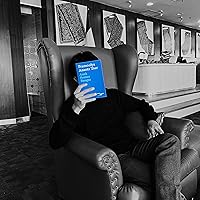
Reason, Type and Setting: I chose this book this non-fiction book because I have always felt somewhat frustrated with my thinking. Most of the time it feels like I know so many facts but I lack the ability to analyze information rationally and draw conclusions from there. I also have trouble trying to think on my own, and as I grow into an adult I think it is important to be able to set up logical principles in my cognition for clearer thinking. Therefore, I bought this book so that I would be able to make better conclusions as I mature into my political, laborious, and whole identity. Bennett helps the reader achieve this by referencing schools of logic from the ancient Greeks to Lofti Zadeh to programming the first computer. However, these concepts have the opportunity to be disproven by contemporary ideas in logic, so the book is updated to what professors teach in their lecture halls. Despite these complex and university-level concepts, this is an informative book set for the nonacademic person in mind.
Content: The book covers basic logic, namely the main ideas of the law of the excluded middle and the law of noncontradiction. Bennett also discusses various Latin-named arguments like reductio ad impossible and reductio ad absurdum as well as terms like “subject” and “predicate” and “converse”. She familiarizes the reader with these abstractions early in the book because they are referenced regularly later on in the book. The author makes points in the book that made me question if she was being logical. She quickly counterclaims me with the laws and vocabulary, which was well thought out because it made sure that I understood the material she presented. The book is significant because of the idiosyncrasies we all have with our own logic systems, and how it plays a role in everyday life. I was surprised to know that I was a victim of the law of nonconversion, which is "Even if all A are B, it may not be the case that all B are A". All mothers are women, but are all women mothers? No. I was fascinated by Bennett to know that even medical doctors, quite possibly the purest form of scientific academia, fall victim to this. She connected this phenomenon to diagnosing patients, and what symptoms signify certain ailments.
Chapter: I found chapter four to be the most fascinating because it discusses the fuzzy logic behind the word "some". Cleverly entitled "SOME Is Part or All of ALL". Bennett talks about how non-logicians assume some as "not none but not all", while logicians assume it as how Bennett put it, "at least one and possibly all". A "some" statement is not universal like "all" or "none", but rather a "particular" statement. My mind opened when I discovered from the book that particular statements can follow the law of conversion: "some teachers are male" and "some males of teachers" are both acceptable statements, or as the proper terms is, identical truth values. There are some instances where we may find a statement to be illogical, like "some women are landladies" and "some landladies are women". Because we know that the word "landladies" refers to female land owners, it is logical to assume that all landladies are women. However, we must keep in mind that the logician interpretation of the term "some" is "at least one and possibly all". This chapter helps with the unity of the book by reinforcing themes about numeration, and what conclusions we can draw from universal and particular statements.
Evaluation: The book kept my interest, but there were some times where I felt that the theories presented were being dragged out to long and over articulated to the point that they were difficult for a non-logician to understand. These moments were rare; minimized by the countless graphical representations and entertaining LSAT example questions. The book, with its academic-though-layperson edge, opened my eyes to the fallacies that I have fallen victim too and has helped strengthen my arguments. Logic Made Easy is a must read for anybody whom has ever wondered if her or his own logic was rational, and should be read by everybody whom will be entering the real world. Logic is not limited to politicians and lawyers, but to anybody that has to fill out tax forms, apply for insurance, driving rules, event planning, medical assessments, and much more.
Trivia: I prefer nonfiction over fiction books, and I have always chosen books on languages, social movements, and gender studies. I decided to buy a book that would be more science oriented, which for me is a leap. I decided to go easy on myself by buying a book that was not straight up mathematics, game theory, physics, chemistry, or too mind-boggling philosophy. Its clean cover, easy to read language, and the fact that she was a professor from an uncommon university, New Jersey City University, was the reason why I purchased this book. I have always thought that a person's bookshelf should not just be from writers living in London, New York City, Vancouver, and San Francisco. Geographical diversity is quite a neat idea, especially in a rather large nation like the one we live in. Now if we could only get some non-London, Boston, and New York City publishers to be more popular...