A Woman of Fascination and a Gifted Artist
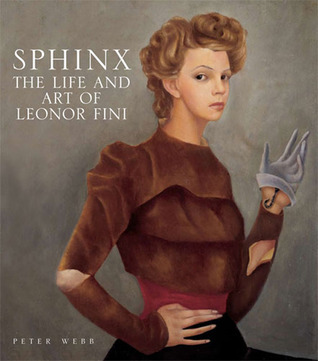
SPHINX (a mythological creature that is depicted as a recumbent feline with a human head) is an apropos title for this book on the enigmatic, talented and now almost forgotten Leonor Fini: Fini had an obsession with cats and was one of the most prominent feminists during her early years, so the image of a sphinx is an apt description. Born in Argentina in 1907 to an Argentine father and an Italian mother, she was taken by her newly divorced mother to live in Italy before the age of one year, but as this woman's colorful life began she was forced to live as a boy to escape abduction by her outraged father. As she became a teenager she suffered form an ophthalmologic disease that required her to wear bandages over both eyes, leaving her perception of the world to her other senses...and her wildly fantastical imagination. When the bandages came off Fini brought these preconceived images to the canvas as an artist of note, committing herself to study Renaissance paintings. Mannerism, Romanticism and the Pre Raphaelites. Her paintings almost immediately drew the attention of artists and public alike, providing her with the strength of character to become a non-conformist, a true original. Some compared her dress and demeanor to that of the famous Surrealist Salvador Dali, even though Fini declared she was not a Surrealist. From Italy she moved to Paris and became associated with the greats in all areas of art. It has been said of her entry into the art capital "In Paris she became a legend almost overnight. When one of the Surrealists saw a painting of hers in a Paris gallery in 1936 and sought out its creator, she arranged a rendezvous in a local cafe and arrived dressed in a cardinal's scarlet robes, which she had purchased in a clothing store specializing in clerical vestments. 'I liked the sacrilegious nature of dressing as a priest, and the experience of being a woman and wearing the clothes of a man who would never know a woman's body.' " She associated with Ernst, Magritte, Artaud, Breton, and Dali, yet refused to be categorized with this group. She lived and created in a life of revolt.
Her subject matter included mythological creature and nearly always represented the feminist view of the world - woman is the goddess while all else is subordinate. Though she is often compared to the Bloomsbury artist Dora Carrington, Anne Bachelier and American artist Dorothea Tanning her painting vocabulary remained her own. Her subjects were women portrayed by goddesses, warriors, and voluptuaries. She reduced the masculine position to insignificance, yet remained one of the more beautifully dressed and exotic appearing women of her time. She not only continued to 'perform ' as an artist of special note (!), but she also painted prolifically, designed sets and costumes for theater, opera, and ballet and was known for her magnificent book illustrations. In keeping with her philosophy of non-conformism she changed her styles at will, but up until her death in 1996 she was still labeled a female surrealist.
Author Peter Webb knew Fini personally and his writing in this amazingly fascinating book is rich in detail about the life of Fini. Less is written about the individual paintings or the philosophy of her art, but there are copious examples in rich color of her paintings and drawing as well as countless photographs of the startling Leonor Fini so embraced by the city of Paris. This is a very fine biography of a fascinating artist and woman, a book that will be the gold standard for information about an artist who for many people today remains an unknown.
Grady Harp