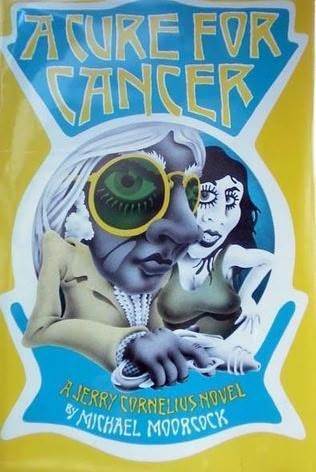
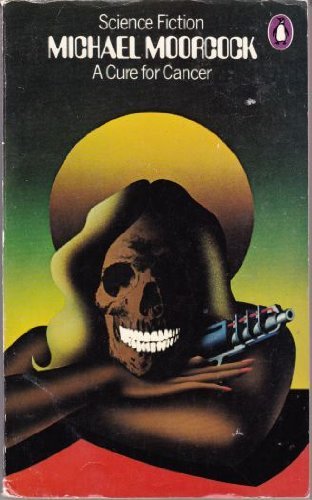
This is Michael Moorcock's second novel in his highly readable Jerry Cornelius tetralogy. As in the other volumes, he uses the stuff of the popular thriller and science fiction to produce what has been called "a kind of literary cubism". Elliptical, ironic, funny, and yet full of fierce satire, the book is wholly serious in intention, encompassing a wide variety of themes and original observation concerning, in particular, the nature of time and identity. The style is "reminiscent of a mixture of Ronald Firbank and Raymond Chandler" (Daily Mail), very concentrated and extremely original.
This book fully justifies Michael Moorcock's reputation as a leading literary innovator, while it remains continuously entertaining.
Michael John Moorcock is an English writer primarily of science fiction and fantasy who has also published a number of literary novels.
Moorcock has mentioned The Gods of Mars by Edgar Rice Burroughs, The Apple Cart by George Bernard Shaw and The Constable of St. Nicholas by Edward Lester Arnold as the first three books which captured his imagination. He became editor of Tarzan Adventures in 1956, at the age of sixteen, and later moved on to edit Sexton Blake Library. As editor of the controversial British science fiction magazine New Worlds, from May 1964 until March 1971 and then again from 1976 to 1996, Moorcock fostered the development of the science fiction "New Wave" in the UK and indirectly in the United States. His serialization of Norman Spinrad's Bug Jack Barron was notorious for causing British MPs to condemn in Parliament the Arts Council's funding of the magazine.
During this time, he occasionally wrote under the pseudonym of "James Colvin," a "house pseudonym" used by other critics on New Worlds. A spoof obituary of Colvin appeared in New Worlds #197 (January 1970), written by "William Barclay" (another Moorcock pseudonym). Moorcock, indeed, makes much use of the initials "JC", and not entirely coincidentally these are also the initials of Jesus Christ, the subject of his 1967 Nebula award-winning novella Behold the Man, which tells the story of Karl Glogauer, a time-traveller who takes on the role of Christ. They are also the initials of various "Eternal Champion" Moorcock characters such as Jerry Cornelius, Jerry Cornell and Jherek Carnelian. In more recent years, Moorcock has taken to using "Warwick Colvin, Jr." as yet another pseudonym, particularly in his Second Ether fiction.
A Cure for Cancer - We're in London during the apocalypse and it's Ian Fleming-style international thriller meets Hieronymus Bosch Garden of Earthly Delights. This 350-page humdinger is the second of four novels forming Michael Moorcock's Cornelius Quartet.
Eternal Champion, Dell Comic Superhero, Demon of Death, you get to choose. This New Wave SF/Magical Surrealist yarn features a souped up version of Jerry Cornelius sporting jet-black ebony skin, silky milk-white hair, earthshaking vibragun (much more deadly than his simple needle-gun) and Rolls-Royce Phantom VI convertible capable of turning into a submarine or sprouting wings to fly like a jet fighter. Take that, James Bond!
Black Knight Jerry. Oh, the Places You'll Go!
The Marvelous Moorcock lays out enough linear narrative to move in action adventure mode coupled with enough strangeness to qualify as experimental. To give a glimpse of what a reader will glean, gander at this batch of bullets:
Apocalyptic London Here comes the napalm, courtesy of the American military. But all is not lost - "North Kensington, the largest densely populated part of the Royal Borough, the most delicious slum in Europe. It is almost teatime." Hey, if you're a member of the British aristocracy, you can play tourist and take a tour of your city's largest slum, watching poor people writhe in agony, suffering on a grand scale. What fun!
The Organization Jerry Cornelius' first loyalty is to the organization but, our chic, fashion plate death dealer admits he works exclusively on a strict commission basis. Jerry, baby, you're in a line of work quite different than 007 in service of the British crown. And what is the organization? - too top secret for easy definition.
Bishop Beesley This fat, slovenly churchman, forever munching on a fistful of chocolates, proves the prime nemesis for Mr. Cornelius. The Bishop makes numerous declarations, claiming he's all for equilibrium, after all, he knows what's good for people. Ha! Our British author slides in a slice of political satire (or sarcasm). Beware any leader acting sadistically, inflicting pain for "someone's own good."
The Multiverse Luscious Karen von Krupp, one of the tale's big players, asks Jerry which life he likes, to which Jerry replies, "Oh, all of them really." Jerry has a sense the universe extends thousands of times beyond what we can see, a cornucopia of worlds with diverse laws, where space is different, time is different, atoms are different and even gravity may be different.
Merciless Mercenaries Jerry travels to New York but then the plot thickens: along with dozen of middle class older folk, he's herded on a bus to Pennsylvania, the destination having an eerie resemblance to a Nazi concentration camp. "The camp governor wore a uniform cut from fine, black needlecord and his cap was at just the right angle above his mirror sunglasses which were as black and as bright as his highly polished jackboots." All this is caused by "present emergency conditions laid down by our president" as a piece of social experimentation. This section of the novel gives one the shudders - echoes of the current day private Blackwater military.
Buffalo Nose Jerry makes his way to the American frontier, out by South Dakota where he smokes the peace pipe with the Sioux and other Indian tribes (what we nowadays term Native Americans). Jerry takes on the name of Buffalo Nose and it isn't long before he and the tribes conduct raids on a number of local towns. But then he's off, flying to Las Vegas for his next adventure.
Comic Book Superhero on the Scene "Jerry let his hog fall and shielded his eyes to peer upward. There in the shadows of the sixth-storey balcony stood a figure which, as he watched, came and leaned over the rail. the figure was dressed in a long, dirty raincoat buttoned in the neck. It could only be Flash Gordon."
Could Flash the Gordon be related in some way to Jumpin' Jack Flash? Oh, the questions you'll be prompted to ask.
Chic Brand Names Knockout young blonde Mitzi wears Miss Cardin cologne that will take a man's breath away. Mitzi always wears Guerlain's Gremoble lipstick and a turquoise and gold pin and armlets by Cadoro. It might be the apocalypse but one thing remains - top of the line products keep those special sexy men and women in top sexy form.
Chapter Headings A Cure for Cancer features 79 short chapters with hip chapter headings, as in "Sing to me, darling, in our castle of agony" and "The erotic ghosts of Viet Nam" and "The old Hollywood spirit never dies." Back in the '60s, cool was king.
Epigraphs Michael Moorcock tosses in clips from current day news, each section of the novel carries an epigraph, subjects ranging from a money back guarantee on how you can impress your friends as you maneuver a polaris nuclear sub to the discovery of echos from the Big Bang. My personal favorites: "Along with the Smothers Brothers and Rowan and Martin, Mort Sahl is part of that radical fringe who try to tear down American decency and democracy." and "Newly and/or unexpectedly imposed tyranny can make people commit suicide."
Beauty Amid Chaos Sure the cancer in the book's title can signify the cancer eating away at Western Civilization but there remains the beauty of a garden, after all Hieronymus Bosch's triptych Garden of Earthy Delights contains scenes of birds and fountains in their full splendor. "Entering the quiet streets of the great village, with its trim grass verges and shady trees, Jerry was filled with a sense of peace that he rarely experienced in rural settlements. Perhaps the size of the empty buildings helped, for most of them were over eighty feet high, arranged around a series of pleasant squares with central fountains splashing a variety of coloured, sparkling water or with freeform sculptures set in flower gardens."
A Cure for Cancer is tops. Get with it. Pick up a copy.
Photo taken around 1968, the time when British author Michael Moorcock started writing The Cornelius Quartet
The second instalment of the Jerry Cornelius quartet and our debonair and shapeshifting adventurer is now a negative of his former self: black with white hair. Israel has annexed the Balkans, the entire British parliament has been arrested, and the Third World War is in full swing. Europe is swarming with US ‘military advisors’ who are busy napalming it to oblivion. The president of the United States is rounding up refugees and putting them in internment camps (thank God this is just fantasy fiction from the 1970s). Jerry, armed with his vibragun which has a literally shattering effect on everyone and everything, is kidnapping establishment figures and subjecting them to transmogrification therapy. It’s unpleasant but helps to restore the equilibrium of anarchy. He is also searching for his randomiser machine which has been stolen from him. He intends to use it to accelerate the heat death of the universe. Or perhaps to bring back to life his beloved sister Catherine, whom he accidentally killed in the first book. Or possibly both. Meanwhile his arch-enemy, the obese chocoholic Bishop Beesley, is also in pursuit of the machine with the aim of returning history to a more orderly church-approved epoch. So that’s all perfectly clear then.
The Cornelius Quartet was published between 1968 and 1977, although the first novel was written, in nine days, in 1965. It reflects the period through an infinity of distorting funhouse mirrors. It’s a song for insane times, so there’s no need to point out its continuing relevance to our own. The preceding book, The Final Programme, had a narrative that, although fantastical, was (more or less) linear. In this one, which relocates the Vietnam War to Europe, things are much more fragmented/collage-like/elliptical: a sequence of bizarre and hallucinatory vignettes that are sometimes chilling but also very funny and imbued with an exuberant surrealistic energy. The ‘cancer’ of the title, according to General Ulysses Washington Cumberland, Commander of the US Advisory Force, is nonconformist humanity and the ‘cure’ is napalm. The text is interpolated with extracts from magazines and newspapers. The chapters, all of them short and some just a paragraph or two, have apparently arbitrary titles unconnected to their content: I Died on the Operating Table, Cops who are Hell on Pillheads, UFOs are Unfriendly, Up to No Good, and Some of Them are Truly Dangerous. All of this adds to the pervading apocalyptic sense of a world off its hinges.
This is a disorientating read and is clearly meant to be. On reflection I think my opening paragraph makes it sound rather more coherent than it actually is (yes, honestly!). Moorcock has said that his aim with the Cornelius books ‘was to liberate the narrative; to leave it open to the reader’s interpretation as much as possible - to involve the reader in such a way as to bring their own imagination into play’. He succeeded. It’s as though every known genre has been fed into Jerry’s randomiser: Swiftian satire, experimental literature, dystopian nightmare, pulp fiction, SF, James Bond, comic books, surrealism, erotica, existentialism, commedia dell’arte, psychedelia, countercultural polemic, absurdism. Does it make sense? Don’t be silly, but that’s reality for you. At the same time it makes perfect sense: Moorcock’s surreal approach taking you closer to the insanity of the Realpolitik of the Nixon era than realism could. Jerry Cornelius knows how to survive, and even enjoy himself, in a hellish and meaningless multiverse. The puzzled reader might be best advised to do as Jerry does and go with the flow. It’s a vertiginous adventure. And, as Jerry says, there’s ‘nothing like adventure’.
An international psychedelic-spy-novel mess where gender and espionage templates get rewired for the sake of discord and absurdia. This is such a 'fuck you' novel in so many ways. Moorcock has tons of fun with this apocalypse (America napalms the fuck out of London for no reason at all), and so did I. Not for most readers, SF or otherwise, but it is important how 'A Cure for Cancer' turns Ian Fleming into a black drag queen (metaphorically speaking, of course). Long live Jerry Cornelius and his vibra-gun.
Not sure there’s much point trying to describe this if you havn’t read the first one in the series but binge watching Man from U.N.C.L.E. episodes spliced with Yellow Submarine... possibly on acid, might give the uninitiated some idea.
Not as fun as the first volume i felt, although it does pick up in the latter 3rd. This is really two separate but consecutive stories so the entire first half feels a bit lacking. Also found the political geography hard to get a handle on for a long time.
I also don’t react well to too much narrative interruption and there are some very short chapters in this. However it still has some great imagery and 60’s surrealism.
The second in Moorcock’s Jerry Cornelius tetralogy. Armed with his vibragun and driving his Phantom VI, Jerry pursues Bishop Beesley, who has stolen one of Jerry’s inventions, a device that can speed up and slow down the cycles of time. The action is set in Europe and North America, and either in the late sixties or in some indeterminate future (perhaps this latter reflects the effects of the stolen device—and then the device possibly functions to comment on the indeterminacy of the time in which the narrative is set). The writing is more experimental than in the first novel of the tetralogy, The Final Programme. Here, there are many short chapters, and quoted advertisements and newspaper articles that function to comment ironically on the narrative.
Acquired Aug 15, 2009 G & A Book Exchange, London, Ontario
This influential series has been a huge disappointment for me. The lack of a plot, developed characters, memorable images, and sharp dialogue added up to a big, dark zero. The storytelling is unconventional; a sort of chopped up narrative set in multiple universes, but following the same characters. In the Jerry Cornelius series, Moorcock takes the perspective of an iconoclast of counter culture, dissecting the pseudo-philosophical nonsense that became a way of life. Although he’s parodying this new-age, hip culture, he’s also playing into it with his rambling unconventional style. Moorcock takes newspaper clippings and occasionally throws them in, showing us the short attention spans of this capitalistic and self-absorbed society. The book is not as much of a story but a series of dull vignettes, days in the life of a psychedelic superspy. Unfortunately they’re not nearly as clever or humorous as intended. Perhaps I didn’t understand this book at all, but I found it really boring.
I think Moorcock was a little TOO high when he wrote this one. Written in the style of Ballard's Atrocity Exhibition, this one takes experimentation past the point of being entertaining and into mind-numbing randomness.
Jerry Cornellius goes on the trail of Bishop Beesley. Weirdness and mayhem ensue.
I went on a Moorcock binge a few years ago and read nothing but until I was sick of him. Last year, I needed something to read while I was getting an oil change. I'd heard good things about Jerry Cornelius and decided to give it a try. It definitely wasn't what I was expecting. It had a very odd feel to it, a little like the weird feeling Richard Brautigan's Hawkline Monster gave me. The plot seemed secondary. Exploring the weirdness of the Jerry Cornelius character was the focus.
Well, I knew the Jerry Cornelius series was going to be weird. But this was ... A psychedelic trip & a half, sprinkled with lots of WTF? and more than a dash of seriously?. I felt like Moorcock just wanted to experiment with stream of consciousness writing, but wasn't sure if he should really go for it or not. This might actually qualify as the first Michael Moorcock book I haven't liked. It wasn't that it was bad, so much as that it just wasn't that good.
A Europe torn apart, invaded by the insidious cancers of Godless Communism, her immoral and degraded clergy defrocked and disbanded in the face of God Is Dead, the land dominated and decimated by American intervention, napalm and death camps, and Jerry Cornelius - beautiful and untamed, ebony skinned and snowy haired, dressed in the very height of fashion - strides through the ravaged lands in search of a device, a MacGuffin stolen from him, which can save the world or destroy it, can open up reality or close it down, but he wants it back for one reason and one reason only - he would break open the Multiverse and siphon off the heat death of the universe just to get back his one true love, even if only for a little while. Immoral, immortal - call him what you like, just don't call him frank.
Chapters headed by lurid tabloid headlines, epigrams from brochures and advertisements, clothing and food over-described in satirically Uber-Fleming detail; sex scenes, death scenes, lists of colours and lists of flowers, derring-do and ne'er-do-well, this is Moorcock in full flow, using the psychedelic superspy genre to present a boxed and nested narrative of details within details (Derry & Toms, as ever, sets the standard); satire beyond the pale, moral turpitude, action, adventure, love and intrigue - all this, and a happy ending too, for a while.
If this was 1970 and I was high, perhaps I'd be more impressed. To me, it seemed more like a series of story fragments with recurring characters interspersed with odd advertisements and such. Through most of the book, it qualifies as SF by virtue of the protagonist having a hi-tech gun and a poorly defined tendency for the protagonist to find himself elsewhere. By the end, there's another gizmo, but of a pseudoscientific nature. For a while, one might think the protagonist's goal is of a nobler sort, but turns out to be quite personal.
Originally published on my blog here in October 1999.
In Moorcock's second Jerry Cornelius book, lots of things have changed. Cornelius himself, for one thing; now virtually a mirror image of his former self in personality and appearance (unusually dark with white hair instead of unusually pale with black hair, far more passive, with opposite tastes - he now only drinks Pernod instead of being allergic to it, for example). The passivity is the only change which makes much difference to the feeling of the book, and it is not a huge change: Jerry was always ready to let things happen to him rather than trying to influence what was going on.
It is the background which has changed most, as though we have moved into a parallel universe to that of The Final Programme. This unsettling change to a more decrepit version of the world, Europe in almost total anarchy occupied by American troops led by officers straight out of Dr Strangelove, is the precursor of the further changes to come. The introduction of the Derry and Toms roof garden also introduces an important location.
Perhaps the least accomplished of the four novel sequence, A Cure for Cancer is principally an indication that not everything in The Final Programme is what it seems.
The second book of the Cornelius Quartet is as strange as the first, apparently taking place in a different but similar part of the Multiverse than book one (at least, that's my impression - also, worth noting that it was Moorcock who was credited with coining the term "multiverse" in 1963, now commonplace term). In this story, Jerry Cornelius is, oddly, a photo-negative version of himself - completely black, including his teeth, with white hair - and an anarchic figure against history as various forces try to impose order on a crumbling world. Cornelius has a device that allows him some sort of access to the possibilities and probabilities of other timelines of the Multiverse, although he does not have direct access to the machine for most of the book, and his use of it in the end is . . . unusual. Overall, I enjoyed it, and I can see why it is in the Appendix N even though it is putatively science fiction rather than fantasy, but it is very strange and hard to follow, owing much to the psychedelic and pop-cult world of the 1970s.
Wow this book is quite a trip. I have to admit I haven’t a clue what it was about, it’s like a really weird James Bond adventure, one set in an alternative reality to our own which is only vaguely recognisable through a psychedelic haze. This is Michael Moorcock at his most strangest, it is science fiction but not as we know it. Social satire filtered through a surrealist kaleidoscope. He even makes Milton Keynes appear trippy. It will not be to everyone’s taste, but it deserves to be read. Pour yourself a large glass of Johnnie Walker Black Label, put on Are You Experienced by the Jimi Hendrix Experience for some background music, and indulge yourself. Jerry Cornelius would approve.
The second book in the Cornelius Quartet. I knew I was in for another trippy trip when this book started with the protagonist now having black skin and white hair (he ended the first book as a Caucasian hermaphrodite). Although a lot of the book I was wondering WTF was going on, I did enjoy trying to figure out WTF was going on and seeing WTF would happen next. Some kind of dystopian multidimensional British craziness right cheer!
I discovered Michael Moorcock this past year and have been working my way through The Cornelius Quartet. These books are quirky and hard to qualify, but also enjoyable. They're pretty much spy novels written in a pulpy style and appear to satirize the swinging 60's in London. A short book but not necessarily and easy read. Definitely worth the time investment if you're interested in exploring Moorcock.
I read a lot of MM books in the eighties and this was one of them. It's part of a quadrilogy, I believe it's called "The Cornelius Chronicles". Anyway, I can't remember any one of the four from the other, only that they were all barmy. At the time I must have enjoyed them, otherwise I wouldn't have read the whole series.
When I crawled out from under the large number of dead bodies, cleaned bones, and burning cities that were left in the wake of Jerry Cornelius in pursuit of his goal, I wanted to go out in the sunshine and recover. Of course, that is all part of the Moorcock experience. As usual, not for the sensitive reader who flinches at casual sex and violence.
This is a tricky book to read. Not because it’s disturbing or uncomfortable, but because it’s completely nonsensical.
Well, not completely. There is a storyline running through it but it’s difficult to discern. I’m sure this book plays an important role in the overall structure of the Jerry Cornelius Quartet, and I can’t bring myself to skip it, but it’s not the most enjoyable read ever.
part of the jerry cornelius series, i find myself reading and re-reading these books every few years and they still make my head spin. And in this day and age with more wars, more greed, more media spin, they are still so relevant. Which in itself is a sad, sad thing.
UNA CURA PARA EL CÁNCER (Las crónicas de Cornelius 2) escrita por Michael Moorcock
“No importa quien gane, nosotros perdemos” decía un slogan de la bastante mediocre Alien Vs Depredador, y esa parece ser una filosofía aplicable a las aventuras de Jerry Cornelius. Ahora se suele usar el término “Anti-héroe” de forma bastante ligera, con cualquier personaje que se corra muy poquitito del modelo de héroe correcto e intachable que todos supimos establecer cómo cánon. En esta época, todos los héroes son “anti-héroes” porque casi todos son oscuros, imperfectos y complejos. Pero es en Jerry Cornelius, este arquetipo creado por Michael Moorcock para “El Programa Final” que la palabra cobra sentido realmente: Jerry es un héroe al mismo tiempo que es el villano de sus propias historias. A pesar de que sus enemigos suelen ser el orden establecido, su objetivo final siempre culmina con la destrucción de la sociedad o la raza humana, por ende, no hay peor antagonista que él.
En “Una Cura Para el Cáncer”, vemos a Jerry Cornelius como parte de una organización que trafica pacientes con fines que desconocemos, en guerra con otra organización secreta encabezada por el Obispo Beasley. Cómo es común en estas historias, la confusión suele ser parte de la trama y no es hasta las últimas páginas que entendemos bien qué es lo que está sucediendo y de la mano de Jerry, viajamos a través de una Norteamerica que impone su guerra mundial contra los quintacolumnistas en Europa mientras sufre una crisis interna y la formación de una nación india, una Londres arrasada por la plaga y la anarquía, constantemente bombardeada por los yanquis para contener la enfermedad, sin importar los costos, todo mientras Jerry busca un cargamentos de pacientes que le robaron, viaja a través del Multiverso a través de grietas dimensionales e intenta rehacer la realidad a su imagen.
Las aventuras de Jerry Cornelius no son para cualquiera. Muchas veces, el estilo de Moorcock es confuso y la falta de información es angustiante, eso sumado a las situaciones y resoluciones ridículas que hay en cada aventura, pueden desanimar a mas de uno, pero a medida que la historia se acerca a su clímax, la narrativa, de alguna u otra forma termina encajando. Cómo dije antes, Jerry Cornelius es el molde perfecto para desafiar géneros, para experimentar y descubrir nuevas posibilidades en las historias. “Una Cura Para El Cáncer” es otra prueba de que Moorcock es una elección más que recomendada para cualquier lector arriesgado.
A bit like someone had really cranked up the surrealistic unease on Joseph Losey's 1966 high camp pop art masterpiece Modesty Blaise, and mixed in loads of dystopian backdrop. A sort of psychedelic existential comic book in prose. Choppy collage kind of technique a la Dos Passos (chapter headings and epigraphs randomly chosen from tabloid headlines and backpage ads) breaking up episodes of cartoonish action, droll banter, and transgressive sex; but meanwhile there is wholesale destruction of major cities, people are being deprogrammed or reprogrammed or something, tanks are on the streets, Bubonic plague rages in Berlin, the United States is running Western Europe through military advisors, and so forth. The UK is ringed by pirate radio ships that shoot to kill. It's 1970, but horse-drawn carriages abound and meanwhile there are "vibration guns" and Gerry Anderson-ish craft that convert to land, sea, or sky travel. The hero is a black fop (at least he's black this time around) with a gender-fluid sort of vibe (he gets a run in his stockings) and a wildly mod fashion sense. Satirical, psychedelic, and unique in my experience. Fans of doctors Strangelove, Goldfoot, Who, Frank-N-Furter, and Phibes may enjoy this farrago of fashion, violence, technology, incest, acid pop, Ragnarök, and relaxed highness. It's really not that clear what is going on most of the time, but it's certainly a trip.
I feel strange rating this so low, because on the one hand I admire some of the formal tricks its making, and I recognize that I'm punishing the book for making these novel formal tricks in the first place. But the fact of the matter is that making an interesting text collage comes at the expense of making an interesting story. A Cure for Cancer has a plot completely untethered from causality and character behavior completely untethered from explicable motivation. Dialogue is largely made up of non-sequiters, and the "plot" as it exists moves the same way—in unrelated fits. Interestlingly kaleidescopic, sure, and certainly there's plenty of gripping images—but untethered as they are, they can't come together to make a noteworthy whole. Its a shame, as there's certainly individual pieces that could become spectacular in a slightly more coherent story. For all the tiredness of the way Moorcock writes about his weight, Beesley has power as a symbolic character. But the story he's in doesn't allow for that symbol to have any lasting power on the reader.
I liked this a lot more than the first Jerry Cornelius! I think that had to do with the fact that this one was not an Elric retelling, but I also think the James Bond parody worked really well in Moorcock’s favor. This time Cornelius is working for a shady organization in the midst of the Western world’s descent into fascism, Israel annexing and killing everyone and their dogs, and American soldiers pouring into other countries as “military advisors.” Also it’s 1970 and not 2026. History really does repeat itself. While that geopolitical satire does hit really well, Jerry Cornelius still spends much of the novel ignoring that and instead continuing his conquest of experiencing as much as he can. He’s more aware of the multiverse and so he doesn’t seem too bothered by the whole apocalypse thing, and I love how he regularly throws away lives and huge conspiracies over personal issues. Moorcock’s morality-free, hard rocking sex-pest is still a super entertaining read if you can get through the verrry strange postmodernist prose.
Not sure what I just read but it was interesting and occasionally fun. Reminded me in some ways of watching “Yellow Submarine” or reading Nicole Claveloux’s “Go, Go, Grabote” with its psychedelic randomness and refusal to stay grounded in any notion of reality or sensible plot. You just go for the ride and accept that every few pages you’ll have an “OK, I guess this is where we’re headed now. Maybe someone’s head will split open and a UFO will fly out, who knows” reaction. One thing it has in its favor is the dialogue. Within the craziness Jerry and cast are always having interchanges that are fun to play out in your head for line delivery.
Love the sense that everything is mutable and changing. Movement is backwards and forwards simultaneously; accept the weird chaotic order. I found Moorcock to create a similar feeling in Elric stories where foggy ambiguities are the overwhelming feeling of the novel. In a similar vein, this novel masterfully mixes comic absurdity and grotesque moments of depravity. If you look for something in this novel, you’ll likely find it.
I suggest you do as you’re told - embrace the strangeness of an actually not so strange reality and ride along in Jerry’s violent and orgiastic psycho-hallucinogenic trip, man.
Perhaps the greatest ever Jerry Cornelius story, A Cure For Cancer is simultaneously hilarious and furious - a laser-sharp satire of the Vietnam War, America's appalling conduct during it, and Britain's shameful silence, achieved by imagining its action transferred from southeast Asia to Britain. Full review: https://fakegeekboy.wordpress.com/201...
A tough book to love. It does not have the same pulp adventure story-spine that the Final Programme (the previous Cornelius novel) has. So you're left with absorbing the sixties-ness and experimentation for its own sake. Robert Mckee this 'aint. One final point: I can now see how the Cornelius books broke the teenage Grant Morrison's brain in the 1970s and he never quite recovered.
If you do not enjoy post-modern litterature, you may want to pass on the quartet. This was a little more difficult (for me) to push through than the others but it was not a first read for me. If you have enjoyed reading of Elric, Corrum, and the rest... this (to me) seems to be a fractured distilation of the Eternal Champion.