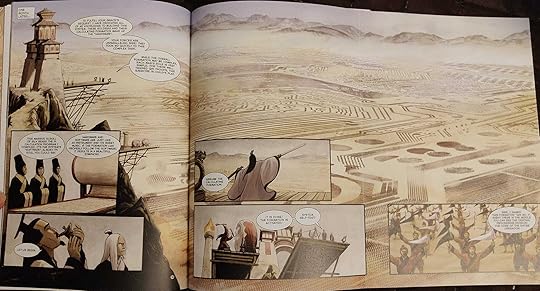
The sixth in a new series of graphic novels from Hugo Award-winning author Liu Cixin and Talos PressAfter infamously failing to assassinate King Zheng of Qin with a hidden dagger, the world-renowned scholar Jing Ke is tossed in prison. Yet the king is though Jing Ke conspired to kill him, he also turned his dagger’s blade away from the king and saved him. Why would Jing Ke attempt regicide . . . and why would he foil his own plot? No amount of torture will make the would-be assassin tell the truth—Jing Ke will only disclose his great secret to King Zheng himself. Under the suspicious glares of the king’s ministers, Jing Ke reveals the true purpose of his to gift King Zheng with a treasure. This gift is not gold, silver, gems, or land, but rather a mathematical language that can decipher even the Will of Heaven. Once 100,000 digits of this ratio are calculated, the king would be able to perceive the Will of Heaven, understand the mysteries of the gods, and even unlock the secret of immortality. King Zheng puts his trust in Jing Ke and mobilizes three million of his elite soldiers to construct a “calculating formation” than can compute Pi at high speeds. All the while, a coup to overthrow King Zheng is steadily growing in the shadowThe sixth of sixteen new graphic novels from Liu Cixin and Talos Press, The Circle is an epic tale of the future that all science fiction fans will enjoy.
After reading The Devourer, I was not expecting the setting of this one at all. A King using his 3 million strong dynasty era army to create a computer and try to calculate Pi so as to become immortal. What a mad idea! So good.
This entire review has been hidden because of spoilers.
🧠 My thoughts Interesting setting and premise with math, Pi, and low-level computing concepts. The artwork was very clean and easy to follow. However, the storytelling confused me from time to time. I felt like these sci-fi concepts might be a bit unsuitable for this ancient period of time in China. Let alone, it was not convincing to me that people back in the day understood completely the futuristic things Jing Ke said without any questions.
👍 What I like - Nice and neat artwork - Interesting story using math, Pi and low-level computing concepts
👎 What I don't like - Storytelling is confusing sometimes - Not convincing details
Le récit est un peu moins intéressant que le précédant mais demeure tout de même fascinant par sa complexité et le processus mathématique astucieux qu’il présente. Le dessin est encore une fois excellent. Le récit reprend également une idée présentée dans le premier volume du roman Le Problème à trois corps. Comme il s’agit d’une uchronie, on peut se demander sur laquelle des trois Terres se déroule cette fresque historique… Cela demeure divertissant et une très bonne lecture.
A simple story that is character-driven; enjoyable graphics depicting a not so usual period for a futuristic sci-fi, involving an organic motherboard, a scientist and a megalomaniac. In the end the storytelling suddenly shifts to become more about characters who weren't properly built up earlier rather than bringing a satisfying conclusion to the story, and moved away from the sci-fi themes introduced too abruptly. Not the finest storytelling in the series but the concept was very "out-there" while remaining close to home, and the unexpected time period setting was very refreshing.
La perfection du cercle est une lecture qui m’a profondément marqué. Ce n’est pas simplement un roman graphique de science-fiction — c’est une réflexion poétique sur l’humanité, le progrès et nos limites. Liu Cixin a ce talent rare : il parle de l’infini, de la science et de la technique, mais il ne perd jamais de vue l’émotion, la solitude et la fragilité des êtres.
Xavier Besse traduit tout cela avec des dessins d’une beauté glaciale et hypnotique. Chaque planche semble respirer, chaque ombre dit quelque chose sur la petitesse de l’homme face à ce qu’il crée. C’est à la fois grandiose et mélancolique.
Ce que j’ai adoré, c’est cette sensation d’émerveillement mêlée d’inquiétude. On se sent minuscule, mais vivant. L’histoire questionne ce que veut dire être humain dans un monde où la perfection devient presque un piège. Et même si le ton reste sobre, le message est puissant : la perfection sans émotion n’est qu’un vide.
Je suis ressorti de cette lecture un peu sonné, un peu contemplatif — comme après un rêve dont on n’est pas sûr d’avoir tout compris, mais qu’on sent profondément vrai.
C’est un roman graphique à lire lentement, à ressentir plus qu’à analyser. Pour moi, La perfection du cercle est un bijou visuel et philosophique, un de ces récits qui continuent de tourner dans la tête longtemps après la dernière page.