Did you know- Every atom in your body has almost certainly passed through several stars and been part of millions of organisms on its way to being you?- If you are an average-size kid, you have enough potential energy inside you to explode with the force of several hydrogen bombs?What happened to the dinosaurs?How big is the universe?How heavy is the Earth?Why are the oceans salty?Is a meteorite going to hit us?Bill Bryson's story-telling skill makes the 'How?' and, just as importantly, the 'Who?' of scientific discovery enertaining and accessible for all ages.In this exciting new edition of his worldwide best-seller, A SHORT HISTORY OF NEARLY EVERYTHING, which has been specially abridged and adapted for younger readers, Bill Bryson explores the mysteries of time and space and how, against all odds, life came to be on the wondrous planet we call home.Along the way, we meet several bizarre scientists, crackpot theories which held sway for far too long, and some accidental discoveries which changed the way science developed.
Bill Bryson is a bestselling American-British author known for his witty and accessible nonfiction books spanning travel, science, and language. He rose to prominence with Notes from a Small Island (1995), an affectionate portrait of Britain, and solidified his global reputation with A Short History of Nearly Everything (2003), a popular science book that won the Aventis and Descartes Prizes. Raised in Iowa, Bryson lived most of his adult life in the UK, working as a journalist before turning to writing full-time. His other notable works include A Walk in the Woods, The Life and Times of the Thunderbolt Kid, and The Mother Tongue. Bryson served as Chancellor of Durham University (2005–2011) and received numerous honorary degrees and awards, including an honorary OBE and election as an Honorary Fellow of the Royal Society. Though he announced his retirement from writing in 2020, he remains one of the most beloved voices in contemporary nonfiction, with over 16 million books sold worldwide.
I started this book primarily because the completeist in me wanted to tick one off in completing the Bill Bryson set of books (I have one more to go). I was aware that this is an abridged, illustrated and watered down version of A Short History of Nearly Everything, targeted at a younger audience. However, I was delighted to find that, apart from standing by itself as a nice little general science introduction book, this more colourful version is also like a nice little summary to the meatier original travelogue to science.
Started reading this one with "the lads" after finishing "The Littlest Prince" in late August of last year. We read about two or three of the short articles regarding some unique aspect of the history and development of our civilization, planet, solar system, galaxy and universe. We generally read this book once or twice a week just before their bedtime to keep their awesome, developing minds focused on the wonders found in the world of science and discovery. It is a great balance to the Bible and/or Sunday school training their young minds are getting. I highly recommend this as "bedtime reading" to anyone over six or seven but under twelve years of age; teens may find the information a bit too simple or uninteresting.
In the article concerning global warming, Bryson paints a picture that we really don't know if the Earth is warming up and if so, what is causing it. The fact that Mother Nature sends out hundred's of billions of tons of carbon dioxide via volcanoes and dead and decaying flora and fauna was an interesting fact I had neither heard nor considered before now. The net effect including humanities' contribution however is tipping the balance in favor of the global warming argument. Good for science, but very BAD for us.
Furthermore, I do agree with his assertion that if you look at the development of our planet and if we are truly the only "intelligent" life out there, then we have been EXTREMELY lucky and should not blow it. But with patient, intelligent and far-reaching analysis on a global (cosmic?) scale, we should be able to address whatever is coming our way. Generally optimistic in me 'umble opinion, Guv'nor!
The last few articles, "chapters" or topics about animal extinction, overpopulation, global warming and pollution were a bit of a downer; especially for my little artist who took the death and loss of animals and the effect of pollution on "their world" pretty hard. He saw exhaust coming out of a vehicle this morning on the way to the bus stop and instantly understood what air pollution was and its harmful effect on our environment and, more important, on "the animals' environment, too" because,"what the heck," he reasoned, "they [the animals] have a right to a healthy environment, too!" He doesn't put much stock in the intelligence and necessity of the "human" race at present. Can't say as I blame him there; to wit, "reality TV" and the doltish emphasis in this society on how one looks or on how much money one makes rather than on what are we doing to our planet and what can I, as an individual, do about it!
Curiously, this little wonder does leave you feeling that one person truly can make a difference -- whether for good or evil. I find the title -- "A Really Short History of Nearly Everything" a bit "sneaky" and particularly instructive in that when you look at the fact that humans have been on this planet for 0.01% of the entire time it has been in existence, the actions we do or do not undertake will pretty much slam the book shut on "nearly everything"; thus, "a really short history" of it.
Nonetheless, we ALL greatly enjoyed this book and truly hate to see it come to an end. Mr. Bryson, could you please write another book just like this one? Pretty please?!
On to "The Hobbit" shortly! I must confess here too that just reading to my children for 30 minutes a night is, perhaps, some of the best 30 minutes of my entire day. They really do appreciate it and, because of it, have made reading on their own a top priority rather than watching the "boob tube" or playing Wii. Yeeesssss! (arm clenched in a downward motion) Successssss!
Really short and interesting with a lot of pictures and easy tone - though meant for kids, works well for a coffee table book for curious adults as well.
Couple of years ago I realized I know hardly anything about sciences, natural history and the like. Most of what I learned in high school, I'd forgotten. But no prob, thought I, isn't that what books are for? Bill Bryson's "A Short History of Nearly Everything" seemed perfect, but when I started reading that, it soon turned out it wasn't quite simple enough for my poor little brain. So when the YA version caught my eye, I jumped to the chance to learn stuff about nearly everything again.
It turns out, a lot of the ground that Bryson covers here wasn't completely new to me. Some of it was, of course, and even if some things were vaguely familiar, I've never fully understood them, so it was good to have a simple, concise introduction to them.
Bryson's book is very entertaining and informative. The illustrations are fun, if not terribly useful in helping to understand the text. There's a fair bit of repetition, which is good. Some of the info is given in s
If I had to criticize this book for something, I'd say there is a bit of a incongruence between the YA label and Bryson the narrative's tone. Young adults refers to people in their late teens, if I'm not much mistaken. Yet Bryson seems to write for a somewhat younger audience. Sometimes it almost feels like his talking down to his reader. Also, a bibliography would have been great.
Those quibbles aside, I'm really glad I read this book. Maybe I'll even try the adult version next.
The "Grown-Ups" version is one of my favourite non-fiction books, so reading the children's version to my 6 and 8 year olds as bedtime reading was a no-brainer. Everyone needs more understanding of the world around us and the history of science is sadly neglected in our schools ('much more important than the history of monarchs).
This was a challenging bedtime read. It was difficult getting them to concentrate on ideas that were new, overwhelming and difficult to grasp at the end of a day. Time periods covering billions of years and the size of a bacteria are difficult concepts for grown-ups too. There were frequent interruptions, questions and explanations to help their understanding. Some nights we only got through two pages in 40 minutes. Some parts were completely beyond them; the structure of DNA and the basics of genetics were a real struggle; I would have been better skimming over that section... But some parts completely gripped their imagination - how often do you have conversations with your children about Newtons' Laws of Motion? Or the Earths orbit around the sun and how that makes summers, winters and ice ages?
Only about half of the book really engaged them and then only about a quarter was understood, but this still means that they've learnt heaps. On one occasion my six year old interrupted to put forward his idea of moving continents ("like a jigsaw") a whole two pages before plate tectonics were described! (Dinosaurs had helped focus his thoughts...) And they now have the the book to go back to in the future.... I hope.
The illustrations and summary pages at the end of each section helped and the finally summing up; "we should be custodians not pillagers of our planet", had them suitably upset by the current rate of extinction and the risks of global warming. Finally, despite having read the grown-ups version, and quite a few other books on science history, this was a pleasure for me to read too.
Strongly recommended for everyone, whatever age. Even if you dip in to read a couple of pages it will be worth it.
Como dice el título, el libro te hace un repaso de casi todo, centrado en la evolución de la ciencia: cosmología, física, química, geología, paleontología, biología, genética, etc y etc...
El autor lo explica todo de forma muy amena, se te hará fácil de entender aunque no domines el tema del que te habla. Lo cuenta todo de una forma interesante y a veces con toques de humor. Está bien que mezcle hechos importantes, con anécdotas curiosas y a veces irrelevantes que hacen la lectura más entretenida. No esperes que profundice al 100% en todos los temas, pero algunos los desarolla bastante.
Resumen de lo que encontrarás en cada capítulo:
- El mundo podría acabarse en cualquier momento, hay miles de amenazas y peligros, pero nunca podremos predecirlo, ni saberlo (así que te jodes) XD. Es una puñetera casualidad que sigas vivo :) - Los científicos viven en un drama constante y cuando alguien tiene una genial ideal, todo el mundo prefiere reírse e ignorarlo. Hasta que pasan años, nadie le da la razón. Esto sigue igual no? - Datos interesantes, muchos datos interesantes para que puedas soltar y hacerte el listo. - Chistes malos, pero reconozco que alguno me ha hecho reír.
We picked this for family book club but ended up not finishing it. It's a bunch of short writings on different topics (how the universe formed, how we know the weight of the earth, etc.) as opposed to a more connected explanation of how we came to be. I find it difficult to stick with a book when every 2 pages it feels as if you're starting something new. This seems to be the structure for a lot of middle grade/ YA non-fiction and I would love to find some (besides biographies) that explore a topic in depth at an age-appropriate level.
This book, A Really Short History of Nearly Everything, is exactly how the title describes it. From microbes, bacteria, and viruses all the way to Earth’s age! Inside it explains prehistoric animals, measuring Earth, the Earth’s age, supernovae, many famous scientists... and so much more. Not only science, but math and history as well! In my opinion this book is a great read for all ages. You are never too young or too old to learn something new! It shows many great pictures, drawings, and diagrams which can help you understand better. Bill Bryson makes science exciting, interesting and understandable. It contains a mountainous number of facts. An example of a really cool fact is that the Earth is 4,550 million years old! It took a long for scientists to finally figure this out. Scientists tried to find the ages of rocks and fossils, but that didn’t really work out. Then scientists tried carbon dating, but the carbon ore rocks were rarely found. Finally, a clever scientist named Clair Patterson solved it all. Meteors would work because they are “leftover building materials” that float around. Now they measured the date of there rocks, and they got 4,550 million years! A Really Short History of Nearly Everything is a great book. It is a brilliant source of information, and if you are curious, you can use this book to answer many of your questions about science!
The value in this book is its survey of earth’s history (as a planet within the Milky Way) and humankind’s scientific advancements as well as the people responsible. As an abridged version intended for younger readers, this volume might be helpful to middle school science teachers for creating curriculum. Young readers, the intended audience, would also derive benefit from many of the discussions, while many others would likely leave them clueless due to the truncated explanations, for each topic is relegated to two-page spread with much of the space dedicated to illustration. My sense is that adults who possess passing knowledge and experience with the subject matter will benefit more than middle school readers without background.
I love this kids' version of the book--it covers most of what we teach in sixth grade social studies and science all in one book! It's kind of like a human primer. I think everyone should read it..and I also think it should serve as a textbook in middle school social studies classes.
“Los humanos conductualmente modernos llevamos por aquí sólo un 0,0001 % más o menos de la historia de la Tierra…, casi nada, en realidad, pero incluso existir durante ese breve espacio de tiempo ha exigido una cadena casi interminable de buena suerte.”
Se trata de un libro que efectivamente nos habla de casi todo en la historia del planeta y la humanidad, de forma sencilla y clara. Nos da diferentes teorías sobre el nacimiento del Universo, sobre los grandes descubrimientos en física, química, biología, paleontología y mucho más. Para poder concluir que efectivamente la vida existe posiblemente en diferentes formas y lugares, pero para poder llegar al hoy, a lo que somos, se han tenido que dar una serie de circunstancias tan específicas, que, si hubieran variado solo un poco, la realidad sería totalmente diferente.
Un libro realmente interesante aún para quienes desconocemos todo sobre la ciencia. Totalmente recomendado.
Libro genial. Presenta a un nivel divulgativo un gran espectro de conocimientos. He aprendido mucho con este libro, escrito de manera concisa y clara a la vez que entretenida.
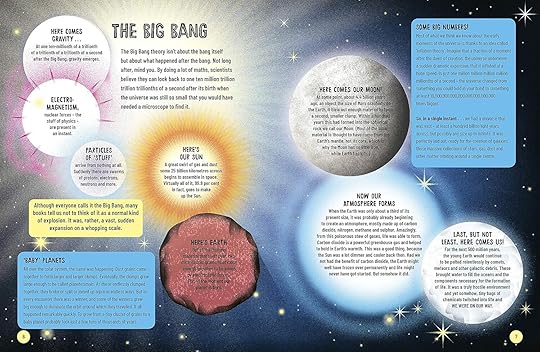
⭐ Θα ξεκινήσω λέγοντας ότι με κέρδισε από την πρώτη σελίδα το συγκεκριμένο βιβλίο αφού ο συγγραφέας μάς καλοδέχτηκε κυριολεκτικά και μεταφορικά από τις πρώτες γραμμές... Ξεκίνησε από το θαύμα της ζωής αφού πρώτα μας έθεσε τις βάσεις για το τι ήταν το big bang.
⭐ Και φυσικά όλα αυτά με εκλαϊκευμένο τρόπο, άπλετο χιούμορ, κυνισμό, σαφήνεια κ απίστευτη εικονογράφηση που είναι αδύνατο να μην κεντρίσει το ενδιαφέρον των παιδιών.
⭐ Είχα διαβάσει το βιβλίο των ενηλίκων από τη σειρά οξυγόνο που είχε κυκλοφορήσει και μάλιστα πολλές φορές είχα σκεφτεί Τι ωραία αν υπήρχε ένα αντίστοιχο βιβλίο που να εξηγεί όλα αυτά με απλοϊκό τρόπο στα παιδιά κ δημιουργήθηκε αυτό το θαύμα που δε γίνεται να λείπει από καμία βιβλιοθήκη 😉
⭐ Πώς βρέθηκε ένας ήλιος στο κέντρο του πλανήτης μας και πώς ξέρουμε τι θερμοκρασία εχει? Πόσο ζυγίζει η γη? Τι σημαίνει κακή χρήση της επιστήμης? Αυτές και πολλές ακόμα ερωτήσεις θα απαντηθούν μέσα από τις σελίδες του βιβλίου στο οποίο τα παιδιά θα γίνουν κυνηγοί δεινοσαύρων ,θα μάθουν να μαγειρεύουν ένα σύμπαν ,θα περιπλανηθούν στα βάθη της θάλασσας, θα είναι προετοιμασμένοι γνωρίζοντας τι είναι ένας σεισμός και φυσικά θα χαθούν στο χωροχρόνο του διαστήματος αναζητώντας αν υπάρχει κανείς εκεί έξω...
⭐ Ένα εγχειρίδιο για μικρούς που θα λύσει αδιαμφισβήτητα πολλές απορίες που αν μη τι άλλο ούτε και εμείς οι ίδιοι γνωρίζαμε τις απαντήσεις .Οπότε δεν θα μου φανεί καθόλου περίεργο αν καταλήξει και στα χέρια των γονιών απολαμβάνοντας την κάθε του σελίδα
This book took me SO long to finish. Honestly, I started it the last week or so of July and finished it the last week of September. Nonfiction has always been hard for me and is generally a genre I stay away from. This book was nice but definitely not my favorite.
I loved the way it was written. Bryson’s writing is witty and entertaining but he still packs tons of information into relatively small paragraphs. The book was also not what I expected. I thought it would be more about historical events and less about science. But the majority of the book was a history of science and how it’s advanced.
The illustrations in the book were gorgeous though and I found most of the time when I was getting annoyed with the info dump I was receiving the images on the page could help to make up for it.
Still I’m glad I read the book and it gave me some interesting facts to dish out in conversations so I can’t say it was time wasted. I just wish it didn’t take me so long to push through.
كتاب علمي مبسط و ممتع جدا.. الدقة في خلق الكون ليس لها نهايه.. .. غريبه هي قدرتنا على العيش في الارض رغم الزلازل والبراكين و التلوث والتصحر والتجمد والبكتيريا والفيروسات.. وكون الانسان ضعيف جدا سبحان القائل: "إنا كل شيء خلقناه بقدر"
من المعلومات الشيقه في الكتاب: - عمر الكون 13.7 بليون سنه - عدد الذرات ثابته في الكون.. عندما تموت تتفكك ذراتك وتتحلل لتكون شيئا اخر.. - عدد النجوم في مجرتنا بين 100 و 400 بليون! ومجرتنا واحده بين 140 بليون مجره! - لو اقتربت الارض من الشمس ولو بنسبه بسيطه احترقنا ولو ابتعدت بنسبه بسيطه تجمدنا! - بدأت الحياه في الارض قبل 3.9 بليون سنه (2بليون سنه منها فقط بكتيريا) - انقرضت الدينصورات بسبب كارثه بيئيه وليس تدريجيا - الناس يسكنون 0.05%من سطح الارض فقط! - الخلايا الحيه في جسم الانسان لاتعيش اكثر من شهر ماعدا خلايا الدماغ - عمر البشر على الارض تقريبا 2 مليون سنه - 99.9% من جيناتنا مشتركه من البشر الاخرين - الانسان عاش على الارض اقل من 0.01% من عمرها!
Een bijzonder aantrekkelijk geschreven verhaal waarin veel onderzoekers voor het voetlicht komen op zo'n manier dat ook hun persoonlijke situatie duidelijk wordt. Zo kun je er bijvoorbeeld achterkomen dat de opa van Darwin Josiah Wedgwood was van het bekende servies bedrijf Wedgwood. Ook hun karakter, anekdotes en hun onderzoek wordt op een toegankelijke manier beschreven ook geschikt voor niet-wetenschappers. De onderzoekers hebben zich bezig gehouden met de natuur van kosmos t/m de micro wereld. En met het leven van plant, dier en mens. De indrukwekkende beschrijving van het universum, de materie en levende wezens heeft mijn besef versterkt dat blind toeval nooit het leidende mechanisme kan zijn voor zulk een ingenieus en schitterend ontwerp, maar dat er een hogere macht moet zijn die dit alles heeft gecreëerd. Ik geloof dat de God van de bijbel die macht is.
I've had a really long relationship with various versions of this book, having co-translated the first edition in Greek with my father, more recently translated an amended edition on my own, and now having translated this edition.
Bryson is among the great beasts of popularizing science, notably, in this case, ALL of science, so there is not much for me to say in this regard. What I can say, is that the illustrations for this book are wonderful, vibrant and eye-catching. It is, indeed, what many of us unknowingly wished an elementary school science book to be.
Do not take my word for it. Much as I would like to say otherwise, I am obviously somewhat biased; but do yourself (and more importantly your children) a favor and leaf through it to judge for yourself. I believe you won't be disappointed.
A slow bedtime read, but I felt I learned something every few pages. The biographical detail and scientifically accurate terms were pretty heavy, but I liked Bryson’s clear passion for the subject matter. Not as much humour as normal for Bryson, but I wasn’t disappointed.
In “A Really Short History of Nearly Everything” Bill Bryson does it again. He takes an impossible subject, and makes it not only readable, but fun, lively, and it still remains informative. More than informative, actually, it is insightful. Very insightful. Now, the book was released in 2008, so you might think that some things have changed. You would be right, but what is 15 years when measured against, millenniums, or, actually, even millions of years. Some things change, but so much remains, more or less, the same.
This book is suitable for the really curious of all ages – or 9 to 109! Words, like the universe bends, “in a way that we can’t really imagine. We are not adrift in some large, ever-expanding bubble. Rather, space curves in a way which allows it to have no actual edge or boundary, but at the same time allows it to be finite” Words do that as they can bring us to places that we can’t imagine imagining. It takes a story-teller to take us there. It’s a slightly troubling fact that if you were to pick yourself apart with tweezers, one atom at a time, you would produce a mound of fine atomic dust, none of which had ever been alive but all of which had once been you. Did you know you are alive, but are made up of substance that is not quite that, “troubling fact that if you were to pick yourself apart with tweezers, one atom at a time, you would produce a mound of fine atomic dust, none of which had ever been alive but all of which had once been you. I remember asking a PH.D. student – a budding scientist, about what an atom is made up. “The atom: Ever atom is mode from three kinds of particles - Protons, which have a positive electrical charge; Electrons, which have a negative electrical charge; And neutrons, which have no charge” Which makes me think of what one granddaughter (almost 4 years old) would ask me, “What makes up a Protons?” “What makes up a Electrons?” “What makes up a Neutrons?”
"We have a universe. It is a place of most wondrous and gratifying possibility, and beautiful, too. And it was all done in about the time it takes to make a sandwich.” --Bill Bryson
Weighing in at a mere 168 pages, this is an abridged, illustrated version of his meatier and much longer book with the slightly different title. (‘Really Short …’ as compared to ‘Short’). It’s geared to a young audience but I learned a lot from it. It will certainly do until I get around to tackling the longer version. Bryson is a marvelous writer, and material that could be dull is anything but.
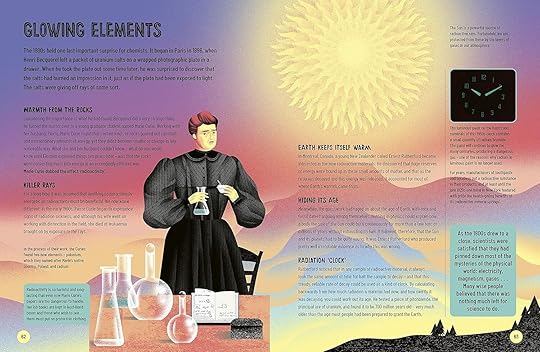
Some tidbits: P62 ‘Radioactivity is so harmful and long-lasting that even now Marie Curie’s papers are too dangerous to handle. Her lab books are kept in lead-lined boxes and those who wish to see them must put on protective clothing.’
P105 Some unfortunate souls in the early days of diving suffered what’s called the squeeze, “when surface pumps failed, leading a catastrophic loss of pressure in the suit, The air would leave the suit with such violence that the diver would be sucked up into the helmet and hosepipe. When hauled to the surface, all that was left in the suit was bones and some rags of flesh.”
P132 “Despite Linnaeus’s admirable work, we don’t have the faintest idea of the number of things that live on our planet. Estimates range from three million to 200 million species, but it’s possible that as many as 97 per cent of the world’s plant and animal species may still await discovery. Why is this? […] most of the living things on the planet are microscopic.”
“Because they are so long-lived, atoms really get around. Every atom you possess has almost certainly passed through several stars and been part of millions of organisms on its way to becoming you. We are each so atomically numerous and so vigorously recycled at death that a significant number of our atoms—up to a billion for each of us, it has been suggested—probably once belonged to Shakespeare. A billion more each came from Buddha and Genghis Khan and Beethoven, and any other historical figure you care to name. (The personages have to be historical, apparently, as it takes the atoms some decades to become thoroughly redistributed; however much you may wish it, you are not yet one with Elvis Presley.) So we are all reincarnations—though short-lived ones. When we die our atoms will disassemble and move off to find new uses elsewhere—as part of a leaf or other human being or drop of dew. Atoms, however, go on practically forever.”
This really isn't the sort of book that I usually pick up - but as ever, true to form, I chose this as my risky read this month and I did find it truly fascinating!
This book literally does as it says and gives us a teeny tiny history of almost everything! Starting with the Big Bang and working through the different sciences and important snippets from each, then finally finishing with what could be the end of the human race.
That might sound a little drastic - but we did go a long way round to get to this point ....and we were talking thousands of years into the future!
Now, I'm not really a huge reader of sci-fi nor really anything science-y at all - however, I do always end up intrigued and fascinated by what I read and this book was just perfect to give us an overview of everything.
It covered so many topics and spanned such a range of information, but each snippet flowed on from the last in a logical manner and timeline.
There were topics from all the sciences - astrophysics starting us off with the creation of our universe, moving on to physics theorems, biology and evolution, some chemistry and the periodic table but we even see some geology and geography thrown in too as we explore weather and natural disasters, bringing us to a close with our next ice age!
For someone like me, who can get a little overwhelmed with too much technical information - this was such a great idea. Don't get me wrong, this definitely goes into quite a lot of detail for each event and topic, but really gets the essential pieces of information over as succinctly as possible before moving on - and this was definitely just the right balance to keep me invested throughout.
A great read for any age audience and I loved the audio book narration too.