

What do you think?

Children of the City: At Work and At Play
The turn of the century was a time of explosive growth for American cities, a time of nascent hopes and apparently limitless possibilities. In Children of the City, David Nasaw re-creates this period in our social history from the vantage point of the children who grew up then. Drawing on
hundreds of memoirs, autobiographies, oral histories and unpublished--and until now unexamined--primary source materials from cities across the country, he provides us with a warm and eloquent portrait of these children, their families, their daily lives, their fears, and their dreams.
Illustrated with 68 photographs from the period, many never before published, Children of the City offers a vibrant protrait of a time when our cities and our grandparents were young.
hundreds of memoirs, autobiographies, oral histories and unpublished--and until now unexamined--primary source materials from cities across the country, he provides us with a warm and eloquent portrait of these children, their families, their daily lives, their fears, and their dreams.
Illustrated with 68 photographs from the period, many never before published, Children of the City offers a vibrant protrait of a time when our cities and our grandparents were young.
256 pages, Paperback
First published January 1, 1985
About the author
David Nasaw
16 books186 followersDavid Nasaw is an American author, biographer and historian who specializes in the cultural, social and business history of early 20th Century America. Nasaw is on the faculty of the Graduate Center of the City University of New York, where he is the Arthur M. Schlesinger Jr. Professor of History.
In addition to writing numerous scholarly and popular books, he has written for publications such as the Columbia Journalism Review, American Historical Review, American Heritage, Dissent, The New Yorker, The New York Times, The Wall Street Journal, Slate, The London Review of Books, and Condé Nast Traveler.
Nasaw has appeared in several documentaries, including The American Experience, 1996, and two episodes of the History Channel's April 2006 miniseries 10 Days That Unexpectedly Changed America: "The Homestead Strike" and "The Assassination of President McKinley". He is cited extensively in the US and British media as an expert on the history of popular entertainment and the news media, and as a critic of American philanthropy.
In addition to writing numerous scholarly and popular books, he has written for publications such as the Columbia Journalism Review, American Historical Review, American Heritage, Dissent, The New Yorker, The New York Times, The Wall Street Journal, Slate, The London Review of Books, and Condé Nast Traveler.
Nasaw has appeared in several documentaries, including The American Experience, 1996, and two episodes of the History Channel's April 2006 miniseries 10 Days That Unexpectedly Changed America: "The Homestead Strike" and "The Assassination of President McKinley". He is cited extensively in the US and British media as an expert on the history of popular entertainment and the news media, and as a critic of American philanthropy.
Ratings & Reviews
Friends & Following
Create a free account to discover what your friends think of this book!
Community Reviews
Displaying 1 - 26 of 26 reviews
November 3, 2017
Imagine my surprise when I discovered that
Spot Conlon

Racetrack Higgins

Mush
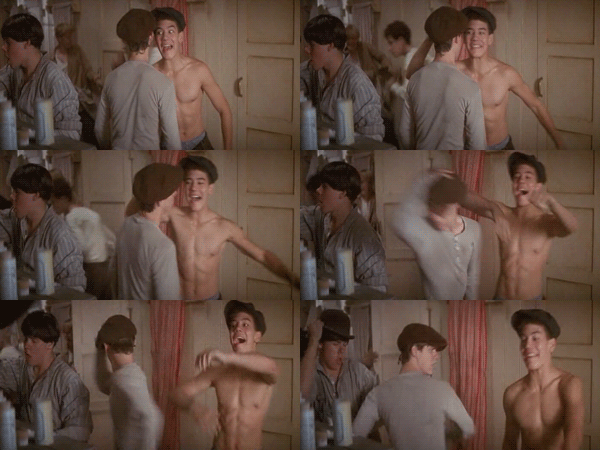
Crutchie

and Boots McAleenan
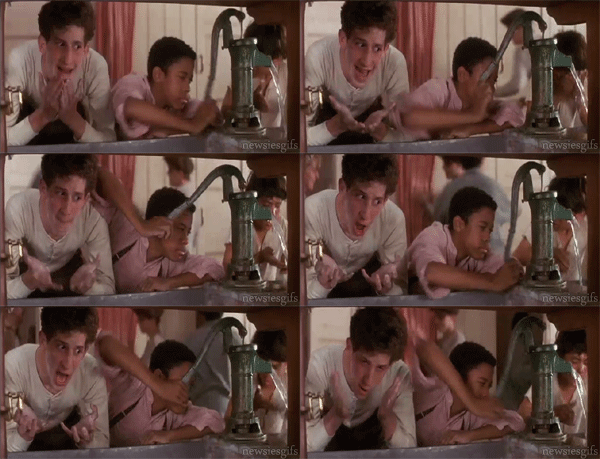
were all real Newsies!
I mean, we all know about Kid Blink.

The book also mentions other newsies and strike supporters.
1.) Morris Cohen: According to Don Seitz, he helped organized the initial 1899 strike (pg 185). And as claimed in the article "Salvation Lassies Wouldn't Sell Them"and "Newsdealers and the Boy Strikers" from City Hall Park 1899 on July 27, Morris stepped in as the strike leader after Kid Blink lost his reputation, who had accepted a hefty bribe from the World and/or Journal and carried boycotted papers. With Blink's fall as leader, Morris became President of the union, Racetrack became vice-president and Dave Simons became treasurer.
2.) Dave Simons: He was president of the union (pg 192) under the Master Workman Kid Blink, and was eventually made treasurer of the union with Blink's loss of title ( City Hall Park 1899 , July 27). On July 28, City Hall Park 1899 articles from different newspapers all declared Simons a "deserter" and was thereby not trusted, along with Kid Blink, who admitted to selling boycotted papers. By July 29, Simons, as well as Blink, were replaced entirely.
3.) Newspaper Annie: As an employee of the Sun newspaper, she supported and encouraged the strike (pg 192), though City Hill Part 1899 said she was quite shy and was pressured to give a speech at the New Irving Hall assembly on July 25. She was given an extravagant and flattering introduction, which called her "the brick of all women and the most faithful of strikers."
4.) Warhorse Brennan: David Nasaw claimed Brennan to be the "oldest newsie" (pg 192). According to City Hall Park 1899 in the July 25 article "Great Meet of Newsboys", Brennan was said to have been selling papers "for twenty years".
5.) Bob "Stone" The Indian: In the City Hall Park 1899 article "Boys Foresee A Victory" from July 25, Bob The Indian was the first at the New Irving Hall assembly in 1899 to call for a universal agreement among all strikers in the union to not use violence as a means to an end. After Bob gave his speech, Kid Blink (who was Master Workman at the time) seconded Bob's desires for nonviolence and for the strikers to stand together.
These people, along with others unmentioned here, were very interesting reading about in Nasaw's book or in old newspaper articles from 1899. Names like William Reese (a black lemonade seller), "Young" Monix (became the main strike organizer after Blink was booted from the union committee), "Crazy" Aborn, and "Blind" Diamond seemed to appear again and again in the old articles, which I found fascinating, especially when some of these people weren't even committee leaders of the union.
This book is fantastic because it gives a very gritty look of how the young street traders lived, worked, and played on the streets of large US cities at the turn of the century. Dangers, temptations, obstacles, and territory limitations were definitely explored in this account of kids selling papes, playing with junk, or hawking gum on busy streets. It is so interesting to see the different aspects of street life back then, as well as the effects of immigration, technology, and wealth on the lives of these young kids. As a fan of the film Newsies and of history, this book is great. I bought this book because of a story I was writing about two breaker boys who end up in New York to try to escape the disparity of the mines they were forced to work in. And my notes from this book are certainly helpful in understanding not only the "what" of street traders, but also the "how" and "why".
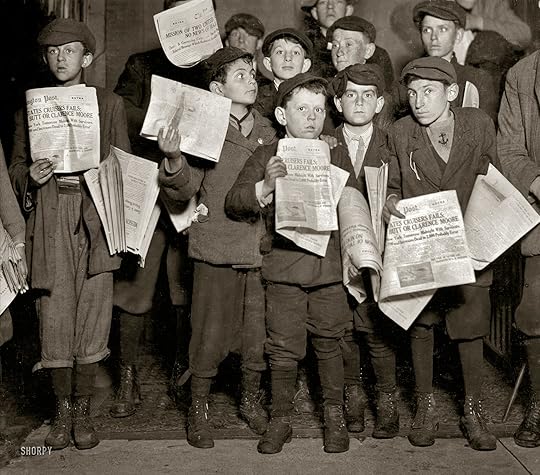
The entertainment chapter was a particular treat for me. I thoroughly enjoyed reading about the different types of things boys liked spending their extra pennies on. In the movie Newsies, it was obvious that the boys loved vaudeville acts. And the flickers were also a huge aspect of a street trader's entertainment, as David Nasaw commented that the kids were "the best patrons of the nickelodeon", making up 25-50% of the regular attendees (pg 132).
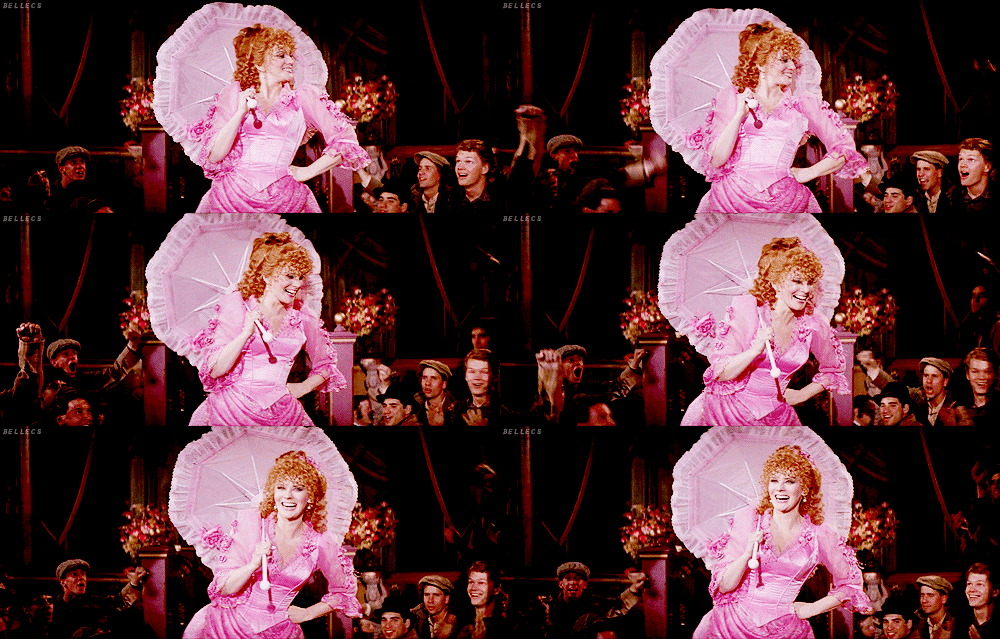
But my favorite part of the book was the spotlight on the camaraderie of the boys, regardless of religion, race, or age. And even though the gang allegiance is strong and sometimes violent towards other gangs, when the 1899 strike was going on, thousands of boys from all different districts from New York gathered together to protest the increased price of the paper (from $0.50 per 100 papers to $0.60 per 100 papers). It was so interesting hearing about the newsie leaders in Brooklyn, Racetrack Higgins (spoke at the assembly on behalf of Brooklyn, explaining that most of his band were shut out from attending) and Spot Conlon (District Master Workboy of the Brooklyn Union), helping the newsies in Manhattan. Spot was quoted saying that the Brooklyn newsies brought "promises of support", and that he and his band of three thousand newsboys "will be over here t' help youse win yer noble scrap fer freedom an' fair play" (pg 188).
For more information on the newsboy strikes, this link will take you to a site where a lot of old newspaper articles are available to look at. This link in particular is for an article called "Great Meet of Newsboys", all about the assembly at New Irving Hall in 1899. Here, the article better explains who Newspaper Annie is, the fact that Warhorse Brennan is well in his 20's, the pleas against violence during the protests, and some of the events happening during the strike --> https://cityhallpark1899.com/newspape...


The book touched upon the strength of unions, but also on what destroyed them. With the legalizing of public newspaper stands, if the newsboys refused to sell papes, then costumers would simply purchase from a newspaper stand. By 1918 and onward, "the children were no longer the essential link between publisher and customer they had been in 1899" (pg 201). The street traders became unneeded. And even though it sounds like a sad end to a way of life, it just helped transition children into a different era, and a different way of life.
If you love the movie or broadway show of Newsies, or if you simply love history, then definitely check out this book. Other reviews complain about the amount of information, but while reading it, I never felt overwhelmed. The only times where I felt the book felt dull were when the book gave accounts of people that Nasaw expected me to know, due to them being famous in some way (comedians, actors, directors, etc). But at the same time, I was able to take a step back and see the accounts as they were: accounts. It didn't matter who the people were. The accounts were very real, gritty, and sometimes humorous. So definitely read this book if you think it's for you! I know I don't look at newspapers the same way. These boys were so essential to the big newspaper companies, and they had a hard life, but they made sure to have fun while living it.
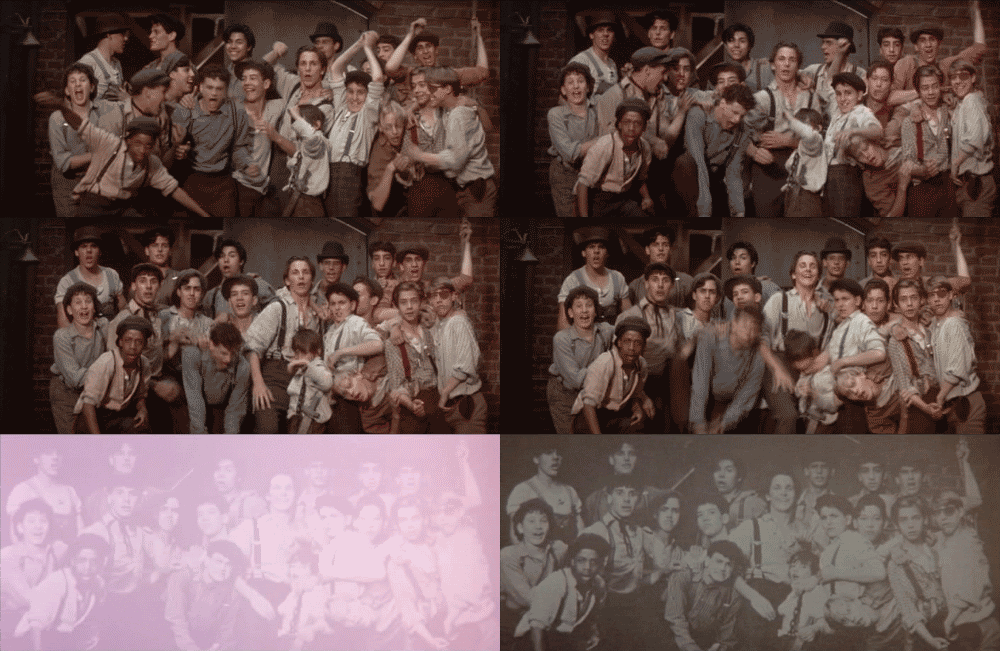
Spot Conlon
Racetrack Higgins
Mush
Crutchie
and Boots McAleenan
were all real Newsies!
I mean, we all know about Kid Blink.
The book also mentions other newsies and strike supporters.
1.) Morris Cohen: According to Don Seitz, he helped organized the initial 1899 strike (pg 185). And as claimed in the article "Salvation Lassies Wouldn't Sell Them"and "Newsdealers and the Boy Strikers" from City Hall Park 1899 on July 27, Morris stepped in as the strike leader after Kid Blink lost his reputation, who had accepted a hefty bribe from the World and/or Journal and carried boycotted papers. With Blink's fall as leader, Morris became President of the union, Racetrack became vice-president and Dave Simons became treasurer.
2.) Dave Simons: He was president of the union (pg 192) under the Master Workman Kid Blink, and was eventually made treasurer of the union with Blink's loss of title ( City Hall Park 1899 , July 27). On July 28, City Hall Park 1899 articles from different newspapers all declared Simons a "deserter" and was thereby not trusted, along with Kid Blink, who admitted to selling boycotted papers. By July 29, Simons, as well as Blink, were replaced entirely.
3.) Newspaper Annie: As an employee of the Sun newspaper, she supported and encouraged the strike (pg 192), though City Hill Part 1899 said she was quite shy and was pressured to give a speech at the New Irving Hall assembly on July 25. She was given an extravagant and flattering introduction, which called her "the brick of all women and the most faithful of strikers."
4.) Warhorse Brennan: David Nasaw claimed Brennan to be the "oldest newsie" (pg 192). According to City Hall Park 1899 in the July 25 article "Great Meet of Newsboys", Brennan was said to have been selling papers "for twenty years".
5.) Bob "Stone" The Indian: In the City Hall Park 1899 article "Boys Foresee A Victory" from July 25, Bob The Indian was the first at the New Irving Hall assembly in 1899 to call for a universal agreement among all strikers in the union to not use violence as a means to an end. After Bob gave his speech, Kid Blink (who was Master Workman at the time) seconded Bob's desires for nonviolence and for the strikers to stand together.
These people, along with others unmentioned here, were very interesting reading about in Nasaw's book or in old newspaper articles from 1899. Names like William Reese (a black lemonade seller), "Young" Monix (became the main strike organizer after Blink was booted from the union committee), "Crazy" Aborn, and "Blind" Diamond seemed to appear again and again in the old articles, which I found fascinating, especially when some of these people weren't even committee leaders of the union.
This book is fantastic because it gives a very gritty look of how the young street traders lived, worked, and played on the streets of large US cities at the turn of the century. Dangers, temptations, obstacles, and territory limitations were definitely explored in this account of kids selling papes, playing with junk, or hawking gum on busy streets. It is so interesting to see the different aspects of street life back then, as well as the effects of immigration, technology, and wealth on the lives of these young kids. As a fan of the film Newsies and of history, this book is great. I bought this book because of a story I was writing about two breaker boys who end up in New York to try to escape the disparity of the mines they were forced to work in. And my notes from this book are certainly helpful in understanding not only the "what" of street traders, but also the "how" and "why".
The entertainment chapter was a particular treat for me. I thoroughly enjoyed reading about the different types of things boys liked spending their extra pennies on. In the movie Newsies, it was obvious that the boys loved vaudeville acts. And the flickers were also a huge aspect of a street trader's entertainment, as David Nasaw commented that the kids were "the best patrons of the nickelodeon", making up 25-50% of the regular attendees (pg 132).
But my favorite part of the book was the spotlight on the camaraderie of the boys, regardless of religion, race, or age. And even though the gang allegiance is strong and sometimes violent towards other gangs, when the 1899 strike was going on, thousands of boys from all different districts from New York gathered together to protest the increased price of the paper (from $0.50 per 100 papers to $0.60 per 100 papers). It was so interesting hearing about the newsie leaders in Brooklyn, Racetrack Higgins (spoke at the assembly on behalf of Brooklyn, explaining that most of his band were shut out from attending) and Spot Conlon (District Master Workboy of the Brooklyn Union), helping the newsies in Manhattan. Spot was quoted saying that the Brooklyn newsies brought "promises of support", and that he and his band of three thousand newsboys "will be over here t' help youse win yer noble scrap fer freedom an' fair play" (pg 188).
For more information on the newsboy strikes, this link will take you to a site where a lot of old newspaper articles are available to look at. This link in particular is for an article called "Great Meet of Newsboys", all about the assembly at New Irving Hall in 1899. Here, the article better explains who Newspaper Annie is, the fact that Warhorse Brennan is well in his 20's, the pleas against violence during the protests, and some of the events happening during the strike --> https://cityhallpark1899.com/newspape...
The book touched upon the strength of unions, but also on what destroyed them. With the legalizing of public newspaper stands, if the newsboys refused to sell papes, then costumers would simply purchase from a newspaper stand. By 1918 and onward, "the children were no longer the essential link between publisher and customer they had been in 1899" (pg 201). The street traders became unneeded. And even though it sounds like a sad end to a way of life, it just helped transition children into a different era, and a different way of life.
If you love the movie or broadway show of Newsies, or if you simply love history, then definitely check out this book. Other reviews complain about the amount of information, but while reading it, I never felt overwhelmed. The only times where I felt the book felt dull were when the book gave accounts of people that Nasaw expected me to know, due to them being famous in some way (comedians, actors, directors, etc). But at the same time, I was able to take a step back and see the accounts as they were: accounts. It didn't matter who the people were. The accounts were very real, gritty, and sometimes humorous. So definitely read this book if you think it's for you! I know I don't look at newspapers the same way. These boys were so essential to the big newspaper companies, and they had a hard life, but they made sure to have fun while living it.
January 27, 2016
I chose to read this book because I had recently seen the play Newsies and really liked it. The musical is based on the book, which was equally as enjoyable. However, it helped me to have seen the play before reading the book.
The story paints a portrait of the bitter hardships, standing up for a belief, and joy experienced by immigrant children in American cities at the turn of the century. The turn of the century was a time of growth for American cities, a time of great hopes and limitless possibilities. David Nasaw tells about this period in our social history from the viewpoint of the children who experienced the many difficulties of this time period.
The boys were out on the streets selling newspapers to raise money for their families. Then a company takes over their job, and they all come together to strike against the newspaper company, and get their jobs back.
I would recommend this book because it was an interesting read for me and I learned a lot about the lives of children my age at the turn of the century.
The story paints a portrait of the bitter hardships, standing up for a belief, and joy experienced by immigrant children in American cities at the turn of the century. The turn of the century was a time of growth for American cities, a time of great hopes and limitless possibilities. David Nasaw tells about this period in our social history from the viewpoint of the children who experienced the many difficulties of this time period.
The boys were out on the streets selling newspapers to raise money for their families. Then a company takes over their job, and they all come together to strike against the newspaper company, and get their jobs back.
I would recommend this book because it was an interesting read for me and I learned a lot about the lives of children my age at the turn of the century.

March 2, 2018
The author seems to take the stance that the era of children working/playing/living on city streets was a happy, golden time. And that all the parents and children's rights advocate were a just a bunch of clueless meanies who wanted to prevent youngsters from earning money, having fun, and/or living meaningful lives. Which strikes me a curious point of view, but whatever.
I read the book to learn more about the history of the 1899 newsboy strike, upon which Disney's musical "Newsies" is based. This history, as it turns out, comprised a comparatively small portion of the narrative. Even so, I could not be altogether disappointed. Mostly because I learned that Spot Conlon was a real person. The joy of such a discovery is worth at least three stars, all on its own.
I read the book to learn more about the history of the 1899 newsboy strike, upon which Disney's musical "Newsies" is based. This history, as it turns out, comprised a comparatively small portion of the narrative. Even so, I could not be altogether disappointed. Mostly because I learned that Spot Conlon was a real person. The joy of such a discovery is worth at least three stars, all on its own.
April 9, 2026
Stumbled upon this book referenced while going on my urbanism reading spur but it was actually really cool. The main thing it made me think about is how little credit do we give children in being able to function in public society. While they may not be mature in every way, they can do a lot more than you'd expect and makes me wonder how much independence I'd wanna give kids in the future

Read
July 18, 2019thank you, chris!
a really enjoyable read! i found the agency he gave the children to be super interesting and i gained an entirely new perspective on american history, which is something i always enjoy.
a really enjoyable read! i found the agency he gave the children to be super interesting and i gained an entirely new perspective on american history, which is something i always enjoy.

March 26, 2019
After seeing "Newsies, The Musical", I was intrigued by the newsboy strike of 1899 and went looking for a book about it. I found this one. Nasaw obviously did lots of research on the society, economics, and families in turn-of-the-century New York. He recounts the overcrowded tenements, forcing children out into the streets from a very young age. The older kids would look after the younger ones, and the streets and alleys were their playgrounds. Many children found work to help supplement their family incomes, and thereby gained confidence, industriousness, and strength of character. I really enjoyed this book. Even though there are lots of citations and footnotes, it is an easy and entertaining read.

October 1, 2014
This is another book that I had to read for a class this semester.
I do have to say, this book is very well written, especially for nonfiction. It is by no means dry or scholarly. It was actually incredibly interesting. It was really nice to see this historical time period from a different perspective. It shed a lot of light on the generation that would become the Greatest Generation and would fight WWII (though that's hardly mentioned in the book at all).
If you are interested in American history, especially during the turn of the twentieth century, it's a good read.
I do have to say, this book is very well written, especially for nonfiction. It is by no means dry or scholarly. It was actually incredibly interesting. It was really nice to see this historical time period from a different perspective. It shed a lot of light on the generation that would become the Greatest Generation and would fight WWII (though that's hardly mentioned in the book at all).
If you are interested in American history, especially during the turn of the twentieth century, it's a good read.

May 21, 2020
An Amazing view into an era where children were at work to help sustain their families. It really puts into perspective how much children take for granted today. I personally think this should be read in schools, As it gives both historical and emotional insight into how children lived back then. The newsboy strike of 1899 was one of the most important events in history, and it's not talked about enough.

June 4, 2017
I learned that the musical Newsies was based on this book and so I had to read it and get the rest of the story. The research is quality and it was a fascinating glimpse into days gone by in the cities of America. I was also surprised to learn just how many celebrities spent time as children working as some sort of street vendor. Interesting stuff.

October 13, 2013
This was an interesting book overall. I read it after seeing (and loving) Newsies on Broadway twice in six weeks. I am glad I read this book to know how the stage version of the story compared to actual events. (Final assessment... the stage version bears some resemblance to reality.)

June 7, 2021
If you have any interest at all in the Newsboy strike of 1899, life in the turn of the century New York, or the golden age of Hollywood, this is the book for you. Nasaw does a fantastic job of presenting this bygone era in such a way that it comes to life. This was definitely NOT a boring textbook read. The pictures were a great touch. I find this era very interesting and have done some of my own research. Although not all of what was covered in the book was new to me, I still got a lot out of it and appreciated reading the author's perspective. Really enjoyed reading quotes from first hand accounts such as Harpo Marx and George Burns.
The author has a slight negative tone when it comes to the reformers and those who felt they needed to "better" the lives of the children who worked and played on the streets and I strongly agree with a lot of what he says. The kids were not stupid. Sure, the streets could be a hazard but these kids knew what they were doing. In that day and age, kids grew up faster. Several of them needed to work to support their families and to take that away was hurting them far worse.
So glad I finally got to read this! Can't recommend this enough for history buffs.
The author has a slight negative tone when it comes to the reformers and those who felt they needed to "better" the lives of the children who worked and played on the streets and I strongly agree with a lot of what he says. The kids were not stupid. Sure, the streets could be a hazard but these kids knew what they were doing. In that day and age, kids grew up faster. Several of them needed to work to support their families and to take that away was hurting them far worse.
So glad I finally got to read this! Can't recommend this enough for history buffs.
July 29, 2020
When I rewatched Newsies during “quarantime” I found myself wondering about the historical accuracy. In my quick Google search I found this book. It was a quick read throwing me back in time. It was informational yet entertaining. The pictures were a nice touch. It would make for a good documentary.

July 23, 2020
I have to say that this was informative and I appreciate all the investigative work that went into writing it. That being said I confess I finished it more from a feeling of "obligation" rather than "enjoyment". It reminded me of reading a sociology textbook back in college.
March 12, 2026
Kind of an odd book. A lot of it seems be listing childhood stories from the autobiographies of various 1930s and 40s celebrities and executives like Harpo Marx. Topics include garbage collecting, child gangs, race/ethnicity, gender, and a newspaper boys strike.

November 16, 2020
A pretty good introduction if you're new to the subject. If you've already done a little research, you're likely to just mostly be reading what you already know.
April 14, 2021
boring but it did make me giggle a few times :p

November 14, 2022
Thanks Nasaw for yet another WASP history perspective with only 12% of the book actually discussing immigrants and non-white people.
February 20, 2023
Just okay.

Read
November 5, 2024I read this for a class over 20 years ago, and don’t remember much about it. But as a pre-teen when Newsies came out, it’s hard to overstate the effect of this story on my life.

February 28, 2017
I read this book because I wanted more information on the Newsboy strike depicted in the movie, The Newsies. I was thinking that I would be disappointed because it wasn't really talking very much about it. But there was a chapter second to the last that finally talked about it. It was neat and I feel like it was worth the wait. The other sections of the book were also interesting and informative. There were some parts of the booked that dragged a bit but for the most part it was great!

February 19, 2015
Controversial, yet remarkable look at how young children, primarily boys, resisted and re-made the conditions of their existence in early 20th century U.S. cities. His chronicle of the newsboys' strike is vital history. The book is more controversial when discussing the actions of the so-called 'child-savers,' one of whom actually included social activist photographer Lewis Hine. He dismisses the action of these advocates as puritanical and fundamentally ignorant of the real conditions of the children's lives. He decides that children are neither powerless nor defenseless, and this decision is, of course, a double-edged sword when dealing with the very real abuses of child labor and child exploitation that still pervade the U.S. and the globe.

September 21, 2013
I read this captivating book for my History 478 (American Youth Culture) course at Cal State Univ. Northridge and enjoyed every minute of it. It was fascinating to read about topics like immigration, urbanization, industrialization, progressive-era reform, gender roles, and child labor from the perspective of the child. This book is easy to read, and hard to put down.

March 31, 2016
Interesting work of revisionist history, most at the time had thought that the cities were a dangerous and inhospitable place. Very intriguing that the children were able to look after themselves and use their hard earned money on the newest forms of entertainment of the day. Cool stuff. Good evidence.

October 6, 2012
I really loved the chapters about the "Newsies" and the Boston Newsboys' Republic and the New York newsboys strike.

November 10, 2012
This is a good book, it just has a lot of information in each paragraph. Honestly I am still reading it.

January 23, 2014
For a book I was required to read, I enjoyed it. The book was both informative and captivating. However, there was a whole lot of information packed into this book and I felt overwhelmed at times.
Displaying 1 - 26 of 26 reviews