

What do you think?

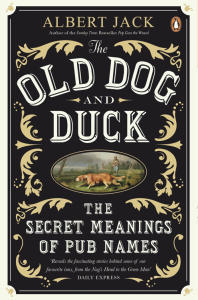
The Old Dog and Duck: The Secret Meanings of Pub Names
This is a book for everyone who has ever wondered why pubs should be called The Cross Keys, The Dew Drop Inn or The Hope and Anchor. You'll be glad to know that there are very good - strange and memorable - reasons behind them all. After much research about (and in) pubs, Albert Jack brings together the stories behind pub names to reveal how they offer fascinating and subversive insights on our history, customs, attitudes and jokes in just the same way that nursery rhymes do. The Royal Oak, for instance, commemorates the tree that hid Charles II from Cromwell's forces after his defeat at Worcester; The Bag of Nails is a corruption of the Bacchanals, the crazed followers of Bacchus, the god of wine and drunkenness; The Cat and the Fiddle a mangling of Catherine La Fidele and a guarded gesture of support for Henry VIII's first, Catholic, wife Catherine of Aragon; plus many, many more. Here too are even more facts about everything from ghosts to drinking songs to the rules of cribbage and shove ha'penny, showing that, ultimately, the story of pub history is really the story of our own popular history.
300 pages, Hardcover
First published September 3, 2009
About the author
Albert Jack
96 books38 followersAlbert Jack, pen name for Graham Willmott, is an international best-selling author and historian. He is an expert in explaining the unexplained and has appeared on live television shows and has made thousands of radio appearances worldwide.
Ratings & Reviews
Friends & Following
Create a free account to discover what your friends think of this book!
Community Reviews
Displaying 1 - 14 of 14 reviews

November 28, 2013
From the description: This is a book for everyone who has ever wondered why pubs should be called The Cross Keys, The Dew Drop Inn or The Hope and Anchor. You'll be glad to know that there are very good - strange and memorable - reasons behind them all.
After much research about (and in) pubs, Albert Jack brings together the stories behind pub names to reveal how they offer fascinating and subversive insights on our history, customs, attitudes and jokes in just the same way that nursery rhymes do. The Royal Oak, for instance, commemorates the tree that hid Charles II from Cromwell's forces after his defeat at Worcester; The Bag of Nails is a corruption of the Bacchanals, the crazed followers of Bacchus, the god of wine and drunkenness; The Cat and the Fiddle a mangling of Catherine La Fidele and a guarded gesture of support for Henry VIII's first, Catholic, wife Catherine of Aragon; plus many, many more.
Here too are even more facts about everything from ghosts to drinking songs to the rules of cribbage and shove ha'penny, showing that, ultimately, the story of pub history is really the story of our own popular history.
Alphabetically listed, here is an example of the goods:
The Alma: THE WAR TO NAME ALL PUBS: There are many inns around Britain bearing this name, or a variation of it. The Battle of Alma, Heroes of Alma, Heights of Alma and the Alma Arms are just a few examples. The Alma is the name of the major river running through the area of the Ukraine formerly known as the Crimea. On 20 September 1854 it became the scene of the first key battle of the Crimean War, fought by the British and her European allies against the Russians over lands once occupied by the declining Ottoman Empire.
 Definitely one to keep on the e-reader when out and about in UK. Wouldn't it be fun to make a holiday just ticking off the names. haha.
May 16, 2021
This was an interesting and quirky read as Albert delved into the historical meanings of those familiar (and some less familiar) pub names.
It's probably not a book to read in one sitting, but more useful as a fun reference guide, with the names listed alphabetically.
My wife and I used it as our bedtime reading book, reading aloud 3 or 4 pub name descriptions each night over a period of a few months.
There's many quirky historical facts to be found, and a few myths and legends too surrounding various inns' nomenclature.
It's certainly a great reference for anyone who loves pubs and their history - Albert has done some excellent research here and come up with something that's intriguing and original.
It's probably not a book to read in one sitting, but more useful as a fun reference guide, with the names listed alphabetically.
My wife and I used it as our bedtime reading book, reading aloud 3 or 4 pub name descriptions each night over a period of a few months.
There's many quirky historical facts to be found, and a few myths and legends too surrounding various inns' nomenclature.
It's certainly a great reference for anyone who loves pubs and their history - Albert has done some excellent research here and come up with something that's intriguing and original.

September 9, 2019
I love the history of the pub names, the "method to madness" of sorts.

October 31, 2020
Perfectly good coffee table trivia book. Nice clear style and some delicate humour. It’s a good general book to learn a bit of local history.

August 16, 2023
Pub names in the UK are always fascinating, especially when they are unusual ones. As this book shows, they all have some kind of historical context. It's not simply a case of naming a pub after a random person or thing, there are a lot of hidden meanings. A lot of the pub names seem to have some significance to the Royals, and others are named after racehorses (there is a short section on this).
Other fascinating pub name origins included The Red Herring, named after the practice of hunt saboteurs to drag a fish behind them to put the hunting hounds off the scent, and the story behind The Drunken Duck, which involved a duck being plucked while it was still alive.
This didn't feel like a book that most people would sit and work their way through, but I decided to anyway. I could tell the author had researched it painstakingly, although at times it felt like a list of facts. There were a couple asides from the author about his own thoughts, and I wished there had been more of these.
Other fascinating pub name origins included The Red Herring, named after the practice of hunt saboteurs to drag a fish behind them to put the hunting hounds off the scent, and the story behind The Drunken Duck, which involved a duck being plucked while it was still alive.
This didn't feel like a book that most people would sit and work their way through, but I decided to anyway. I could tell the author had researched it painstakingly, although at times it felt like a list of facts. There were a couple asides from the author about his own thoughts, and I wished there had been more of these.
June 6, 2026
This is a cheesy but nonetheless informative book about pub names. Why cheesy? Because Albert Jack adopts a conversational tone and loves to indulge in "common sense" and cheeky rationales for pub names and for the behavior of historical figures that often inspired them. Speaking of history, if you are not interested in Wellington, Nelson, Palmerston, Kitchener, Mother Shipton, etc., you will have a lot to skip over here! The entries are organized alphabetically by pub name, with the exception of a brief final section on pubs named after race horses. My favorite take-away concerns "Chequers," which is not only a pub name but also refers to an aristocratic home, a tree, a method of flavoring beer, and the game, of course. I will also say that Jack's synthesis of the "Green Man" legend is one of the most complete and satisfying that I have encountered.

February 7, 2020
Only pen and ink pictures, no words??
I bought. Kindle version of this book but all it is is a selection of pen and ink drawings of pub signs. Where's the information??!
I bought. Kindle version of this book but all it is is a selection of pen and ink drawings of pub signs. Where's the information??!

March 21, 2023
discursive historical notes on pub names - occasionallyamusing, and/or revelatory
March 3, 2024
Interesting, informative and well researched - this book reveals some truly fascinating stories behind the origins of some of our favourite watering holes. 3⭐️

July 2, 2024
A good read about how english pubs derived their name - a good history lesson !

July 5, 2026
A fun book full of interesting facts I then instantly forgot.

January 20, 2013
I'm eternally curious about names, and this book didn't fail to inform me about a good few. On the other hand, there were times when I thought the author was trying too hard to be funny and political in one go, and falling rather flat. Definitely a book to drop in and out of, although I'm not enthusiastic enough to search out my own copy after returning the one I borrowed from the library.

July 12, 2016
A quirky book that combines history, biographies and toughness with etymology and geography, I learned so much by reading "The Old Dog and Duck" and now I can't help but question pub name origins whenever I come across a pub!
Read
June 28, 2014An interesting & funny way to learn about a bit of English history & improve my chances in a pub quiz
Displaying 1 - 14 of 14 reviews