

What do you think?
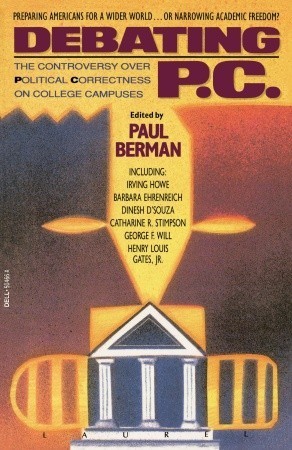
Debating P.C.: The Controversy over Political Correctness on College Campuses
The debate over "P.C." at America's universities is the most important discussion in American education today and has grown into a major national controversy raging on the covers of our top magazines and news shows. This provocative anthology gives voice to the top thinkers of our time, liberal and conservative, as they tackle the question. From the multicultural perspective of Henry Louis Gates, Jr., who argues passionately for more diversity, to the erudition of Irving Howe, who stresses the profound value of the literary canon, this exciting collection is required reading for thinking Americans . . . and for everyone concerned with the future of higher education and the shaping of young minds.
Contents
“The Big Chill? Interview with Dinesh D’Souza” by Robert MacNeil
“On Modern Language Association Presidential Address 1990” by Catharine R. Stimpson
“The Periphery v. the The MLA in Chicago” by Roger Kimball
“The Storm over the University” by John Searle
“Public Imaged Political Correctness and the Media’s Big Lie” by Michael Berubé
“The Value of the Canon” by Irving Howe
“The Politics of Knowledge” by Edward W. Said
“Whose Canon Is It, Anyway?” by Henry Louis Gates, Jr.
“Why Do We Read?” by Katha Pollitt
“’Speech Codes’ on the Campus and Problems of Free Speech” by Nat Hentoff
“Freedom of Hate Speech” by Richard Perry and Patricia Williams
“There’s No Such Thing as Free Speech and It’s a Good Thing, Too” by Stanley Fish
“The Statement of the Black Faculty Caucus” by Ted Gordon and Wahneema Lubiano
“Radical English” by George F. Will
“Critics of Attempts to Democratize the Curriculum Are Waging a Campaign to Misrepresent the Work of Responsible Professors” by Paula Rothenberg
“ E Pluribus Plures” by Diane Ravitch
“ An Exchange” by Molefi Kete Asante
“The Prospect Before Us” by Hilton Kramer
“P.C. Rider” by Enrique Fernández
“Diverse New World” by Cornel West
“The Challenge for the Left” by Barbara Ehrenreich
Contents
“The Big Chill? Interview with Dinesh D’Souza” by Robert MacNeil
“On Modern Language Association Presidential Address 1990” by Catharine R. Stimpson
“The Periphery v. the The MLA in Chicago” by Roger Kimball
“The Storm over the University” by John Searle
“Public Imaged Political Correctness and the Media’s Big Lie” by Michael Berubé
“The Value of the Canon” by Irving Howe
“The Politics of Knowledge” by Edward W. Said
“Whose Canon Is It, Anyway?” by Henry Louis Gates, Jr.
“Why Do We Read?” by Katha Pollitt
“’Speech Codes’ on the Campus and Problems of Free Speech” by Nat Hentoff
“Freedom of Hate Speech” by Richard Perry and Patricia Williams
“There’s No Such Thing as Free Speech and It’s a Good Thing, Too” by Stanley Fish
“The Statement of the Black Faculty Caucus” by Ted Gordon and Wahneema Lubiano
“Radical English” by George F. Will
“Critics of Attempts to Democratize the Curriculum Are Waging a Campaign to Misrepresent the Work of Responsible Professors” by Paula Rothenberg
“ E Pluribus Plures” by Diane Ravitch
“ An Exchange” by Molefi Kete Asante
“The Prospect Before Us” by Hilton Kramer
“P.C. Rider” by Enrique Fernández
“Diverse New World” by Cornel West
“The Challenge for the Left” by Barbara Ehrenreich
356 pages, Paperback
First published January 1, 1992
About the author
Paul Berman
84 books63 followersPaul Lawrence Berman is an American author and journalist who writes on politics and literature. His articles have been published in The New Republic, The New York Times Book Review and Slate, and he is the author of several books, including A Tale of Two Utopias and Terror and Liberalism.
Berman received his undergraduate education from Columbia University, from which he graduated in 1971 with a BA and MA in American history. He has reported on Nicaragua's civil wars, Mexico's elections, and the Czech Republic's Velvet Revolution. Currently he is a senior fellow at the World Policy Institute, a professor of journalism and distinguished writer in residence at New York University, and a member of the editorial board of Dissent. Berman's influence has seen him described as a 'Philosopher King' of the liberal hawks."
http://en.wikipedia.org/wiki/Paul_Berman
"Paul Berman is a writer on politics and literature whose articles and reviews have appeared in The New York Times, the New Republic (where he is a contributing editor), the New Yorker, Slate, the Village Voice, Dissent, and various other American, European and Latin American journals. He has reported at length from Europe and Latin America. He has written or edited eight books, including, most recently, Power and the Idealists: Or, the Passion of Joschka Fischer and Its Aftermath, with a new preface by Richard Holbrooke for the 2007 paperback edition; Carl Sandburg: Selected Poems, edited with an introduction, published in 2006 by the American Poets Project of the Library of America; and Terror and Liberalism, a New York Times best-seller in 2003. His writings have been translated into fifteen languages. Berman received a B.A. and M.A. in American History from Columbia University and has been awarded a MacArthur, a Guggenheim, the Bosch Berlin Prize, a fellowship at the New York Public Library’s Center for Writers & Scholars, and other honors.
Berman received his undergraduate education from Columbia University, from which he graduated in 1971 with a BA and MA in American history. He has reported on Nicaragua's civil wars, Mexico's elections, and the Czech Republic's Velvet Revolution. Currently he is a senior fellow at the World Policy Institute, a professor of journalism and distinguished writer in residence at New York University, and a member of the editorial board of Dissent. Berman's influence has seen him described as a 'Philosopher King' of the liberal hawks."
http://en.wikipedia.org/wiki/Paul_Berman
"Paul Berman is a writer on politics and literature whose articles and reviews have appeared in The New York Times, the New Republic (where he is a contributing editor), the New Yorker, Slate, the Village Voice, Dissent, and various other American, European and Latin American journals. He has reported at length from Europe and Latin America. He has written or edited eight books, including, most recently, Power and the Idealists: Or, the Passion of Joschka Fischer and Its Aftermath, with a new preface by Richard Holbrooke for the 2007 paperback edition; Carl Sandburg: Selected Poems, edited with an introduction, published in 2006 by the American Poets Project of the Library of America; and Terror and Liberalism, a New York Times best-seller in 2003. His writings have been translated into fifteen languages. Berman received a B.A. and M.A. in American History from Columbia University and has been awarded a MacArthur, a Guggenheim, the Bosch Berlin Prize, a fellowship at the New York Public Library’s Center for Writers & Scholars, and other honors.
Ratings & Reviews
Friends & Following
Create a free account to discover what your friends think of this book!
Community Reviews
Displaying 1 - 3 of 3 reviews

February 6, 2026
The essays in this book take us back to 1990 when one of the hot debates on campus and elsewhere was between the defenders of the Western canon of great books and those who wanted to either replace it or to open it to a multicultural collection of writers, recognizing that the canon was mostly a collection of dead white male Europeans. This debate continues to this day. Another concern taken up in these essays is the tension between free speech and regulation of harmful speech. Is freedom of speech more important than making all of the different cultures that make up the campus community safe and secure? Is a supportive community more important than a right to say whatever you like? But then, even if one acknowledged there are limits, where should they be drawn? Reading through these essays I was struck by just how relevant they are to our current moment on campus under Trump. Donald Trump's spearheading of an attack on academia is largely based on the same concerns about tradition and tolerance that were coming to a head back in the 1990s. We have some really good debaters in this collection. Writers like Dinesh D'Souza, Edward Said, Irving Howe, George Will, Henry Louis Gates, Jr., Catharine Stimpson, Nat Hentoff, Stanley Fish, run the gamut of political commitments and Paul Berman, once of Village Voice fame, has done a great job in collecting these essays. I think anyone who happens to pick up this collection will find it as relevant in 2025 as it was in 1990, perhaps more relevant as we have a better perspective on the issues due to the time between 1990 and now.
One of the exchanges in this collection is between George Will and Paula Rothenberg. UT-Austin had attempted to revise its Freshmen composition course to make all instructors use and students read a book focused on sexism and racism. The outcry at this proposed change led to the book being dropped. Will's main criticism of this is that the book was more of an indoctrination into a leftist viewpoint of America than it was a book helpful for the teaching of composition.
Will in a short three-page essay suggests that the campuses of America are home to all the leftist radicals coming out of the late-sixties, people who would like to wage the revolution in classrooms to take down the status quo. Paula's anthology was for Will an example of how this sort of activism on campus was ruining education.
Paula's reply in a five-page rejoinder is that those who attack her anthology are unfair. In the first part of her essay, she establishes her positioning as one who had watched the McCarthy hearings on TV as a child and so she is appalled that now she is being associated with what is being called a new McCarthyism on the left. She says her book is not a primer of politically correct thought, as critics charged, but rather "an interdisciplinary text designed to allow students and teachers to examine the comprehensive and interconnected nature of racism, sexism, and class privilege within the United States." She doesn't even seem to realize that her own description of her book absolutely aligns with Will criticism. Although she says that her book it to "allow students" to "examine" various texts; it is pretty clear that her goal is for them to see the United States as she does, burdened with comprehensive and interconnected racism and sexism. Even then she seems oblivious to the fact that her political goals shouldn't take the place of students learning to write. She goes on to characterize the opposition as trying to "silence" anyone not among the approved writers of the status quo. "The traditional curriculum teaches all of us [no longer using "allow" here] to see the world through the eyes of privileged, white, European males and to adopt their interests and perspectives as our own." Apparently students are no longer examining texts with their own critical minds but likely being brainwashed by the traditional curriculum, while using her book in its place would not lead to that end. Anyway, in a long-winded way, she does make at least one good point, I would say, and that it is a good thing for students to read from various sources, which would allow them to perceive that there are different ways to see the world. What irks me is that she has no sense that her role is to present the spectrum, not to drive students towards one side or the other in the various issues that are being debated. Probably the only required textbook in a composition course should not be one from such a singular point of view.
One of the exchanges in this collection is between George Will and Paula Rothenberg. UT-Austin had attempted to revise its Freshmen composition course to make all instructors use and students read a book focused on sexism and racism. The outcry at this proposed change led to the book being dropped. Will's main criticism of this is that the book was more of an indoctrination into a leftist viewpoint of America than it was a book helpful for the teaching of composition.
Will in a short three-page essay suggests that the campuses of America are home to all the leftist radicals coming out of the late-sixties, people who would like to wage the revolution in classrooms to take down the status quo. Paula's anthology was for Will an example of how this sort of activism on campus was ruining education.
Paula's reply in a five-page rejoinder is that those who attack her anthology are unfair. In the first part of her essay, she establishes her positioning as one who had watched the McCarthy hearings on TV as a child and so she is appalled that now she is being associated with what is being called a new McCarthyism on the left. She says her book is not a primer of politically correct thought, as critics charged, but rather "an interdisciplinary text designed to allow students and teachers to examine the comprehensive and interconnected nature of racism, sexism, and class privilege within the United States." She doesn't even seem to realize that her own description of her book absolutely aligns with Will criticism. Although she says that her book it to "allow students" to "examine" various texts; it is pretty clear that her goal is for them to see the United States as she does, burdened with comprehensive and interconnected racism and sexism. Even then she seems oblivious to the fact that her political goals shouldn't take the place of students learning to write. She goes on to characterize the opposition as trying to "silence" anyone not among the approved writers of the status quo. "The traditional curriculum teaches all of us [no longer using "allow" here] to see the world through the eyes of privileged, white, European males and to adopt their interests and perspectives as our own." Apparently students are no longer examining texts with their own critical minds but likely being brainwashed by the traditional curriculum, while using her book in its place would not lead to that end. Anyway, in a long-winded way, she does make at least one good point, I would say, and that it is a good thing for students to read from various sources, which would allow them to perceive that there are different ways to see the world. What irks me is that she has no sense that her role is to present the spectrum, not to drive students towards one side or the other in the various issues that are being debated. Probably the only required textbook in a composition course should not be one from such a singular point of view.
February 9, 2008
This was big stuff 15 years ago, now, it's pretty tired, though you still occasionally find right-wingers flogging some version of the "Tenured Radicals are Eating Kids' Brains with Political Correctness" arguments or stories. Nonetheless, if you like reading sociological essays on universities (and I do, I'm a nerd & that's where I work/live) it's a nice set of essays.

April 12, 2022
An interesting set of essays about campus "PC" culture that was written in 1991. It is amazing how much this is still relevant and debated today. The issues are similar, but the relatively new issues of the day now seem to be settled and "uncontroversial" among most of the faculty at universities.
Displaying 1 - 3 of 3 reviews