

What do you think?

Dark Heart
'This all began quite unexpectedly one rainy autumn evening a couple of years ago in a fairground near to the centre of Nottingham...'
In amongst the bright lights and bumper cars, Nick Davies noticed two boys, no more than twelve years old, oddly detached from the fun of the scene. Davies discovered they were part of a network of children selling themselves on the streets of the city, running a nightly gauntlet of dangers: pimps, punters, the Vice Squad, disease, drugs. This propelled Davies into a journey of discovery through the slums and ghettoes of our cities. He found himself in crack houses and brothels, he befriended street gangs and drug dealers.
Davies' journey into the hidden realm is powerful, disturbing and impressive, and is bound to rouse controversy and demands for change. He unravels threads of Britain`s social fabric as he travels deeper and deeper into the country of poverty, towards the dark heart of British society.
In amongst the bright lights and bumper cars, Nick Davies noticed two boys, no more than twelve years old, oddly detached from the fun of the scene. Davies discovered they were part of a network of children selling themselves on the streets of the city, running a nightly gauntlet of dangers: pimps, punters, the Vice Squad, disease, drugs. This propelled Davies into a journey of discovery through the slums and ghettoes of our cities. He found himself in crack houses and brothels, he befriended street gangs and drug dealers.
Davies' journey into the hidden realm is powerful, disturbing and impressive, and is bound to rouse controversy and demands for change. He unravels threads of Britain`s social fabric as he travels deeper and deeper into the country of poverty, towards the dark heart of British society.
320 pages, Paperback
First published January 1, 1997
Ratings & Reviews
Friends & Following
Create a free account to discover what your friends think of this book!
Community Reviews
Displaying 1 - 22 of 22 reviews

March 9, 2013
Whoso stoppeth his ears at the cry of the poor, he also shall cry himself, but shall not be heard.
Proverbs 21
Reading this book will give you a taste for black humour – you know, for instance, what happens when you play a country song backwards? (You get your dog back and your wife back and I guess your mother rises from her grave too. What happens when you play a death metal song backwards is that it sounds better. )
This is investigative journalism about the English underclass written in the late 1990s. My jaw dropped as I read the first pages, which describe child prostitution (rent boys of 11 and 13) plying their trade ten minutes’ walk from my house! Yes, the first chapter is all about Nottingham.
Have things improved since 1998? For the people in this book, probably not. (And check out what's happening in Detroit!)
The underclass, then. The people of the abyss, as Jack London called them. Hey, Jack - it's the 21st century and they're still here! What do you think of that? I’ve read the academic studies (okay, one!) and I’ve read Theodore Dalrymple’s great essays on the subject , but this is the up close and revolting version.
NOTHING REMOTELY CHEERFUL FROM HERE ON IN
This cruel country has driven me down
Teased me and lied, teased me and lied
I've only sad stories to tell to this town
My dreams have withered and died
Richard Thompson
There’s a lurid case hitting the headlines here in the UK at the moment. Six children were burned to death in a house fire. These kids:
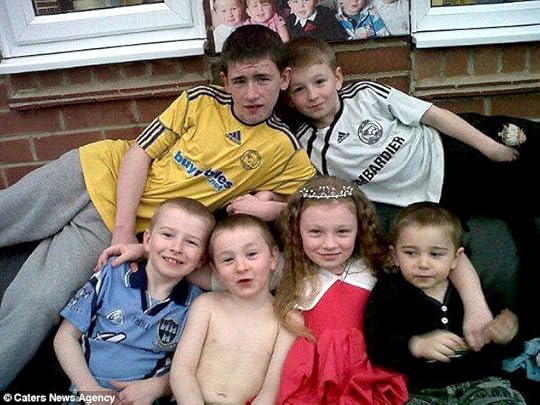
The story behind that grisly fact is pure underclass. A guy was living with his wife, with whom he had six children, and his girlfriend, with whom he had five more. They were all in the same house. The girlfriend got fed up of this ménage and moved out. The police say he then set fire to his own house one night. The idea was that he would rescue the kids and then tell the cops that the girlfriend had set fire to the house. The motive was revenge on the girlfriend for leaving and the hope that the council would give the family a bigger house. But the plan failed because the fire spread too quickly and he couldn’t get back into the house.
It turns out this guy was previously on the notorious Jeremy Kyle Show (UK version of Jerry Springer) the defending his lifestyle .
Well, every now and then a spectacularly horrible story like this emerges from the underclass. There are several I remember well but I’ll spare you all any more.
Nick Davies, the reporter who boldly went into the roughest areas and spoke to the kids who were twocking three or four cars a day (twocking = Taking Without Consent) and who committed dozens of burglaries every month describes in stultifying detail the physical, moral and spiritual degradation of the underclass. He thinks it’s grown alarmingly and he sees the main cause as simple but intractable. No jobs. No jobs means no money, no money means genuine poverty, absolute poverty not the relative poverty the politicians will talk about. He is saying that roughly a quarter (this amazed me) of the population live in actual poverty. The other three quarters cheerfully deny that such a thing exists. The poor are invisible, until they commit their vile crimes.
There are vast gulfs between the ways the poor are perceived. The ranting you hear on any political show or in any internet message board will have you believe that a life on state benefits is a life of government-bankrolled indolence. The public does not believe these people are poor. They also don’t believe there aren’t any jobs. Look at all the Poles and Lithuanians coming over and getting work! They will say.
And Theodore Dalrymple, a creature of the right, is eloquent on this very point. In his view, decades of the welfare state has rotted people's sense of personal responsibility :
The legions of helpers and carers, social workers and therapists, whose incomes and careers depend crucially on the supposed incapacity of large numbers of people to fend for themselves and behave responsibly. …their entire therapeutic worldview of the patient as the passive, helpless victim of illness legitimises the very behaviour from which they are there to redeem him from. … ...the idea has become entrenched that if one does not know or understand the unconscious motives for one's acts, one is not truly responsible for them.
Contrast that with Nick Davies’ description of the inner city area of Leeds which he makes a special study of :
Gaps had opened up in the fabric of daily life. To fill them, the team from the County Council reported that Hyde Park needed more play schemes, an organised baby sitting service, more full time nurseries, more school clubs, more after-school clubs, more weekend clubs, local services for drug addicts, more social workers, training for parents, more outreach workers for young people, more playing fields, more youth clubs, more home-care help, more and cheaper public transport , more doctors, a health care service on Saturdays, more homes, more repairs to homes, more security in homes, more cooking facilities, more laundry facilities, more damp-proofing and heating, roofs without leaks, doors without draughts, more police, more streetlights, more college places, more college funding, more courses in office skills and English language, more traffic control and road safety measures, a clean-up campaign, more special needs teachers, more cashpoints, a local supermarket, more street cleaning, more library books, a community centre, a council gardener, a nice pub with a garden, more money and above all else more jobs.
Whoever is right, it still appears that the underclass are surplus population. They can’t find their way into society, except to prise open our sociable windows and rob us if they get half a chance. The work they could do, and did, in the past, is no longer done in the UK, it’s all been exported. Their time is taken up making themselves and each other miserable. This book makes crystal clear that there is a direct correlation between poverty and child abuse (physical and sexual), whatever the don't-stigmatise-the-poor rhetoric will tell you. So really, what chance have they got?
However, since describing 25% of the population as surplus sounds like something Heinrich Himmler would say, I’ll take that back. I don't know what is to be done. Does anybody?
Now some of the people are poor in the purse
They don't have the cash at the ready
And some of the people they're crippled and lame
They can never stand up true and steady
And some of the people they're poor in the head
Like the simpleton fools that you see
But most of the people they're poor in the heart
It's the worst kind of poor, it's the worst kind of poor you can be
Richard Thompson

September 5, 2013
DEEPLY DISTURBING
Nick Davies book on the underclass in Britain in the mid 90s is a deeply disturbing piece of reporting. Child abuse (physical/emotional/sexual), drugs, riots, crime, harrasment, police brutality are all covered in painfull detail. The account of the woman who lost two of her children in a fire that was started by a candle when her electricity meter had ran out was one of the most upsetting pieces of writing Ive ever read.
The book is a searing inditement of the Thatcher years, of the communities turned upside down in the recession of the early 80s and early 90s. The cuts in social programs relating to benefits (State Pension, 16-18 year old benefits, Unemployment Benefit,etc), public sector housing, the National Health Service and Social Services are painted in stark contrast to the huge cuts in income tax for the wealthy.
The "Trickle Down Effect" was always the alleged silver lining to this huge cut in taxes for the rich; there are examples in the book - rich businessmen, or in one case an MP, paying to sexually abuse young woman. When scum like Peter Mandelson says he's comfortable with people being "filthy rich" (especially if they will "lend" him the odd quarter million) he is presumably comfortable with the other side of the coin - the world that Nick Davies describes in this heart breaking book.
A valuable piece of reportage that is definetely not easy going, but ought to be required reading.
Nick Davies book on the underclass in Britain in the mid 90s is a deeply disturbing piece of reporting. Child abuse (physical/emotional/sexual), drugs, riots, crime, harrasment, police brutality are all covered in painfull detail. The account of the woman who lost two of her children in a fire that was started by a candle when her electricity meter had ran out was one of the most upsetting pieces of writing Ive ever read.
The book is a searing inditement of the Thatcher years, of the communities turned upside down in the recession of the early 80s and early 90s. The cuts in social programs relating to benefits (State Pension, 16-18 year old benefits, Unemployment Benefit,etc), public sector housing, the National Health Service and Social Services are painted in stark contrast to the huge cuts in income tax for the wealthy.
The "Trickle Down Effect" was always the alleged silver lining to this huge cut in taxes for the rich; there are examples in the book - rich businessmen, or in one case an MP, paying to sexually abuse young woman. When scum like Peter Mandelson says he's comfortable with people being "filthy rich" (especially if they will "lend" him the odd quarter million) he is presumably comfortable with the other side of the coin - the world that Nick Davies describes in this heart breaking book.
A valuable piece of reportage that is definetely not easy going, but ought to be required reading.

June 21, 2019
I picked this up last year as a bit of a punt, in a ramshackle shop in Menai Bridge. I guess I may have been drawn to the author’s name and sensed something charismatic and intelligent about this. I didn’t write the book. If I had, I would have spotted that the cover of the issue I had, misspelled ‘Britain’ as ‘Britian’ :-)
It’s an interesting read, a mostly fair and factual account of numerous individuals caught up in the ‘dark heart’ of poverty in late 20th Century Britain. Without sentimentality, without being patronising, with a clear intent to draw attention to a subculture out of the view of most ordinary folk, this made for a book I admired for its lack of one-eyed bias. It explores poverty, and the link to crime, drugs, prostitution, child abuse, violence and the destruction of community. There are some powerful arguments without the author preaching his POV in an overly emotive manner, and I found sections about Nottingham when I lived there, and Leeds when I used to visit my older brother there, certainly quite frightening in their time/place and my general lack of understanding and awareness of this underlying culture.
But yes, it was slightly frustrating because I wasn’t completely convinced by the author’s socialist leanings/arguments, and it instead left me with more questions than it provided answers. The focus on particularly sad and upsetting human stories led me to wonder about the folks who hadn’t fallen into a life of crime, poverty and drugs, the elements of culture and family which gave some groups a better chance of beating the odds, and the lack of discussion of free will and those who - under admittedly very difficult circumstances - did better than the tragic subjects of many of these stories. What, after all, are the fundamental aims and functions of society?
I don’t know enough about economics, sociology or politics to have the answer myself, I know it’s a complex problem, poverty and crime, but i think here the author examines a lot of thought-provoking areas and deserves a lot of credit. I would be interested to see if there are differences twenty years down the line in the UK, whether some things are better, some things are worse, what is working.
It’s an interesting read, a mostly fair and factual account of numerous individuals caught up in the ‘dark heart’ of poverty in late 20th Century Britain. Without sentimentality, without being patronising, with a clear intent to draw attention to a subculture out of the view of most ordinary folk, this made for a book I admired for its lack of one-eyed bias. It explores poverty, and the link to crime, drugs, prostitution, child abuse, violence and the destruction of community. There are some powerful arguments without the author preaching his POV in an overly emotive manner, and I found sections about Nottingham when I lived there, and Leeds when I used to visit my older brother there, certainly quite frightening in their time/place and my general lack of understanding and awareness of this underlying culture.
But yes, it was slightly frustrating because I wasn’t completely convinced by the author’s socialist leanings/arguments, and it instead left me with more questions than it provided answers. The focus on particularly sad and upsetting human stories led me to wonder about the folks who hadn’t fallen into a life of crime, poverty and drugs, the elements of culture and family which gave some groups a better chance of beating the odds, and the lack of discussion of free will and those who - under admittedly very difficult circumstances - did better than the tragic subjects of many of these stories. What, after all, are the fundamental aims and functions of society?
I don’t know enough about economics, sociology or politics to have the answer myself, I know it’s a complex problem, poverty and crime, but i think here the author examines a lot of thought-provoking areas and deserves a lot of credit. I would be interested to see if there are differences twenty years down the line in the UK, whether some things are better, some things are worse, what is working.

March 8, 2011
An astounding, horrifying and heartbreaking look at the extent and effects of poverty in Britain; 13.7 million people live below the poverty line and yet it's a world that is largely hidden (albeit in plain sight) or ignored as the majority of us go about our daily lives.
Looking fully into the circumstances of, in particular, the child prostitutes of the Forest area of Nottingham and the deprived inhabitants of a crime ridden estate, and looking into the causes of much of the poverty and its associated effects (crime, drugs, prostitution, abuse) and the damage inflicted on communities and people living under its shadow, this is a terrifying look at what is happening to a large section of the country. Horrifyingly, it's a situation that can only get worse as the Government hacks wildly at public spending budgets and welfare.
Essential reading for anyone who wants to know what's going on outside of their front door, and one that should make you angry enough to want answers, and change.
Looking fully into the circumstances of, in particular, the child prostitutes of the Forest area of Nottingham and the deprived inhabitants of a crime ridden estate, and looking into the causes of much of the poverty and its associated effects (crime, drugs, prostitution, abuse) and the damage inflicted on communities and people living under its shadow, this is a terrifying look at what is happening to a large section of the country. Horrifyingly, it's a situation that can only get worse as the Government hacks wildly at public spending budgets and welfare.
Essential reading for anyone who wants to know what's going on outside of their front door, and one that should make you angry enough to want answers, and change.

July 23, 2020
Nick Davies - Dark Heart
Dark Heart should be a required reading. It describes the tales of the poorest and destitute of Britain, the hidden Britain. Showing how they face the same struggles, again and again, across the country. It begins with the boys in the forest, Jamie and Luke, who have fallen into prostitution and drugs, pushed into the care systems by broken families. This is the magic, of Davies journalistic piece, he describes first a case, and then he slowly breaks it down, analysing what are the factors that led to this tragic state affairs. With each case we learn something new and our understanding broadens about the state and factors of poverty in Britain. He shows that when benefits are cut till they barely keep people alive and job opportunities are low, it opens the floodgates of crime, drugs, and desperation.
In the end of the book, Davies asks what are the reasons for such spikes in poverty and crime. He concludes that years of government cuts to public services, to the welfare state, and education are to blame. Davies also goes on to say that after many of these cuts to welfare state were made, the richest of the country were given tax cuts, allowing for the rich to grow richer and the poor to grow poorer. He then asks what could allow for such cuts being made? It is because the poorest of this country are seen but as objects to be used, firstly by the rich, and then resultantly by themselves. They lack any hope to rise from this pit that they have thrown in to. They have been reduced simply to an economic burden, for whom there aren’t enough jobs. This growing lack of humanity, or ‘Dark Heart’ as Davies calls it is, is the sole factor that allows human lives to be reduced to statistics and spreadsheets. It allows for ideas that were once on the fringe of the political spectrum to become government policy.
**Note: this is my first writing a review in a long time, and I’ve never been particularly good at writing, so this review doesn’t really convey how great this book is, however if you all want to know anything about poverty in Britain I would recommend you start here***
Dark Heart should be a required reading. It describes the tales of the poorest and destitute of Britain, the hidden Britain. Showing how they face the same struggles, again and again, across the country. It begins with the boys in the forest, Jamie and Luke, who have fallen into prostitution and drugs, pushed into the care systems by broken families. This is the magic, of Davies journalistic piece, he describes first a case, and then he slowly breaks it down, analysing what are the factors that led to this tragic state affairs. With each case we learn something new and our understanding broadens about the state and factors of poverty in Britain. He shows that when benefits are cut till they barely keep people alive and job opportunities are low, it opens the floodgates of crime, drugs, and desperation.
In the end of the book, Davies asks what are the reasons for such spikes in poverty and crime. He concludes that years of government cuts to public services, to the welfare state, and education are to blame. Davies also goes on to say that after many of these cuts to welfare state were made, the richest of the country were given tax cuts, allowing for the rich to grow richer and the poor to grow poorer. He then asks what could allow for such cuts being made? It is because the poorest of this country are seen but as objects to be used, firstly by the rich, and then resultantly by themselves. They lack any hope to rise from this pit that they have thrown in to. They have been reduced simply to an economic burden, for whom there aren’t enough jobs. This growing lack of humanity, or ‘Dark Heart’ as Davies calls it is, is the sole factor that allows human lives to be reduced to statistics and spreadsheets. It allows for ideas that were once on the fringe of the political spectrum to become government policy.
**Note: this is my first writing a review in a long time, and I’ve never been particularly good at writing, so this review doesn’t really convey how great this book is, however if you all want to know anything about poverty in Britain I would recommend you start here***

September 7, 2011
What a wake up call. A truly exceptional piece of journalism detaling the poverty, violence and sex and drug trades of Britain. Made me both weep and be truly thankful for how lucky I am with my upbringing. Read this and re-evaluate. I'd love to give a copy to David Cameron.

February 19, 2017
I wish that his line of work would be taken up in earnest in modern day Britain. Years and years of austerity and relentless neoliberal policies with tax cuts and cuts in benefits - how does the underclass fare now?

May 29, 2016
Read this years ago. Outstanding bit of journalism. Have to dig it out and reread it now I've been reminded about it. Sort of thing you wouldn't be allowed to make a documentary about now because the chaps at the BBC are too worried about their pensions...

May 23, 2016
3.5 stars
A revealing look at the causes and effects of poverty in the UK.
A revealing look at the causes and effects of poverty in the UK.
November 16, 2025
In Britain today, it’s hard for most of us to believe that true poverty exists. We all know somebody on benefits or have a family member on low income. We may even have suffered periods of unemployment ourselves. So, it’s easy to judge and think that lack of wealth doesn’t always lead to ill health, child neglect, depression and crime – because in our experience it doesn’t. However, what Nick Davies illustrates over and over again is that there are chasms of poverty in this country that are so deep that escaping them is not just beyond their residents’ reach, but they don’t even know that another way of life exists. Our “normal” way of life is as invisible to them as their deprivation is to us.
For this reason it is rare to find an inside perspective. Those who are experiencing it are not in a position to write about it, to believe that anyone will listen or to even think it is worthy of comment. However, Nick Davies investigates with a rare combination of passion and compassion, giving a voice to those that are typically not heard. He unearths these poverty-ravished areas of Britain, and how they evolved. In a society that values private venture over community, and fails to review the effects of decades’ of cutbacks and neglect by Government, it becomes clear that the first to lose out are those that need help the most. As the author says, “It is the replacement of human values by economic ones, the commercialisation of human relations”.
Dark Heart takes us deep into this undiscovered country – a version of 1990s Britain where families, teens and even very young children are sucked into a world of crime, addiction, abuse and, too many times, death. The book reads as a haunting reflection of Engels’ “Condition of the Working Class in England in 1844”. Comparisons go beyond the metaphorical with direct likenesses such as the transient nature of employment; dangerously substandard housing; child mortality; disease; infestation; the fragility of family, security and a roof over your head; and society’s blindness to those suffering the most. Like Engels, Davies avoids sensationalising by skilfully laying bare only the facts.
I will refrain from adding my opinion on how things have or haven’t changed in the thirty years since publication, but I would love to read a sequel. I wonder if Nick Davies would feel as safe investigating these areas today?
A quote by Robert McCrum of the Observer suggests a copy should be sent to every Labour MP. I think Dark Heart should be read by everyone who wants to inform their opinion on the true nature of poverty and what we need to do about it.
For this reason it is rare to find an inside perspective. Those who are experiencing it are not in a position to write about it, to believe that anyone will listen or to even think it is worthy of comment. However, Nick Davies investigates with a rare combination of passion and compassion, giving a voice to those that are typically not heard. He unearths these poverty-ravished areas of Britain, and how they evolved. In a society that values private venture over community, and fails to review the effects of decades’ of cutbacks and neglect by Government, it becomes clear that the first to lose out are those that need help the most. As the author says, “It is the replacement of human values by economic ones, the commercialisation of human relations”.
Dark Heart takes us deep into this undiscovered country – a version of 1990s Britain where families, teens and even very young children are sucked into a world of crime, addiction, abuse and, too many times, death. The book reads as a haunting reflection of Engels’ “Condition of the Working Class in England in 1844”. Comparisons go beyond the metaphorical with direct likenesses such as the transient nature of employment; dangerously substandard housing; child mortality; disease; infestation; the fragility of family, security and a roof over your head; and society’s blindness to those suffering the most. Like Engels, Davies avoids sensationalising by skilfully laying bare only the facts.
I will refrain from adding my opinion on how things have or haven’t changed in the thirty years since publication, but I would love to read a sequel. I wonder if Nick Davies would feel as safe investigating these areas today?
A quote by Robert McCrum of the Observer suggests a copy should be sent to every Labour MP. I think Dark Heart should be read by everyone who wants to inform their opinion on the true nature of poverty and what we need to do about it.
May 29, 2023
5 stars is not enough for this book, definitely deserves more for the research and compelling writing alone. I've never read a book which made me feel so hopeless before, and yet it was worth persevering to the end. It gives voice to those experiencing economic disadvantage and social disenfranchisement, shames those exploiting and terrorising people and examines how social and economic policies have brought this about. I felt as though I was reading a Jack London expose, but it was dates from 1997. What would the 'undiscovered country' look like now, with cost of living crisis thrown in as well? Intriguing the book highlights spiritual damage as one of the results of ongoing economic disadvantage, and should come with a warning as it will change you spiritually - you will come out the other side after reading it mourning, grieving, heart broken and determined to un-do the damage created by heartless economic and social policies which have robbed the poor to pay the rich, deeming people economically worthless and redundant. We have stopped thinking of humanity in human terms and need to begin again.
"People have become objects....people have had the humanity squeezed out of them... poverty is bad for people."
"In the new world without equality, the new wealth of the rich was paid for entirely by the new poverty of the poor"
"Spiritual damage. It runs deep and into unexpected places....which saw everyone treating everyone they came across as though they were mere objects....No friendship. No trust. No care. Not for anyone and not for themselves...many of the affluent, too, have come to look upon the poor as mere objects..."
"A mainstream society that is losing its humanity is willing to create a poor country in its own image, but the destruction which sweeps through this undiscovered country then causes a new cycle of damage to the affluent"
"People have become objects....people have had the humanity squeezed out of them... poverty is bad for people."
"In the new world without equality, the new wealth of the rich was paid for entirely by the new poverty of the poor"
"Spiritual damage. It runs deep and into unexpected places....which saw everyone treating everyone they came across as though they were mere objects....No friendship. No trust. No care. Not for anyone and not for themselves...many of the affluent, too, have come to look upon the poor as mere objects..."
"A mainstream society that is losing its humanity is willing to create a poor country in its own image, but the destruction which sweeps through this undiscovered country then causes a new cycle of damage to the affluent"

March 20, 2020
I was recommended this book by two ladies who had been in care in Nottingham. Both had sadly ended up in prison at some point in their lives. They said Nick Davies' vivid portrayals of the 'undiscovered world', the poor underclass and the lives of poor children in particular, were accurate. They urged me to read it. I enjoyed the book, but would have liked to know more about the people responsible for the children in care, and the politicians turning a blind eye to the abuse and crime on the council estates.
This book relates to the 90s, most spefically. Nick Davies conducted a lengthy investigation during this period, speaking to residents on council estates, children in prostitution, drug dealers and madams. He pulls you deep into the dark, dangerous criminal underbelly of Britain. These people are real, that's the saddest thing... Threaded through the stories he uncovers the knife tearing at the fabric of society - the politics, the values denying a child's right to love, innocence, a secure home, and state protection - if needed. It's gut wrenching in places. I was glad that he picked up again on Nottingham at the end. For a large chunk of the book is about Leeds, and then links to London vice through the characters lives.
This book relates to the 90s, most spefically. Nick Davies conducted a lengthy investigation during this period, speaking to residents on council estates, children in prostitution, drug dealers and madams. He pulls you deep into the dark, dangerous criminal underbelly of Britain. These people are real, that's the saddest thing... Threaded through the stories he uncovers the knife tearing at the fabric of society - the politics, the values denying a child's right to love, innocence, a secure home, and state protection - if needed. It's gut wrenching in places. I was glad that he picked up again on Nottingham at the end. For a large chunk of the book is about Leeds, and then links to London vice through the characters lives.
June 27, 2018
“The effect of poverty on the health of Britain is the same as a plane crashing and killing 115 passengers every day of every year. Poverty kills with subtlety and skill. This is not the clumsy tyranny of the third world dictator, leaving his subjects in twisted pieces by the roadside. This is clever. Poverty will use the damaged emotions of its victims as a deadly weapon, driving them to suicide and to violence against each other. Poverty will inject its victims with stress and anxiety and take away their sleep and watch their hearts slowly succumb to the poison…Poverty will set up accidents-an easy thing to do in homes with no money to pay for fire guards or stair guards or safety rails or window bars, where the parents cannot afford a nanny or an au pair.”
Although originally published back in 1997, this is one of those books that is still painfully relevant in terms of what it addresses. What Davies has done here is basically a mid-90s update of Orwell’s journalistic investigations into lower working class England, during the 30s, but with an even darker and more disturbing subject matter. At times it can feel like a Martina Cole novel, with some of the graphic and violent encounters, but it’s all too real. To call this book shocking would be a bit of an understatement and yet it’s not really that surprising.
Davies slides into a verboten, subterranean world of guns, drugs, prostitution and murder. He refuses to settle for simple sensationalism, he wanted to dig deeper than that and get into the real issues and root causes of the problem. He ensured he got both sides of these complex problems and explored it as much as he could without over simplifying the seriousness, refusing to take the easier option of scapegoating one element of society. This is why this is such a well-rounded and revealing piece of investigative journalism.
As ever Davies’ research is solid and he really gets deep into his environment, giving us an all too authentic window into some seriously dark and disturbing places, which rarely if ever get fair or balanced reporting from anyone who can be bothered to go and have a look. This is gritty stuff and at times it makes for genuinely uncomfortable reading, but because the majority of the mainstream media never address or tries to understand these places or the people in them, this only adds to the problem, creating fear and fuelling ignorant stereotypes.
“It all flows from this extraordinary idea that we have to give rich people an incentive to work by giving them more money and poor people an incentive to work by taking money away from them.”
This book is packed with many dispiriting and shocking figures and research. According to the Rowntree Foundation, between 1979 and 1992 the highest wages in the UK grew by 50%, those in the middle grew by 35% and those of the lowest paid hardly increased at all. The number of working poor rocketed by 300% between 1979 and the early 90s. By the late 90s, the men, women and children of the poor in Great Britain, amounted to around 14 million, nearly a quarter of the then population.
By the mid-80s Thatcher’s government’s benefit cuts were in full swing, but she was only getting warmed up as she then went onto cut housing benefit again in 1984, in 1985, again in 1986 and yet again in 1987, so that by the end of 1987 a million people had lost their housing benefit, and a further 5.5 million had seen their housing benefit cut. Of course the cuts continued with Major’s rule. Meanwhile the government had sold £47 million worth of council houses. “The government attacked not only the money that was paid directly to the poor in their benefits, but also the money that was paid to them indirectly through services.” Between 1979 and 1995 council house rates rose by 100%, pushing more and more people onto housing benefits, which was being so dramatically cut. By 1987 Thatcher welfare cuts yielded an incredible £12 billion, some was used to pay off public debt, some to fund increased military spending, but most of it, around £8 billion was used to pay for cuts in taxes for the wealthy.
If there is one minor criticism that can be levelled at this book, it would be towards the end, where we get an almost scattergun approach, and for a spell we nearly get snowed under a deluge of names, crimes and information. I can understand why this has been done, but it can get a little distracting as we get this blizzard of detail, where he seems to lose focus, but thankfully it’s only a passing storm and it soon becomes clear again.
As ever with books of this nature, it can often make for deeply uncomfortable reading, this often has the feel of a far-fetched Ballardian dystopia, but for those concerned, it’s all too real. This is the legacy of Thatcherism in Britain, the true face of neo-liberalism for most people. This is the real meaning of the so called, trickle-down effect, the real cost paid for rampant privatisation, continued welfare cuts, the breaking up of community, the increasing isolation, all as a result of decisions made by an elite set from a different world completely removed from most people living elsewhere in the same country. This is a fine read from a fine journalist.
Although originally published back in 1997, this is one of those books that is still painfully relevant in terms of what it addresses. What Davies has done here is basically a mid-90s update of Orwell’s journalistic investigations into lower working class England, during the 30s, but with an even darker and more disturbing subject matter. At times it can feel like a Martina Cole novel, with some of the graphic and violent encounters, but it’s all too real. To call this book shocking would be a bit of an understatement and yet it’s not really that surprising.
Davies slides into a verboten, subterranean world of guns, drugs, prostitution and murder. He refuses to settle for simple sensationalism, he wanted to dig deeper than that and get into the real issues and root causes of the problem. He ensured he got both sides of these complex problems and explored it as much as he could without over simplifying the seriousness, refusing to take the easier option of scapegoating one element of society. This is why this is such a well-rounded and revealing piece of investigative journalism.
As ever Davies’ research is solid and he really gets deep into his environment, giving us an all too authentic window into some seriously dark and disturbing places, which rarely if ever get fair or balanced reporting from anyone who can be bothered to go and have a look. This is gritty stuff and at times it makes for genuinely uncomfortable reading, but because the majority of the mainstream media never address or tries to understand these places or the people in them, this only adds to the problem, creating fear and fuelling ignorant stereotypes.
“It all flows from this extraordinary idea that we have to give rich people an incentive to work by giving them more money and poor people an incentive to work by taking money away from them.”
This book is packed with many dispiriting and shocking figures and research. According to the Rowntree Foundation, between 1979 and 1992 the highest wages in the UK grew by 50%, those in the middle grew by 35% and those of the lowest paid hardly increased at all. The number of working poor rocketed by 300% between 1979 and the early 90s. By the late 90s, the men, women and children of the poor in Great Britain, amounted to around 14 million, nearly a quarter of the then population.
By the mid-80s Thatcher’s government’s benefit cuts were in full swing, but she was only getting warmed up as she then went onto cut housing benefit again in 1984, in 1985, again in 1986 and yet again in 1987, so that by the end of 1987 a million people had lost their housing benefit, and a further 5.5 million had seen their housing benefit cut. Of course the cuts continued with Major’s rule. Meanwhile the government had sold £47 million worth of council houses. “The government attacked not only the money that was paid directly to the poor in their benefits, but also the money that was paid to them indirectly through services.” Between 1979 and 1995 council house rates rose by 100%, pushing more and more people onto housing benefits, which was being so dramatically cut. By 1987 Thatcher welfare cuts yielded an incredible £12 billion, some was used to pay off public debt, some to fund increased military spending, but most of it, around £8 billion was used to pay for cuts in taxes for the wealthy.
If there is one minor criticism that can be levelled at this book, it would be towards the end, where we get an almost scattergun approach, and for a spell we nearly get snowed under a deluge of names, crimes and information. I can understand why this has been done, but it can get a little distracting as we get this blizzard of detail, where he seems to lose focus, but thankfully it’s only a passing storm and it soon becomes clear again.
As ever with books of this nature, it can often make for deeply uncomfortable reading, this often has the feel of a far-fetched Ballardian dystopia, but for those concerned, it’s all too real. This is the legacy of Thatcherism in Britain, the true face of neo-liberalism for most people. This is the real meaning of the so called, trickle-down effect, the real cost paid for rampant privatisation, continued welfare cuts, the breaking up of community, the increasing isolation, all as a result of decisions made by an elite set from a different world completely removed from most people living elsewhere in the same country. This is a fine read from a fine journalist.
July 8, 2018
Shocking!! 😞
December 8, 2021
Read this book if your a Tory Voter - you might just change your life.

February 23, 2025
Rarely has a book hit me so hard. At times it was very difficult to read, but there are poor people out there leading very difficult lives that they have been thrown into, and it’s important that people read books like this to unterstand the situation that successive UK governments have forced them into.

October 26, 2014
This book just blew me away. It should be mandatory reading for every politician, every teacher, every social worker, medical professional and all those who work in the courts, prisons and probation services. in fact, everyone ought to read this book, to allow them to gain a better understanding of poverty and how it creates a hidden country of its own people, so often overlooked or ignored by the rest of society. It explains in great detail how the removal of seemingly arbitrary amenities, leads to adverse problems for some people and sets in motion a domino effect as they slip further down into poverty and all it brings with it.
For many people this will not be an easy read. It forces you to look intently upon those parts of society you allow yourself to become willfully ignorant to: the homeless person begging on the streets, the young girl stood huddled under a streetlight at 11pm, the family of unruly children who never attend school, the estates that you never venture into because you know better.
Dark Heart removes the blinkers from your eyes and takes you on a journey through the parts of Britain you've purposely avoided, revealing the chilling statistics behind every welfare cut and reform, levied on the poor. It's not pleasant, but it is written brilliantly, from a place of empathy, by a journalist who still knows how to do in-depth research into a topic that needs to be discussed. Just read it, you won't regret it.
For many people this will not be an easy read. It forces you to look intently upon those parts of society you allow yourself to become willfully ignorant to: the homeless person begging on the streets, the young girl stood huddled under a streetlight at 11pm, the family of unruly children who never attend school, the estates that you never venture into because you know better.
Dark Heart removes the blinkers from your eyes and takes you on a journey through the parts of Britain you've purposely avoided, revealing the chilling statistics behind every welfare cut and reform, levied on the poor. It's not pleasant, but it is written brilliantly, from a place of empathy, by a journalist who still knows how to do in-depth research into a topic that needs to be discussed. Just read it, you won't regret it.

August 8, 2012
The only book of it's kind as far as I can tell...

April 7, 2013
Pretty shocking stuff but a great read

May 29, 2012
A truly devastating portrait of the truly heinous social inequality that exists in the UK today!!!
September 7, 2014
A real eye opener to the underbelly of Britain - it is particularly grim up North !

February 12, 2015
Even though the book is set in the mid 90s the story's are still chilling
Displaying 1 - 22 of 22 reviews