

What do you think?

A Renegade History of the United States
In this groundbreaking book, noted historian Thaddeus Russell tells a new and surprising story about the origins of American freedom. Rather than crediting the standard textbook icons, Russell demonstrates that it was those on the fringes of society whose subversive lifestyles helped legitimize the taboo and made America the land of the free.
In vivid portraits of renegades and their “respectable” adversaries, Russell shows that the nation’s history has been driven by clashes between those interested in preserving social order and those more interested in pursuing their own desires—insiders versus outsiders, good citizens versus bad. The more these accidental revolutionaries existed, resisted, and persevered, the more receptive society became to change.
Russell brilliantly and vibrantly argues that it was history’s iconoclasts who established many of our most cherished liberties. Russell finds these pioneers of personal freedom in the places that usually go unexamined—saloons and speakeasies, brothels and gambling halls, and even behind the Iron Curtain. He introduces a fascinating array of antiheroes: drunken workers who created the weekend; prostitutes who set the precedent for women’s liberation, including “Diamond Jessie” Hayman, a madam who owned her own land, used her own guns, provided her employees with clothes on the cutting-edge of fashion, and gave food and shelter to the thousands left homeless by the 1906 San Francisco earthquake; there are also the criminals who pioneered racial integration, unassimilated immigrants who gave us birth control, and brazen homosexuals who broke open America’s sexual culture.
Among Russell’s most controversial points is his argument that the enemies of the renegade freedoms we now hold dear are the very heroes of our history books— he not only takes on traditional idols like John Adams, Thomas Jefferson, Andrew Carnegie, John Rockefeller, Thomas Edison, Franklin Roosevelt, and John F. Kennedy, but he also shows that some of the most famous and revered abolitionists, progressive activists, and leaders of the feminist, civil rights, and gay rights movements worked to suppress the vibrant energies of working-class women, immigrants, African Americans, and the drag queens who founded Gay Liberation.
This is not history that can be found in textbooks— it is a highly original and provocative portrayal of the American past as it has never been written before.
400 pages, Hardcover
First published January 1, 2010
Ratings & Reviews
Friends & Following
Create a free account to discover what your friends think of this book!
Community Reviews
Displaying 1 - 30 of 248 reviews

December 28, 2010
Thaddeus Russell is not so much a historian as he is a contrarian. Whatever you think you know, he disagrees. That does not mean that he doesn't make some interesting points, but his thinking is so fuzzy, his examples so selective, and his statements so unsubstantiated, that it is a stretch to take this book seriously as a history.
His thesis, loosely defined, is that renegades are responsible for most freedoms in the United States because whatever the law says, renegades will disregard and ignore said law or social more until eventually the law or the society changes to accept it. But he never actually defines what, specifically, he means when he talks about freedoms. He talks extensively about drinking, dancing, sex, enjoying leisure, and not working. These, it would seem, embody freedom. And certainly, they do. But he disregards things like, for example, voting. He actually comes across as being extremely contemptuous of the basic right of Americans to choose the way that they want to live. He characterizes anyone who is not a renegade as an enemy of 'freedom,' including, for example, abolitionists (who want to free the slaves) because of their Christian principles.
I should say, at the outset, that I enjoyed the section on how whores owning bordellos in the west was a trailblazing victory for the right of women to own property. I also thought that the section on FDR as an American dictator made some interesting points that go against the standard historiography of his presidency. (He did, after all, run for four terms as President, and tried to expand the number of justices on the Supreme Court so that he could stack it with loyalists.) His remarks about how government sponsored hemp production during WWII led to the start of the marijuana farming industry in California are also on point. It is these inclusions, along with the fact that he used to teach at Columbia, which demonstrate that he is capable of serious and insightful scholarship. And that is what makes the rest of the book equal parts embarrassment and travesty.
Renegade's History is packed with sweeping generalizations, too broad statements, sketchy anecdotal evidence, and often reprehensible conclusions. In the chapter titled "The Freedom of Slavery," he posits that "slaves enjoyed pleasures that were forbidden for white people," and that "slaves were often the envy of America." One of his major supports for this argument? The popularity of black face minstrel performance. Now, who are the black face minstrel performers? White people. But he attributes their routines as representing a desire to be black, or to be slaves, living on a plantation. I would actually argue it represents their desire to be entertainers. And say that you can't take a white man's view of slavery as being an accurate assessment of life under that institution, being that he has not actually, you know, _been a slave_.
Russell also makes statements like, "Contrary to what popular images of emancipation tell us, when given the opportunity to leave the plantation, most slaves stayed." To back this up, he uses an anecdote from one woman who was interviewed circa 1937 (age not given, so if she was BORN in 1865, that would make her at least 72 - her age would be kind of an important indicator for how old she was when emancipation came and how long she lived under slavery and how well she remembered it). He also cites WPA interviews with ex-slaves done in the late 1930s, and says that Paul D. Escott tabulated them to learn that "9.6% stayed with their master after freedom but were uncertain as to how long, 18.8% stayed for one to twelve months, 14.9% stayed for one to five years, and 22.1% stayed for more than five years. By contrast, only 9% left immediately after emancipation." First of all, what date are we marking time from? If it is the date of the Emancipation Proclamation, which decreed freedom for all slaves in the Confederacy, the Federal Government of the United States had no way of enforcing or communicating that to slaves in the South. You might not hear about it, or be able to act on it, until the end of the war two years later. Also, under what conditions did they stay? Did they stay on as paid workers? If they stayed for a week until they figured out where to go, where does that fall? And all of the percentages in this survey only account for 74.4% of a total. What did everyone else do? This is extremely selective presentation based on scant historical evidence. But at least for that statement he used actual statistics.
Compare to his theory that, "Many shiftless slaves were sold by masters who could no longer afford their inefficiency. Indeed, in an era when the vast majority of free Americans lived on family farms, were born to their employers--their fathers--and were morally prohibited from leaving their jobs, it is entirely reasonable to argue that slaves possessed more occupational mobility than the average free American." To recap: they were 'freer' in terms of job mobility because they could be SOLD. And, while free Americans might feel obligated to stay and work the family farm, he is rather overlooking the point that slaves were LEGALLY obligated to stay in their jobs as the property of their master. Which, I feel, seems to indicate that he is more concerned with being provocative than he is with being serious or accurate. The only other conclusion is that he has no capacity for rational thought.
Which could, maybe, also have something to do with it. Page 67: "Statistics further suggest that rapes were rare on plantations." The statistics that he cites are related to the 1860 census regarding how many mulattoes were living in the South. Any information regarding how the census data was collected, who was reporting it, and how accurate we can take it to be - not mentioned. Are the percentages adjusted for the 3/5ths of a person clause of the Constitution? Acting like this information is either accurate, or related to rape statistics, would be laughable if it weren't so disgusting. He concludes that paragraph by stating "There is also evidence of significant numbers of consensual relations between white men and slave women, which would make the percentage of children produced by rape even smaller." No actual evidence is cited at this point, no discussion of what a 'significant' number would be, and no discussion of whether a slave woman has the ability to consent to sex with the man who has the right to beat, kill, or sell her if she refuses. He also leaves unremarked the ways in which slavery, from an economic standpoint, promoted widespread rape because the children of slave women were born into slavery, and thereby increased the master's work force. This is the historical equivalent of junk science, and these omissions are a clear signal that his conclusions fail any simple test of logic, much less academic or moral challenge.
The sections on dancing, jazz, and immigrant culture are less egregiously offensive, but are all quite similar to one another, and lack rigor in their continual use of secondary sources - quoting the newspapers and words of the white, the powerful, and the moneyed to describe what they thought the lives of immigrants were like. There is a difference between a popular cultural stereotype and a historical reality, which is a distinction that Thaddeus Russell never seems to bother with noticing, and which would not pass muster in a freshman history seminar.
The chapter on gay liberation reads as if the Stonewall riots mainly served to allow straight people to enjoy oral sex. Russell brushes aside everything accomplished by homophile organizations in the 1950s because they were not radical enough (as if to be homosexual in the fifties was not renegade in and of itself), and credits the mythologized flash point of gay liberation with ending police harassment, and making gayness a "common theme" in Hollywood movies in the 1970s. He also veers off from the (granted, at this point, largely insane) facade of himself as a historian to declare that, "Today's movement for gay marriage...ended gay liberation, is helping to end straight liberation, and seeks to return all of us to the 1950s." And that "Advocates for gay marriage insist that such a reform is necessary to acquire many long denied rights, yet virtually all of those rights have been won in Europe through 'domestic partner laws' and in the majority of major companies in the Unites States, which give full benefits to non-married domestic partners." What a whiny load of white privileged opinion, masquerading as something deeper or more important to America. Unless he is, perhaps, ironically demonstrating how oppression in America can stem from white guys who think they know what is best to be done with minorities.
The thing that is really missing from Russell's history (well, one thing) is a respect for the freedom of choice in America. All non-renegades are considered anti-freedom, as opposed to being portrayed as people who simply have a different view of the country, or who choose to use their freedom for other ends. I am sure he considers himself quite the renegade historian, but he's not. He's just an idiot provocateur.
His thesis, loosely defined, is that renegades are responsible for most freedoms in the United States because whatever the law says, renegades will disregard and ignore said law or social more until eventually the law or the society changes to accept it. But he never actually defines what, specifically, he means when he talks about freedoms. He talks extensively about drinking, dancing, sex, enjoying leisure, and not working. These, it would seem, embody freedom. And certainly, they do. But he disregards things like, for example, voting. He actually comes across as being extremely contemptuous of the basic right of Americans to choose the way that they want to live. He characterizes anyone who is not a renegade as an enemy of 'freedom,' including, for example, abolitionists (who want to free the slaves) because of their Christian principles.
I should say, at the outset, that I enjoyed the section on how whores owning bordellos in the west was a trailblazing victory for the right of women to own property. I also thought that the section on FDR as an American dictator made some interesting points that go against the standard historiography of his presidency. (He did, after all, run for four terms as President, and tried to expand the number of justices on the Supreme Court so that he could stack it with loyalists.) His remarks about how government sponsored hemp production during WWII led to the start of the marijuana farming industry in California are also on point. It is these inclusions, along with the fact that he used to teach at Columbia, which demonstrate that he is capable of serious and insightful scholarship. And that is what makes the rest of the book equal parts embarrassment and travesty.
Renegade's History is packed with sweeping generalizations, too broad statements, sketchy anecdotal evidence, and often reprehensible conclusions. In the chapter titled "The Freedom of Slavery," he posits that "slaves enjoyed pleasures that were forbidden for white people," and that "slaves were often the envy of America." One of his major supports for this argument? The popularity of black face minstrel performance. Now, who are the black face minstrel performers? White people. But he attributes their routines as representing a desire to be black, or to be slaves, living on a plantation. I would actually argue it represents their desire to be entertainers. And say that you can't take a white man's view of slavery as being an accurate assessment of life under that institution, being that he has not actually, you know, _been a slave_.
Russell also makes statements like, "Contrary to what popular images of emancipation tell us, when given the opportunity to leave the plantation, most slaves stayed." To back this up, he uses an anecdote from one woman who was interviewed circa 1937 (age not given, so if she was BORN in 1865, that would make her at least 72 - her age would be kind of an important indicator for how old she was when emancipation came and how long she lived under slavery and how well she remembered it). He also cites WPA interviews with ex-slaves done in the late 1930s, and says that Paul D. Escott tabulated them to learn that "9.6% stayed with their master after freedom but were uncertain as to how long, 18.8% stayed for one to twelve months, 14.9% stayed for one to five years, and 22.1% stayed for more than five years. By contrast, only 9% left immediately after emancipation." First of all, what date are we marking time from? If it is the date of the Emancipation Proclamation, which decreed freedom for all slaves in the Confederacy, the Federal Government of the United States had no way of enforcing or communicating that to slaves in the South. You might not hear about it, or be able to act on it, until the end of the war two years later. Also, under what conditions did they stay? Did they stay on as paid workers? If they stayed for a week until they figured out where to go, where does that fall? And all of the percentages in this survey only account for 74.4% of a total. What did everyone else do? This is extremely selective presentation based on scant historical evidence. But at least for that statement he used actual statistics.
Compare to his theory that, "Many shiftless slaves were sold by masters who could no longer afford their inefficiency. Indeed, in an era when the vast majority of free Americans lived on family farms, were born to their employers--their fathers--and were morally prohibited from leaving their jobs, it is entirely reasonable to argue that slaves possessed more occupational mobility than the average free American." To recap: they were 'freer' in terms of job mobility because they could be SOLD. And, while free Americans might feel obligated to stay and work the family farm, he is rather overlooking the point that slaves were LEGALLY obligated to stay in their jobs as the property of their master. Which, I feel, seems to indicate that he is more concerned with being provocative than he is with being serious or accurate. The only other conclusion is that he has no capacity for rational thought.
Which could, maybe, also have something to do with it. Page 67: "Statistics further suggest that rapes were rare on plantations." The statistics that he cites are related to the 1860 census regarding how many mulattoes were living in the South. Any information regarding how the census data was collected, who was reporting it, and how accurate we can take it to be - not mentioned. Are the percentages adjusted for the 3/5ths of a person clause of the Constitution? Acting like this information is either accurate, or related to rape statistics, would be laughable if it weren't so disgusting. He concludes that paragraph by stating "There is also evidence of significant numbers of consensual relations between white men and slave women, which would make the percentage of children produced by rape even smaller." No actual evidence is cited at this point, no discussion of what a 'significant' number would be, and no discussion of whether a slave woman has the ability to consent to sex with the man who has the right to beat, kill, or sell her if she refuses. He also leaves unremarked the ways in which slavery, from an economic standpoint, promoted widespread rape because the children of slave women were born into slavery, and thereby increased the master's work force. This is the historical equivalent of junk science, and these omissions are a clear signal that his conclusions fail any simple test of logic, much less academic or moral challenge.
The sections on dancing, jazz, and immigrant culture are less egregiously offensive, but are all quite similar to one another, and lack rigor in their continual use of secondary sources - quoting the newspapers and words of the white, the powerful, and the moneyed to describe what they thought the lives of immigrants were like. There is a difference between a popular cultural stereotype and a historical reality, which is a distinction that Thaddeus Russell never seems to bother with noticing, and which would not pass muster in a freshman history seminar.
The chapter on gay liberation reads as if the Stonewall riots mainly served to allow straight people to enjoy oral sex. Russell brushes aside everything accomplished by homophile organizations in the 1950s because they were not radical enough (as if to be homosexual in the fifties was not renegade in and of itself), and credits the mythologized flash point of gay liberation with ending police harassment, and making gayness a "common theme" in Hollywood movies in the 1970s. He also veers off from the (granted, at this point, largely insane) facade of himself as a historian to declare that, "Today's movement for gay marriage...ended gay liberation, is helping to end straight liberation, and seeks to return all of us to the 1950s." And that "Advocates for gay marriage insist that such a reform is necessary to acquire many long denied rights, yet virtually all of those rights have been won in Europe through 'domestic partner laws' and in the majority of major companies in the Unites States, which give full benefits to non-married domestic partners." What a whiny load of white privileged opinion, masquerading as something deeper or more important to America. Unless he is, perhaps, ironically demonstrating how oppression in America can stem from white guys who think they know what is best to be done with minorities.
The thing that is really missing from Russell's history (well, one thing) is a respect for the freedom of choice in America. All non-renegades are considered anti-freedom, as opposed to being portrayed as people who simply have a different view of the country, or who choose to use their freedom for other ends. I am sure he considers himself quite the renegade historian, but he's not. He's just an idiot provocateur.

August 10, 2012
Sex, Drugs, and Rock and Roll, according to Thaddeus Russell, author of A Renegade History of the United States are even more American than mom and apple pie.
Perhaps more accurately to the theme of this book is “Well behaved women rarely make history” – a quote often erroneously attributed to Marilyn Monroe but was actually said by Laurel Thatcher Ulrich, a Harvard professor. Which makes this a good quote to illustrate this book also because many times in history what we have been taught and believed to be true, turn out not to be the case.
This is a libertarian history, concerning itself with elements of our national history that has most defined and expanding personal freedoms. The author begins with an explanation of early histories, romantically capturing the exploits of heroes and highlighting the achievements of predominantly white, Anglo Saxon males. In the sixties and seventies, the author explains, revisionist historians began writing books that paid more attention to feminist leaders, minority causes and labor movements. In doing so, many of these revisionists were overly zealous in either their defense of their heroes or overly ambitious with their demonization of the older order. This book, then, is something of a revisionists revision of American History, capturing the good, the bad and the ugly of our society from the bottom up and centering on how decades of previously unsung (and too frequently unsavory) patriots defined who we are.
A central theme that runs throughout this book is the enduring conflict between personal liberty and the interests of the state. A good point that the author makes is that an early argument to stay under the crown of England was that we colonists enjoyed freedom FROM personal responsibility. Such ideas of paternalism remain relevant today.
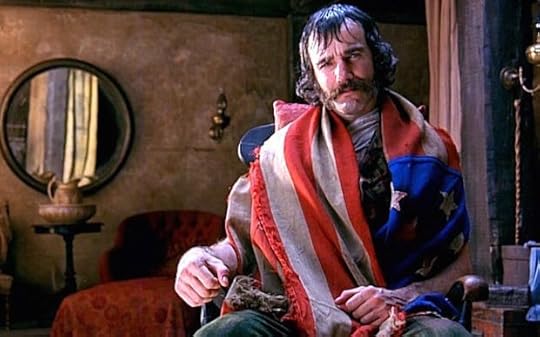
Another perspective taken by the author is that previous histories focus analysis on leadership and prominent citizens and movements. The renegade history instead focuses on a history of the bottom rungs of our socio-economic culture and those groups evolution through our history. Fans of Martin Scorsese’s Gangs of New York would enjoy this book, as would enthusiastic readers of the Freakonomic books.
Renegade history also features a heavy focus on race as both a contributor toward our society as it is now as well as an examination of how our cultural and governmental emphasis of race has been a continuing national problem.
This book is sure to make everyone mad, it compares Roosevelt’s New Deal to Italian Fascism and showed where high-ranking members of Roosevelt’s “Brain Trust” idolized and embodied the basic tenets of National Socialism. Russell also pays tribute to prominent black leaders and then spends an inordinate amount of time discussing Renegade African-American leaders who eschewed work ethic and family values and brazenly promoted criminal activity. At it’s best this book is edgy and provocative but it too frequently delves into contrarian argument and anecdotal evidence.
Fun, a little too long, but all in all a good, very different, history of the United States.
Perhaps more accurately to the theme of this book is “Well behaved women rarely make history” – a quote often erroneously attributed to Marilyn Monroe but was actually said by Laurel Thatcher Ulrich, a Harvard professor. Which makes this a good quote to illustrate this book also because many times in history what we have been taught and believed to be true, turn out not to be the case.
This is a libertarian history, concerning itself with elements of our national history that has most defined and expanding personal freedoms. The author begins with an explanation of early histories, romantically capturing the exploits of heroes and highlighting the achievements of predominantly white, Anglo Saxon males. In the sixties and seventies, the author explains, revisionist historians began writing books that paid more attention to feminist leaders, minority causes and labor movements. In doing so, many of these revisionists were overly zealous in either their defense of their heroes or overly ambitious with their demonization of the older order. This book, then, is something of a revisionists revision of American History, capturing the good, the bad and the ugly of our society from the bottom up and centering on how decades of previously unsung (and too frequently unsavory) patriots defined who we are.
A central theme that runs throughout this book is the enduring conflict between personal liberty and the interests of the state. A good point that the author makes is that an early argument to stay under the crown of England was that we colonists enjoyed freedom FROM personal responsibility. Such ideas of paternalism remain relevant today.
Another perspective taken by the author is that previous histories focus analysis on leadership and prominent citizens and movements. The renegade history instead focuses on a history of the bottom rungs of our socio-economic culture and those groups evolution through our history. Fans of Martin Scorsese’s Gangs of New York would enjoy this book, as would enthusiastic readers of the Freakonomic books.
Renegade history also features a heavy focus on race as both a contributor toward our society as it is now as well as an examination of how our cultural and governmental emphasis of race has been a continuing national problem.
This book is sure to make everyone mad, it compares Roosevelt’s New Deal to Italian Fascism and showed where high-ranking members of Roosevelt’s “Brain Trust” idolized and embodied the basic tenets of National Socialism. Russell also pays tribute to prominent black leaders and then spends an inordinate amount of time discussing Renegade African-American leaders who eschewed work ethic and family values and brazenly promoted criminal activity. At it’s best this book is edgy and provocative but it too frequently delves into contrarian argument and anecdotal evidence.
Fun, a little too long, but all in all a good, very different, history of the United States.

June 19, 2015
Could not recommend this any higher

April 1, 2013
First, I did enjoy the writing style. However, passing this book off as nonfiction is a far stretch. There is not a single reference that you can track. Talk about plagiarism. And this, from a guy who professes to be a History teacher. He puts the n-word in parenthesis as if it is a direct quote at least everything other page. I think that one of his primary goals was to see exactly how many times he could write racial epithets directed at black people and get away with it.
What I expected was a book about people who really bucked the system and changed the United States. I know about people like Robert Johnson, Sally Ride, and Steve Jobs. Tell me about lesser known people who made great impacts. What I got was 300 pages about how all white Americans strategically distanced themselves from black Americans in an effort to be "true" Americans because black Americans can never really be Americans. We are the renegades because we're lazy, prefer to be slaves so we don't have to take care of ourselves, and have never contributed anything to the world other than singing and dancing.
However, the positive side of this book is that the United States is a really great country and one in which everyone can succeed. Even a fool like Thaddeus Russell can pass himself off as an expert and somebody believes it.
What I expected was a book about people who really bucked the system and changed the United States. I know about people like Robert Johnson, Sally Ride, and Steve Jobs. Tell me about lesser known people who made great impacts. What I got was 300 pages about how all white Americans strategically distanced themselves from black Americans in an effort to be "true" Americans because black Americans can never really be Americans. We are the renegades because we're lazy, prefer to be slaves so we don't have to take care of ourselves, and have never contributed anything to the world other than singing and dancing.
However, the positive side of this book is that the United States is a really great country and one in which everyone can succeed. Even a fool like Thaddeus Russell can pass himself off as an expert and somebody believes it.
January 31, 2011
In this revisionist history of personal freedom in the U.S., Thaddeus Russell poses some interesting arguments about our view of history and its "heroes" of personal freedom. Russell proposes that our Founding Fathers wanted to take away liberties; that abolitionists were motivated by a desire to make slaves work harder; that the women's rights movements owes most of its progress to Wild West madams; and that the only way for immigrants to assimilate into American society was to give up the things that made them unique. Russell's views aren't for everyone (comparisons of New Deal policies to the rise of fascism won't make him any friends among the progressive old guard) and he admits several times that the "bad guys" in his book did a lot of actual "good" (the two terms are frequently examined and redefined). But this is an interesting take on what Russell calls the "margin of freedom," or how much the "guardians of social order" allow the "renegades" of American history to get away with. If you love your weekends, value your reproductive rights, and believe that we are a better society for doing away with racial and sexual prejudice, this is a must-read.

December 4, 2016
Didn't finish. I gave it the ol' college try. I love history. I loved A People's History of the United States, but the author's writing is condescending and douchey. The argument that free white workers somehow had a worse life than slaves or that slaves had freedoms that white people didn't - no. just no. No. .... no.

May 10, 2017
Историята, ако съдим по учебниците, е съставена главно от царе,политици, генерали, велики учени и герои, които се открояват през вековете. Влиятелните личности затова са влиятелни, защото са имали и имат голямо влияние върху хода на човешките съдби и света около себе си. Само че макар тяхното влияние да расте с геометрична прогресия колкото по-влиятелни стават те, то пак не може да е по-голямо от комбинираното влияние на всички останали хора - за които обаче учебниците рядко пишат.
Ако не сме внимателни или просто сме интелектуално мързеливи, обаче, можем да си четем учебниците по история и да си мислим, че напредъка или назадъка на човечеството се случва само заради и чрез тия големи, важни личности, докато всички останали хора са само пясък в колелата на битките на велики личности и идеи в историята. Реалния свят обаче, сега както и в миналото, не е епична приказка, борба между добро и зло, а просто сборът на милионите различни човеци, които някак се опитват да живеят в него.
"Ренегадската" история на САЩ е ренегадска с това, че описва влиянието на различните хора "извън мейнстрийма" като роби, проститутки, гангстери и т.н. за оформяне на моралния облик на Америка (и до голяма степен и света, защото както пеят Рамщайн, "ние всички живеем в Америка").
Докато прави това, Тадеус Ръсел неизбежно се отклонява от общоприетото виждане за историята на царе и генерали, на епични сблъсъци на добро и зло и разказва (често - с цитирани техните собствени думи от писма, публикации от периода и т.н.) историите на обикновените хора - както ренегати, така и консервативната, работлива средна класа, която може да се каже е тяхна противоположност.
Въпреки, че самият авторът е непоправимо ляв (всъщност, захванах да чета книгата като част от усилията си да не се самозатварям идейно и да чета и книги от автори с различни и дори противоположни на моята идеологии и виждане за света), фактите, които описва разбиват много от свещените крави на лявото в САЩ и описват историята на страната доста далеч от картинката, която то представя (далече и от това, което дясното там си представя също де, защото и двете страни на политическия спектър имат идеализирано виждане за миналото на Америка само дето за едните то е рождество от черно подтисничество, а за другите свещено правдив генезис).
Ръсел не се пести и започва с крошетата от първата глава, където описва робството на негрите в САЩ в далеч не толкова черни краски, колкото то типично се представя - дотолкова, че много от белите всъщност им се е искало да живеят като негри, свободни от строгите морални ограничения и граждански задължения в живота на средния "свободен" американец. След като надълго се занимава с робите (все пак те са значителна част от моралния исторически багаж на Америка) той преминава към проститутките, допринесли за еманципацията на жените много повече от феминистките, към гангстерите по времето на сухия режим и как те помогнали гейовете и техните права чрез подкрепата си на гей-заведенията от чисто финансов интерес и продължава все така.
За правдивостта на начина му на мислене мога да съдя от описанието му на подривното влияние, които имат американската и като цяло западната култура в социалистическите общества чрез джаз музиката, модата, Бийтълс и западните стоки, които са популярни в ъндърграунда тогава и не само устояват на всякакви опити на "работническата власт" да ги изкорени, ами накрая допринасят значително за обществените нагласи срещу нея.
Като цяло, основната червена линия в книгата е, че основната битка в създаването на душата на Америка и американския народ е водена по линията на от една страна строгата протестантска етика на упорит труд, скромност, пестеливост и самоограничение чрез силни морални устои и от там отговорно гражданство и от друга страна свободния либертинско-либертариански дух на низшите икономически класи, които винаги са искали да правят каквото си искат, без да мислят за утре - а основните политически течения не отразяват интересите на едните и на другите, а само на първите, като срещу вторите се борят както десните, така и левите, за да ги подчинят на машината на политико-икономическата власт и ред.
Ако не сме внимателни или просто сме интелектуално мързеливи, обаче, можем да си четем учебниците по история и да си мислим, че напредъка или назадъка на човечеството се случва само заради и чрез тия големи, важни личности, докато всички останали хора са само пясък в колелата на битките на велики личности и идеи в историята. Реалния свят обаче, сега както и в миналото, не е епична приказка, борба между добро и зло, а просто сборът на милионите различни човеци, които някак се опитват да живеят в него.
"Ренегадската" история на САЩ е ренегадска с това, че описва влиянието на различните хора "извън мейнстрийма" като роби, проститутки, гангстери и т.н. за оформяне на моралния облик на Америка (и до голяма степен и света, защото както пеят Рамщайн, "ние всички живеем в Америка").
Докато прави това, Тадеус Ръсел неизбежно се отклонява от общоприетото виждане за историята на царе и генерали, на епични сблъсъци на добро и зло и разказва (често - с цитирани техните собствени думи от писма, публикации от периода и т.н.) историите на обикновените хора - както ренегати, така и консервативната, работлива средна класа, която може да се каже е тяхна противоположност.
Въпреки, че самият авторът е непоправимо ляв (всъщност, захванах да чета книгата като част от усилията си да не се самозатварям идейно и да чета и книги от автори с различни и дори противоположни на моята идеологии и виждане за света), фактите, които описва разбиват много от свещените крави на лявото в САЩ и описват историята на страната доста далеч от картинката, която то представя (далече и от това, което дясното там си представя също де, защото и двете страни на политическия спектър имат идеализирано виждане за миналото на Америка само дето за едните то е рождество от черно подтисничество, а за другите свещено правдив генезис).
Ръсел не се пести и започва с крошетата от първата глава, където описва робството на негрите в САЩ в далеч не толкова черни краски, колкото то типично се представя - дотолкова, че много от белите всъщност им се е искало да живеят като негри, свободни от строгите морални ограничения и граждански задължения в живота на средния "свободен" американец. След като надълго се занимава с робите (все пак те са значителна част от моралния исторически багаж на Америка) той преминава към проститутките, допринесли за еманципацията на жените много повече от феминистките, към гангстерите по времето на сухия режим и как те помогнали гейовете и техните права чрез подкрепата си на гей-заведенията от чисто финансов интерес и продължава все така.
За правдивостта на начина му на мислене мога да съдя от описанието му на подривното влияние, които имат американската и като цяло западната култура в социалистическите общества чрез джаз музиката, модата, Бийтълс и западните стоки, които са популярни в ъндърграунда тогава и не само устояват на всякакви опити на "работническата власт" да ги изкорени, ами накрая допринасят значително за обществените нагласи срещу нея.
Като цяло, основната червена линия в книгата е, че основната битка в създаването на душата на Америка и американския народ е водена по линията на от една страна строгата протестантска етика на упорит труд, скромност, пестеливост и самоограничение чрез силни морални устои и от там отговорно гражданство и от друга страна свободния либертинско-либертариански дух на низшите икономически класи, които винаги са искали да правят каквото си искат, без да мислят за утре - а основните политически течения не отразяват интересите на едните и на другите, а само на първите, като срещу вторите се борят както десните, така и левите, за да ги подчинят на машината на политико-икономическата власт и ред.

February 4, 2017
I first learned about “A Renegade History” while listening to the Michael Medved show. The author was promoting his book and talked about the chapter on slavery. It seemed like an interesting, revisionist take and I decided I would read it. Six years later, I finally got around to it and I wish I read it earlier.
The basic premise of “A Renegade History” is that, historically, it was often unwitting scumbags or renegades who pioneered many of the freedoms we cherish today.
I wasn't really sure what to expect from this book. The author described himself as a liberal who believed in capitalism and since this wasn't a book that was particularly about economics, I expected it to offend my conservative side more than my liberal side. Having finished the book, I would almost describe this book as so liberal, that it's conservative.
There really is no attempt to be politically correct in this book. Many old racial stereotypes are accepted at face value. There are chapters on blacks, Jews, Irish, and Italians (among others), all of which were heavily discriminated against at one point. In each case, these groups have or had (until they were Americanized) a vibrant, outgoing culture that didn't work particularly hard. Being outside of regular society, often pushed them to think outside the box when it came to making money and they often resorted to illegal activities. They helped make porn, jazz, gambling, alcohol during prohibition, and gay and interracial bars, accessible to the American public. This helped push the boundaries of what people considered their basic freedoms, many of which we take for granted today.
There's a lot to be offended by in this book, as many other reviews have pointed out. Still, I think it's mostly unwarranted. “A Renegade History” seemed historically accurate. Most of what I read wasn't particularly new information. What the author does do is give a new perspective to conventional history. I would recommend this book to anyone interested in American history.
The basic premise of “A Renegade History” is that, historically, it was often unwitting scumbags or renegades who pioneered many of the freedoms we cherish today.
I wasn't really sure what to expect from this book. The author described himself as a liberal who believed in capitalism and since this wasn't a book that was particularly about economics, I expected it to offend my conservative side more than my liberal side. Having finished the book, I would almost describe this book as so liberal, that it's conservative.
There really is no attempt to be politically correct in this book. Many old racial stereotypes are accepted at face value. There are chapters on blacks, Jews, Irish, and Italians (among others), all of which were heavily discriminated against at one point. In each case, these groups have or had (until they were Americanized) a vibrant, outgoing culture that didn't work particularly hard. Being outside of regular society, often pushed them to think outside the box when it came to making money and they often resorted to illegal activities. They helped make porn, jazz, gambling, alcohol during prohibition, and gay and interracial bars, accessible to the American public. This helped push the boundaries of what people considered their basic freedoms, many of which we take for granted today.
There's a lot to be offended by in this book, as many other reviews have pointed out. Still, I think it's mostly unwarranted. “A Renegade History” seemed historically accurate. Most of what I read wasn't particularly new information. What the author does do is give a new perspective to conventional history. I would recommend this book to anyone interested in American history.

November 15, 2010
Russell's unique thesis is that "bad" Americans are the ones who should be our national heroes because they helped secure freedoms that we all now get to enjoy. By freedom he mostly means having fun - partying, not working, and enjoying (nonmarital) sex. The enemies of fun are those who want to turn bad Americans into respectable and hardworking citizens - the founding fathers, for starters, and basically white middle class Protestants. The book is frustrating on a number of fronts. Russell is a scholar who has written a popular book, and therefore doesn't spend time defending his arguments so much as presenting them. As such his thesis is presented as a given. Several chapters feel a bit repetitious: African Americans are shown to be "bad" Americans who won't assimilate as productive citizens in monogamous marriages during and after Reconstruction because they don't want to give up certain freedoms enjoyed under slavery. Following chapters discuss how Irish, Italian, and Jewish immigrants are characterized as "black" - meaning following the pattern laid out in the African American chapters - until they successfully assimilate and become "good" Americans. Overall this is a lively read, but I think I might have preferred the more rigorous, scholarly version of Russell's work.

August 27, 2014
A look at what makes America great, how the discontented, the criminal, the bad citizens changed this country. Yep, Russell thinks history has expended too much time on the good people — settlers, abolitionists, capitalists, suffragists, conservatives and not enough on prostitutes, pirates, gangsters, and slaves who set the stage for change.
Just to warn you, it is a wee bit on the long side, but it truly only touches on bits here and there.
My Take
I don't buy all of Russell's premise, but I can see where it comes from. There certainly are some facts in here I was NOT aware of from our history. Not from the history I learned in school, and it makes me angry. I hate revisionist history. If you screwed up, own it! Explain what you learned from those mistakes. Don't change things around to make yourself feel better. Mistakes aren't truly bad unless you DON'T learn from it. It's that old adage: if you don't learn from history, you are doomed to repeat it. Don't make us do that!
You may well be asking what those mistakes are. Well…there's Franklin Roosevelt and his New Deal — christ, this is a terrifying idea! Substituting fascism for democracy…ugh. And a good example of why censorship is so incredibly wrong. A different take on the implementation of welfare. It was a "deal" everyone ignored on pain of going out of business. How patriotic and enthusiastic America was about going "over there" to fight in the war. The truth behind the Japanese internment camps and the Boston Massacre which, I remind you, set off the American War for Independence. A new perspective on our Founding Fathers and their obsession with work, work, work, work, work, work…work… Fun? You ask about fun? Oh, my lord, bite your tongue! Well, unless you'd enjoy doing that!? I do like Russell's point that historians chose to interpret people having fun as "resistance" against oppression when all they were doing was havin' a good time.
Why do we have to feel so bloody insecure that we have to oppress others? Can you believe that people of the time thought the Irish, the Jews, and then the Italians were niggers? Because…shhh…they liked to dance! They liked music. They liked having a good time. Just like them darkies! *Eye roll*. If that what makes you of the negroid race, I'm volunteering. Yeah, race. Scientists of the times "proved" that the Irish, the Jews, and the Italians were of different races from Nordic races. When the Irish, Jews, and then the Italians immigrated to America, they saw nothing "wrong" with mixing it up with African Americans. They lived with them, married them, had affairs, danced, and had fun. But Americans, "normal" citizens, didn't like how much fun they were having, thought they were a bad influence, so the Irish/Jewish/Italians were discriminated against. Finally Irish/Jewish/Italian leaders started to lean hard on their people to look down upon African Americans, that they must keep away from them if they wanted to succeed at anything in America. Martin Luther King was one of the African Americans who wanted to help his fellow man mainstream as well. All this is the equivalent of having to knuckle under to a bunch of bully boys.
When you think about it, every generation has its new omigod fashion, dance, music that the older generation claims will destroy civilization as they know it. And that new generation cycles on to become the older generation shocked by what their younger generation brings forth. Parents were shocked by the waltz, the lindy, the jitterbug, tap dancing, the twist… It was dresses that came above the ankle, to the knee then above it!! Zoot suits! Blue jeans! Today's hilarious habit of wearing your pants so they hang halfway off your butt, exposing your boxers. Duck tails, bobs, long hair on men, heck, I'm sure someone was shocked at buzz cuts.
Omigod, Russell lists the contributions the African Americans and Irish/Jews/Italians made to this country! Wow, just…wow…! And it includes, lol, the Jews' and Italians' valiant efforts to keep us wet during Prohibition! Seems the Jews were pretty athletic as well back in the day…until they were forced into assimilation. 'Cause, you know, "real" white men don't move with grace. Then consider Irving Berlin, Frank Sinatra, Perry Como, George Gershwin, Louis Armstrong, Sophie Tucker, Aaron Copland, Leonard Bernstein, Bob Dylan, Burt Bacharach, Marvin Hamlisch, Randy Newman, Jelly Roll Morton, Frankie Avalon, Dean Martin, Ben Stiller, Larry David, the Beastie Boys, Edward G. Robinson, Kirk Douglas, and so many more.
I have to wonder if Americans saw these incoming Europeans as "disgusting" and "indolent" because they weren't as committed to that Puritan work ethic. If it was because they took the time to have some fun.
This prejudice was disgusting, and it makes me wonder how we're still doing it today. What I did love was the joy that people experienced when they "rebelled" and mixed it up — blacks, whites, Chinese, men, women, miners, Mexicans, Indians together! The shock!! LOL.
Some interesting sections on fashion, makeup, and hairstyles are scattered throughout. A look at the Ku Klux Klan and Russell notes that the KKK didn't only go after African Americans, they also went after "vile places of amusement", partially to protect their white women.
At one point, Russell notes how the Italians took a long time before they identified themselves as Americans, but in truth, we still identify ourselves by our ancestral origins. If I'm overseas, I'll say I'm American. If I'm home, here, I'll say I'm half-German, a quarter Norwegian, you know, a mutt. And it must be due…gasp…to not limiting immigration enough to keep out the "wrong" element. Omigod, we let mongrel races mix with AMERICANS! We're, we're…*gasp*…a mongrel race. Hullo??
One point that Russell raises continually is the very different culture of African Americans, and I'm hoping some African Americans will weigh in on this. Russell's statements do seem borne out by what I've read in the news, and it makes sense if what he stated about slavery was true. It does seem as if African Americans were rejecting the white man's work ethic and cultural expectations, which only makes sense if you are offered citizenship in name only.
All of this is a result of that Puritan work ethic of our Founding Fathers. Yes, the same ones who also went out and had fun in their own lives, but didn't want it for anyone else. It's a completely different perspective on Benjamin Franklin and Thomas Jefferson and others who thought there was too much wickedness and corruption — 'cause once we had their democracy, everyone behaved themselves from mine owners to business tycoons at the turn of the twentieth century to plantation owners to today's venal corporations…*eye roll*… This idea continued through centuries even down to the labor unions wanting to cut back on working hours, so workers would find work "enjoyable", a place they wanted to come back to. They thought that if workers had extra time at the end of the day, they'd be rested and want to sit through lectures on improvements, morality, etc. Even Margaret Sanger and those who promoted birth control were actually interested in eugenics and controlling the population.
The section on freedom for slaves after the Civil War is interesting. There's a different perspective on how slaves were treated and what they thought about it as well as the why of Russell's statements. I suspect it might have been less cruel to be a slave than a white child growing up with parents who believed in "spare the rod, spoil the child". At least slaves had value…jesus. I have to wonder how much of my interpretation of it is based on novels and white historians rewriting history. I can see Russell's point, and he does have a slew of facts and a few interviews that seem to support his conclusions. I'd want to read a lot more primary sources before I can buy it all.
The democracy the Founding Fathers wanted was denial of desire, to feel shame for wanting, to instead desire restraint and more work. They actually liked the boycott of British goods as it would teach Americans to deny themselves luxuries! Hmmm, wonder if Jefferson would have denied himself his books…or Sally? They tried to tax pleasure — and it gives new meaning to the Whiskey Rebellion!
Russell notes that historians [and contemporary pundits] see consumerism as bad. That spending money on anything not essential to sustaining life is "bad", that it distracts from finding joy in working. I'm wondering who decides what the minimum amount is and if everyone is expected to adhere to this minimum. The governor? The billionaire? The business owner? This desire to enforce a work ethic also explains why only landowners could vote! No manufacturers, bankers, merchants, or consumers need apply. Yeah, you won't be able to believe it, but it does make sense if you buy into this. Of course, when you see how many wealthy men believe that consumerism is bad, ya gotta wonder why they manufacture anything. Although Carnegie did think the rich should be heavily taxed so the state would have a nice chunk of change to help people. Then again, Max Weber believes they wanted their wealth so they'd have more power to control people. That's a concept I'd believe.
Then there's his comment about psychologists saying "that sexuality informs all of our social activities and that people are obsessed with sex [NO?!!], but historians rarely mentioned it. Well, unless they're talking about Henry VIII, lol.
Hmmm, the reason for Coney Island's continued success back then…
Before America became independent, sex was freewheeling and women could work at anything; there were no laws about marriage or divorce; prostitution was not the horror we all think it was (remember who writes the histories!); and, gay liberation was in very interesting hands, lol. You thought the scandal about Marilyn Monroe and John Kennedy was salacious… Hah, it ain't got nothin' on Vito Genovese and "Fat Tony" Lauria!
What Russell emphasizes is that these "rebels" who enjoyed life, who danced, listened or created music, drank, gambled, had sex are why we (and the Soviet bloc) have the liberty we have today. In many respects, I agree with him. The entertainment we enjoy today — movies, dancing, music, Las Vegas etc. — are due to mobsters and ex-slaves who influenced others who helped spread such decadence as doo-wop, jazz, blues, rap, scat, rhythm and blues, ragtime, and rock and roll. The truth behind "Dixie" and the Selwyn Theater. And it explains why the whitey ain't got no rhythm, lol. There's Edison and his Trust versus the nickelodeons along with what led to the Hays Code. Interesting insights into the movies produced during World War II as well as why San Francisco became a mecca for gays! Oh, oh, and the start of growing marijuana!
I'd like to see this book used as part of a history class in high school. And incorporate a lot of his facts into history classes. His book explains a lot about a number of legislative acts passed by the government. History should be balanced, honest, true, and not only the "victor's" idea of true.
It makes me sad to think how much richer America would have been if the control freaks had simply left people alone.
It all comes down to embracing pleasure, being free with one's body, and that work is simply a means to fun.
Or we could go back to the Puritan work ethic and give up our novels, movies, music, and Xboxes.
Nahhh…
The Cover and Title
The cover is a close-up of an American flag with "naughty" symbols replacing some of the stars. A skull for the poison symbol, a guitar, high heels (oh, no!), a cigarette, handcuffs, a marijuana leaf, and a smoking cigarette. I do like the title overlaid on the two white stripes of the flag.
The title is the perspective Randall takes at A Renegade History of the United States.
Just to warn you, it is a wee bit on the long side, but it truly only touches on bits here and there.
My Take
I don't buy all of Russell's premise, but I can see where it comes from. There certainly are some facts in here I was NOT aware of from our history. Not from the history I learned in school, and it makes me angry. I hate revisionist history. If you screwed up, own it! Explain what you learned from those mistakes. Don't change things around to make yourself feel better. Mistakes aren't truly bad unless you DON'T learn from it. It's that old adage: if you don't learn from history, you are doomed to repeat it. Don't make us do that!
You may well be asking what those mistakes are. Well…there's Franklin Roosevelt and his New Deal — christ, this is a terrifying idea! Substituting fascism for democracy…ugh. And a good example of why censorship is so incredibly wrong. A different take on the implementation of welfare. It was a "deal" everyone ignored on pain of going out of business. How patriotic and enthusiastic America was about going "over there" to fight in the war. The truth behind the Japanese internment camps and the Boston Massacre which, I remind you, set off the American War for Independence. A new perspective on our Founding Fathers and their obsession with work, work, work, work, work, work…work… Fun? You ask about fun? Oh, my lord, bite your tongue! Well, unless you'd enjoy doing that!? I do like Russell's point that historians chose to interpret people having fun as "resistance" against oppression when all they were doing was havin' a good time.
"America developed a national culture that was more sexually restrained and work obsessed than Victorian England."Russell also provides an encapsulated look at the waves of prejudice America coughed up. Oh, brother. I didn't learn until some five or six years ago, that part of my heritage is…shhh…Irish. Shhhhhh, don't tell anyone! I can certainly understand why my great-greats didn't want to admit to that one! ROFLMAO. Truly. How incredibly stupid. No. Not them. Not my great-greats. People. I know I've read this description of the Irish in a wide variety of books, and again, I'm very curious as to the why of this. I certainly never felt that my grandparents were filthy, disgusting people. But then again, they'd "assimilated"…
Why do we have to feel so bloody insecure that we have to oppress others? Can you believe that people of the time thought the Irish, the Jews, and then the Italians were niggers? Because…shhh…they liked to dance! They liked music. They liked having a good time. Just like them darkies! *Eye roll*. If that what makes you of the negroid race, I'm volunteering. Yeah, race. Scientists of the times "proved" that the Irish, the Jews, and the Italians were of different races from Nordic races. When the Irish, Jews, and then the Italians immigrated to America, they saw nothing "wrong" with mixing it up with African Americans. They lived with them, married them, had affairs, danced, and had fun. But Americans, "normal" citizens, didn't like how much fun they were having, thought they were a bad influence, so the Irish/Jewish/Italians were discriminated against. Finally Irish/Jewish/Italian leaders started to lean hard on their people to look down upon African Americans, that they must keep away from them if they wanted to succeed at anything in America. Martin Luther King was one of the African Americans who wanted to help his fellow man mainstream as well. All this is the equivalent of having to knuckle under to a bunch of bully boys.
When you think about it, every generation has its new omigod fashion, dance, music that the older generation claims will destroy civilization as they know it. And that new generation cycles on to become the older generation shocked by what their younger generation brings forth. Parents were shocked by the waltz, the lindy, the jitterbug, tap dancing, the twist… It was dresses that came above the ankle, to the knee then above it!! Zoot suits! Blue jeans! Today's hilarious habit of wearing your pants so they hang halfway off your butt, exposing your boxers. Duck tails, bobs, long hair on men, heck, I'm sure someone was shocked at buzz cuts.
Omigod, Russell lists the contributions the African Americans and Irish/Jews/Italians made to this country! Wow, just…wow…! And it includes, lol, the Jews' and Italians' valiant efforts to keep us wet during Prohibition! Seems the Jews were pretty athletic as well back in the day…until they were forced into assimilation. 'Cause, you know, "real" white men don't move with grace. Then consider Irving Berlin, Frank Sinatra, Perry Como, George Gershwin, Louis Armstrong, Sophie Tucker, Aaron Copland, Leonard Bernstein, Bob Dylan, Burt Bacharach, Marvin Hamlisch, Randy Newman, Jelly Roll Morton, Frankie Avalon, Dean Martin, Ben Stiller, Larry David, the Beastie Boys, Edward G. Robinson, Kirk Douglas, and so many more.
I have to wonder if Americans saw these incoming Europeans as "disgusting" and "indolent" because they weren't as committed to that Puritan work ethic. If it was because they took the time to have some fun.
This prejudice was disgusting, and it makes me wonder how we're still doing it today. What I did love was the joy that people experienced when they "rebelled" and mixed it up — blacks, whites, Chinese, men, women, miners, Mexicans, Indians together! The shock!! LOL.
Some interesting sections on fashion, makeup, and hairstyles are scattered throughout. A look at the Ku Klux Klan and Russell notes that the KKK didn't only go after African Americans, they also went after "vile places of amusement", partially to protect their white women.
At one point, Russell notes how the Italians took a long time before they identified themselves as Americans, but in truth, we still identify ourselves by our ancestral origins. If I'm overseas, I'll say I'm American. If I'm home, here, I'll say I'm half-German, a quarter Norwegian, you know, a mutt. And it must be due…gasp…to not limiting immigration enough to keep out the "wrong" element. Omigod, we let mongrel races mix with AMERICANS! We're, we're…*gasp*…a mongrel race. Hullo??
One point that Russell raises continually is the very different culture of African Americans, and I'm hoping some African Americans will weigh in on this. Russell's statements do seem borne out by what I've read in the news, and it makes sense if what he stated about slavery was true. It does seem as if African Americans were rejecting the white man's work ethic and cultural expectations, which only makes sense if you are offered citizenship in name only.
All of this is a result of that Puritan work ethic of our Founding Fathers. Yes, the same ones who also went out and had fun in their own lives, but didn't want it for anyone else. It's a completely different perspective on Benjamin Franklin and Thomas Jefferson and others who thought there was too much wickedness and corruption — 'cause once we had their democracy, everyone behaved themselves from mine owners to business tycoons at the turn of the twentieth century to plantation owners to today's venal corporations…*eye roll*… This idea continued through centuries even down to the labor unions wanting to cut back on working hours, so workers would find work "enjoyable", a place they wanted to come back to. They thought that if workers had extra time at the end of the day, they'd be rested and want to sit through lectures on improvements, morality, etc. Even Margaret Sanger and those who promoted birth control were actually interested in eugenics and controlling the population.
The section on freedom for slaves after the Civil War is interesting. There's a different perspective on how slaves were treated and what they thought about it as well as the why of Russell's statements. I suspect it might have been less cruel to be a slave than a white child growing up with parents who believed in "spare the rod, spoil the child". At least slaves had value…jesus. I have to wonder how much of my interpretation of it is based on novels and white historians rewriting history. I can see Russell's point, and he does have a slew of facts and a few interviews that seem to support his conclusions. I'd want to read a lot more primary sources before I can buy it all.
"William Ellery Channing, an intellectual founder of abolitionism, made plain the ugly irony of his movement. The problem with slavery was that slaves were too free…"Russell also looks at Reconstruction after the Civil War, and if his earlier statements are correct, then it puts a different light on Republican efforts. It also seems shameful. Play by our rules, however stupid, or you're out. I dunno. I'd want to see more primary sources on this as well.
The democracy the Founding Fathers wanted was denial of desire, to feel shame for wanting, to instead desire restraint and more work. They actually liked the boycott of British goods as it would teach Americans to deny themselves luxuries! Hmmm, wonder if Jefferson would have denied himself his books…or Sally? They tried to tax pleasure — and it gives new meaning to the Whiskey Rebellion!
Russell notes that historians [and contemporary pundits] see consumerism as bad. That spending money on anything not essential to sustaining life is "bad", that it distracts from finding joy in working. I'm wondering who decides what the minimum amount is and if everyone is expected to adhere to this minimum. The governor? The billionaire? The business owner? This desire to enforce a work ethic also explains why only landowners could vote! No manufacturers, bankers, merchants, or consumers need apply. Yeah, you won't be able to believe it, but it does make sense if you buy into this. Of course, when you see how many wealthy men believe that consumerism is bad, ya gotta wonder why they manufacture anything. Although Carnegie did think the rich should be heavily taxed so the state would have a nice chunk of change to help people. Then again, Max Weber believes they wanted their wealth so they'd have more power to control people. That's a concept I'd believe.
Then there's his comment about psychologists saying "that sexuality informs all of our social activities and that people are obsessed with sex [NO?!!], but historians rarely mentioned it. Well, unless they're talking about Henry VIII, lol.
If sex is so awful, why do we keep seeking it out?There are reasons today why there are restrictions on various vices such as drinking. For one, back then, nobody had to drive home drunk and alcohol was healthier to drink than water.
Ah, women's lib. I've always loved this. Well, I am a woman. When you consider that any woman before this revolution was essentially considered a whore or "asking for it" if she wore makeup, was alone in public, attempted to be independent and more. In truth, real prostitutes had it pretty good, before the Revolution and in the Old West. Consider that the average weekly wage for a "good" woman in 1916 was $6.67 while a prostitute could earn $30 to $50 a week. Before laws were enacted against it, prostitutes in a bordello had free health care, food, nice clothing, a warm place to live, free birth control, safety, and legal assistance. None of this was a guarantee for "good" women. Ya gotta read what happened in Denver when the council decided to shame its prostitutes, lol. Russell's comments on the Social Purity movement of the 1870s will make you shake your head in disgust. All it did was lead to women being turned out onto the streets and being subjected to pimps. Without health insurance. It's not for nothing that prostitution and brewing alcohol are considered some of the oldest professions. Hullo?I love this comment Russell makes about the Volstead Act, lol.
"To try to explain the theory of prohibition … sounds interesting [but] … people of this type, who are otherwise law-abiding and patriotic and well-intentioned, protect bootleggers and otherwise violate the Volstead Act with the same faith in the justice of their actions that a group of Middle Western Americans would have in evading a law that prohibited them from planting corn…"
Hmmm, the reason for Coney Island's continued success back then…
Before America became independent, sex was freewheeling and women could work at anything; there were no laws about marriage or divorce; prostitution was not the horror we all think it was (remember who writes the histories!); and, gay liberation was in very interesting hands, lol. You thought the scandal about Marilyn Monroe and John Kennedy was salacious… Hah, it ain't got nothin' on Vito Genovese and "Fat Tony" Lauria!
What Russell emphasizes is that these "rebels" who enjoyed life, who danced, listened or created music, drank, gambled, had sex are why we (and the Soviet bloc) have the liberty we have today. In many respects, I agree with him. The entertainment we enjoy today — movies, dancing, music, Las Vegas etc. — are due to mobsters and ex-slaves who influenced others who helped spread such decadence as doo-wop, jazz, blues, rap, scat, rhythm and blues, ragtime, and rock and roll. The truth behind "Dixie" and the Selwyn Theater. And it explains why the whitey ain't got no rhythm, lol. There's Edison and his Trust versus the nickelodeons along with what led to the Hays Code. Interesting insights into the movies produced during World War II as well as why San Francisco became a mecca for gays! Oh, oh, and the start of growing marijuana!
I love it! An Italian opera house went bankrupt while an Ethiopian opera flourished, 'cause one was fun and the other wasn't. I'll let you decide which one.Tons and tons and tons of facts in here, but Russell writes it well. He does have a tendency to run on and repeat himself and yet he is trying to make a point.
"Elvis Presley 'a Cold War Weapon'"!
I'd like to see this book used as part of a history class in high school. And incorporate a lot of his facts into history classes. His book explains a lot about a number of legislative acts passed by the government. History should be balanced, honest, true, and not only the "victor's" idea of true.
It makes me sad to think how much richer America would have been if the control freaks had simply left people alone.
It all comes down to embracing pleasure, being free with one's body, and that work is simply a means to fun.
Or we could go back to the Puritan work ethic and give up our novels, movies, music, and Xboxes.
Nahhh…
The Cover and Title
The cover is a close-up of an American flag with "naughty" symbols replacing some of the stars. A skull for the poison symbol, a guitar, high heels (oh, no!), a cigarette, handcuffs, a marijuana leaf, and a smoking cigarette. I do like the title overlaid on the two white stripes of the flag.
The title is the perspective Randall takes at A Renegade History of the United States.

June 9, 2016
One of the more mind-blowing books I've ever read. Essentially, what it does is argue that throughout US history, progress has been driven by people who would generally be viewed as degenerates—not unlike how, for example, a lot of technological developments have been driven by people trying to find new ways to consume pr0n.
Aside from whatever aversion one might have to reading about drunks, prostitutes and what have you (positive portrayals, no less), it's likely that almost anyone would be offended by some aspect of this book, even people who aren't usually prone to taking offense. You can check some of the other reviews here to get an idea of the strong emotions this book provokes. For example, he argues that FDR was the equivalent of Hitler and that slaves were better off than their poor white counterparts. At times, you get the sense that he's trolling, but I'd say he offers some fairly compelling arguments.
Aside from whatever aversion one might have to reading about drunks, prostitutes and what have you (positive portrayals, no less), it's likely that almost anyone would be offended by some aspect of this book, even people who aren't usually prone to taking offense. You can check some of the other reviews here to get an idea of the strong emotions this book provokes. For example, he argues that FDR was the equivalent of Hitler and that slaves were better off than their poor white counterparts. At times, you get the sense that he's trolling, but I'd say he offers some fairly compelling arguments.

February 17, 2011
An amazing book that -- even if you hate history -- will make you enjoy it. In fact, if this was the kind of history we were taught in school, we might have actually fought for places in the class.
Warning though: having read this book, you'll never again see the "founding fathers", the first Americans, prostitutes before the 1900s, pirates, slaves, working people and unions, people of irish-ancestry, people of african-ancestry, people of italian-ancestry, jewish people, organized crime, Franklin Roosevelt, world war 2, rock and roll, the black civil rights movement, the women's movement, the gay liberation movement, rednecks, or hippies the same ever again. I read huge sections of this book to my wife -- which I never do, as we never have the same tastes in books -- and she was just as fascinated as I was. Great book.
Warning though: having read this book, you'll never again see the "founding fathers", the first Americans, prostitutes before the 1900s, pirates, slaves, working people and unions, people of irish-ancestry, people of african-ancestry, people of italian-ancestry, jewish people, organized crime, Franklin Roosevelt, world war 2, rock and roll, the black civil rights movement, the women's movement, the gay liberation movement, rednecks, or hippies the same ever again. I read huge sections of this book to my wife -- which I never do, as we never have the same tastes in books -- and she was just as fascinated as I was. Great book.

June 18, 2019
Should have been named "Big, If True: The Book."
It's got tons of information, plenty that seems possible or even likely... all ruined by a complete lack of sources and footnotes. Russell makes wild, interesting claims without doing the necessary work to build any of this case.
I would not be surprised to learn that maybe 40% of this book is dead on accurate. But which 40%? Who knows? What a frustrating book.
It's got tons of information, plenty that seems possible or even likely... all ruined by a complete lack of sources and footnotes. Russell makes wild, interesting claims without doing the necessary work to build any of this case.
I would not be surprised to learn that maybe 40% of this book is dead on accurate. But which 40%? Who knows? What a frustrating book.
April 7, 2011
A great and engrossing book on many levels. However, I felt the chapter on slavery did not take nearly enough factors into consideration concerning the psychology of ex slaves and the conditions they endured. I understand that the point Russell was making about how ex slaves after the war were conditioned by the government against bigamy and encouraged deeply towards the rigid moral sexual codes of the day and that they associated slavery with a freer time of sexual exploration, but I felt that not enough consideration was paid to the intricacies of control and the paradoxes of cruelty that so infused the US during this time period. I realize that children around the board were punished and that black slaves were not exclusively targeted, but the idea remains hard to swallow that slaves were somehow happier during the pre Reconstruction era. I find the author's apologetic tone to be somewhat of a trap in psychological terms. The first hand accounts taken down in the 30s aside, a lot remained unsaid. The entire period was victim to what I interpret as a nation wide Stockholm Syndrome, where many slaves felt powerless and with little choice in spite of the massive social reforms happening around them. This psychological phenomenon exists today in our world of retail wage slavery, as people have choices in technicality, but are severely limited by the factor of money to the point where very little choice is at hand. The same principle but different environment and level of intensity and control, mind you, but the psychology remains true. The more time people spend with little or no choice in how they run their lives, the more likely they are to keep to the same patterns. Many slaves did stay on plantations after the war ended. But there are MANY economic and social factors at play here, and we can see this is true when you look at the pattern of migration of blacks to the west and urban north later on in the 19th century. As far as levels of happiness go, I think that the text Russell comes up with should be described as speculative and should be left at that. Regarding the nature of his writing, I do think he needed to make more of a connection between the fascinating subjects he brings up and the forces aligning against them. I would like to have seen more of an effort to get behind the scenes, as it were, of the government after the Founding Fathers. Equally, I felt that he deliberately ignored making a distinct analysis and conclusion regarding the American workplace, and how it could be improved through comparison to previous time periods. The rest of this book is filled, however, with incredibly important accounts of left out American history. The history of alcohol, taverns, prostitution, and various outlaw activities and how they are integrated with our culture is extremely interesting and everyone should familiarize themselves with those aspects of American history at some point.

December 28, 2012
Thaddeus Russell upholds the gifts of the slackers, carousers, 'deviants' and other residents of society's underbelly in this rollicking tour of American History that is unlike anything most of us experienced in our formal schooling on the subject. This is a book I would like to put into the hands of certain people who constantly bemoan the downfall of contemporary civilization and pine for the 'good old days'.
I am an avid reader of the news...and that would be the historic news. I frequent our library's web site where I can access every edition of the major Cleveland paper going back to the 1840s. So, it is not exactly news to me that 'there is nothing new under the sun'. And I never believed that 'immorality' was invented in the 20th century. (The old papers are rife with stories of knock down drunkards, murder, rape, incest and all matter of crime, petty or otherwise. The average person lived in conditions that we would consider appalling...life was often a short, miserable and rather blurry affair. The death rolls are filled with people in their 20s and 30s succumbing to drink and disease. I do not envy the 19th century citizen his or her experience.)
So I was not exactly unprepared for many of the revelations within A Renegade History. Still, I learned quite a few interesting things. Some of the more fascinating tidbits include: off the charts illegitimacy in Colonial America; the connections between organized crime and gay culture; the somewhat 'carefree' lives of slaves; and the fact that Bing Crosby was Protestant. (That last one blew what is left of my mind these days.)
This book can be a bit of an unsettling read. It is uncomfortable for me to think of slavery in terms of anything but a heinous institution that reduced people to chattel. Although the author certainly does not condone slavery in any sense, he does point out some elements that made me squirm. Most surprising to me were the oral histories performed in the 1930s with former slaves. Many of these people recalled slavery days too fondly for the 21st century reader. Many claimed that life was easier on the plantation than it was for them after Reconstruction.
Another section that proved fascinating to me was the chapter about the New Deal. Russell's comparison between the architects of the New Deal with the rise of fascism in Italy and Germany during the same era was interesting. It is an uncomfortable connection for me. I am aware of the conflation of FDR to Hitler in some conservative circles. Although I remain an admirer of FDR and underscore the point that he deviated from the path of the Hitler and Mussolini (to the point of orchestrating their defeat)...I am more educated on the era after reading this section.
Another sacred cow that Russell slays to a degree is the myth of universal patriotism during the WWII Era. Apparently, we were more reluctant to fight than is generally recognized 75 years after the fact.
A Renegade History is definitely designed and written to raise some eyebrows and it is a bit showy in its desire to be outre. And that is what makes it so much fun to read. If only history was treated a bit more like this in school. Students would see that they are not learning dry facts and dates about people remote from them. Instead, they would see history as a steady stream of humanity flowing through time...filled with villains as well as heroes...but mostly filled with regular people who were not so different from us.
Russell takes care not to glorify the renegades and admits, in his preface, that society would be an ugly and miserable place if left strictly in their hands. However, he also warns us against the excesses of the killjoys who have always found a way to rule us. Wouldn't we be better off, postulates, Russell, if we had a foot in both worlds?
A Renegade History of the United States is a quick and entertaining read that has convinced me of the truism: All Work and No Play Makes Jack a Dull Boy.
I am an avid reader of the news...and that would be the historic news. I frequent our library's web site where I can access every edition of the major Cleveland paper going back to the 1840s. So, it is not exactly news to me that 'there is nothing new under the sun'. And I never believed that 'immorality' was invented in the 20th century. (The old papers are rife with stories of knock down drunkards, murder, rape, incest and all matter of crime, petty or otherwise. The average person lived in conditions that we would consider appalling...life was often a short, miserable and rather blurry affair. The death rolls are filled with people in their 20s and 30s succumbing to drink and disease. I do not envy the 19th century citizen his or her experience.)
So I was not exactly unprepared for many of the revelations within A Renegade History. Still, I learned quite a few interesting things. Some of the more fascinating tidbits include: off the charts illegitimacy in Colonial America; the connections between organized crime and gay culture; the somewhat 'carefree' lives of slaves; and the fact that Bing Crosby was Protestant. (That last one blew what is left of my mind these days.)
This book can be a bit of an unsettling read. It is uncomfortable for me to think of slavery in terms of anything but a heinous institution that reduced people to chattel. Although the author certainly does not condone slavery in any sense, he does point out some elements that made me squirm. Most surprising to me were the oral histories performed in the 1930s with former slaves. Many of these people recalled slavery days too fondly for the 21st century reader. Many claimed that life was easier on the plantation than it was for them after Reconstruction.
Another section that proved fascinating to me was the chapter about the New Deal. Russell's comparison between the architects of the New Deal with the rise of fascism in Italy and Germany during the same era was interesting. It is an uncomfortable connection for me. I am aware of the conflation of FDR to Hitler in some conservative circles. Although I remain an admirer of FDR and underscore the point that he deviated from the path of the Hitler and Mussolini (to the point of orchestrating their defeat)...I am more educated on the era after reading this section.
Another sacred cow that Russell slays to a degree is the myth of universal patriotism during the WWII Era. Apparently, we were more reluctant to fight than is generally recognized 75 years after the fact.
A Renegade History is definitely designed and written to raise some eyebrows and it is a bit showy in its desire to be outre. And that is what makes it so much fun to read. If only history was treated a bit more like this in school. Students would see that they are not learning dry facts and dates about people remote from them. Instead, they would see history as a steady stream of humanity flowing through time...filled with villains as well as heroes...but mostly filled with regular people who were not so different from us.
Russell takes care not to glorify the renegades and admits, in his preface, that society would be an ugly and miserable place if left strictly in their hands. However, he also warns us against the excesses of the killjoys who have always found a way to rule us. Wouldn't we be better off, postulates, Russell, if we had a foot in both worlds?
A Renegade History of the United States is a quick and entertaining read that has convinced me of the truism: All Work and No Play Makes Jack a Dull Boy.

August 16, 2011
This is a strange book, with something to repel readers of all major political persuasions. By "renegades" Russell means uncivilized people: hedonists; the irresponsible, undisciplined, and impulsive; low-income lovers of luxury, fashion and leisure; the frivolous and lazy; the over-indulgers; the selfish and criminal, the anti-ant grasshoppers. This is a popular, as opposed to scholarly, history of the USA (no footnotes, few original sources), and it presents more a perspective than it does an argument. That perspective is of the US as a nation ruled by puritans, with only renegade resistance and consumer culture making life bearable.
Russell says in the introduction that his pro-renegade viewpoint applies specifically to US history, in other countries renegades have done a lot of damage. He doesn't say why this might be the case but later in the book does provide evidence that the US has historically been on the hard-working end of the spectrum: from a 17th Century visitor's comment that an "infinite" amount of work was required of colonists, to the claim that 19th Century US manufacturing workers worked the longest hours ever recorded; to the claim that the free US farmer majority worked hundreds of hours more per year than did even US *slaves*, to late-20th Century Americans working more hours than Europeans.
Most of the chapters consist of descriptions of what some class of renegade did, followed by a brief statement that we should thank those renegades for our freedom, without the first being shown to cause the second. You'd think that sometimes renegade behavior would decrease freedom by provoking a backlash but you won't find that here. Indeed, Russell suggests that freedom is more often won by direct, often illegal, action than by lawfully working within the political system. One theme that runs through the book is that many reformers -- the founding fathers, abolitionists, Reconstruction officials, feminists, civil rights leaders, et al -- have actually worked against freedom by trying to make renegades into hardworking, law-abiding, respectable, frugal, self-sacrificing, citizens. Russell credits increasing levels of African-American violence in Birmingham AL with MLK's successful desegregation negotiations, rather than the policy of nonviolent protest. He compares the respectable homophile movement of the '50s & early '60s with the rioting drag queens of Stonewall 1969; the former was unsuccessful (or maybe even counterproductive) and the latter is widely acknowledged as being the turning point for gay rights. But what caused what? And if Russell is right about these two examples how frequently does this approach work? It's hard to believe that offending majority opinions can often be a winning strategy. I'd like to read a book in which Russell, a conservative historian and a liberal historian debate what reform movement strategies have worked in US history.
To sum up: this book is thought-provoking -- more thought-provoking than convincing -- and includes entertaining descriptions of people and activities rarely discussed in history books.
Russell says in the introduction that his pro-renegade viewpoint applies specifically to US history, in other countries renegades have done a lot of damage. He doesn't say why this might be the case but later in the book does provide evidence that the US has historically been on the hard-working end of the spectrum: from a 17th Century visitor's comment that an "infinite" amount of work was required of colonists, to the claim that 19th Century US manufacturing workers worked the longest hours ever recorded; to the claim that the free US farmer majority worked hundreds of hours more per year than did even US *slaves*, to late-20th Century Americans working more hours than Europeans.
Most of the chapters consist of descriptions of what some class of renegade did, followed by a brief statement that we should thank those renegades for our freedom, without the first being shown to cause the second. You'd think that sometimes renegade behavior would decrease freedom by provoking a backlash but you won't find that here. Indeed, Russell suggests that freedom is more often won by direct, often illegal, action than by lawfully working within the political system. One theme that runs through the book is that many reformers -- the founding fathers, abolitionists, Reconstruction officials, feminists, civil rights leaders, et al -- have actually worked against freedom by trying to make renegades into hardworking, law-abiding, respectable, frugal, self-sacrificing, citizens. Russell credits increasing levels of African-American violence in Birmingham AL with MLK's successful desegregation negotiations, rather than the policy of nonviolent protest. He compares the respectable homophile movement of the '50s & early '60s with the rioting drag queens of Stonewall 1969; the former was unsuccessful (or maybe even counterproductive) and the latter is widely acknowledged as being the turning point for gay rights. But what caused what? And if Russell is right about these two examples how frequently does this approach work? It's hard to believe that offending majority opinions can often be a winning strategy. I'd like to read a book in which Russell, a conservative historian and a liberal historian debate what reform movement strategies have worked in US history.
To sum up: this book is thought-provoking -- more thought-provoking than convincing -- and includes entertaining descriptions of people and activities rarely discussed in history books.

March 17, 2014
Very interesting and definitely politically incorrect revisions to the American history typically taught in schools. The list of renegades starts with "drunkards, laggards, prostitutes, pirates, and other heroes of the American revolution." No great surprises there. After the civil war, the freed slaves were expected to adopt the American work ethic and work from dawn to dusk 7 days a week. Many of them said they preferred slavery, which gave them freedom from responsibility. Many white Americans also resisted the work ethic and the idea that pleasure was sinful, and "lit out for the territories" or became criminals.
Other renegades were the blacks who created jazz and the whites who liked to listen to and/or imitate it, especially when it morphed into the blues and then rock and roll. Parents worried and scolded but couldn't stop it. More renegades came along with the immigrant Irish (called "white n-word"), then Jews and Italians, each taking their turn as the despised foreigners, and each resisting it. Prohibition provided new opportunities for organized crime, first headed by Jews, later by Italians.
The Great Depression gave us FDR, whose mission was national unity. He shared this goal with Hitler and Mussolini, and the three watched and admired one another's efforts to bring it about by organizing and indeed regimenting their respective nations. The media were controlled; resisters were punished. The regimentation intensified with WWII, as did censorship and propaganda.
After the war the author returns to the relations between blacks and whites, and between blacks and blacks: Martin Luther King Jr. preaching responsibility, the work ethic, marriage, monogamy and good parenting, versus the "Bad "N-word" who resists all of that, deals in drugs and prostitution, etc. Much the same dichotomy is being played out between open gays, closet gays, those who want gay marriage and to serve openly in the military.
The point is that rebels and renegades are responsible for a good portion of the way American history has unfolded. The beginning was not particularly surprising, but later in the book there were many things I didn't know and found fascinating. A good read.
Other renegades were the blacks who created jazz and the whites who liked to listen to and/or imitate it, especially when it morphed into the blues and then rock and roll. Parents worried and scolded but couldn't stop it. More renegades came along with the immigrant Irish (called "white n-word"), then Jews and Italians, each taking their turn as the despised foreigners, and each resisting it. Prohibition provided new opportunities for organized crime, first headed by Jews, later by Italians.
The Great Depression gave us FDR, whose mission was national unity. He shared this goal with Hitler and Mussolini, and the three watched and admired one another's efforts to bring it about by organizing and indeed regimenting their respective nations. The media were controlled; resisters were punished. The regimentation intensified with WWII, as did censorship and propaganda.
After the war the author returns to the relations between blacks and whites, and between blacks and blacks: Martin Luther King Jr. preaching responsibility, the work ethic, marriage, monogamy and good parenting, versus the "Bad "N-word" who resists all of that, deals in drugs and prostitution, etc. Much the same dichotomy is being played out between open gays, closet gays, those who want gay marriage and to serve openly in the military.
The point is that rebels and renegades are responsible for a good portion of the way American history has unfolded. The beginning was not particularly surprising, but later in the book there were many things I didn't know and found fascinating. A good read.

April 8, 2015
Bored with the usual US survey texts and want a cultural history-focused account that you can argue with? Here you go. With the exception of the civil rights chapter, about which Russell has done some solid work of his own, it's mostly a reimagining of his U.S. history comps list. Sure, he plays fast and loose with examples--his reliance on 70s-era comparative work to draw parallels between the New Deal and European fascism is downright risible--but the book's readable as hell, privileges laziness over hard work (my students and I love that!), and is a neat corrective both to toothless overpriced textbooks and Zinn's rah-rah workers-as-noble-savages account. Because you're always disagreeing with or supplementing this material, it makes lecturing a breeze...and oh the class discussions. Assign it if you're eager to mix things up.

July 16, 2020
I wholeheartedly agree with the review who said the writer is not so much a historian as a contrarian. What I was hoping to get out of this book was some lesser know stories from American history. And there were some. But for the most part there was a lot of "contrary to popular belief" and giving just as ham-fisted and unnuanced a portrayal of American history as the textbooks do. I was listening to the audio version. And after all the factoids about how slavery really wasn't that bad....and seemingly endless recitation of minstrel lyrics I'd had enough.

June 17, 2013
Really revealing exploration which creates many questions for the conventionally educated. 'We have met the enemy and it is us'. But read this after you have read 'The People's History of the United States' by Howard Zinn'. This book gives me hope for survival against our current right wing advocates, although, reaching back into our history demonstrates a stunning sameness to the past. It seems to me that so many negative comments show a fear to 'question authority'.
August 17, 2022
We’ve burnt through hyperbole like fossil fuels, and it too creates an obnoxious smog: this is the worst, that’s the best ever, etc etc. That said, on careful consideration, I am pretty sure this is the single worst work of history I’ve ever read, certainly the worst work of history by a historian serious people have praised to me. One of the smarter people in my grad program had “Big Bad Thad” (as she informed he was nicknamed) Russell as an undergrad instructor. She disagreed with his politics — back then, near when this book came out, more or less down-the-middle libertarianism, strolling down history’s lane to its rendezvous with Trumpism — but thought he was a good instructor and that his book sounded interesting.
Well, I could kind of see the instructor thing. Russell’s out of the academy now, a podcaster, looks like he’s backed by someone’s money, and given that he’s tight now with “Moldbug” Yarvin, it’s probably Peter Thiel’s money. He’s trying to be some kind of “intellectual dark web” don, sitting his high table with “race realists,” various reactionary mystics, and other purveyors of the “renegade” and forbidden. I haven’t listened, but there’s certainly a tone in this book of his — conversational, imaginative, committed — I could see getting across to both podcast audiences and undergrads.
In that year of years 2010, Russell published this history that purports to tell the history of the United States from the perspectives of “renegades.” This isn’t any Howard Zinn stuff, though, or a retelling of slave rebellions and labor uprisings. Russell, as it happens, did write an earlier book on the labor movement- specifically, about how Jimmy Hoffa was actually a great labor leader, more or less because was a crook. “A Renegade History of the United States” is about, more or less, how laws regulating various pleasurable activities rose and fell over the course of US history, specifically from the point of view of the “renegades” who did not allow “reformers” – here understood as a straight up pejorative – who would regulate them to do so easily.
Would it be possible to write a good history from this perspective? Good histories have been written from worse ideas, or anyway, readable and informative histories, histories that reflect some kind of thought worth having. There’s definitely a lot of historical material in the political battles over assorted recreational activities in American history, and you can probably do a good synoptic history of that, too- I bet someone has. But that’s not quite what Russell did here. In attempting to tell this story as the story of American history, he is trying to advance various deeply stupid and tendentious ideas, where the stupidity and tendentiousness involved reenforce each other in such ways that you probably couldn’t get anything like a good work of history out of Russell’s project.
The bullshit begins in the presentation. You don’t want to be a dweeb, do you? A bluenose, all offended at the raunchy pleasures of the poor? Do you want to be like John Adams, the fattest and least glamorous of the founding fathers, who Russell depicts for us walking through Philadelphia circa 1787 and wrinkling his nose at all the wonderful sin Russell details- the taverns, the brothels, the streets full of glorious, dirty, interracial life? You don’t want to be like the right or the left, right, with their self-righteous insistence on their moral values? You’re smarter than that- importantly, you’re cooler than that. You’re a renegade.
Don’t buy it. Never buy it. Because if you have a brain in your head, you know what’s next, the same kind of come on that untold generations of hucksters and missionaries have been using forever. That inevitable “therefore…” To the extent Russell has a claim on anything other than a line of shit that can hook undergrads and “intellectual dark web” habitues (I wonder if he cried when that stupid Times article about the IDW didn’t mention him…), it’s a slightly more adept shell game than many libertarian ideologues… back then, at least, I think he’s gotten less subtle as time has gone on. Accepting his positive vision is comparatively unimportant, and mostly an easy ask- after all, Prohibition was a bad idea, a lot of regulators of public behavior were bigots or petty tyrants, etc. But the idea is to slide in his negative vision with the positive vision: that anyone who has politics beyond “let me smoke weed and/or pollute this river in peace” is a nasty regulator type, an enemy, and moreover, an enemy sans any pathos, almost sans humanity.
And that regulator type extends to just about anyone pressing for any kind of power, regardless of the power differentials involved. It’s not just John Adams and J. Edgar Hoover. As elsewhere in this book, tendentiousness and sloppiness reinforce each other. So the abolitionists were just out to ruin everyone’s good time on the plantation (the opening riff of The Rolling Stones’ slave-rape anthem “Brown Sugar” kept coming to my mind unbidden in that section- though at least the Stones were talented) and the civil rights movement was the same but with ghettos, largely through the device of defining both movements through decontextualized moral exhortations by some of the preachers involved. He extends that game to just flat out ignoring any movements for suffrage, including the extension of the suffrage to poor people, who presumably could have used the vote to stop the busybodies from telling them not to be drunk all the time?
I tried to get at this in one of my birthday lectures (I should have read this book for that- I didn’t realize quite what it was at the time), but there is a sort of countercultural take on American history that holds that the American past was not just more free than its present – this is common enough, mostly with conservatives, and has been almost since the country’s founding – but also weirder, funkier, looser. Russell also despises the counterculture, because it was anti-consumerist and consumerism is one of the pleasures he goes to bat for, but he gets at the mood of this school of thought, and really, it was always about mood more than anything. Russell wants to get across the idea that everyone was just getting down, drinking and fucking and spending money, in the taverns, men and women and white and black having a true, unforced equality in the absence of formal rules or even serious discussion about the matter. Anyone who brings up power or organization or anything like that, it’s like a record scratch ending the party. “Aww man, who invited this square?!”
It’s stupid, but it’s not an altogether uninfluential vision of history. That Russell manages to export this vision, always questionable, to goddamn slave plantations… whatever else it is, this book represents what happens when tendentious assholes with stupid ideas they’re trying to get over on suckers walk through the doors opened by scholars with naive ideas about structure and power. Like a completely open internet forum, it gets taken over by racists and creeps.
All of this, with the sloppy argumentation and sourcing of an undergraduate term paper and a tone by turns smug, revelatory (he really thinks he did good spadework here, but relied largely on other secondary sources), and faux-outraged by the depredations on freedom by the political types of the world. I can do evil, and I can even do stupid if it’s interesting enough, but every aspect of this that’s morally and politically bankrupt hooks into some aspect of the book that is stupid and sloppy. It’s no good saying I’m not a bluenose, because you automatically are to Russell or anyone who takes him seriously if you object to anything they say, but frankly, after this, I kind of want to be. No more whiskey and squalor for you fucks, because we know what the likes of Russell and his masters will use the nth-generation copy of a copy of a bad understanding of what that looked like to convince people that black people don’t really need to vote. Especially when you consider Russell defends possibly the least compelling set of pleasures imaginable, i.e. those preferred by American blockheads – bashing your own brain in with booze, sex with equally gross and poorly-bathed people, spending money on shit you don’t need and that doesn’t generally work as advertised – the spiteful position is awfully tempting.
Russell is pals these days with Yarvin and other open racists and homophobes (had both Red Scare gals, individually! He’s definitely the type of older Xer know-nothing who goes gooey eyed over nothings like them) now, but still postures as though he’s the defender of the little guy against. Generally, the trash bigots he has on are the kind who like to pretend they want what’s best for those lesser types (invariably, the opposite of what said types fight and struggled for, historically). I haven’t bothered to listen to his podcast, but I feel I can almost see through some shitty version of The Force that he got “redpilled” by people like me not immediately giving him all of the awards for his book on pleasure (though he got serious historians, like Alan Brinkley and Nancy Cott, to blurb it, along with historical trailblazers like the guy who wrote “The Politically Incorrect Guide to American History”). Who could be against pleasure, and a book defending it? Who wants to be a dweeb? Globalists with agendas, that’s who! Well, honestly, I’d be down to play the villain if this pathetic charade is what needs heroes to save it. ‘
Well, I could kind of see the instructor thing. Russell’s out of the academy now, a podcaster, looks like he’s backed by someone’s money, and given that he’s tight now with “Moldbug” Yarvin, it’s probably Peter Thiel’s money. He’s trying to be some kind of “intellectual dark web” don, sitting his high table with “race realists,” various reactionary mystics, and other purveyors of the “renegade” and forbidden. I haven’t listened, but there’s certainly a tone in this book of his — conversational, imaginative, committed — I could see getting across to both podcast audiences and undergrads.
In that year of years 2010, Russell published this history that purports to tell the history of the United States from the perspectives of “renegades.” This isn’t any Howard Zinn stuff, though, or a retelling of slave rebellions and labor uprisings. Russell, as it happens, did write an earlier book on the labor movement- specifically, about how Jimmy Hoffa was actually a great labor leader, more or less because was a crook. “A Renegade History of the United States” is about, more or less, how laws regulating various pleasurable activities rose and fell over the course of US history, specifically from the point of view of the “renegades” who did not allow “reformers” – here understood as a straight up pejorative – who would regulate them to do so easily.
Would it be possible to write a good history from this perspective? Good histories have been written from worse ideas, or anyway, readable and informative histories, histories that reflect some kind of thought worth having. There’s definitely a lot of historical material in the political battles over assorted recreational activities in American history, and you can probably do a good synoptic history of that, too- I bet someone has. But that’s not quite what Russell did here. In attempting to tell this story as the story of American history, he is trying to advance various deeply stupid and tendentious ideas, where the stupidity and tendentiousness involved reenforce each other in such ways that you probably couldn’t get anything like a good work of history out of Russell’s project.
The bullshit begins in the presentation. You don’t want to be a dweeb, do you? A bluenose, all offended at the raunchy pleasures of the poor? Do you want to be like John Adams, the fattest and least glamorous of the founding fathers, who Russell depicts for us walking through Philadelphia circa 1787 and wrinkling his nose at all the wonderful sin Russell details- the taverns, the brothels, the streets full of glorious, dirty, interracial life? You don’t want to be like the right or the left, right, with their self-righteous insistence on their moral values? You’re smarter than that- importantly, you’re cooler than that. You’re a renegade.
Don’t buy it. Never buy it. Because if you have a brain in your head, you know what’s next, the same kind of come on that untold generations of hucksters and missionaries have been using forever. That inevitable “therefore…” To the extent Russell has a claim on anything other than a line of shit that can hook undergrads and “intellectual dark web” habitues (I wonder if he cried when that stupid Times article about the IDW didn’t mention him…), it’s a slightly more adept shell game than many libertarian ideologues… back then, at least, I think he’s gotten less subtle as time has gone on. Accepting his positive vision is comparatively unimportant, and mostly an easy ask- after all, Prohibition was a bad idea, a lot of regulators of public behavior were bigots or petty tyrants, etc. But the idea is to slide in his negative vision with the positive vision: that anyone who has politics beyond “let me smoke weed and/or pollute this river in peace” is a nasty regulator type, an enemy, and moreover, an enemy sans any pathos, almost sans humanity.
And that regulator type extends to just about anyone pressing for any kind of power, regardless of the power differentials involved. It’s not just John Adams and J. Edgar Hoover. As elsewhere in this book, tendentiousness and sloppiness reinforce each other. So the abolitionists were just out to ruin everyone’s good time on the plantation (the opening riff of The Rolling Stones’ slave-rape anthem “Brown Sugar” kept coming to my mind unbidden in that section- though at least the Stones were talented) and the civil rights movement was the same but with ghettos, largely through the device of defining both movements through decontextualized moral exhortations by some of the preachers involved. He extends that game to just flat out ignoring any movements for suffrage, including the extension of the suffrage to poor people, who presumably could have used the vote to stop the busybodies from telling them not to be drunk all the time?
I tried to get at this in one of my birthday lectures (I should have read this book for that- I didn’t realize quite what it was at the time), but there is a sort of countercultural take on American history that holds that the American past was not just more free than its present – this is common enough, mostly with conservatives, and has been almost since the country’s founding – but also weirder, funkier, looser. Russell also despises the counterculture, because it was anti-consumerist and consumerism is one of the pleasures he goes to bat for, but he gets at the mood of this school of thought, and really, it was always about mood more than anything. Russell wants to get across the idea that everyone was just getting down, drinking and fucking and spending money, in the taverns, men and women and white and black having a true, unforced equality in the absence of formal rules or even serious discussion about the matter. Anyone who brings up power or organization or anything like that, it’s like a record scratch ending the party. “Aww man, who invited this square?!”
It’s stupid, but it’s not an altogether uninfluential vision of history. That Russell manages to export this vision, always questionable, to goddamn slave plantations… whatever else it is, this book represents what happens when tendentious assholes with stupid ideas they’re trying to get over on suckers walk through the doors opened by scholars with naive ideas about structure and power. Like a completely open internet forum, it gets taken over by racists and creeps.
All of this, with the sloppy argumentation and sourcing of an undergraduate term paper and a tone by turns smug, revelatory (he really thinks he did good spadework here, but relied largely on other secondary sources), and faux-outraged by the depredations on freedom by the political types of the world. I can do evil, and I can even do stupid if it’s interesting enough, but every aspect of this that’s morally and politically bankrupt hooks into some aspect of the book that is stupid and sloppy. It’s no good saying I’m not a bluenose, because you automatically are to Russell or anyone who takes him seriously if you object to anything they say, but frankly, after this, I kind of want to be. No more whiskey and squalor for you fucks, because we know what the likes of Russell and his masters will use the nth-generation copy of a copy of a bad understanding of what that looked like to convince people that black people don’t really need to vote. Especially when you consider Russell defends possibly the least compelling set of pleasures imaginable, i.e. those preferred by American blockheads – bashing your own brain in with booze, sex with equally gross and poorly-bathed people, spending money on shit you don’t need and that doesn’t generally work as advertised – the spiteful position is awfully tempting.
Russell is pals these days with Yarvin and other open racists and homophobes (had both Red Scare gals, individually! He’s definitely the type of older Xer know-nothing who goes gooey eyed over nothings like them) now, but still postures as though he’s the defender of the little guy against. Generally, the trash bigots he has on are the kind who like to pretend they want what’s best for those lesser types (invariably, the opposite of what said types fight and struggled for, historically). I haven’t bothered to listen to his podcast, but I feel I can almost see through some shitty version of The Force that he got “redpilled” by people like me not immediately giving him all of the awards for his book on pleasure (though he got serious historians, like Alan Brinkley and Nancy Cott, to blurb it, along with historical trailblazers like the guy who wrote “The Politically Incorrect Guide to American History”). Who could be against pleasure, and a book defending it? Who wants to be a dweeb? Globalists with agendas, that’s who! Well, honestly, I’d be down to play the villain if this pathetic charade is what needs heroes to save it. ‘

January 29, 2015
"All of you, you think there's someone just gonna drop money on you? Money they could use? ...well, there ain't people like that! There's just people like me!" (Jayne Cobb, Firefly )
In A People's History of the United States, Howard Zinn delivered the hitherto-untold story of the common man, the poor and oppressed, fighting nobly for equality, liberty, and justice. Chumps! Thaddaeus Russell's A Renegade History is a celebration of the unruly side of the common man, a tribute to those who just don't behave the way they oughta. It's a prickly history, guaranteed to irritate to some degree just about everyone who reads it. At its best, it demonstrates how 'progress' is a subjective label, and something that happens herky-jerky, from a maelstrom of confusion and strife; at its worst, it hails man's cravenness as heroic.
The stage is set when, in the first chapter, Russell delights in how utterly depraved pre-revolutionary America was. There were more taverns than churches; prostitution, drugs, and dancing abounded, and whatever appetites existed in man's nature could be fed. And then came the American Revolution, and there went freedom. With the war came sternness, moral discipline, and announcements that men must gird their loins not only for the martial fight against the Royal army, but for war against the sins of sloth, cowardice, and gluttony that would smother liberty in its cradle. After independence, the nation's leaders were not distant bureaucrats in London, turning an indulgent eye toward the shenanigans of their colonists, but influential scolds like John Adams, who strolled the harbors noting with pleasure the growing American navy, and ignoring with great dignity the whorehouses behind him. The American nation took another direction, a more disciplined one -- but ever since, there have been those who swam against the current, who attempted to turn the drums of a forward march into the beat of a ragtime dance.
Russell's offensive is two-fold, first sneering at both great men and the dignified minorities fighting for rights, and then Russell's chapter titles give away his delight in overturning expectations -- "The Freedom of Slavery", "How Gangsters Made America a Better Place", and "How Juvenile Delinquents Won the Cold War". Although the Founding Fathers might, in defining freedom, look back to the hoplite-citizens of Greece and wax poetic on freedom'z ennobling effect on the human character, for Russell freedom is the ability to gorge, drink, rut, and sleep. Slaves, he writes, were often better off than free men. To be sure, they were beaten for misconduct, but their legal status as property meant owners were bound by self-interest. They couldn't dismiss a slave, or stop feeding him for slacking on the job: they would forfeit every dime paid, every resource given before. Compare that to the northern factoryman, Russell urges, who worked long hours to the ruin of his body, who -- if he was injured, sick, or otherwise unable to continue -- was dismissed into the cold entirely. The apparent perversity continues throughout, as when Russell honors the Mafia; their fun habits of extortion, murder, and theft aside, they saw profit in opening gay bars in the 1970s, so more power to them. That they were doing this for selfish motives (a la Adam Smith's butcher) is Russell's concealed point: humans at their worst can create an environment where people are 'better off' in general. The obscene becomes the respectable, as when First Ladies began sporting the makeup that once belonged exclusively to Ladies of the Night. 'Better off' will be a point of contention, however, since Russell's idea of a good life is Pleasure Island from Pinocchio.
Civilization is the taming of human nature, the domestication of it -- perhaps even its suppression. If there is any hope in A Renegade History, it is that human nature is simply too wild to remain in fetters for long: regardless of the dystopian nightmares of Orwell and Huxley, or dreams of politicians to inflict their favored order on us, humans are an unruly race. A Renegade History is infuriating, but I knew even as I held my nose going through, utterly unforgettable. Not only are there gems to be found shifting through the garbage of history -- startling facts, like that the FBI raid on the Stonewall Inn had more to do with its Mafia-owned status than a campaign of anti-gay persecution, or that Martin Luther King's success was predicated on being the alternative to the violence already sweeping American streets -- but there's some slight comfort in knowing how contrary we are. Russell's heroes aren't protestors; they don't whine. They retaliate. They kick over tables, throw up middle fingers, and charge off. There's ferocious energy here, the energy of a riot. But while it was a disorderly, drunken mob that initiated the violence of the American Revolution in Boston, the prosperity that sustained them came from the peaceful, disciplined farms of civilization. It's refreshing to take a draft of the human spirit here -- there's such a kick to it -- but as always our best hope is the path of moderation -- a little work, a little play.
Related:
The Redneck Manifesto, Jim Goad
http://thisweekatthelibrary.blogspot....

April 29, 2021
I can't think of a time that I've enjoyed reading about history this much. This is the type of content that should be taught in history classes, rather than painfully dragging through who won which election and memorizing dates of battles and names of generals.
Instead, we learn about the history of how society has evolved - leisure, sex, music, dancing, drugs, racism, and how people breaking the status quo despite serious consequences has served to drive culture forward.
Instead, we learn about the history of how society has evolved - leisure, sex, music, dancing, drugs, racism, and how people breaking the status quo despite serious consequences has served to drive culture forward.
August 30, 2011
Russell presents a "hidden" side of history, and puts forth the argument that we wouldn't have the society we have today, much less our sense of independence without the people that are so consistently labeled outlaw, renegade, or wear a virtual "badge", by dint of who they are and how they live their lives that puts them outside of "normal" or "nice" society's boundaries. Russell does a thorough decade by decade examination, starting in pre-Revolutionary times, of the role that people, classes of people, races and nationalities, and finally sub-cultures; all of whom were considered in their time to be different, or outside the boundaries. From the drunken sailors of port cities and bawdy women, through each era, there has always been a class of people who fearlessly weren't afraid to push boundaries and flip a finger to normal society, without fear.
Given the current socio-political climate, and a portion of the populace that is attempting to bring about a rigid theocracy imposed externally on the rest of us, it's important to remember exactly who we are, how we got here and how important the contributions of outsiders, bawdy loud women, sailors, loners, supposed outlaws, bikers, hippies, rock and rollers and rednecks are and the changes they've made to the composition and quilt of who are.
Given the current socio-political climate, and a portion of the populace that is attempting to bring about a rigid theocracy imposed externally on the rest of us, it's important to remember exactly who we are, how we got here and how important the contributions of outsiders, bawdy loud women, sailors, loners, supposed outlaws, bikers, hippies, rock and rollers and rednecks are and the changes they've made to the composition and quilt of who are.

January 7, 2013
This is a fascinating book and a really shocking piece of revionist history at times, but it's getting a middling review from me because it just wasn't convincing. Te author consistently draws conclusions that I don't think are warranted by the evidence, does not dig very deep or think very deeply about certain conclusions and relies way too heavily on correlation and coincidence instead of providing context. A couple of chapters spring instantly to mind - his comparison of New Deal era politics to Fascism and National Socialism in Europe was truly laughable at times (He actually thinks the fact that FDR and Mussolini liked the same style of architecture is evidence of something or at least worth mentioning?). Also, i wanted to throw the book across the room when he talked about abou blaxplloitation films. His reading of the film Superfly specifically made me think he hadn't seen the film or at least that he hadn't thought about it.
Anyway - super provocative; glad I read it; lots of information and analysis to chew on; the author is way too selective and obtuse about some things.
Anyway - super provocative; glad I read it; lots of information and analysis to chew on; the author is way too selective and obtuse about some things.

July 29, 2011
Though there are a few points that I question, overall this is a great look back at American history focused upon the little known nor talked about influences of the power that the renegades of our culture have had in determining the fate of the nation.
I am history buff and known as the master of useless trivia, and I walked away from this read enriched with a lot of facts that I had never known. The book is fascinating and is well researched and footnoted.
Any fan of history will love this work. I challenge the reader to make the connections from what you read here and see how it plays out in current history. Look for trends, look for links, and see if you can see the origins of why certain groups behave the way that they do now.
I am history buff and known as the master of useless trivia, and I walked away from this read enriched with a lot of facts that I had never known. The book is fascinating and is well researched and footnoted.
Any fan of history will love this work. I challenge the reader to make the connections from what you read here and see how it plays out in current history. Look for trends, look for links, and see if you can see the origins of why certain groups behave the way that they do now.
December 30, 2011
While the facts in this book were interesting, something about the way they were presented rubbed me the wrong way. I think I expected more analysis from a book with that sort of title, when what little analysis there was was shallow and meandering. I suppose it's a good read if you're not interested in the little details, but I am (especially with history I already know so well!), so for me, it wasn't too great. I really did not like the way he sidelined women's contributions throughout the book, either; there was some mention of it in the beginning, then occasional mentions of prostitutes throughout, but that's it.

February 10, 2011
As with many good reads, this book challenges our view of the world. Russell wants us to consider American history from a different perspective. As he states: "...many freedoms that we now cherish were available only to slaves in early America...citizenship in the young republic was a terribly constrained thing. His take on America and the Irish, Italians and Jews is refreshing. His discussion of the rise of "shopping" is insightful. In many instances, his writing style is up to his level of thought. When it isn't I was less swept away. Definitely worth the time spent.

March 9, 2015
Provocative to say the least. I'm not sure I buy 80% of of the opinions in the book, nonetheless, it certainly makes you think about the subtle (and overt) influences that have (and continue to) shape our culture today. Certainly book to open your mind, and invite you into an ongoing discussion with the author about his point of view. If nothing else, it will be a book that sticks with me for a while as I see and experience different elements in our social fabric today.

November 3, 2016
I'm inspired to go look up some of Russell's sources, as well as researching more of his subjects in depth. He makes minority history into something more nuanced than I'd expected, and I want to know more, especially about African-American history. Russell is white; I'd like to read some black history books written by African-Americans. Overall this book was very thought-provoking, and while I was left with more questions than answers, I greatly enjoyed it and want to learn more.
Displaying 1 - 30 of 248 reviews