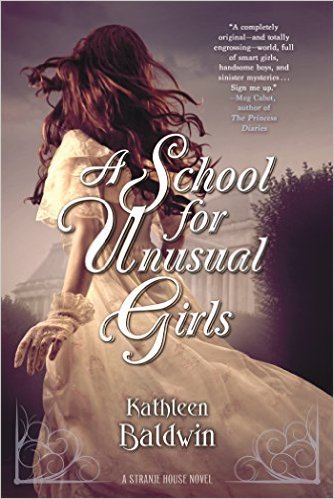
I received an advance copy of this book for review through Netgalley. Rarely have I ever so deeply regretted requesting a book.
The story itself does have some charm. Georgie is a frightfully intelligent (if also clueless) teenager. She gets into scrapes all the time where she tests a theory without properly considering all of the angles (such as when she made her own glider). After having caused a devastating fire with one her experiments, her family drops her off at the Stranje School for Unusual Girls. The scene where her family abandons her there is pure theatre--Georgie's parents are shown medieval torture devices with the implication that these devices are used on the girls to "educate" them. (Of course, that's not true.) Georgie runs off and gets lost in the building--and stumbles on two men discussing the need for invisible ink. By chance, Georgie was working on a formula for invisible ink when she burned the barn down. . .
As quickly becomes clear, the Stranje House is not what it seems, and neither are the girls inside. Each one has some sort of talent--for observation, for bonding with animals--something that makes it difficult for them to fit in with society. Here, they are able to learn the proper modes of behavior while also being useful in the fight against Napoleon. Yep, Napoleon. England's greatest spy resources are a group of underage girls.
I've read far more than my share of novels written during the Regency. I am very familiar with the racism of the time. Thomas De Quincey, in his "Confessions of an English Opium-Eater" from 1822, describes a "Malay" that came to visit him as having "sallow and bilious skin," "small fierce restless eyes, thin lips, slavish gestures and adorations." The extreme focus on the man's appearance--as well as the terms De Quincey uses that express both a vague intrigue and disgust--are typical of the racism of the time. When a contemporary writer sets a novel in the past, she has a choice. She can choose to represent the racism of the time somewhat faithfully. Do do so usually triggers disgust in contemporary readers. She can have an "enlightened" character (and therefore one that is most definitely anachronistic) condemn the racism. She can ignore it and pretend that there was no racism.
Baldwin, unfortunately, takes a variation on the first option. The novel is told from Georgie's first person perspective, so her voice is narrating the story to us. Therefore, we're privileged to read her thoughts about one of the instructors at the school, Madame Cho. Unfortunately, Georgie is never called out on her racist thoughts, so they remain in the book, normalized by their very presence. Let me walk you through a few examples.
The first time Georgie meets Madame Cho, the reader is told "A small Oriental woman padded silently out of the shadows and whacked the mummy case [see comment above about torture devices] several times with a bamboo stick, setting off a sickening chime" (300*). First, people are Asian. Rugs and vases--objects, in other words--are Oriental. Second, the stereotype of her walking--how she "padded silently"--is also disturbing. It ties into images of Asian men and women as dangerous and untrustworthy--racist ideas that were present at the time. Later in the same page, we're told that Madame Cho "looked as crafty as a black cat" (305) and that she moved "swift as a thief" (308). Finally, we're told that she has a "lizard's" eyes (309).
Madame Cho is not the only person to be talked about in a racist fashion. One of the other students is an "exotic creature" named Maya Barrinton (581). She's a "half-caste" daughter of an Englishman and an Indian woman (587). Georgie wonders "How had [Maya] blended into the shadows so perfectly and moved with such quiet stealth? A delicate girl, with dark shining eyes, smooth whiskey-colored skin, she was draped in a swath of cinnamon brown fabric trimmed in filigreed saffron" (582). Later, the "musical quality of [Maya's] voice, or her gentle nature" convinces Georgie to follow the other girls in exploring the house (670).
Sadly, the way that Baldwin writes about Maya is actually more disturbing than the somewhat overt racism of her treatment of Madame Cho. The emphasis on Maya's beauty, on how exotic she is in comparison with these English girls, is yet another racist stereotype. Instead of being the sneaky Other, she's the entrancing, enchanting Other.
Both of these introductions occur fairly early in the text, so one might expect that Georgie would learn better throughout the narrative. Even if she's never confronted with her racism, she can learn to see both Maya and Madame Cho as individuals, can she not? Well, the answer to that seems to be "not". Consistently throughout the rest of the book, Madame Cho is referred to as the "old dragon" (619, 627, 1289, and 2730). She is also referred to as "Madame Dragon" (2286) and as a "sneaky fox" (650). Madame Cho "slithered" into rooms and stared at Georgie with "her cold lizard eyes" (1289-90). Maya remains consistently beautiful, exotic, and sweet.
It should be noted that Madame Cho does nothing to deserve to Georgie's spite. She is simply there. All of the quotes, above, are not dialogue. They are Georgie's mental narrative--the exposition of the book--literally, the words the character uses to describe woman to herself and to her readers.
Georgie herself is a deeply unpleasant character. She never listens to anyone around her. They warn her to take care to avoid haste and dangerous actions--and she does whatever she wants anyway. The romantic relationship is ridiculous in the extreme--the sort of insta-love one typically only sees in a paranormal novel, not in an arguably historical fiction.
I am deeply sorry that I requested this book. I read it from beginning to end, in the hopes that it would improve and that I would be able to leave a positive review. But I cannot.
I consider the book to be bad in both writing and characterization. But I consider it to be dangerous when it comes to race and racism. The casual racism of this text--especially since it is never confronted and recognized as such--is insidious and awful. Too many of our young people do not understand racism well enough to recognize it in this context. Instead, they might find it funny, laugh at "Madame Dragon," and not realize the ideas that they're internalizing.
I have never met Kathleen Baldwin. I do not mean to impugn her character in this review. I simply wish she--and her editors--had made better narrative choices. As it stands now, I do think I can recommend this book to anyone.
*All numbers refer to text locations in my Kindle advanced reader's edition. They have not been checked against the final draft, but the sheer number of them indicate that it's unlikely they will have been edited out.