Je leert een stad pas echt kennen als je in de straten en stegen ervan verdwaalt. Venetië, met al haar verstopte hoeken en gesloten poorten, omringd door de ontelbare lagunes, is gemaakt om de weg in kwijt te raken. Maar, zo weet de echte de weg kwijtraken betekent het vinden van het mooiste wat een plek te bieden heeft. Cees Nooteboom is zo’n echte reiziger. Hij zoekt zijn weg langs gebeeldhouwde bogen en dobberende gondels en neemt de lezer mee achter het toeristische masker van de stad van het water. Vanaf de voorplecht van een vaporetto laat hij leven en kunst aan zich voorbijglijden.Zijn eerste indruk van Venetië publiceerde Nooteboom begin jaren tachtig, vele mijmeringen volgden. Dit voorjaar bezocht hij zijn geliefde stad opnieuw en besefte eens te meer dat in Venetië de verhalen nooit ophouden.
Cees Nooteboom (born Cornelis Johannes Jacobus Maria Nooteboom) was a Dutch author. He has won the Prijs der Nederlandse Letteren, the P.C. Hooft Award, the Pegasus Prize, the Ferdinand Bordewijk Prijs for Rituelen, the Austrian State Prize for European Literature and the Constantijn Huygens Prize, and has frequently been mentioned as a candidate for the Nobel Prize in literature.
His works include Rituelen (Rituals, 1980); Een lied van schijn en wezen (A Song of Truth and Semblance, 1981); Berlijnse notities (Berlin Notes, 1990); Het volgende verhaal (The Following Story, 1991); Allerzielen (All Souls' Day, 1998) and Paradijs verloren (Paradise Lost, 2004). (Het volgende verhaal won him the Aristeion Prize in 1993.) In 2005 he published "De slapende goden | Sueños y otras mentiras", with lithographs by Jürgen Partenheimer.
Cees Nooteboom's atmospheric portrait of Venice which I finished a few weeks ago has merged in my mind with another book I read immediately afterwards, Joseph Brodsky's essay about the city, Watermark, and both have further merged with my own memories of visiting Venice recently. This review is my tribute to both those writers and to their very creative words about the city they love so much.
Nooteboom and Brodsky's books recall the many times their authors (one Dutch, one Russian) visited Venice from the 1960s onwards, sometimes in the company of lovers, sometimes alone. Inevitably, because of lovers later lost, their memories of those visits are tinged with sadness—unlike my own. Mine are greatly influenced by the fun-filled book I read while I was there—Jan Morris's Venice—and I'm grateful to the book gods for arranging my reading in that order. Had I been reading Nooteboom's or Brodsky's beautiful but melancholic thoughts while staring at the waters lapping close to my toes, my experiences of the city might have been different.
However, I'm still very glad to have read their dreamy love letters to Venice—because that's essentially what both books are, as opposed to the entertaining and fact-filled adventure that is Jan Morris' book.
And Nooteboom and Brodsky have given me the desire to revisit Venice in the fogs of winter when, as Nooteboom says in his opening pages, the city becomes "what limbo might well look like, alleys with no exit, sudden bridges, corners, abandoned houses, sounds that belong to nothing, the call of a foghorn, footsteps moving away, faceless passers-by, their heads wrapped in shawls, a city full of spirits, Monteverdi, Proust,Wagner, Mann, Couperus, wandering in the constant proximity of that black, death-coated water, polished like a marble gravestone."
Brodsky's book begins with a description of the fogs of winter too: a traveler arrives at the station on a winter's night and is confronted with "the dark silhouettes of church cupolas and rooftops; a bridge arching over a body of water's black curve, both ends of which were clipped off by infinity. At night, infinity in foreign realms arrives with the last lamppost, and here it was twenty meters away..."
Nooteboom talks about his own arrival by train, and quotes his compatriot, Louis Couperus, whose impressions of the station area sound a lot like Brodsky's : "The high bridges arched across the dim canals and there was a dark scent of moisture, moss and green decay, and the atmosphere of a centuries-old mysterious past, a past of intrigue and crime; dark figures skulked across the bridges, along the waterside, wrapped in cloaks, masked…But they were only shades, merely phantoms of the imagination."
That dark brooding silent Venice recurs in both their portraits of the city—"with the frequency of a bad dream" as Brodsky puts it. They avoid tourists where possible—Brodsky never visits the city in summer—while being always conscious that they too are outsiders. Nooteboom is sometimes addressed by the name on the nameplate of the apartment he is renting, giving him the illusion of being a true Venetian, and he tries to cultivate native habits such as always taking his morning coffee at the same table in the same café, but he knows that no matter how hard he tries to merge with the background—I tried to look like a chair—he is never taken for a native. The historical right to be there, no matter the long history of his visits, inevitably eludes him.
Brodsky talks about the perennial strangeness of the city and relates it partly to the destabilizing aspect of having to traverse it by boat. As he rides the vaporetto from the infinity-shrouded station area on his first winter's night in Venice (reminding me of Calvino's traveler), he says: "There is something primordial about traveling on water, even for short distances. You are informed that you are not supposed to be there not so much by your eyes, ears, nose, palate, or palm as by your feet, which feel odd acting as an organ of sense. Water unsettles the principle of horizontality, especially at night, when its surface resembles pavement."
Speaking of Calvino, books and reading are a big part of Brodsky's and Nooteboom's Venice. Brodsky likens walking through the narrow streets at night to passing among "the bookshelves of some immense, forgotten library. All the 'books' are shut tight, and you guess what they are about only by the names on their spines, under the doorbells."
Both authors reflect on the books they read while in the city. Many famous names associated with Venice are mentioned, as you might expect, but interestingly, both mention the little-known novels of the French writer Henri de Régnier (I saw a plaque with his name on it when I was there), many of which are set in Venice in winter. Reflecting on one of Régnier's novels, Brodsky says, "from its pages came the sense of damp, cold, narrow streets through which one hurries in a state of growing apprehension, turning left, turning right. For somebody with my birthplace, the city emerging from these pages was easily recognizable and felt like Petersburg's extension into a better history, not to mention latitude."
Nooteboom also finds parallels between Venice and the city he hails from, Amsterdam, with its huge network of canals and bridges. And when I pause to think about it, the three cities, Petersburg, Amsterdam, and Venice, are all as if reclaimed from the sea in defiance of possibility. Petersburg was built on marshy grounds on the very edge of the Baltic sea and has its own network of canals and bridges, Amsterdam lies below sea level, and Venice sits on little islands of silt deposited by the tides of the Adriatic. No wonder Brodsky and Nooteboom returned to Venice so very often.
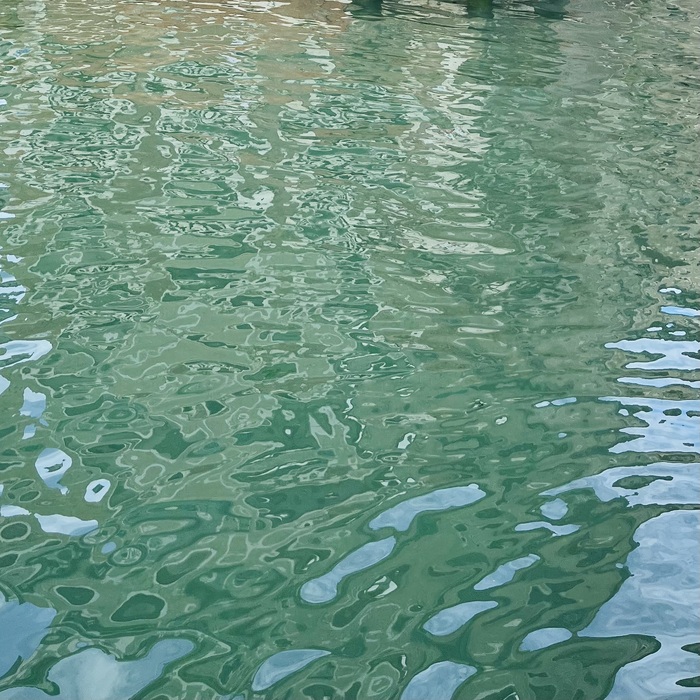
The quality of winter light seems to be something that attracts both of them too, and especially light as it is reflected on water. On one of his visits, Nooteboom had an apartment with windows looking onto a canal, "and when the wind or one of the few boats that came by stirred the water, all manner of moving pictures were created in the grayish green, and I could watch for hours. Long before modern painters, wind and water distorted and stretched things and colours, making rectangles ripple and gleam in a way that a window or a wall can never in fact move" all of which echoes Brodsky's "hues and rhythms of the local facades [reflected in] the waves' ever-changing colors and patterns" which in turn reflects my own photos from my time there.
Further on, after stepping out from a music recital, Brodsky thinks about the history of Venice and its waters, and I immediately understood why he is principally known as a poet: "For water, too, is choral, in more ways than one. It is the same water that carried the Crusaders, the merchants, St Mark's relics, Turks, every kind of cargo, military, or pleasure vessel, above all it reflected everybody who ever lived, not to mention stayed, in this city, everybody who ever strolled or wades its streets. Small wonder that it looks muddy green in the daytime and pitch black at night, rivaling the firmament. A miracle that, rubbed the right and the wrong way for over a millennium, it doesn't have holes in it, that it is still H2O, though you would never drink it; that it still rises. It really does look like musical sheets, frayed at the edges, constantly played, coming to you in tidal scores, in bars of canals with innumerable obbligati of bridges, mullioned windows, or curved crownings of Coducci cathedrals, not to mention the violin necks of gondolas. In fact, the whole city, especially at night, resembles a gigantic orchestra, with dimly lit music stands of palazzi, with a restless chorus of waves, with the falsetto of a star in the winter sky. The music is, of course, greater than the band, and no hand turns the page."
Interestingly, Nooteboom talks about reading Brodsky's poems while in Venice, and also his Watermark essay which I've been quoting from here. And Nooteboom goes on to say: "If you walk along the Zattere to the tip of the Dogana, you pass the famous guesthouse La Calcina—the house where Ruskin once lived…Not far from there is a brick wall with a simple plaque stating that Brodsky often stayed in the house behind it, the home of a noble Venetian friend. Through a gate you can catch a glimpse of the house and garden, but that is all. On the cover of his collected poems in English, which I have with me, he sits relaxed on a bench on a quayside, with his eternal cigarette, legs crossed, left hand in the pocket of his jeans, someone who did not necessarily want to be photographed. With a slightly ironic smile, he looks into the camera. He had a bad heart, was not actually allowed to smoke or drink, but disregarded that advice. It must be autumn or winter, judging by the peeling walls of the house behind him, it may also be Venice, through one of the windows a chaos of furniture and antique frames for paintings, possibly a second-hand bookshop. In the book, I read the poems that have to do with Venice…What strikes the reader of 'Watermark' is the lightning fast eye through which everything he sees and thinks is processed with an undertone of melancholy; in the poetry, it is the rapid succession of kaleidoscopic images, with a combination of that quickness of seeing and thinking and a form of sadness, especially in the longer poems."
While visiting the Jewish cemetery on the Lido, Nooteboom gives us some further thoughts on Brodsky—and on another author I admire a lot, Georgio Bassani: "The tall gravestones lean towards one another, as if bowing and courtseying....everything is possible here now, the illegible names, the dancing shadows on the fallen stones, all a mixture of misery and another sentiment that is much harder to interpret, perhaps an almost inexplicable joy because the world is as it is. Suddenly, I wonder if Brodsky ever walked around here. What would he have thought beside the grave of Esther Finzi Cohen? Anyone who has ever read Georgio Bassani's 'Il Giardino dei Finzi-Contini' or seen Vittorio De Sica's film about Jewish life in this part of Italy and how the war and hatred put an end to it, knows the forms of nostalgia for the past that has gone for good, which makes you stop at this grave because something impossible and incomprehensible is expressed on this stone too... I stand there for a while, looking at the broken branches, the withered laurel leaves, and leave this Esther alone among all those others she knew or did not know. On the way out, I deposit my kippah in a basket among the other kippahs..."
Before this review becomes as 'yawn-inducing' as Brodsky considers recounting dreams to be, a thought prompted by quoting compatriot Anna Akhmatova's statement that, "Italy is a dream that keeps returning for the rest of your life", I will wrap up with a quote from Nooteboom about reading his compatriot Louis Couperus' recollections of visiting Venice with a lost lover decades before. When he looks up from the Couperus book, Nooteboom finds that "the century between him and me has evaporated, that is what I saw for myself just a few days ago, and when I close my eyes, I see Couperus sitting in his Venetian hotel and hear his pen scribbling the words I have just read."
While reading Nooteboom and Brodsky, I would often look up to think a similar thought: the decades between their experience and mine had evaporated, what they'd just mentioned was what I'd seen for myself a short time before, and I too had a clear image of Brodsky and Nooteboom sitting in one or another of their various Venetian lodgings, scribbling the words I had just read…
bellissimo! il libro che avrei voluto scrivere su Venezia se sapessi scrivere come Cees!
Ha perfettamente colto l'essenza del visitatore consapevole (e reiterato - quello che a Venezia deve dormirci, e svegliarcisi, e ritornarci, e camminarci, e poi scoprire che ci sono ancora tantissime cose che non ha visto, non sa, non conosce) e l'anima scoperta e segreta di questa città che se ti entra sotto alla pelle non ne esce più.
Ik heb lange tijd het werk van Nooteboom gemeden. Ik had namelijk een boek met reisverhalen van zijn hand gelezen waaraan ik mij flink had geërgerd omdat naar mijn mening de taal te gezwollen was en het voornamelijk mooischrijverij om de mooischrijverij was. (Ik kan me zo niet meer herinneren welke bundel dit was). Een aantal jaren terug pakte ik een later werk van hem en zag toen dat het veel beheerster was geschreven en dat de taal doelgericht en precies maar ook bloemrijk was. Daarna heb ik nog een aantal boeken van hem gelezen die ik mooi vond.
Ik was erg geïnteresseerd in dit boek omdat ik in 2005 en 2008 zelf twee keer anderhalve week in Venetië ben geweest en het een heerlijke stad vond om in te verdwalen. Beide keren gingen we begin juni, hetgeen een mooie tijd is vanwege het vele daglicht en de nog redelijk fris ruikende kanalen. Ik heb nog veel beelden in mijn hoofd die door het lezen van dit boek van Cees Nooteboom alleen maar versterkt werden. Net als de schrijver werd ik ook verliefd op deze merkwaardige stad in het water.
Het boek van Nooteboom spant heeft gelukkig slechts weinig van de gezwollen taal en mooischrijverij waar ik me in het verleden aan ergerde. Veel van wat hij over Venetië schrijft is van een beeldende schoonheid en hij weet mijn herinneringen weer op gang te brengen. Zijn beschrijvingen van de kunst in Venetië vind ik minder interessant. Vooral zijn omzwervingen door de stad, de beschrijvingen van plekken en gebouwen vind ik erg mooi. Als fotograaf ben ik natuurlijk vrij krititsch op de foto's in het boek waarvan ik een paar erg mooi vind maar de rest middelmatig. Ze voegen naar mijn mening weinig toe. Het gaat dan ook voornamelijk om de tekst en die is van hoog niveau. Een absolute aanrader.
Voor degenen die na het lezen van dit boek nog geen genoeg hebben van Venetië, kan ik de 9 delige podcastreeks Venezia, met Serge Simonart uitgezonden door het programma Klara op de Belgische radio aanraden. https://radioplus.be/#/klara/herbelui...
Voor mijn verjaardag kreeg ik van mijn echtgenote onlangs "Venetië" van Cees Nooteboom, een cadeau dat vooral bedoeld was om mijn reislust en verlangen naar eigen Venetiaanse belevenissen aan te wakkeren. Dat lukte heel aardig, want door dit boek raakte ik zwaar aan het mijmeren over deze bijzondere, weliswaar al te toeristische, maar toch onuitputtelijk mysterieuze stad. Maar nog fascinerender vond ik om een tijd te verblijven in Nootebooms hoofd, dat een brein heeft met beschouwelijke mijmeringen als in geen enkel ander brein, en ogen die zien wat geen enkel ander oog ooit ziet. Nooteboom dwaalt door plekken in Venetië waar geen toerist ooit komt, kijkt naar dingen die geen toerist ooit ziet, of kijkt naar al te bekende schilderijen en kerken met een blik die opmerkt wat geen toerist ooit opmerkt, en doet dit met een hoofd vol herinneringen en erudiete beschouwingen die elke toerist volkomen vreemd zijn. Hij is een reiziger die doolt en dwaalt door de stad, zonder plan, en komt waar niemand komt, en die doolt en dwaalt in zijn eigen hoofd, en zijn indrukken dus verrijkt met associaties die niemand anders ooit bedenkt. Althans niet op die manier, in die meanderende en gedragen stijl. Was ik nu maar in Venetië, dacht ik na het lezen van dit boek. Maar vooral: had ik maar zo'n rijk hoofd, en zo'n opmerkzaam oog.
Het boek is een bundeling van meerdere, soms oudere stukken, die soms verfraaid worden door foto's van Simone Stassen (Nootebooms partner). Meerdere indrukken uit meerdere Venetië- bezoeken raken in die stukken met elkaar vermengd, wat nog wordt versterkt door de pluriforme en vloeiende veelvormigheid van de stad zelf: opgetrokken uit eilanden omringd met water, op elke straathoek verwijzend naar vele verledens en een even rijke als mysterieuze geschiedenis. Heden en verleden vervloeien kortom voortdurend, in de stad en in Nootebooms hoofd, wat Nooteboom fraai voelbaar maakt door vaak te spreken over het "nu van toen" en het "toen van nu", en door zijn zinnen inhoudelijk en grammaticaal soms eindeloos te laten meanderen. Venetië bestaat uit eilandjes in een grillig meanderende lagune, Nootebooms zinnen lijken soms wel reeksen eilandjes met komma's ertussen. Of, wellicht, meanderende lagunes met komma's die de kronkelingen en eilandjes markeren. Zoals bijvoorbeeld deze zin: "Alles wat ik nu wil is op het water een boot zien, de roeiers afgetekend tegen het licht van de horizon, maar het enige wat er te zien valt is het water zelf, een grijze, glanzende vlakte waarin maar weinigen de geheime wegen kennen, we lopen over de smaller weg tussen de groene velden en het water, Venetië is ver weg en dichtbij, en terwijl ik daar loop met de maat van mijn stappen met de wind als begeleider, probeer ik te denken over het wonder van dit alles, een stad door mensen in dit water gebouwd, een mensensoort dat in dit waterlandschap een krankzinnige droom gedroomd heeft, in gedachten zie ik over het water een stad oprijzen van paleizen en kerken, een nooit zo gezien visioen".
Dat de stad Venetië uitnodigt tot dromen en visioenen was mij natuurlijk bekend, al was het maar door al die andere schrijvers - Mann, Brodsky, Mulisch, Henry James, Twain, Luiselli, Donna Leon- die zich door deze stad lieten inspireren. Maar de verlokking van die dromen en visioenen worden door Nooteboom nog verder versterkt, ten eerste omdat hij zich op aanstekelijke wijze door al die schrijvers laat inspireren, maar ook en vooral door zijn stijl, en boven alles door het aanstekelijk verlangen dat uit die stijl opstijgt. Bijvoorbeeld in de volgende scene, in een kerk waar Nooteboom min of meer toevallig is aangeland: "en dan gebeurt het, ineens stroomt de kerk vol gecomponeerd geluid, stemmen die zich door elkaar heen weven, elkaar achtervolgen, ondersteunen, mensen die geen instrument nodig hebben om muziek te maken, hun lichaam is hun instrument, de stemmen vliegen langs de hoge zuilen omhoog, zoeken de muren op, dwalen door het gewelf tot de hele kerk van muziek is en wij gewiegd worden, in harmonieën die dingen beloven die niet bestaan, behalve nu, in deze muziek". Of in een andere scene, in nog weer een andere kerk waar Nooteboom ook weer min of meer toevallig via een dwalende voettocht is aangeland: "Met romaans en gothiek blijf ik meestal op de grond zoals dat bij mensen hoort, maar bij een barokkerk als deze zou ik vleugels willen hebben, gewoon om door de ruimte te zoeven en dan als een soort reuzenkolibrie voor het hoofdaltaar te blijven hangen om de gedraaide zuilen van rond Frans marmer beter te bekijken, en dan langzaam mijn ogen naar boven te laten draaien om het op die zuilen uitgewaaierde schuim van de ijselijk witte marmeren Korinthische kapitelen van zo dichtbij mogelijk op me in te laten werken en daar te blijven kijken waar de geordende waanzin van de barok omhoogvliegt naar een kroon en koepel van extreme uitbundigheid". In de eerste scene een wereld van muziek, die dingen belooft die in de echte wereld niet kunnen bestaan, en juist dat maakt die wereld zo verlokkend. In de tweede scene het verlangen op te vliegen naar "geordende waanzin", in plaats van met beide benen op de grond te blijven: ook hier dus weer een onmogelijkheid, die door zijn onmogelijkheid verlokt. Dat is de verlangende droom die Nooteboom overal in Venetië droomt, kijkend naar het water, starend naar de vele beeldhouwwerken, mijmerend bij de overdadig aanwezige kunst van de vele grote Venetiaanse schilders, bladerend in vele mooie boeken over Venetië en zijn geschiedenis, en ronddwalend door de stad en het eigen geheugen. En dat is ook de droom die Nooteboom zijn lezers laat voelen, door de rijke inhoud en meanderende elegantie van zijn stijl.
Wil ik nu naar Venetië? Meer dan eerst, in elk geval, al schrikken de wagonladingen toeristen mij nog steeds af. Maar ik wil vooral meer Nooteboom.
Ik ben nog nooit in Venetië geweest en ik vrees dat dit ook nooit zal gebeuren. Er is zoveel te zien in de wereld en dan opteer ik liever voor rustiger oorden dat plaatsen die in niet-Corona-tijden door toeristen worden overspoeld. Niet zo voor Cees Nooteboom, hij houdt van deze stad aan en in het water, verblijft er vaak in rustiger tijden en mijdt de drukke plaatsen. Voor hem is Venetië een constante in zijn bestaan als reiziger. Met Cees Nooteboom gaan we op verkenning naar minder gekende plaatsen van deze stad, we gaan waar zijn stappen ons voeren. En hij doet dat op een weergaloze manier. Deze man blijft verwonderd over wat hij ziet, deze man kan schrijven, deze man kan zijn ervaringen delen, deze man is een meester-observator die de tijd neemt om zijn waarnemingen duidelijk en poëtisch neer te schrijven, het is alsof je erbij bent, je ziet de stad, de kunstwerken die hij beschrijft, de kerken die hij bezoekt, zijn wandelingen, de beweging van het water, door zijn ogen. Cees Nooteboom is zonder twijfel een taalvirtuoos. Zelfs al ken je, net zoals ik, de stad niet en heb je geen voorstelling van de dingen, toch geniet je van elke pagina. Er staan ook foto's in het boek die zijn tekst ondersteunen. De beschreven kunstwerken moet je zelf googelen.
El viaje a Venecia de Nooteboom tiene algo de clásico y algo de postmoderno. Es tan clásico que no tiene más remedio que actualizar el síndrome de Stendhal, es tan inevitable como un contagio:
“El sol rebotaba en la plaza contra las redondas formas femeninas de arcadas y cúpulas, el mundo hizo un giro de noventa grados y sentí que la cabeza me daba vueltas. En aquel lugar el ser humano había creado algo imposible: en un par de terrenos pantanosos, había inventado un antídoto, un remedio mágico contra toda la fealdad del mundo. Esas imágenes las había visto yo cientos de veces y, sin embargo, no estaba preparado para ellas, porque me enfrentaba a la perfección. Aquel sentimiento de felicidad que me embargó nunca me ha abandonado. Recuerdo que me encaminé hacia aquella plaza [de San Marco] como si estuviera haciendo algo prohibido: salí de los angostos y oscuros callejones y me adentré en aquel gran rectángulo desprotegido, bañado por la luz del sol, con aquella cosa asomando al fondo, aquel inverosímil encaje de piedra”. . Pero también es postmoderno porque no puede omitir lo que ya se ha vivido allí, lo que se ha escrito, el paso de las hordas de turistas, la sensación de decorado de ficción. Entra en una iglesia barroca y piensa que es una gran nave espacial, sospecha que está hospedado en la misma habitación del hotel desde donde Kafka le envió la última carta a Felice, busca la comisaría del inspector Brunetti de Donna Leon: la comisaría existe, el inspector no pero “creo que Brunetti sigue trabajando aquí”.
Nu, dit is het eerste boek in het Nederlands dat ik *vrijwillig* gelezen heb. En het was niet zo erg! Begrijp mij niet verkeerd, ik bedoel hiermee dat ik aangenaam verrast was met de beschrijvende taal, waarvan ik dacht dat die al lang niet meer bestond in deze ordes. Sommige passages die aan de goede oude tijden, wanneer men geen haast had, doen denken, maakten het wel voor mij. Zo onbeschaamd ouderwets met taal schilderen - daar had ik niet op durven hopen, maar dat kwam ik wel tegen, vandaar zoveel sterren. Het is wel zo dat ‘reisnotities’ minder spannend zijn om te volgen dan een roman, omdat er schijnbaar geen verhaallijn is. Toch zal het eerder eigen aan de genre zijn en niet zozeer aan het werk an sich, dat bovendien toch relatief vlot las.
Venice has been recuperating in 2020 from the mass onslaught of tourists it has suffered over the past few years. It is a mixed blessing in many ways for the people who depend on the tourist income but a boon to creating a cleaner and less trampled city. Thus, this is a timely book of gathered thoughts, reflections and historical observations, effusively tied together with art and culture. This is a must-read for anyone who loves the city; Cees Nooteboom somehow manages to say something new and profound about the city. He references past authors and artists who have brought us the city in its many guises, he can evoke the colour and smells of the lapping waters, and, in delightful prose, he describes the simple pleasures of travelling by boat to outlying islands.
The author has been visiting the city since the 1960s and he returns time and again to explore and imbibe the atmosphere, gathering experiences and learning along the way. It is like exploring the city through his eyes, a true treasury! And whilst I am on the subject of literary wanderlust, I would like to quote a piece from the text: Two of the best-known thriller writers who focus on Venice are Michael Dibdin and Donna Leon. I enjoy reading thrillers, but I am most fond of the ones about Venice, as I feel that by reading them I understand more about the city. After all, they take you all kinds of places. Shipyards, hospitals, palazzi – you find crime and corruption everywhere. And when I read something like that, something about strange and ancient sea defences, I want to go there. It is one of the way in which I penetrate the secrets of the city.
And not only do you have his erudite words, but the photos by Simone Sassen are interspersed throughout the text and really evoke the city. Nooteboom has a lyrical writing style, brought to us beautifully in translation by Laura Watkinson.
I very much enjoyed this book by the writer Cees Nooteboom. I have read several of his works, liked some and disliked others, and this is definitely in the liked category. It is at times more like reading poetry in prose form, than ordinary prose. It is about Venice, and if you know Venice will tell you various things you did not know, but I suspect it may be a more challenging read to enjoy if you have never been there or have no concept of the city. The topic is explicitly Venice, but implicitly it is also about the author and traveller himself. It felt to me at times like an old lover describing the sense of seeing his beloved for the last time and knowing it is the last time.
It contains many interesting observations, but is mostly about mood and the feel for the city. You should not expect a guidebook, but still there is plenty to learn.
Additionally, it is generously and well illustrated with photos by the author's wife which suit the text and the mood it creates.
Non sono un'amante dei libri di viaggio...troppo ondivaghi, li seguo male senza la traccia stretta del "plot". Ma Venezia rimane nel cuore se la si è vista almeno una volta nella vita. E ogni volta che se ne parla viene voglia di tornarci; magari con un merryraduno!!!
Qui la luce è usata come se fosse un materiale, ha dato il suo colore alle slanciate colonne che sollevano in alto l’edificio, si viene come trascinati in avanti, verso l’iconostasi che posa su colonne ancora più leggere, sopra i bassorilievi in marmo di pavoni e di leoni. [Torcello]
la tempesta spirituale dell’illuminato XVIII secolo, quando si pensava di poter rifare da capo il mondo in chiaroscuro, leggero e profondo al tempo stesso, un teatro che figure di giganti, a passo di danza, hanno attraversato scrivendo, intrigando, pensando tra letti, salotti e scrivanie, con l’Encyclopédie e la ghigliottina sullo sfondo. [su Casanova] [...] Ora però vorrei dire, con Sollers, che da questo XXI secolo non verrà niente di buono se non ritroveremo lo spirito del XVIII.
Se non sapessi che si tratta di Maria, vedrei una donna su un trono, con un bambino in grembo che porge un paio di chiavi a un vecchio. Il vecchio ha un triregno in capo, e se sai cos’è un triregno, sai anche che qui davanti a te hai un papa e, visto che tiene ben salda in mano una grossa chiave, deve essere Pietro, il primo papa di Roma. L’enigma delle immagini: se significassero solo quel che vedi, letteralmente, potrebbero suscitare strane idee. Per un attimo mi metto nei panni di un turista cinese dello Xiangzhou che ha perso di vista i compagni di viaggio: cosa vedrei allora? Un bambinetto con una gamba sola in grembo a una giovane che ha la gonna diventata di roccia, un uccello rimasto pietrificato sopra le figure. Una storia, senza dubbio, ma cosa significa?
Ero diffidente, avendo letto anni fa un libro di Nooteboom e avendolo trovato autore molto saccente e autoreferenziale. Ma mi sono ricreduta. Da anni non trovavo un libro su Venezia così piacevole e interessante. Contiene, com’è inevitabile, alcuni errori e alcune banalità, ma contiene anche molti pensieri interessanti, e storie avvincenti. Più di una volta sono rimasta commossa nello scoprire delle vere e proprie affinità fra i suoi sentimenti per la città e i miei, nell’immaginarlo percorrere le mie strade, i miei giardini, osservando chiese, statue, facciate che conosco così bene (l'autore ama, fra tante altre cose, il sestiere dove vivo). Nooteboom non è solo un pozzo di scienza, ma un'intelligenza brillante e acuta sempre in movimento, una curiosità instancabile e mai futile. Peccato solo per le fotografie che si è voluto aggiungere per accompagnare il testo: era una buona idea, ma queste, fatte dalla moglie, sono assolutamente insignificanti.
I was sure I'd read Nooteboom before, but Goodreads says I haven't. No matter. Picked this up in a bookstore in, well, wouldn't you know it, Venice, started it by the B&B window overlooking a minor yet surprisingly noisy canal, and finished it on the train out. Did that play a role in my loving it? Probably. Nooteboom hit several thoughts I'd had during my brief stay (the conflict between a frozen, open-air-museum city and the hordes of tourists taking selfies with centuries-old monuments, many details of their visual language forgotten and unexplainable by now; the overwhelm / saturation of seeing too many impressive things in quick succession, and of knowing it's been seen and written about over literal centuries; the unlikeliness of this city even existing in the first place, much less becoming a trading empire and a center of the cultural age; the eerie, mysterious quality of this fragmented city, the unavoidability of getting lost and feeling locked in when you turn a corner and almost slip into a canal), but writes them much better than could I.
Het eerste boek dat ik lees van Nooteboom en het smaakt meteen naar meer. De poëtische pracht waarmee hij Venetië beschrijft, geeft net dat laatste duwtje om la Serenissima te bezoeken. De toeristenmassa neem je er graag bij want speelt gelukkig slechts een figurantenrol in dit boek.
De zin die me het meeste bijblijft: "Ik weet niet of het Baudelaire was die musea met bordelen vergeleek, maar zeker is dat er altijd veel meer schilderijen zijn die met jou iets willen dan dat jij met hen iets wilt". Prachtig.
Thank you NetGalley for providing me with an e-ARC in exchange for an honest review.
I found Venice as a book quite.. tedious. The text is very dense and the writing style isn't consistent that you can get through a couple of essays and fall into a predictable rhythm. The research and the content is spectacular, as are some of the shorter essays. The author's love for Venice is clear and palpable, but for someone unfamiliar with the location, it's not necessarily the most comprehensive but rather rambly and voluble with little context. It's endearing to think about an old man walking Venice end to end to find interesting things, but the writing doesn't readily yield to that image.
I presume if you can get through swathes of dense prose, lots of tangents, and want to understand Venice better from a European traveler's perspective, you'll enjoy it. I personally had to force myself to finish it for this review.
A more pompous and pretentious book I have never read.
With short delves into the history and future of Venice, Nooteboom is very much captivated by the present, by the interplay of water upon the perceptions of the Serene Republic and I can appreciate that. I too can appreciate the multiple arrivals he undertakes, as I too have visited Venice multiple times and arrived in many forms, each of which introduce you to the city in a new light.
However, for me too much of the book is overshadowed by the author’s imaginings, detailing his own interpretations of the city’s quirks, yet he is quick to dismiss the experiences of the mass market tourists.
I love the city and understand the damage done by the cruise ships, air B&B and the negative multiplier effect yet until an alternative is provided, why should those from more deprived backgrounds or those from further afield be priced out of and excluded from the wonders of Venice - the lion, the city and the water?
Mooie belletrie. Daar is niets op af te dingen. En toch heb ik ook deze lectuur weer afgesloten met een onvoldaan gevoel, zoals vaak, zoniet meestal bij Nooteboom. Er staan heel veel mooie volzinnen in dit boek, maar geen één die me echt treft. Och, het kan ook aan mij liggen ...
In a pandemic the only safe travel is armchair travel through the eyes and experiences of another. Author Nooteboom takes the reader to Venice time and time again in the wonderful travel memoir that is Venice: The Lion, the City, and the Water. The author first visited Venice in 1964 and has returned ten times for stays that are much longer than the average American tourist. I have visited Venice three times so far and many of Nooteboom’s recollections struck a memory chord of mine. Memories so well told as the early morning walks as the boats of vegetables and fish arrive at the market, the symphony of footsteps as the day nears an end, a visit to an early morning mass with a group of Venetian faithful as they have gathered together for 1500 years. There are impressions of canals, neighboring islands and architecture as personal and lyrical as only a poet like the author can tell. The author’s visits also tell of the seasons in Venice especially the splendor of late fall and the quiet of late winter. I particularly enjoyed the author’s own reading list about Venice from such contemporary novelists as Donna Leon and Michael Dibdin to Venetian visitors of long ago including Mark Twain and Henry James and other lesser known writers. There are recollections of painters and their paintings that have impressed, museums, special exhibitions and churches all rendered in well told tales. A “nation of statues lives in Venice” each with its own history. Visits to Venice and this book are highly recommended.
A poetic transportation to the City of the Lion. I have loved every word of every sentence I have read. Until now, I had never been to Venice, but it was so well depicted that it was as if I had been there all the time.
Un libro bellissimo e potrei fermarmi qui. Questo "Venezia. Il Leona, la città e l'acqua" è un il risultato delle innumerevoli visite effettuate dal suo autore a Venezia, dal quale emerge tutto l'amore ed il rispetto per questa incredibile città. Un libro che non è un libro, ma più una raccolta di pensieri ed osservazioni, capaci però di cogliere perfettamente quel "sotto" che il turista medio non riesce, e non vuole cogliere. Inoltre, ritrovo nelle parole di Nooteboom molti dei suoi pensieri, come quello di lasciarsi perdere tra i calli e ponti ed all'improvviso ritrovarsi davanti ad un palazzo mai visto prima o ad particolare mai notato in precedenza, o quello di esplorare le parti meno turistiche della città, come le isole o alcuni quartieri più esterni al centro storico. Insomma, un libro da vivere più che da leggere.
Un libro sin guión porque da la impresión que Cees Nooteboom, en una prueba de entender la ciudad, se rinde ante el laberinto de la Venecia que él ve y describe.
Un bonito homenaje, repleto de erudición, a la 'Serenissima'. Nooteboom es un escritor diferente.
«Nunca había contemplado tanto el agua como en esta ciudad. Cuando vas sentado en un 'vaporetto', el agua, que cambia constantemente de color y de forma, queda a la altura de los ojos. Esta es la ciudad líquida por excelencia; si permaneces en ella el tiempo suficiente, su forma, tal como se presenta en el plano, se convierte en parte de tu cuerpo, un contraste continuo entre la movilidad del agua y la inmovilidad de la piedra, la irrevocabilidad de los muros, el extremo inexorable de una calle que termina en un canal y te obliga a dar la vuelta».
4,5 Nel libro l'autore racconta il suo rapporto con la città di Venezia e facendolo permette al lettore di viaggiare con lui, di far caso al dettaglio in una calle solitaria o su un angolo di un edificio, di empatizzare con i veneziani e di conoscere i loro trucchetti, di apprendere una goccia della storia e dell'arte di cui Venezia è intrisa. Ho assaporato ogni pagina, serbandola per i momenti di calma e concentrazione al fine di immergermi nelle suggestive atmosfere che la città è in grado di creare e che l'autore ha saputo immortalare con le parole. Complice un viaggio a Venezia, in cui mi sono sorpresa a riconoscere casualmente le fotografie (poche, di scorci) presenti nel libro, mi sono gustata con piacere la somma dei viaggi compiuti da Cees Nooteboom nella città del leone e dell'acqua.
Questo libro è la perfezione assoluta. I miei complimenti allo scrittore per aver descritto Venezia in modo impeccabile. Le sensazioni che ho provato leggendolo sono quelle di essere cittadina di questa città . Mi rendo conto che anche se ho avuto modo di visitare Venezia non mi sono sentita veramente lì come lo sono stata con questa lettura. Un libro straordinario con un fascino incredibile. Ogni racconto è come una fotografia, ogni racconto una riflessione. C’è tutto in questo libro: arte, storia, politica, turismo, vite vissute, la quotidianità della gente. Ti fa innamorare di Venezia fin dalle prime pagine e ti porta a sognare ogni angolo di questa magica città. Non c’è nient’altro da aggiungere perché tutto è perfetto.
A love letter to Venice from the acclaimed Dutch author. Written over a period during which he made many extended visits to the city he thinks of as his spiritual home, this book is many things. It is a travel guide, a companion to the lesser known Venice, the sights and sounds most of us never seek out. It is a history lesson, a geography lesson, educating the reader about this unique place and its centuries as a vital hub for international trade, a centre of power and a bridge between east and west. It is also a meditation where the author takes us with him on his rambles around the city, his wanderings, his contemplations. A fascinating bok which, like all good travel writing, tells us something about the author too.
Nooteboom en Venetië, dat moet wel een mooie combinatie opleveren. En inderdaad: Nooteboom zal nooit van Venetië zijn, maar Venetië is wel van hem. Hij schrijft over wat hij gelezen heeft, over de kunst die hij ziet, maar vooral over het onverwachte. In de beste stukken koppelt hij de doges en hun geschiedenis aan het landschap van de lagune. En verwondert hij zich over de beelden die in de stad staan en over de ontdekkingsreizigers die de stad heeft voortgebracht, waaronder één wiens standbeeld hij ziet en die op de Noordpool is doodgevroren. Ook een elegisch boek over een stad die aan stijgend water, massatoerisme en corruptie ten onder lijkt te gaan.
No soy fan de los libros de viajes pero este de Cees me ha gustado mucho. No sé si por la nostalgia de viajar en tiempos de covid o porque realmente, más que un libro de viajes, el autor neerlandés describe escenas, cuadros, personajes, problemas e historias de una ciudad peculiar.
Aunque he disfrutado de la lectura, tengo que decir que me costó un poco entrar en el libro. Una vez adaptado al estilo de Cees he podido disfrutar de sus impresiones de Venecia, que cuenta evitando caer en generalidades, y los (re)descubrimientos de artistas y lugares que, espero, algún día visitaré una vez supere la pereza que me da bregar con miles de turistas como yo.
Ik ben het boek beginnen lezen voor dat ik naar Venetië ging en na ongeveer 100 bladzijden opzijgelegd, het zegde me gewoon niets, het leek vaak ook nergens over te gaan. Na mijn vakantie heb ik het terug opnieuw opgepikt en wanneer hij schrijft over delen van de stad waar ik ook geweest ben, kan ik me alles heel levendig voorstellen en begon het me wel te boeien. In het algemeen toch wat teleurgesteld, heb al veel betere reisliteratuur gelezen, met iemand als Paul Theroux zit ik vanaf de eerste bladzijde mee op de trein, daar slaagt Nooteboom niet in, misschien omdat hij vaak zijn mijmerende gedachten opschrijft in plaats van de omgeving te beschrijven.
Venice a city of passion, romance and picturesque delight, well you would think so but unfortunately this author has killed any thought of that with endless lists of churches, historic dead VIPs and endless moaning of tourism. With the exceptional canvas in front of the author... yes he does know a lot about the cities famous previous inhabitants and can drop the odd one or forty trivia about the doges "leaders" of Venice but I wanted more than a walk through some dusty library full of long forgotten names.
N doorsnee Nooteboom, dus knap geschreven, vol van zijn typische ‘passanten-boodschap’. Misschien juist daardoor kwam het extra speciale van Venetie voor mij minder uit de verf dan wanneer een ‘local’ het geschreven had, vergelijkbaar aan hoe waarachtig Pamuk over zijn Istanbul schreef, die andere toverstad. Al ligt de lat voor literatoren wel giga hoog die over Venetie willen schrijven, over dat laatste is Nooteboom openhartig eerlijk en bijna adept van Brodsky eva