

What do you think?
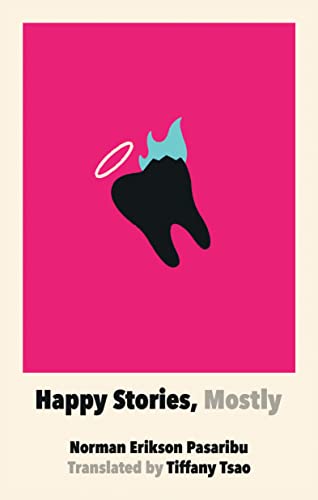
Happy Stories, Mostly
In their stunning fiction debut, queer Indonesian writer Norman Erikson Pasaribu blends together speculative fiction and dark absurdism, drawing from Batak and Christian cultural elements. Longlisted for the International Booker Prize, Happy Stories, Mostly introduces “one of the most important Indonesian writers today” ( Litro Magazine ). These twelve short stories ask what it means to be almost happy—to nearly find joy, to sort-of be accepted, but to never fully grasp one's desire. Joy shimmers on the horizon, just out of reach. An employee navigates their new workplace, a department of Heaven devoted to archiving unanswered prayers; a tourist in Vietnam seeks solace following her son’s suicide; a young student befriends a classmate obsessed with verifying the existence of a mythical hundred-foot-tall man. A tragicomic collection that probes the miraculous, melancholy nature of survival amid loneliness, Happy Stories, Mostly considers an oblique approach to human In the words of one of the stories’ narrators, “I work in the dark. Like mushrooms. I don’t need light to thrive.”
168 pages, Paperback
First published January 1, 2020
About the author
Norman Erikson Pasaribu
15 books102 followersNorman Erikson Pasaribu was born in Jakarta in 1990. His first short story collection Hanya Kamu yang Tahu Berapa Lama Lagi Aku Harus Menunggu (Only You Know How Much Longer I Should Wait) was shortlisted for the 2014 Khatulistiwa Literary Award for Prose. His debut poetry collection Sergius Mencari Bacchus (Sergius Seeks Bacchus) won the 2015 Jakarta Arts Council Poetry Competition, was shortlisted for the 2016 Khatulistiwa Literary Award for Poetry and named by Tempo as one of the best poetry collections of that year.
Ratings & Reviews
Friends & Following
Create a free account to discover what your friends think of this book!
Community Reviews
Displaying 1 - 30 of 507 reviews
May 12, 2022
Winner of Republic Of Consciousness prize 2022
Longlisted for Booker International 2022
Tilted Axis press is having a ball this year. They won two prizes I follow, ROC prize with this novel and Booker International with Tomb of Sand. They are getting stronger and stronger which is wonderful for a small press like them.
Happy Stories is a varied, daring and emotional collection of queer short stories written by the Indonesian writer Norman Erikson Pasaribu. The shorter stories were quite strange and I preferred the longer ones. All stories deal with queerness in a certain way and it was interesting to read about the subject from an Indonesian perspective. Most stories are quite sad, despite the title. They deal with loss, need for belonging, love etc. I do not seem to be able to give more details as I read this one quite more than a month ago.
Longlisted for Booker International 2022
Tilted Axis press is having a ball this year. They won two prizes I follow, ROC prize with this novel and Booker International with Tomb of Sand. They are getting stronger and stronger which is wonderful for a small press like them.
Happy Stories is a varied, daring and emotional collection of queer short stories written by the Indonesian writer Norman Erikson Pasaribu. The shorter stories were quite strange and I preferred the longer ones. All stories deal with queerness in a certain way and it was interesting to read about the subject from an Indonesian perspective. Most stories are quite sad, despite the title. They deal with loss, need for belonging, love etc. I do not seem to be able to give more details as I read this one quite more than a month ago.

January 12, 2022
I enjoyed this story collection from Norman Erikson Pasaribu, translated by Tiffany Tsao. As a queer Indonesian writer, Pasaribu provides a welcome counterbalance to heteronormative fiction and LGBTQ+ work that privileges the western experience. Published in the UK by Tilted Axis and now in the US by Feminist Press.

March 19, 2022
Long-listed for the International Booker Prize 2022 and winner of the Republic of Consciousness Prize for Small Presses 2022 🥇
A wide ranging bundle of stories covering querness, longing for belonging and living in Indonesia. The longer stories for me worked better than the shorter work, but the author is daring and varied
I mean, hetero readers hate sad-all-the-time fictional gays, but give zero effort to make us, who are gay in the flesh, happy. It’s a sad irony.
This bundle by Norman Erikson Pasaribu is again varied, as is his poetry from the bundle Sergius Seeks Bacchus. We move through modern day and near future Indonesia, with queer people everywhere. I like his poems better, and Almost Happy seems a better translation, since longing, loss and missed chances form the staple of much of Happy Stories, Mostly, but well deserved recognition for this interesting writer. Looking forward to look more long work from him, since The true story of the story of the giant is my favourite of this book.
Enkidu comes knocking on New Year’s Eve
One page, more a poem than a story
A bedtime story for your long sleep
An intertextual and playful story in a story in a story, that takes a shot against creative writing classes
So what’s your name Sandra?
A woman coming to terms with the death of her only son due to suicide after being rejected for being gay. A visit to Hanoi doesn’t help in less crying.
The naming conventions in this story are interesting.
A young poet’s guide to surviving a broken heart
Reminds me a bit of Zadie Smith her short stories, an if statement filled narrative of picking up life after a break up
The true story of the story of the giant
Longest story, surprisingly touching. About a slacking student who goes to Jakarta and is confronted by unrequited love and it’s consequences. The main character is quite unsympathetic at times, and most of the trauma passes him, but still loneliness, want for acceptance and connection in a modern world focussed on both achievement and conformity with religious norms bring anguish with it. Also the influence of Western culture, with Joan Didion as a grief response for instance, is interesting. Finally, the character most embracing a “gay lifestyle” ends up happiest, or at least most unscarred apparently, which I enjoyed.
Three love you, four despise you
A two pager reflecting on the life of the author loose from religion and parents, squeezing out a living by translation and taking the first steps into becoming a full time writer
Metaxu Jakarta 2038
In a world were human labor is hardly needed Lin works in a karaoke studio and argues with her brother. Jakarta is abandoned to the waves and a new capital is in place, but lost places and people keep haunting the characters in this story.
Deep brown, verging on black
A story of obsession, I like how you are slowly pulled into doubting the narrator.
Welcome to the department of unanswered prayers
A story of a bureaucratic afterlife, told with humor
Hah! If you ask me, is any nation - especially a postcolonial one - ever not at a crossroads? Even more so if you’re poor. Like I used to be. I was at a crossroads and at a dead end all at once, every single day of my life.
Ad maiorem dei gloriam
Humans can’t live on God alone, her mother had said before that.
A nun flees her retirement and runs into a gay father and his son.
Our descendants will be as numerous as the clouds in the sky
A mother is intrusive into the life of her married gay son, who has a surrogate child in the hospital. She is shunned by her surroundings due to her son marrying a man in The Netherlands. Knowledge brings about unhappiness, an echo to the fruits of the tree of knowledge from the Bible.
Her story
A character becomes self aware, bleeds ink and encounters the limits of her character
The afterword, featuring a Q&A between the author and translator Tiffany Tsao is really insightful, they seem to have excellent chemistry. Also this section has some sharp and hard hitting quotes, like:
Happiness requires an endless list of privileges, in any part of the world.
I mean, we need to invent our own new histories, because our own histories have often been erased, and fiction is just the way for that.
A wide ranging bundle of stories covering querness, longing for belonging and living in Indonesia. The longer stories for me worked better than the shorter work, but the author is daring and varied
I mean, hetero readers hate sad-all-the-time fictional gays, but give zero effort to make us, who are gay in the flesh, happy. It’s a sad irony.
This bundle by Norman Erikson Pasaribu is again varied, as is his poetry from the bundle Sergius Seeks Bacchus. We move through modern day and near future Indonesia, with queer people everywhere. I like his poems better, and Almost Happy seems a better translation, since longing, loss and missed chances form the staple of much of Happy Stories, Mostly, but well deserved recognition for this interesting writer. Looking forward to look more long work from him, since The true story of the story of the giant is my favourite of this book.
Enkidu comes knocking on New Year’s Eve
One page, more a poem than a story
A bedtime story for your long sleep
An intertextual and playful story in a story in a story, that takes a shot against creative writing classes
So what’s your name Sandra?
A woman coming to terms with the death of her only son due to suicide after being rejected for being gay. A visit to Hanoi doesn’t help in less crying.
The naming conventions in this story are interesting.
A young poet’s guide to surviving a broken heart
Reminds me a bit of Zadie Smith her short stories, an if statement filled narrative of picking up life after a break up
The true story of the story of the giant
Longest story, surprisingly touching. About a slacking student who goes to Jakarta and is confronted by unrequited love and it’s consequences. The main character is quite unsympathetic at times, and most of the trauma passes him, but still loneliness, want for acceptance and connection in a modern world focussed on both achievement and conformity with religious norms bring anguish with it. Also the influence of Western culture, with Joan Didion as a grief response for instance, is interesting. Finally, the character most embracing a “gay lifestyle” ends up happiest, or at least most unscarred apparently, which I enjoyed.
Three love you, four despise you
A two pager reflecting on the life of the author loose from religion and parents, squeezing out a living by translation and taking the first steps into becoming a full time writer
Metaxu Jakarta 2038
In a world were human labor is hardly needed Lin works in a karaoke studio and argues with her brother. Jakarta is abandoned to the waves and a new capital is in place, but lost places and people keep haunting the characters in this story.
Deep brown, verging on black
A story of obsession, I like how you are slowly pulled into doubting the narrator.
Welcome to the department of unanswered prayers
A story of a bureaucratic afterlife, told with humor
Hah! If you ask me, is any nation - especially a postcolonial one - ever not at a crossroads? Even more so if you’re poor. Like I used to be. I was at a crossroads and at a dead end all at once, every single day of my life.
Ad maiorem dei gloriam
Humans can’t live on God alone, her mother had said before that.
A nun flees her retirement and runs into a gay father and his son.
Our descendants will be as numerous as the clouds in the sky
A mother is intrusive into the life of her married gay son, who has a surrogate child in the hospital. She is shunned by her surroundings due to her son marrying a man in The Netherlands. Knowledge brings about unhappiness, an echo to the fruits of the tree of knowledge from the Bible.
Her story
A character becomes self aware, bleeds ink and encounters the limits of her character
The afterword, featuring a Q&A between the author and translator Tiffany Tsao is really insightful, they seem to have excellent chemistry. Also this section has some sharp and hard hitting quotes, like:
Happiness requires an endless list of privileges, in any part of the world.
I mean, we need to invent our own new histories, because our own histories have often been erased, and fiction is just the way for that.

August 21, 2022
Beautiful, fascinating, and depressing. 💗
On rare occasions, I'll appreciate every story in a collection of short stories. All of the stories have ratings greater than 3. The book's title is a myth, to be specific. They are not cheerful tales; instead, they are filled with searing feelings about individuals and life in general. These tales are connected despite their glaring disparities. Though they include various characters and plots, they convey the same emotion. Norman excelled at narrating stories and evoking these depressing feelings in us. a gifted writer and great storyteller.
Overall rating :- 4 stars 🙌💜
----------------------
Enkidu Comes Knocking on New Year’s Eve :- 4 stars
-Even though the story was only one page long, I knew the full book would be excellent. The poetic wording simply creates the atmosphere.
A Bedtime Story for Your Long Sleep :- 4.5 stars
-What was that? I'm in admiration. Yes, I enjoy reading sad stories before night, and I enjoyed this one.
What's your name Sandra? :- 3 stars
-This book's clickbait title asks readers to think of these tales as happy ones. Having lost her son, the mother is currently trying to find her position in society. So emotional.
A Young Poet’s Guide to Surviving a Broken Heart :- 4 stars
-I made notes.
The true story of the story of giant :- 5 stars
-Omg this is perfect. It's both upsetting and sad. It discusses death, love, and friendship. I need to read more of the excellent author's books.
Three Love You, Four Despise You :- 3.5 stars
-"How stupid of him, not to realise that he’s made of limestone, not tiresome red flesh and blood and pale skin and bone, liable to be stolen or recycled."
2 pages long, but packed with intense feelings
Metaxu: Jakarta, 2038 :- 3.5 stars
-a future-set tale about loss of family and how barriers may both divide and unite us. Very heartbreaking and depressing.
Deep Brown, Verging on Black :- 3.5 stars
-Oh my God, that was spooky. Gave me Edward Cullen vibes, however it came to a really tragic conclusion.
Welcome to the Department of Unanswered Prayers :- 4 stars
Norman, Mr. Yes, you merit all the acclaim. Such a tale! What a presumption. The heading and the epilogue ( not to forget the entire story was in monologue). Stunning, intriguing, and depressing.
Ad maiorem dei gloriam :- 3.5 stars
-Despite their stark differences, these stories are all related. They transmit the same sentiment but have different people and plots.
Our Descendants Will Be as Numerous as the Clouds in the Sky :- 5 stars
-a tale involving a woman, her lone child, and his son's spouse. I have a strong bond with mother-child narratives. Even when they are joyful, they always make me sad, which is kind of strange to describe.
Her story :- 4.5 star
-It was easy to relate to this.
Highly recommended👉👈
On rare occasions, I'll appreciate every story in a collection of short stories. All of the stories have ratings greater than 3. The book's title is a myth, to be specific. They are not cheerful tales; instead, they are filled with searing feelings about individuals and life in general. These tales are connected despite their glaring disparities. Though they include various characters and plots, they convey the same emotion. Norman excelled at narrating stories and evoking these depressing feelings in us. a gifted writer and great storyteller.
Overall rating :- 4 stars 🙌💜
----------------------
Enkidu Comes Knocking on New Year’s Eve :- 4 stars
-Even though the story was only one page long, I knew the full book would be excellent. The poetic wording simply creates the atmosphere.
A Bedtime Story for Your Long Sleep :- 4.5 stars
-What was that? I'm in admiration. Yes, I enjoy reading sad stories before night, and I enjoyed this one.
What's your name Sandra? :- 3 stars
-This book's clickbait title asks readers to think of these tales as happy ones. Having lost her son, the mother is currently trying to find her position in society. So emotional.
A Young Poet’s Guide to Surviving a Broken Heart :- 4 stars
-I made notes.
The true story of the story of giant :- 5 stars
-Omg this is perfect. It's both upsetting and sad. It discusses death, love, and friendship. I need to read more of the excellent author's books.
Three Love You, Four Despise You :- 3.5 stars
-"How stupid of him, not to realise that he’s made of limestone, not tiresome red flesh and blood and pale skin and bone, liable to be stolen or recycled."
2 pages long, but packed with intense feelings
Metaxu: Jakarta, 2038 :- 3.5 stars
-a future-set tale about loss of family and how barriers may both divide and unite us. Very heartbreaking and depressing.
Deep Brown, Verging on Black :- 3.5 stars
-Oh my God, that was spooky. Gave me Edward Cullen vibes, however it came to a really tragic conclusion.
Welcome to the Department of Unanswered Prayers :- 4 stars
Norman, Mr. Yes, you merit all the acclaim. Such a tale! What a presumption. The heading and the epilogue ( not to forget the entire story was in monologue). Stunning, intriguing, and depressing.
Ad maiorem dei gloriam :- 3.5 stars
-Despite their stark differences, these stories are all related. They transmit the same sentiment but have different people and plots.
Our Descendants Will Be as Numerous as the Clouds in the Sky :- 5 stars
-a tale involving a woman, her lone child, and his son's spouse. I have a strong bond with mother-child narratives. Even when they are joyful, they always make me sad, which is kind of strange to describe.
Her story :- 4.5 star
-It was easy to relate to this.
Highly recommended👉👈

February 19, 2022
Winner of the 2022 Republic of Consciousness Prize
Longlisted for the 2022 International Booker Prize
Little green, he's a non-conformer
Little green, have a happy ending
(Joni Mitchell, Little Green)
Happy Stories, Mostly is the translation from Indonesian by Tiffany Tsao of the 2020 short-story collection Cerita-cerita Bahagia, Hampir Seluruhnya by Norman Erikson Pasaribu.
This is the 6th year of the UK's most exciting literary prize, the Republic of Consciousness, and the prize has now featured books from 44 small independent presses, including six first timers this year. Perhaps a little surprisingly given their profile, this is the first time Tilted Axis have featured.
I have previously read Sergius Seeks Bacchus (my review).
a collection of poems from the same author/translator/publisher and commented on how well it fitted with Tilted Axis's (then) mission statement, including the author's own intersectional background (per Tsao "a queer Toba-Batak-Indonesian poet from a working-class Christian background").
One of the poems, "ON A PAIR OF YOUNG MEN IN THE UNDERGROUND CAR PARK AT FX SUDIRMAN MALL", includes lines that sum up the collection:
This sense of simply seeking acceptance is key to this collection as well, as well as a certain sense of humour. The collection's original title Cerita-cerita Bahagia, Hampir Seluruhnya, which literally translated would be Happy Stories, Almost All, is a ironic retort to a Goodreads review of a previous the author's first collection, the reviewer suggesting he change the title to "Stories of People in Suffering." One signature feature of Tilted Axis books is a frontpiece explaining the meaning of a key word in the text, and here it focuses on the Hampir (Almost) in the title, a word the author delibarately chose as:
Hampir, the Indonesian for almost, only a letter away from vampir-the bloodsucking demon.
What does it mean to be happy? Also, what does it mean to be almost happy?
To almost get in, to be almost accepted, to be almost there, but, at the same time, to be not there/accepted/in.
So, in a world where we celebrate disneyfied heterosexualities, for queer folks, what is happiness?
Often, if becomes the bloodsucking demon, the vampir, the hampir.
The relationship between author and translator seems particularly close here, as shown by a conversation between the two added to the end of the text, one which also explains the author's approach: Layered stories, with their endless connections to other or older texts, work damn well with queer narratives. We need to invent our own new histories, because our own histories have often been erased, and fiction is just the way for that.
The collection itself consists of 12 pieces ranging in length from a page to 32 pages, with light interconnections between them.
The collection opens with the one page "Endiku Comes Knocking on New Year’s Eve", more a prose poem than a story, inspired by a flood in the author's home area.
"A Bedtime Story for Your Long Sleep" is about how everyone believes they have the darkest secretsor most miserable experience. It begins the first time I took a short story writing class, I was asked to tell the saddest story that I'd ever heard and the narrator begins with a far-fetched story told to him by his mother, but ends up constructing "a babel Tower of misery": If the tale of me telling the story of Alarm Man and being thought a liar was sadder than the story of Alarm Man itself, wouldn't the tale of be being thought a liar after telling the story of me telling the story of Alarm Man and being thought a liar be sadder still.
"So What’s Your Name, Sandra", is written with a soundtrack of Joni Mitchell's "Little Green" in mind, as is a moving tale of a woman visiting Thailand after her son committed suicide after she had rejected him when he told her he was dating another boy.
"A Young Poet's Guide to Surviving a Broken Heart" is a self-help guide / hypothetical story but:
In short, all a young poet needs in order to survive a broken heart is: (1) one button-down shirt or dress, scintillating; (2) one sheet of tissue, premium; (3) a pair of running shoes, soles intact; (4) one novel by a writer with an intimidatingly long name; (5) one empty cardboard instant-noodle box; (6) the album Blue by Joni Mitchell; (7) and one book unburdened by whether "where" in Indonesian should be "dimana" or "di mana" because its written in a foreign language, say, Finnish.
— Ginanjar Dantonik, romance consultant on the now–defunct Rawa Belong Young Poets' Community listserv
"The True Story of the Story of the Giant", the longest piece, was the highlight of the collection for me, the narrator a heterosexual student whose cousin, Jamie, has come out as homosexual and is very happy, but whose closest companion at university, Tunggul, has repressed his own sexuality. The link between the two is a obscure story of a giant in early Dutch colonial times, one which combines Batak theology and the pernicious effect of colonialism:
Tunggul went on to tell me about Parulian, who lived in :he 1850s, before the start of the Batak War. Not much historical information was available about him. Just a few notes here and there, saying that he was the offspring of a human being and a begu ganjang—a long-bodied creature in Batak stories from days of yore. Some said that Parulian was a living stepping stone, through which Mulajadi Na Bolon—God in traditional Batak theology—descended to the middle world. Our world. Any mention of Parulian, which wasn't much at all, wasn't coherent enough to be considered evidence—to the point that historians initially considered his story a folktale. Yet, according to Tunggul, one thing was for certain: the very fact of Parulian's presence made the Dutch tremble. The man as tall as a mountain deterred the VOC, the Dutch East India Company, from expanding their rule into Tapanuli.
Tunggul's own situation isn't helped by his parents, both highly religious but from different, Islamic vs. Christian, backgrounds, fighting over his soul: Life at home felt like being in the middle of the Crusades, but with him as Jerusalem.
"Three Love You, Four Despise You" is another brief piece, but one which ties many of the collection's themes together, its title with echoes of Proverbs actually taken from the 3m * 4m standard size of a room in a kos, the Indonesian boarding houses which feature in many of the stories.
"Metaxu: Jakarta 2038" takes its title from Simone Weil's concept (from Gravity and Grace, translated by Emma Crawford and Mario van der Rurh): Two prisoners whose cells adjoin communicate with each other by knocking on the wall. The wall is the thing which separates them but it is also their means of communication. It is the same with us and God. Every separation is a link., with this theme of separation and walls another common link across the stories.
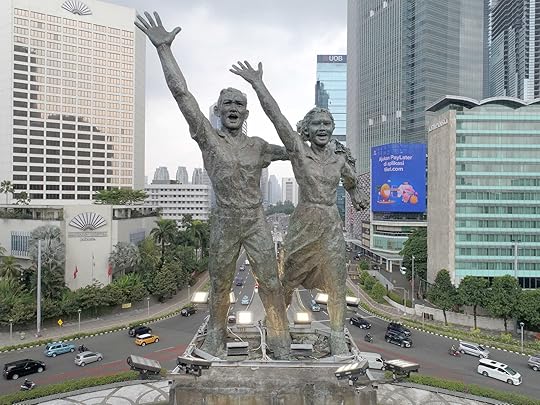
It is set in a near-future world and also inspired by the (heteronormative?) Selamat Datang (Welcome) Monument in Jakarta, set up to welcome the world to the 1962 Asian Games and to symbolise the Indonesian people greeting their future. Here with the city abandoned for a futuristic new town, it has become the Bon Voyage Monument.
"Deep Brown, Verging on Black" is a haunting tale of obsession, the narrator stalking someone he believes is a child she knew many years earlier, with the same coloured eyes, their connection lost after an "incident" (which the story hints involves a group of children being abused by a priest).
"Welcome to the Department of Unanswered Prayers" was a bit of a misttep for me, a satiral story of bureaucrats (former mortals) in Heaven, although the Weilian theme of the wall between even these inhabitants of the heavenly realm and God is one that fits the overall theme, as is that of unanswered wishes.
"Ad maiorem dei gloriam" is told from the perspective of a retired nun, Tula, whose faith and connection with God is weakening (the wall again) and who keeps sneaking out of her convent, and changing out of her habit, seeking human connection. She finds it in a widowed father Yohannes (who has since realised heis gay) and his sick son. Tula hides her identity from the father and son, but when they ask about her family:
"What does your husband do?"
"He's the Lord," says Tula, "And he doesn't care about me any more."
Yohannes gives a startled snort, "Huh?"
"A landlord I mean," she says. "His business always keeps him busy. You'd think he owned the whole world."
"I ... see. And your family? What about your mother?"
"She gave birth to my husband. Some people call her the Queen of Heaven?"
"Our Descendants Will Be as Numerous as the Clouds in the Sky" is based on a mis-remembered version of Genesis 26:4. It is another very moving story, narrated from the perspective of a woman who lives with her son, his husband and their boy, born from a surrogate parent. The woman feels she has come, with difficulty, to accept her son's situation, but gradually learns that her coldness initially to her son-in-law and their marriage has left lasting scars.
Neatly, adding to the links between the collection, her son-in-law is writing a novel which is the same as the previous story "Ad maiorem dei gloriam".
"Her Story" finishes the collection with a delightful metafictional twist, a woman who discovers her life is fictional (when she goes for the first time up the stairs in her kos to another flaw, she finds only blank walls as the narrator hasn't filled in that part):
She hopes her story isn't some sad tale intended to attract readers who've given up on life
A brilliant inclusion on the Republic of Consciousness list, and a strong Booker International contender. 4.5 stars.
Longlisted for the 2022 International Booker Prize
Little green, he's a non-conformer
Little green, have a happy ending
(Joni Mitchell, Little Green)
Happy Stories, Mostly is the translation from Indonesian by Tiffany Tsao of the 2020 short-story collection Cerita-cerita Bahagia, Hampir Seluruhnya by Norman Erikson Pasaribu.
This is the 6th year of the UK's most exciting literary prize, the Republic of Consciousness, and the prize has now featured books from 44 small independent presses, including six first timers this year. Perhaps a little surprisingly given their profile, this is the first time Tilted Axis have featured.
I have previously read Sergius Seeks Bacchus (my review).
a collection of poems from the same author/translator/publisher and commented on how well it fitted with Tilted Axis's (then) mission statement, including the author's own intersectional background (per Tsao "a queer Toba-Batak-Indonesian poet from a working-class Christian background").
A not-for-profit press on a mission to shake up contemporary international literature. Tilted Axis publishes the books that might not otherwise make it into English, for the very reasons that make them exciting to us – artistic originality, radical vision, the sense that here is something new.
Tilting the axis of world literature from the centre to the margins allows us to challenge that very division. These margins are spaces of compelling innovation, where multiple traditions spark new forms and translation plays a crucial role.
As part of carving out a new direction in the publishing industry, Tilted Axis is also dedicated to improving access. We’re proud to pay our translators the proper rate, and to operate without unpaid interns.
One of the poems, "ON A PAIR OF YOUNG MEN IN THE UNDERGROUND CAR PARK AT FX SUDIRMAN MALL", includes lines that sum up the collection:
are sure the longing they feel is genuine longing
and the love in their hearts is the same love that made
Sergius and Bacchus one, and the loneliness they feel in their vacant rooms
is no different from John Henry Newman’s from 1876 to his death,
and isn’t it the rest of the world that has it all wrong?
Aelred of Rievaulx said there is nothing more exquisite
than to love and be loved – it’s true, even though they also
know that the world’s just not ready for us.
This sense of simply seeking acceptance is key to this collection as well, as well as a certain sense of humour. The collection's original title Cerita-cerita Bahagia, Hampir Seluruhnya, which literally translated would be Happy Stories, Almost All, is a ironic retort to a Goodreads review of a previous the author's first collection, the reviewer suggesting he change the title to "Stories of People in Suffering." One signature feature of Tilted Axis books is a frontpiece explaining the meaning of a key word in the text, and here it focuses on the Hampir (Almost) in the title, a word the author delibarately chose as:
Hampir, the Indonesian for almost, only a letter away from vampir-the bloodsucking demon.
What does it mean to be happy? Also, what does it mean to be almost happy?
To almost get in, to be almost accepted, to be almost there, but, at the same time, to be not there/accepted/in.
So, in a world where we celebrate disneyfied heterosexualities, for queer folks, what is happiness?
Often, if becomes the bloodsucking demon, the vampir, the hampir.
The relationship between author and translator seems particularly close here, as shown by a conversation between the two added to the end of the text, one which also explains the author's approach: Layered stories, with their endless connections to other or older texts, work damn well with queer narratives. We need to invent our own new histories, because our own histories have often been erased, and fiction is just the way for that.
The collection itself consists of 12 pieces ranging in length from a page to 32 pages, with light interconnections between them.
The collection opens with the one page "Endiku Comes Knocking on New Year’s Eve", more a prose poem than a story, inspired by a flood in the author's home area.
"A Bedtime Story for Your Long Sleep" is about how everyone believes they have the darkest secretsor most miserable experience. It begins the first time I took a short story writing class, I was asked to tell the saddest story that I'd ever heard and the narrator begins with a far-fetched story told to him by his mother, but ends up constructing "a babel Tower of misery": If the tale of me telling the story of Alarm Man and being thought a liar was sadder than the story of Alarm Man itself, wouldn't the tale of be being thought a liar after telling the story of me telling the story of Alarm Man and being thought a liar be sadder still.
"So What’s Your Name, Sandra", is written with a soundtrack of Joni Mitchell's "Little Green" in mind, as is a moving tale of a woman visiting Thailand after her son committed suicide after she had rejected him when he told her he was dating another boy.
"A Young Poet's Guide to Surviving a Broken Heart" is a self-help guide / hypothetical story but:
In short, all a young poet needs in order to survive a broken heart is: (1) one button-down shirt or dress, scintillating; (2) one sheet of tissue, premium; (3) a pair of running shoes, soles intact; (4) one novel by a writer with an intimidatingly long name; (5) one empty cardboard instant-noodle box; (6) the album Blue by Joni Mitchell; (7) and one book unburdened by whether "where" in Indonesian should be "dimana" or "di mana" because its written in a foreign language, say, Finnish.
— Ginanjar Dantonik, romance consultant on the now–defunct Rawa Belong Young Poets' Community listserv
"The True Story of the Story of the Giant", the longest piece, was the highlight of the collection for me, the narrator a heterosexual student whose cousin, Jamie, has come out as homosexual and is very happy, but whose closest companion at university, Tunggul, has repressed his own sexuality. The link between the two is a obscure story of a giant in early Dutch colonial times, one which combines Batak theology and the pernicious effect of colonialism:
Tunggul went on to tell me about Parulian, who lived in :he 1850s, before the start of the Batak War. Not much historical information was available about him. Just a few notes here and there, saying that he was the offspring of a human being and a begu ganjang—a long-bodied creature in Batak stories from days of yore. Some said that Parulian was a living stepping stone, through which Mulajadi Na Bolon—God in traditional Batak theology—descended to the middle world. Our world. Any mention of Parulian, which wasn't much at all, wasn't coherent enough to be considered evidence—to the point that historians initially considered his story a folktale. Yet, according to Tunggul, one thing was for certain: the very fact of Parulian's presence made the Dutch tremble. The man as tall as a mountain deterred the VOC, the Dutch East India Company, from expanding their rule into Tapanuli.
Tunggul's own situation isn't helped by his parents, both highly religious but from different, Islamic vs. Christian, backgrounds, fighting over his soul: Life at home felt like being in the middle of the Crusades, but with him as Jerusalem.
"Three Love You, Four Despise You" is another brief piece, but one which ties many of the collection's themes together, its title with echoes of Proverbs actually taken from the 3m * 4m standard size of a room in a kos, the Indonesian boarding houses which feature in many of the stories.
"Metaxu: Jakarta 2038" takes its title from Simone Weil's concept (from Gravity and Grace, translated by Emma Crawford and Mario van der Rurh): Two prisoners whose cells adjoin communicate with each other by knocking on the wall. The wall is the thing which separates them but it is also their means of communication. It is the same with us and God. Every separation is a link., with this theme of separation and walls another common link across the stories.
It is set in a near-future world and also inspired by the (heteronormative?) Selamat Datang (Welcome) Monument in Jakarta, set up to welcome the world to the 1962 Asian Games and to symbolise the Indonesian people greeting their future. Here with the city abandoned for a futuristic new town, it has become the Bon Voyage Monument.
"Deep Brown, Verging on Black" is a haunting tale of obsession, the narrator stalking someone he believes is a child she knew many years earlier, with the same coloured eyes, their connection lost after an "incident" (which the story hints involves a group of children being abused by a priest).
"Welcome to the Department of Unanswered Prayers" was a bit of a misttep for me, a satiral story of bureaucrats (former mortals) in Heaven, although the Weilian theme of the wall between even these inhabitants of the heavenly realm and God is one that fits the overall theme, as is that of unanswered wishes.
"Ad maiorem dei gloriam" is told from the perspective of a retired nun, Tula, whose faith and connection with God is weakening (the wall again) and who keeps sneaking out of her convent, and changing out of her habit, seeking human connection. She finds it in a widowed father Yohannes (who has since realised heis gay) and his sick son. Tula hides her identity from the father and son, but when they ask about her family:
"What does your husband do?"
"He's the Lord," says Tula, "And he doesn't care about me any more."
Yohannes gives a startled snort, "Huh?"
"A landlord I mean," she says. "His business always keeps him busy. You'd think he owned the whole world."
"I ... see. And your family? What about your mother?"
"She gave birth to my husband. Some people call her the Queen of Heaven?"
"Our Descendants Will Be as Numerous as the Clouds in the Sky" is based on a mis-remembered version of Genesis 26:4. It is another very moving story, narrated from the perspective of a woman who lives with her son, his husband and their boy, born from a surrogate parent. The woman feels she has come, with difficulty, to accept her son's situation, but gradually learns that her coldness initially to her son-in-law and their marriage has left lasting scars.
Neatly, adding to the links between the collection, her son-in-law is writing a novel which is the same as the previous story "Ad maiorem dei gloriam".
"Her Story" finishes the collection with a delightful metafictional twist, a woman who discovers her life is fictional (when she goes for the first time up the stairs in her kos to another flaw, she finds only blank walls as the narrator hasn't filled in that part):
She hopes her story isn't some sad tale intended to attract readers who've given up on life
A brilliant inclusion on the Republic of Consciousness list, and a strong Booker International contender. 4.5 stars.

September 6, 2024
Kocham te opowiadania i tak bardzo się cieszę, że cudownie brzmią też po polsku.

May 17, 2022
"Think about it. Gay men don't have many role models. This is your own friend! And right now he feels like the most miserable person in the world".
A workplace set in heaven in which staff archive unanswered prayers, a woman's holiday to Vietnam after her son's suicide, a man's haunting disposition of a giant in Sumatra and surviving life after a break-up.
Winner of the International Booker Prize and Republic of Conciousness Prose 2022, Jakartan born Pasaribu's blends absurdism, science-fiction, myth and realism to form a powerful, refreshing set of layered short-stories - all expertly translated by Tiffany Tsao.
Awash with Batak and Christian elements, queer characters are placed in situations that are usually awarded to a hetero cast. A truly genre-defying collection, portrayed with unusual perspectives, counterbalancing heteronormative fiction and LGBTQ+ that typically favours Western experience and traditions.
"I work in the dark. Like mushrooms. I don't need light to thrive'.
Equally as insightful is the Q&A at the end of the collection, which reveals a special chemistry and bond between writer and translator.
A workplace set in heaven in which staff archive unanswered prayers, a woman's holiday to Vietnam after her son's suicide, a man's haunting disposition of a giant in Sumatra and surviving life after a break-up.
Winner of the International Booker Prize and Republic of Conciousness Prose 2022, Jakartan born Pasaribu's blends absurdism, science-fiction, myth and realism to form a powerful, refreshing set of layered short-stories - all expertly translated by Tiffany Tsao.
Awash with Batak and Christian elements, queer characters are placed in situations that are usually awarded to a hetero cast. A truly genre-defying collection, portrayed with unusual perspectives, counterbalancing heteronormative fiction and LGBTQ+ that typically favours Western experience and traditions.
"I work in the dark. Like mushrooms. I don't need light to thrive'.
Equally as insightful is the Q&A at the end of the collection, which reveals a special chemistry and bond between writer and translator.
October 6, 2024
Powściągliwa, ale jednocześnie refleksyjna i stawiająca pod znakiem zapytania liczne granice wykreowane przez społeczeństwo. Na pewno przyciągająca i nieprzeciętna lektura.

October 28, 2024
4.5 wspaniałe; dużo tu dziwności i wątków religijnych, ale niech was to nie zniechęca, bo stracicie naprawdę fundamentalnych, życiowych refleksji

March 30, 2022
This group of short stories by Indonesian author Norman Erikson Pasaribu has a playful, metafictional vibe while evoking many vivid characters and situations that contain a great deal of emotional heft. Many focus on the points of views of characters related to or connected with homosexuals whether it be a mother grieving for her son who committed suicide, a man whose close friend turns out to be gay or a woman who snoops through the underwear drawer of her son's husband. The feelings of marginalization and isolation which accompanies much of gay life is approached at arm's length. This sense is carried through the opening and closing stories which are in many ways about the nature of fiction itself. The first story begins in a creative writing class. The final story concerns a woman aware she is being written and finds empty space when she tries to transcend the borders of what is constructed for her. All this ties into the presence of religion throughout the stories and questions concerning omnipotence, destiny and God. These tales collectively give a fascinating insight into Indonesian life and individuals sidelined by mainstream society.
Read my full review of Happy Stories, Mostly by Norman Erikson Pasaribu at LonesomeReader
Read my full review of Happy Stories, Mostly by Norman Erikson Pasaribu at LonesomeReader

February 25, 2022
Winner of the Republic of Consciousness Prize 2022
Longlisted for the International Booker Prize 2022
Another book from the varied and surprising Republic of Consciousness list. Pasaribu is a gay Indonesian whose poetry has also been translated into English by the same translator Tiffany Tsao. This is a varied collection of short stories which defies genre categorisation, and is full of unusual perspectives and surprises. There are also links between the stories making it more of a unified whole.
Well worth seeking out.
Longlisted for the International Booker Prize 2022
Another book from the varied and surprising Republic of Consciousness list. Pasaribu is a gay Indonesian whose poetry has also been translated into English by the same translator Tiffany Tsao. This is a varied collection of short stories which defies genre categorisation, and is full of unusual perspectives and surprises. There are also links between the stories making it more of a unified whole.
Well worth seeking out.

October 22, 2020
Norman Erikson Pasaribu
Cerita-Cerita Bahagia, Hampir Seluruhnya
Gramedia Pustaka Utama
203 pages
8.3 (Best New Book)
Norman Erikson Pasaribu's Cerita-Cerita Bahagia, Hampir Seluruhnya comprises excellent short stories that feel tender and meek. Pasaribu, an observant author indeed, explores the themes of grief and loss, but at the same time he also celebrates his queerness unapologetically, thus the exuberant title.
One of the most notable poetries that I particularly enjoy from Pasaribu's amazing poetry collection, Sergius Mencari Bacchus: 33 Puisi , is about a couple of young men who were in consummate love at a basement parking lot of a mall. There Pasaribu shows off his keen observation; his sentences are long, elaborating the couple's longing and heartache and drawing parallels between their love and Christian mythos of Sergius and Bacchus, the alleged patron saints of gay people. His detailed lines allow me to actually feel what this couple feel and I think this is where Pasaribu's penmanship shines through. He's able to shift the readers' attention to beautiful things that are usually neglectable.
So when his keenness, which works effectively in the form of poetry, is used for narrative form, it translates into something that is even more impactful and devastating. The way Pasaribu describes in excruciating details things that other authors even bothered to see or notice really resonates with me. In Siapa Namamu, Sandra?, clearly one of the highlights from this book, I am particularly moved by his description of washing machine standing on a polystyrene base, some common setup in many families that's hard to shed off. Or in another highlight, Kisah Sesungguhnya Tentang Lelaki Raksasa, the code-switching to 'gue-lo' that most of non-Jakartans who move to Jakarta for college do really sticks with me. These details add more emotive layer to the story, so when the tragedy hits in those stories, they can crush your heart harder.
Pasaribu's gentle and sensitive heart can also be observed from how he portrays the familial theme, especially in the maternal department. This is clearly seen in Siapa Namamu, Sandra?, where the protagonist, a grieving mother, decided to travel to Vietnam after the death of her beloved son. Pasaribu paints a mother's pain and sorrow, but also her regret because she failed to love her son fully after learning about his boyfriend. The theme of a mother's regret recurs again in Keturunan Kita Akan Sebanyak Awan di Angkasa. In Ad Maiorem Dei Gloriam, Pasaribu shows that maternal love doesn't only come from your mother, but also from a lonely stranger.
Pasaribu obviously gets his inspiration from his own life. Coming from Batak and Christian background, it's no surprise that many elements in this book are borrowed from his cultural upbringing. You will find that Pasaribu often throws Batak and Christian references here; the title of Keturunan Kita Akan Sebanyak Awan di Angkasa comes from God's promise to Abraham. But somehow, you can also sense his faith relapse and frustration with the higher being. In Divisi Doa Tak Berjawab, Pasaribu imagines heaven as a bureaucratic and ineffective office ala The Office. Deciding on prayer's answer is still God's prerogative and no one still doesn't know the reason, even the heaven workers themselves. But seeing how these people work, it's no wonder that many prayers are unanswered.
Pasaribu is a queer writer and this book is his medium to celebrate that. So that's why many stories here feature gay characters; whether they're still in the closet or already out. You will probably wonder why the book is called (mostly) happy stories despite its sepulchral theme of grief and loss. I can only think two reasons: first, celebration is a happy thing, and second, gay initially means happy and joyful. I guess in this book, Pasaribu wants to reclaim that definition.
Cerita-Cerita Bahagia, Hampir Seluruhnya
Gramedia Pustaka Utama
203 pages
8.3 (Best New Book)
Norman Erikson Pasaribu's Cerita-Cerita Bahagia, Hampir Seluruhnya comprises excellent short stories that feel tender and meek. Pasaribu, an observant author indeed, explores the themes of grief and loss, but at the same time he also celebrates his queerness unapologetically, thus the exuberant title.
One of the most notable poetries that I particularly enjoy from Pasaribu's amazing poetry collection, Sergius Mencari Bacchus: 33 Puisi , is about a couple of young men who were in consummate love at a basement parking lot of a mall. There Pasaribu shows off his keen observation; his sentences are long, elaborating the couple's longing and heartache and drawing parallels between their love and Christian mythos of Sergius and Bacchus, the alleged patron saints of gay people. His detailed lines allow me to actually feel what this couple feel and I think this is where Pasaribu's penmanship shines through. He's able to shift the readers' attention to beautiful things that are usually neglectable.
So when his keenness, which works effectively in the form of poetry, is used for narrative form, it translates into something that is even more impactful and devastating. The way Pasaribu describes in excruciating details things that other authors even bothered to see or notice really resonates with me. In Siapa Namamu, Sandra?, clearly one of the highlights from this book, I am particularly moved by his description of washing machine standing on a polystyrene base, some common setup in many families that's hard to shed off. Or in another highlight, Kisah Sesungguhnya Tentang Lelaki Raksasa, the code-switching to 'gue-lo' that most of non-Jakartans who move to Jakarta for college do really sticks with me. These details add more emotive layer to the story, so when the tragedy hits in those stories, they can crush your heart harder.
Pasaribu's gentle and sensitive heart can also be observed from how he portrays the familial theme, especially in the maternal department. This is clearly seen in Siapa Namamu, Sandra?, where the protagonist, a grieving mother, decided to travel to Vietnam after the death of her beloved son. Pasaribu paints a mother's pain and sorrow, but also her regret because she failed to love her son fully after learning about his boyfriend. The theme of a mother's regret recurs again in Keturunan Kita Akan Sebanyak Awan di Angkasa. In Ad Maiorem Dei Gloriam, Pasaribu shows that maternal love doesn't only come from your mother, but also from a lonely stranger.
Pasaribu obviously gets his inspiration from his own life. Coming from Batak and Christian background, it's no surprise that many elements in this book are borrowed from his cultural upbringing. You will find that Pasaribu often throws Batak and Christian references here; the title of Keturunan Kita Akan Sebanyak Awan di Angkasa comes from God's promise to Abraham. But somehow, you can also sense his faith relapse and frustration with the higher being. In Divisi Doa Tak Berjawab, Pasaribu imagines heaven as a bureaucratic and ineffective office ala The Office. Deciding on prayer's answer is still God's prerogative and no one still doesn't know the reason, even the heaven workers themselves. But seeing how these people work, it's no wonder that many prayers are unanswered.
Pasaribu is a queer writer and this book is his medium to celebrate that. So that's why many stories here feature gay characters; whether they're still in the closet or already out. You will probably wonder why the book is called (mostly) happy stories despite its sepulchral theme of grief and loss. I can only think two reasons: first, celebration is a happy thing, and second, gay initially means happy and joyful. I guess in this book, Pasaribu wants to reclaim that definition.

May 19, 2022
3.5 stars
A disarming collection of stories from Indonesia. All are in some way about gay characters or the gay experience, including mothers who adore their sons but can’t accept them and friendships ruined by admissions of attraction, and they are not really happy stories, but nor are they overwhelmingly depressing. Many of them have a slightly magical undertone, particularly “The True Story of the Giant.” Others seem like slightly postmodern writing exercises. Actually I enjoyed some of those the most. They were short and clever. For example, asked to tell a sad tale in a creative writing class:
If the tale of me telling the story of Alarm Man and being thought a liar was sadder than the story of Alarm Man itself, wouldn't the tale of be being thought a liar after telling the story of me telling the story of Alarm Man and being thought a liar be sadder still.
In general, it’s a collection I enjoyed more at the beginning than the end. It didn’t suffer from the usual problem of short story collections for me (putting it down at the end of a story and not picking it up again), in part because no story is overly long and some are really very short, in part because the prose was very easy and washed over me pleasantly. But I had a hankering for the whole to be more than the sum of its parts. In the beginning it seemed it would be, but some of the later stories were less compelling.
A disarming collection of stories from Indonesia. All are in some way about gay characters or the gay experience, including mothers who adore their sons but can’t accept them and friendships ruined by admissions of attraction, and they are not really happy stories, but nor are they overwhelmingly depressing. Many of them have a slightly magical undertone, particularly “The True Story of the Giant.” Others seem like slightly postmodern writing exercises. Actually I enjoyed some of those the most. They were short and clever. For example, asked to tell a sad tale in a creative writing class:
If the tale of me telling the story of Alarm Man and being thought a liar was sadder than the story of Alarm Man itself, wouldn't the tale of be being thought a liar after telling the story of me telling the story of Alarm Man and being thought a liar be sadder still.
In general, it’s a collection I enjoyed more at the beginning than the end. It didn’t suffer from the usual problem of short story collections for me (putting it down at the end of a story and not picking it up again), in part because no story is overly long and some are really very short, in part because the prose was very easy and washed over me pleasantly. But I had a hankering for the whole to be more than the sum of its parts. In the beginning it seemed it would be, but some of the later stories were less compelling.

March 1, 2022
My eighth book from the 2022 Republic of Consciousness long list and the fourth one that has been a collection of short stories. I don’t think I would have read this book without it being on that long list, so my thanks to the prize and the judges because I did enjoy reading this. But more than just enjoying it, I appreciate the exposure to something a bit different to my normal reading. Firstly, I have very little experience of Indonesian writing (probably “no experience” would be more accurate but I might have snuck one in a long time ago and forgotten about it). Secondly, the blurb on the back of the book describes it as “a collection of twelve stories that queer the norm” and goes on to explain that the stories “put queer characters in situations and plots conventionally filled by heterosexual characters”. This is further explained in an interview between author and translator at the back of the book where the author says:
”Layered stories, with their endless connections to other or older texts, work damn well with queer narratives. I mean, we need to invent our own new histories, because our own histories have often been erased, and fiction is just the way for that”
This is the second book I have read in the last 2-3 weeks that has drawn heavily on Simone Weil. The first was Denis Johnson’s “Resuscitation of a Hanged Man” and here the blurb tells us the stories are inspired by Weil’s concept of ‘decreation’. And these stories contain a lot of references to Christianity alongside Batak cultural references. All this makes for a very interesting mix that gives the stories a freshness. And I think it’s a collection that would bear a second reading because, all the way through, there are hints of connections, there are moments when you think “I’ve seen something like that recently”. Sometimes, I couldn’t remember exactly whether the thing I was reminded of was from earlier in this book or from another book I have read recently, but I am sure there are a lot more echoes and references than the ones I saw.
As with all short story collections, some worked better for me than others (and the mix will be different for other readers). I think my personal favourite was the longest piece in the book, “The True Story of the Story of the Giant”. I also liked “Deep Brown, Verging on Black” for its darkness and mystery.
Overall, a fascinating collection of stories and my favourite of the short story collections on the long list (although I should probably re-read Dark Neighbourhood before saying that too confidently).
”Layered stories, with their endless connections to other or older texts, work damn well with queer narratives. I mean, we need to invent our own new histories, because our own histories have often been erased, and fiction is just the way for that”
This is the second book I have read in the last 2-3 weeks that has drawn heavily on Simone Weil. The first was Denis Johnson’s “Resuscitation of a Hanged Man” and here the blurb tells us the stories are inspired by Weil’s concept of ‘decreation’. And these stories contain a lot of references to Christianity alongside Batak cultural references. All this makes for a very interesting mix that gives the stories a freshness. And I think it’s a collection that would bear a second reading because, all the way through, there are hints of connections, there are moments when you think “I’ve seen something like that recently”. Sometimes, I couldn’t remember exactly whether the thing I was reminded of was from earlier in this book or from another book I have read recently, but I am sure there are a lot more echoes and references than the ones I saw.
As with all short story collections, some worked better for me than others (and the mix will be different for other readers). I think my personal favourite was the longest piece in the book, “The True Story of the Story of the Giant”. I also liked “Deep Brown, Verging on Black” for its darkness and mystery.
Overall, a fascinating collection of stories and my favourite of the short story collections on the long list (although I should probably re-read Dark Neighbourhood before saying that too confidently).

July 7, 2026
Najzupełniej się nie spodziewałem, że tak bardzo wsiąknę w te tak krótkie opowiadania, a jednak.
O ile zwykle traktuję wszelkie blurby z dużą dozą ostrożności, nieraz nawet z przymrużeniem oka, to w tym wypadku absolutnie się z nim zgadzam! Chce się do tych opowiadań wracać i wracać
O ile zwykle traktuję wszelkie blurby z dużą dozą ostrożności, nieraz nawet z przymrużeniem oka, to w tym wypadku absolutnie się z nim zgadzam! Chce się do tych opowiadań wracać i wracać
November 18, 2020
Di mana cerita-cerita bahagia itu?
[Pembaruan sehari setelah menulis pertanyaan di atas]
Sejak aku menulis secara pertanyaan itu membayang-bayang di pikiran. Aku lalu membolak-balik ulang bukunya, skimming beberapa bagian cerpen secara random, menyimak dengan sedikit lebih dalam adegan-adegan di sana. Aku paham sekarang. Cerita-cerita bahagia itu ada di sana. Mereka betulan ada.
Bahagia itu ada pada anak semata wayang Sandra yang hengkang ke Vietnam. Bahagia ada ketika si penyair muda belum patah hati dan mesti membaca sebuah panduan. Bahagia itu ada saat Suster Tula keluar dari biara pensiunan dan bertemu dengan Sebastian dan Yohannes, pun saat Yohannes merangkul Anton puluhan tahun silam dan hanya tersisa sebuah foto yang Yohannes simpan di kotak P3K. Dan bahagia itu tentu saja terlihat pada Leo dan Thomas bila kau menyimaknya baik-baik.
Tak ada gading yang tak retak. Cerita-cerita bahagia itu tergores oleh kondisi dan permasalahan. Maka itu, pengarang melengkapi judul "cerita-cerita bahagia" dengan "hampir seluruhnya" sebagaimana memberi gambaran bahwa kebahagiaan yang tidak akan pernah beriringan dengan kesempurnaan. Bukankah, kehidupan sebenarnya pun begitu?
Cerita-cerita dalam buku ini begitu miris. Namun, seperti buah-buahan berkulit pahit, bila ditilik lebih intim lagi, cerita-cerita miris nan tragis itu berisi hal-hal manis nan bahagia di dalam (walaupun ada yang kecut juga).
Buku ini bagus sekali. Akan kubaca beberapa cerpennya di masa mendatang, terutama "Siapa Namamu, Sandra?", "Ad maiorem dei gloriam", dan " Keturunan Kita Akan Sebanyak Awan di Angkasa".
Ya Tuhan!
Apa aku sudah bilang kalau buku ini bagus sekali?
[Pembaruan sehari setelah menulis pertanyaan di atas]
Sejak aku menulis secara pertanyaan itu membayang-bayang di pikiran. Aku lalu membolak-balik ulang bukunya, skimming beberapa bagian cerpen secara random, menyimak dengan sedikit lebih dalam adegan-adegan di sana. Aku paham sekarang. Cerita-cerita bahagia itu ada di sana. Mereka betulan ada.
Bahagia itu ada pada anak semata wayang Sandra yang hengkang ke Vietnam. Bahagia ada ketika si penyair muda belum patah hati dan mesti membaca sebuah panduan. Bahagia itu ada saat Suster Tula keluar dari biara pensiunan dan bertemu dengan Sebastian dan Yohannes, pun saat Yohannes merangkul Anton puluhan tahun silam dan hanya tersisa sebuah foto yang Yohannes simpan di kotak P3K. Dan bahagia itu tentu saja terlihat pada Leo dan Thomas bila kau menyimaknya baik-baik.
Tak ada gading yang tak retak. Cerita-cerita bahagia itu tergores oleh kondisi dan permasalahan. Maka itu, pengarang melengkapi judul "cerita-cerita bahagia" dengan "hampir seluruhnya" sebagaimana memberi gambaran bahwa kebahagiaan yang tidak akan pernah beriringan dengan kesempurnaan. Bukankah, kehidupan sebenarnya pun begitu?
Cerita-cerita dalam buku ini begitu miris. Namun, seperti buah-buahan berkulit pahit, bila ditilik lebih intim lagi, cerita-cerita miris nan tragis itu berisi hal-hal manis nan bahagia di dalam (walaupun ada yang kecut juga).
Buku ini bagus sekali. Akan kubaca beberapa cerpennya di masa mendatang, terutama "Siapa Namamu, Sandra?", "Ad maiorem dei gloriam", dan " Keturunan Kita Akan Sebanyak Awan di Angkasa".
Kemarin, aku duduk di halaman belakang dan teringat janji Tuhan kepada Abraham. Keturunannya akan sebanyak bintang di angkasa, sebanyak pasir di pantai. Memandangi awan-awan yang berarak, aku bertanya kepada diriku sendiri, "Bagaimana dengan kami? Apakah keturunan kami tidak akan sebanyak awan di angkasa?" (hlm. 178)
Ya Tuhan!
Apa aku sudah bilang kalau buku ini bagus sekali?
March 20, 2022
May 11, 2022 Update Now the winner of the 2022 Republic of Consciousness Prize.
April 8, 2022 Update #SignedbytheTranslator spotted at Foyles, I hope this becomes a thing!
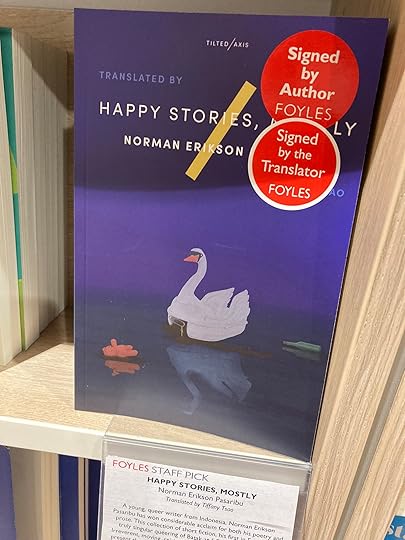
Image sourced via Twitter.
Mostly All Bittersweet
Review of the Tilted Axis Press paperback edition (December 2021) translated by Tiffany Tsao from the Indonesian language original Cerita-cerita Bahagia, Hampir Seluruhnya (October 2020)
[Average 3.67 rounded up to a strong 4] Longlisted for both the 2022 International Booker Prize and the 2022 Republic of Consciousness Prize.
The longer and the more humorous stories had the most impact for me, several were strong 5s. Overall a great collection which leaned more to the bittersweet than actually 'happy.' It seems to be marketed as queer fiction, but the religious themes were more dominant to me. There was a tendency to not translate all of the Indonesian, but most of the words could be understood in context, e.g. a kos is a rooming house or boarding house; Batak are a tribal people in northern Indonesia. There is a bonus Afterword section where the author is interviewed by the translator.
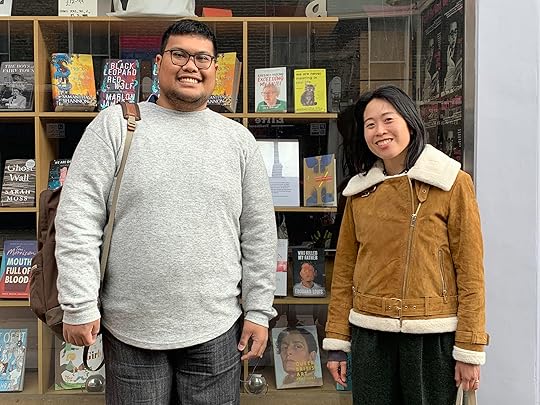
Author Norman Erikson Pasaribu and translator Tiffany Tsao. Image sourced from Twitter.
1. Enkidu Comes Knocking on New Year's Eve ** One page story which describes a flood (presumably an allusion to the great flood in the Gilgamesh epic) with apparently the wild man Enkidu from that epic appearing at the end? Too short to have much of an impact.
2. A Bedtime Story for Your Long Sleep *** A 3 page story describing the saddest story you've ever read. It wraps around itself in a surreal manner.
3. So What's Your Name, Sandra? **** Mama Sandra makes a pilgrimage to the site of Mỹ Sơn, Vietnam in tribute to her dead son Bison.
4. A Young Poet's Guide to Surviving a Broken Heart **** Exactly as the title describes, a step by step guide of actions to perform.
5. The True Story of the Story of the Giant ***** The friendship between two students and their tie-in to the story of a legendary giant of Indonesia.
6. Three Love You, Four Despise You ** A man is in despair in a room with a crucifix on the wall where the Jesus figure has been removed?
7. Metaxu: Jakarta, 2038 *** A future story from an Indonesia which has been flooded and the capital Jakarta has disappeared.
8. Deep Brown, Verging on Black **** A man is stalking people who may or may not be his actual past lover.
9. Welcome to the Department of Unanswered Prayers **** A humorous fantasy fiction where those who go to heaven end up working in different bureaucratic departments of God's operation.
10. Ad maiorem dei gloriam [Latin: To the Greater Glory of God] ***** A forcibly retired teacher/nun persists in escaping from her retirement convent and seeking out her former pupils and hoping to find a new one.
11. Our Descendants Will Be as Numerous as the Clouds in the Sky ***** A mother frets about her gay son and his husband and spies on and interferes with their relationship and her grandson who was conceived by a surrogate mother.
12. Her Story *** Metafictional story about the writer writing about a student who works in a coffee shop and lives in a boarding house where she is forbidden to go upstairs.

Graphic interpretations of the various covers of "Happy Stories, Mostly" along with caricatures of the author and the translator. Image sourced from Twitter.
April 8, 2022 Update #SignedbytheTranslator spotted at Foyles, I hope this becomes a thing!
Image sourced via Twitter.
Mostly All Bittersweet
Review of the Tilted Axis Press paperback edition (December 2021) translated by Tiffany Tsao from the Indonesian language original Cerita-cerita Bahagia, Hampir Seluruhnya (October 2020)
[Average 3.67 rounded up to a strong 4] Longlisted for both the 2022 International Booker Prize and the 2022 Republic of Consciousness Prize.
The longer and the more humorous stories had the most impact for me, several were strong 5s. Overall a great collection which leaned more to the bittersweet than actually 'happy.' It seems to be marketed as queer fiction, but the religious themes were more dominant to me. There was a tendency to not translate all of the Indonesian, but most of the words could be understood in context, e.g. a kos is a rooming house or boarding house; Batak are a tribal people in northern Indonesia. There is a bonus Afterword section where the author is interviewed by the translator.
Author Norman Erikson Pasaribu and translator Tiffany Tsao. Image sourced from Twitter.
1. Enkidu Comes Knocking on New Year's Eve ** One page story which describes a flood (presumably an allusion to the great flood in the Gilgamesh epic) with apparently the wild man Enkidu from that epic appearing at the end? Too short to have much of an impact.
2. A Bedtime Story for Your Long Sleep *** A 3 page story describing the saddest story you've ever read. It wraps around itself in a surreal manner.
3. So What's Your Name, Sandra? **** Mama Sandra makes a pilgrimage to the site of Mỹ Sơn, Vietnam in tribute to her dead son Bison.
4. A Young Poet's Guide to Surviving a Broken Heart **** Exactly as the title describes, a step by step guide of actions to perform.
5. The True Story of the Story of the Giant ***** The friendship between two students and their tie-in to the story of a legendary giant of Indonesia.
6. Three Love You, Four Despise You ** A man is in despair in a room with a crucifix on the wall where the Jesus figure has been removed?
7. Metaxu: Jakarta, 2038 *** A future story from an Indonesia which has been flooded and the capital Jakarta has disappeared.
8. Deep Brown, Verging on Black **** A man is stalking people who may or may not be his actual past lover.
9. Welcome to the Department of Unanswered Prayers **** A humorous fantasy fiction where those who go to heaven end up working in different bureaucratic departments of God's operation.
10. Ad maiorem dei gloriam [Latin: To the Greater Glory of God] ***** A forcibly retired teacher/nun persists in escaping from her retirement convent and seeking out her former pupils and hoping to find a new one.
11. Our Descendants Will Be as Numerous as the Clouds in the Sky ***** A mother frets about her gay son and his husband and spies on and interferes with their relationship and her grandson who was conceived by a surrogate mother.
12. Her Story *** Metafictional story about the writer writing about a student who works in a coffee shop and lives in a boarding house where she is forbidden to go upstairs.
Graphic interpretations of the various covers of "Happy Stories, Mostly" along with caricatures of the author and the translator. Image sourced from Twitter.

May 10, 2022
A solid collection that had a few stories that didn’t resonate as much as often happens in a collection, but most of which captured the idea of coming close to happiness yet not quite making it. There were a couple of stories that were quite funny, A Young Poet’s Guide to Surviving a Broken Heart which is entirely self-explanatory and Welcome to the Department of Unanswered Prayers, a cynical view of the afterlife. Several of the most successful for me were those that revolved around older women which is something I always enjoy reading about. Mothers of gay sons feature in several stories and the consequences of their views on those relationships with their sons, who hide their sexuality if only for a while. This feeling of needing to hide queerness comes up again in one of my favorite stories about a nun and the single father she meets, Ad maiorem dei gloriam. Religion is another theme that comes up frequently, usually as something constrictive and didactic and there are references to colonial history in various ways including in another favorite The True Story of the Story of the Giant. This playing with stories themselves is very much a part of the final very meta story, Her Story, where the narrator realizes she’s a character and wonders about her author.
In the translation conversation at the end of the book between Norman Erikson Pasaribu and Tiffany Tsao he makes the point that these stories should be read slowly and then reread to really tweeze out all the layers and connections. Short stories do seem to lend themselves really well to rereading and noticing things you missed first time around so I’m hoping to go back and reread this over the coming months and see what that brings.
In the translation conversation at the end of the book between Norman Erikson Pasaribu and Tiffany Tsao he makes the point that these stories should be read slowly and then reread to really tweeze out all the layers and connections. Short stories do seem to lend themselves really well to rereading and noticing things you missed first time around so I’m hoping to go back and reread this over the coming months and see what that brings.
October 20, 2024
20 października 2024:
4.5 gut sup
Najlepsze opowiadania:
1) ,,Złamane serce - poradnik przetrwania dla młodego poety"
2) ,,Nasi potomkowie będą tak liczni jak chmury na niebie"
Jeśli książka zaczyna się od cytatu Amy Winehouse ,,You're Pisces. It means you're gay" (rel) - to świadectwo majstersztyku.
22 października 2025:
nadal gut sup. Zapomniałem kompletnie na przestrzeni tego roku, co się działo w tych opowiadaniach i dlatego zwątpiłem w moją sympatię do tej książki, ale gdy sobie ją odświeżyłem, to na nowo ją pokochałem.
Trochę zazdroszczę Pasaribu. Chciałbym napisać takie opowiadania.
ps reread, bo idę na spotkanie z osobą autorską i tłumaczką!
4.5 gut sup
Najlepsze opowiadania:
1) ,,Złamane serce - poradnik przetrwania dla młodego poety"
2) ,,Nasi potomkowie będą tak liczni jak chmury na niebie"
Jeśli książka zaczyna się od cytatu Amy Winehouse ,,You're Pisces. It means you're gay" (rel) - to świadectwo majstersztyku.
22 października 2025:
nadal gut sup. Zapomniałem kompletnie na przestrzeni tego roku, co się działo w tych opowiadaniach i dlatego zwątpiłem w moją sympatię do tej książki, ale gdy sobie ją odświeżyłem, to na nowo ją pokochałem.
Trochę zazdroszczę Pasaribu. Chciałbym napisać takie opowiadania.
ps reread, bo idę na spotkanie z osobą autorską i tłumaczką!

December 31, 2023
should be titled “happy stories, barely” because why was i on the floor
short rtc
short rtc

October 24, 2024
Hipnotyzuje w piękny sposób.

September 6, 2023
There were a couple of stories that grabbed my attention but for the most part, the collection was rather boring. The author has a lot of good concepts and sentiments, but sadly for me, they were not executed well enough to feel powerful or entertaining.

March 19, 2022
I liked this collection of stories and was impressed with Erikson’s writing and Tsao’s translation. I read this as part of the 2022 Republic of Consciousness longlist, but I don’t like reading a collection of short stories in one or two sitting. It dilutes the experience of each story for me. I really hope Erikson writes a novel and that Tsao translates it.

September 10, 2022
98th book of 2022.
3.5. Loved the first few, didn't care for the middle few and liked the penultimate a lot. Pasaribu has written a number of stories that are playful and melancholic at once, as the title suggests. Tiled Axis Press are impressing me greatly with the books they are putting out. Many of them deal with ostracised gay characters in modern day Indonesia. Other stories are a little more abstract. It's a short collection with a lot to offer.
In the back of the book, Tilted Axis have included a discussion between writer and translator. Pasaribu makes many observations about his own work and the process. Most interestingly, on the title, he says, 'The idea of using the word bahagia (happy) as a title of the book comes from a Goodreads reviewer who advised me to change the title of my first collection to "Stories of People in Suffering," a review that I found very funny.' The power of Goodreads. He also makes remarks like, 'I always hate it when I see Marvel movies trivializing traumatic events,' or, 'I hate the overwhelming heterosexualities in Disney movies.'
3.5. Loved the first few, didn't care for the middle few and liked the penultimate a lot. Pasaribu has written a number of stories that are playful and melancholic at once, as the title suggests. Tiled Axis Press are impressing me greatly with the books they are putting out. Many of them deal with ostracised gay characters in modern day Indonesia. Other stories are a little more abstract. It's a short collection with a lot to offer.
In the back of the book, Tilted Axis have included a discussion between writer and translator. Pasaribu makes many observations about his own work and the process. Most interestingly, on the title, he says, 'The idea of using the word bahagia (happy) as a title of the book comes from a Goodreads reviewer who advised me to change the title of my first collection to "Stories of People in Suffering," a review that I found very funny.' The power of Goodreads. He also makes remarks like, 'I always hate it when I see Marvel movies trivializing traumatic events,' or, 'I hate the overwhelming heterosexualities in Disney movies.'

December 31, 2021
Update 31/12/2021
Find my reviews on : An Ode to Fiction
Official Release Date : December 2021 (Tilted Axis Edition) / October 2020 (Cerita-cerita Bahagia, Hampir Seluruhnya)
Buy the book :
Amazon | Book Depository | Tilted Axis
4.5 rounded up to 5/5 ⭐️
Happy Stories, Mostly is a collection of melancholic and bittersweet stories that are proudly Batak and unapologetically queer. An enticing fresh piece of fiction that weaves discussions of the Christian faith and heteronormativity of Indonesian society with a blend of sci-fi, absurdism, and alternate-history realism.
Since I started reading books back in 2020 I have not picked up a single book written by an Indonesian author. I am happy that Happy Stories, Mostly is my first dip into Indonesian literature. Plenty of my Indonesian mutuals have read this book and raved about it so when I saw there is a translated version of it, I thought why not give it a try.
In this collection of twelve short stories Norman Erikson Pasaribu captures snippets of individuals in various stages of their lives and sometimes breathing life to inanimate objects. Each piece centers around a character with varying premises and perspectives but they all have a common theme, they don't have a happy ending but some of them ends on the cusp of something close to a happy ending. Fair warning to readers that have set expectations for a feel good story this is not the book. Another common theme are the Batak queer characters and discussions on Christian faith. This is what sold me on reading the book because I'm born and raised as a Catholic that is also queerthough closeted. Norman Erikson Pasaribu's prose is uniquely absurd in a good way, Pasaribu isn't shy in changing the trajectory of the narrative instead relies on the beat in which the story takes. The first piece "Enkidu Comes Knocking on New Year's Eve" is a great example and serves as a good introduction for readers to know what's in store. As readers dive deeper the stories has undertones of vulnerability that is clearly taken from Pasaribu's own accounts in life. In this review I want to do a dive deep into the stories that have the strongest impression on me.
First, "So, What's your name Sandra?", the third short story in the book. In this piece Pasaribu introduces us to a grieving mother. The mother's life has revolved around her son that has passed on (this is established in the first sentence of the story so it's not a spoiler at all). The death of her son has shook her to the core that she is now numbed by grief. All her life she has given everything to her son from her time, money, and even her identity. Distraught by tragedy she takes it upon herself to travel to Vietnam to find the son she lost.
This piece main theme in my opinion is about identity, regret, and grief. Pasaribu emphasizes on names a lot for example the nickname the mother is given after having her son, the son's name, and the place she want to go to in Vietnam. A name is the core of one's identity, the mother in this case has lost her identity because of the death of her son. Pasaribu masterfully weaves this identity crisis into the mother's process in taking steps to find closure with a question in Batak language that the mother asks herself throughout the story. It is absolutely brilliant.
Second—this is probably my favorite one—"The True Story of the Story of the Giant". This is the longest piece in the book and is the most compelling of the bunch in my opinion. The story is told from the perspective of Henri that stumbled upon a short story that has followed him throughout his teens into his early twenties. He first found this story titled "The Secret History of the Giant Man" on a handout he got when Henri accompanied his gay cousin to a get together organized by the local queer Facebook group in his hometown. Henri thought it was the most ridiculous short story he has ever read. With the passing of time Henri forgets about this story, graduating highschool and then goes to university in Jakarta. The story reappears when Henri over hears an annoying classmate mentioning it to a group of other students.
Reading this piece I got the general vibe that Henri is morally grey and plays the part of an unreliable narrator. The main themes I noticed in this piece are about friendship, grief, and imposter syndrome. Henri's shaky morality and internal struggle to achieve academic success resulted in him making poor decisions that led to tragedy. In my opinion it serves as commentary to Indonesian youth that are pushed to be overachievers by any means necessary and the self centered views of certain people by taking advantage of people through friendships. All this is tied together with a centered plot device which is the story about the giant man that connects Henri to his academic rival turned best friend. I don't want to disclose any details because spoilers and it will ruin the experience. When I finished reading the whole collection I reflected back on each of them, I've come to the conclusion that this story is a prime example of Pasaribu's ability in story telling and defines his style in writing. The main character seems like an anti hero to me that redeemed himself too late and by the end tragically failed. The unraveling in the character's development is done wonderfully even though it didn't end as I expected it to end. It's bittersweet and beautifully tragic, it is hands down my favorite piece in the collection.
Third is "Ad maiorem de gloriam", the piece that focuses on faith and the humanity. This piece hits close to home because I went to Catholic school for 12 years and I was baptized when I was a baby in a church. I grew up surrounded by nuns and priests all my life and spent my early mornings or evenings every Sunday at church with my family. Faith is engrained in my DNA basically. It's intriguing to see that Pasaribu writes this story from a perspective of a retired nun—Sister Tula—that yearns to feel alive with purpose after being admitted into a convent filled with fellow retirees.
In this piece Pasaribu discusses faith and questions it through Sister Tula. Reading through the book there is always a room that the characters in the stories feels confined to. For me Pasaribu manifested the complexities associated with being a queer person of faith in Ad maiorem de gloriam. There is another piece titled "Three Love You, Four Despise You" that also touches on the theme of confinement, but for now I will focus on this one because the strongest impressions of it is contained in Ad maiorem de gloriam. Pasaribu intricately conveys the internal struggle of wanting to abandon everything and live the best life but always ending up stuck in a loop that restricts movement and decision making. This struggle is a prominent thing dealt by not only Indonesian queers but any queer person in countries that has traditional views and sees queerness as an abnormality or absolute crime. The discussions aren't at all preachy, on the contrary it takes on a vulnerable approach that is accessible and can resonate with so many people that have shared the same experience.
Final thoughts, "Happy Stories, Mostly" is an interconnected web of beautiful stories with lyrical prose that strikes it's own beat in narrative and sings it's own tune of queer resilience. My first and certainly will not be the last work by Norma Erikson Pasaribu I will read. I applause Tiffany Tsao for translating such brilliant work to make Indo lit more accessible to western audiences. I understand that this short review wont cover every story in the collection but I will vouch from the moon and back that Norman Erikson Pasaribu is a talented writer that masterfully woven an amazing and elaborate collection of stories that deserves the highest of praise. I highly recommend friends to pick this fine piece of Indonesian literature or if you're looking for translated work that you can consume and savor slowly in your tight schedule. What a great book to end my 2021!
Find my reviews on : An Ode to Fiction
Official Release Date : December 2021 (Tilted Axis Edition) / October 2020 (Cerita-cerita Bahagia, Hampir Seluruhnya)
Buy the book :
Amazon | Book Depository | Tilted Axis
4.5 rounded up to 5/5 ⭐️
So, in a world where we celebrate disneyfied heterosexualities, for queer folks, what is happiness?
Happy Stories, Mostly is a collection of melancholic and bittersweet stories that are proudly Batak and unapologetically queer. An enticing fresh piece of fiction that weaves discussions of the Christian faith and heteronormativity of Indonesian society with a blend of sci-fi, absurdism, and alternate-history realism.
Since I started reading books back in 2020 I have not picked up a single book written by an Indonesian author. I am happy that Happy Stories, Mostly is my first dip into Indonesian literature. Plenty of my Indonesian mutuals have read this book and raved about it so when I saw there is a translated version of it, I thought why not give it a try.
In this collection of twelve short stories Norman Erikson Pasaribu captures snippets of individuals in various stages of their lives and sometimes breathing life to inanimate objects. Each piece centers around a character with varying premises and perspectives but they all have a common theme, they don't have a happy ending but some of them ends on the cusp of something close to a happy ending. Fair warning to readers that have set expectations for a feel good story this is not the book. Another common theme are the Batak queer characters and discussions on Christian faith. This is what sold me on reading the book because I'm born and raised as a Catholic that is also queer
Ise goarmu?—What's your name?
Sandra, Inanguda. Tongtong Sandra goarku.—Sandra has always been my name.
First, "So, What's your name Sandra?", the third short story in the book. In this piece Pasaribu introduces us to a grieving mother. The mother's life has revolved around her son that has passed on (this is established in the first sentence of the story so it's not a spoiler at all). The death of her son has shook her to the core that she is now numbed by grief. All her life she has given everything to her son from her time, money, and even her identity. Distraught by tragedy she takes it upon herself to travel to Vietnam to find the son she lost.
This piece main theme in my opinion is about identity, regret, and grief. Pasaribu emphasizes on names a lot for example the nickname the mother is given after having her son, the son's name, and the place she want to go to in Vietnam. A name is the core of one's identity, the mother in this case has lost her identity because of the death of her son. Pasaribu masterfully weaves this identity crisis into the mother's process in taking steps to find closure with a question in Batak language that the mother asks herself throughout the story. It is absolutely brilliant.
Everyone was convinced the child was fated to be forever alone. But he had one friend, who was very skinny and very small.
Second—this is probably my favorite one—"The True Story of the Story of the Giant". This is the longest piece in the book and is the most compelling of the bunch in my opinion. The story is told from the perspective of Henri that stumbled upon a short story that has followed him throughout his teens into his early twenties. He first found this story titled "The Secret History of the Giant Man" on a handout he got when Henri accompanied his gay cousin to a get together organized by the local queer Facebook group in his hometown. Henri thought it was the most ridiculous short story he has ever read. With the passing of time Henri forgets about this story, graduating highschool and then goes to university in Jakarta. The story reappears when Henri over hears an annoying classmate mentioning it to a group of other students.
Reading this piece I got the general vibe that Henri is morally grey and plays the part of an unreliable narrator. The main themes I noticed in this piece are about friendship, grief, and imposter syndrome. Henri's shaky morality and internal struggle to achieve academic success resulted in him making poor decisions that led to tragedy. In my opinion it serves as commentary to Indonesian youth that are pushed to be overachievers by any means necessary and the self centered views of certain people by taking advantage of people through friendships. All this is tied together with a centered plot device which is the story about the giant man that connects Henri to his academic rival turned best friend. I don't want to disclose any details because spoilers and it will ruin the experience. When I finished reading the whole collection I reflected back on each of them, I've come to the conclusion that this story is a prime example of Pasaribu's ability in story telling and defines his style in writing. The main character seems like an anti hero to me that redeemed himself too late and by the end tragically failed. The unraveling in the character's development is done wonderfully even though it didn't end as I expected it to end. It's bittersweet and beautifully tragic, it is hands down my favorite piece in the collection.
"He's the Lord," says Tula, "And he doesn't care about me anymore.
Third is "Ad maiorem de gloriam", the piece that focuses on faith and the humanity. This piece hits close to home because I went to Catholic school for 12 years and I was baptized when I was a baby in a church. I grew up surrounded by nuns and priests all my life and spent my early mornings or evenings every Sunday at church with my family. Faith is engrained in my DNA basically. It's intriguing to see that Pasaribu writes this story from a perspective of a retired nun—Sister Tula—that yearns to feel alive with purpose after being admitted into a convent filled with fellow retirees.
In this piece Pasaribu discusses faith and questions it through Sister Tula. Reading through the book there is always a room that the characters in the stories feels confined to. For me Pasaribu manifested the complexities associated with being a queer person of faith in Ad maiorem de gloriam. There is another piece titled "Three Love You, Four Despise You" that also touches on the theme of confinement, but for now I will focus on this one because the strongest impressions of it is contained in Ad maiorem de gloriam. Pasaribu intricately conveys the internal struggle of wanting to abandon everything and live the best life but always ending up stuck in a loop that restricts movement and decision making. This struggle is a prominent thing dealt by not only Indonesian queers but any queer person in countries that has traditional views and sees queerness as an abnormality or absolute crime. The discussions aren't at all preachy, on the contrary it takes on a vulnerable approach that is accessible and can resonate with so many people that have shared the same experience.
He asked me to return everything in the rainy season
He asked me to return everything to the rainy season
To the rainy season I returned everything he'd ever asked
To the rainy season on the rainy season I asked for a rainy season
This whole time he's given me a rainy season hue
This whole time he's painted me a rainy season hue
Now he asks me to return the Rainy Season to him
And I return it in full
And I return in full
Final thoughts, "Happy Stories, Mostly" is an interconnected web of beautiful stories with lyrical prose that strikes it's own beat in narrative and sings it's own tune of queer resilience. My first and certainly will not be the last work by Norma Erikson Pasaribu I will read. I applause Tiffany Tsao for translating such brilliant work to make Indo lit more accessible to western audiences. I understand that this short review wont cover every story in the collection but I will vouch from the moon and back that Norman Erikson Pasaribu is a talented writer that masterfully woven an amazing and elaborate collection of stories that deserves the highest of praise. I highly recommend friends to pick this fine piece of Indonesian literature or if you're looking for translated work that you can consume and savor slowly in your tight schedule. What a great book to end my 2021!

November 16, 2024
„Kiedy po raz pierwszy poszłam na zajęcia z pisania opowiadań, poproszono mnie o opowiedzenie najsmutniejszej prawdziwej historii, jaką kiedykolwiek słyszałam. I tak opowiedziałam o tym, jak zostałam odrzucona, kiedy starałam się o pracę nauczycielki przedszkolnej, po tym, jak poproszono mnie o opowiedzenie najsmutniejszej prawdziwej historii, jaką kiedykolwiek słyszałam, i opowiedziałam historię Mężczyzny Budzika. Usłyszałam o niej od swojej zmarłej matki, która niegdyś mieszkała w tej samej wsi co Mężczyzna Budzik. Opowiedziałam rekruterowi o tym, jak Mężczyzna Budzik, którego mógł obudzić jedynie budzik, zapomniał nastawić go w noc poprzedzającą pierwszą randkę z przyjacielem mojej mamy, którego kochał skrycie od siedmiu lat.”
„Nie do końca szczęśliwe historie” rozdrapały we mnie małe szramy, przez które dostały się do najgłębszej z wrażliwości. Powyższy fragment pochodzi z opowiadania „Kołysanka na długi sen” i gdy przeczytałam je do snu, to paradoksalnie tym bardziej nie mogłam zasnąć, ponieważ tak bardzo poruszyło mnie głębi. Nie mogę sobie przypomnieć, kiedy ostatni raz zawędrowałam do Indonezji i ich literackiego świata, ale Pasaribu bez wątpienia zachęcił mnie do śledzenia jego twórczości.
Sposób snucia przez niego opowieści, na granicy poetyckiej finezji, czułości oraz w splocie narracyjnych zaskoczeń w każdym z 12 opowiadań wzbudził we mnie wrażenia i uczucia podobne do tych, kiedy spotkałam się po raz pierwszy z twórczością i wyobraźnią Etgara Kereta. Ci z Was, który śledzą mnie od dawna, prawdopodobnie wiedzą, że była to miłość ogromna i walnęła mnie jak obuchem. Pasaribu w podobnie zaskakujący sposób łączy konwencje i zaskakuje puentami. Nie zgadzam się z ani jedną opinią na portalu lubimyczytac, gdzie kilkukrotnie przeczytałam, że te opowiadania są o niczym. Jakież to krzywdzące i powierzchowne. Pasaribu zaprasza nas do świata, w którym czerpie z kultury Bataków Toba oraz chrześcijańskich wierzeń, jednak to nie one stanowią centrum jego wszechświatów. Zaskarbił mnie tym, że niemal w każdej z opowieści przekuwa nasze heteronormatywne przyzwyczajenia w queerowe zaskoczenia czyniąc je absolutnie naturalnymi. „Nie do końca szczęśliwe historie” odzwierciedlają swój tytuł, nie są po to, by kończyć się szczęśliwe, ale zapewniam Was, że kończą się tak, że zapadają w czułą pamięć i zapraszają do powrotów.
„Nie do końca szczęśliwe historie” rozdrapały we mnie małe szramy, przez które dostały się do najgłębszej z wrażliwości. Powyższy fragment pochodzi z opowiadania „Kołysanka na długi sen” i gdy przeczytałam je do snu, to paradoksalnie tym bardziej nie mogłam zasnąć, ponieważ tak bardzo poruszyło mnie głębi. Nie mogę sobie przypomnieć, kiedy ostatni raz zawędrowałam do Indonezji i ich literackiego świata, ale Pasaribu bez wątpienia zachęcił mnie do śledzenia jego twórczości.
Sposób snucia przez niego opowieści, na granicy poetyckiej finezji, czułości oraz w splocie narracyjnych zaskoczeń w każdym z 12 opowiadań wzbudził we mnie wrażenia i uczucia podobne do tych, kiedy spotkałam się po raz pierwszy z twórczością i wyobraźnią Etgara Kereta. Ci z Was, który śledzą mnie od dawna, prawdopodobnie wiedzą, że była to miłość ogromna i walnęła mnie jak obuchem. Pasaribu w podobnie zaskakujący sposób łączy konwencje i zaskakuje puentami. Nie zgadzam się z ani jedną opinią na portalu lubimyczytac, gdzie kilkukrotnie przeczytałam, że te opowiadania są o niczym. Jakież to krzywdzące i powierzchowne. Pasaribu zaprasza nas do świata, w którym czerpie z kultury Bataków Toba oraz chrześcijańskich wierzeń, jednak to nie one stanowią centrum jego wszechświatów. Zaskarbił mnie tym, że niemal w każdej z opowieści przekuwa nasze heteronormatywne przyzwyczajenia w queerowe zaskoczenia czyniąc je absolutnie naturalnymi. „Nie do końca szczęśliwe historie” odzwierciedlają swój tytuł, nie są po to, by kończyć się szczęśliwe, ale zapewniam Was, że kończą się tak, że zapadają w czułą pamięć i zapraszają do powrotów.

March 21, 2022
Another queer read from the International Booker Prize 2022 Longlist and I couldn’t be happier. I am so glad that queer voices are finally getting the attention and space, we have been jostling for since forever.
This collection of short stories is a punch to the gut, but perhaps quietly, more aware of what the stories are going to do to the reader, so they go gentle into the night, and spring up on you, astonishing you with their might and power.
There is a lot going on in this collection of short stories – intersection is key – from religion to gender identity to sexual orientation – they all intersect with each other and with marginalized lives, always striving and hoping for more to materialize.
All of the stories though come to the point of dealing with homosexuality – the isolation and what it means to be queer. Whether it is a mother in mourning for her son who took his life, or a friendship at a crossroads when a man discovers his best friend (well, sort of) is gay or when a woman discovers something about her husband, all these stories are on the periphery of the seen and the unseen.
I could connect with some stories a lot more than the others, as is the case with any short-story collection. Not all work for most people. But the ones that stood out the most for me was “So What’s Your Name, Sandra?”.
These stories speak to each other in an uncanny manner. The stories aren’t interconnected and yet it feels that way, maybe because of all the queer people navigating the straight world – with also religion playing such an important role throughout the book.
The writing is raw, vivid, and sparse in most parts, which makes the translation by Tiffany Tsao even more delicious -to see the lengths she has gone through to keep the prose intact. You can tell that as a reader.
The idea to break away from heteronormativity and how difficult that is, is explored through all these stories. The jealousies, the misunderstandings, the anguish of the other is seen so starkly, along with the stigma of coming out in a society that just will not notice you.
I hope more such voices get published and promoted. The LGBTQIA+ community could do with all these voices and more, telling our stories, the way we see them, feel them, and live them every single day.
This collection of short stories is a punch to the gut, but perhaps quietly, more aware of what the stories are going to do to the reader, so they go gentle into the night, and spring up on you, astonishing you with their might and power.
There is a lot going on in this collection of short stories – intersection is key – from religion to gender identity to sexual orientation – they all intersect with each other and with marginalized lives, always striving and hoping for more to materialize.
All of the stories though come to the point of dealing with homosexuality – the isolation and what it means to be queer. Whether it is a mother in mourning for her son who took his life, or a friendship at a crossroads when a man discovers his best friend (well, sort of) is gay or when a woman discovers something about her husband, all these stories are on the periphery of the seen and the unseen.
I could connect with some stories a lot more than the others, as is the case with any short-story collection. Not all work for most people. But the ones that stood out the most for me was “So What’s Your Name, Sandra?”.
These stories speak to each other in an uncanny manner. The stories aren’t interconnected and yet it feels that way, maybe because of all the queer people navigating the straight world – with also religion playing such an important role throughout the book.
The writing is raw, vivid, and sparse in most parts, which makes the translation by Tiffany Tsao even more delicious -to see the lengths she has gone through to keep the prose intact. You can tell that as a reader.
The idea to break away from heteronormativity and how difficult that is, is explored through all these stories. The jealousies, the misunderstandings, the anguish of the other is seen so starkly, along with the stigma of coming out in a society that just will not notice you.
I hope more such voices get published and promoted. The LGBTQIA+ community could do with all these voices and more, telling our stories, the way we see them, feel them, and live them every single day.

October 23, 2025
I was so happy to meet Norman Erikson Pasaribu at the Conrad Festival in October 2025 in Kraków, Poland, and be swept away by his positive energy and witty replies to the questions posed by his Polish translator and interviewer on stage Marianna Lis. “Nie do końca szczęśliwe historie” (“Cerita-cerita Bahagia, Hampir Seluruhnya”, “Happy Stories, Mostly”) is a collection that defies its ironic title in the most beautiful way. These stories are often suffused with melancholy and longing, yet they pulse with life, humor, and defiant tenderness. Pasaribu crafts a world where queer identity, faith, and cultural heritage intersect in surprising and playful ways. Each narrative - whether it unfolds in the bustling streets of Jakarta or in surreal, speculative realms (like in my favourite story “Wydział Modlitw Niewysłuchanych”, “Welcome to the Department of Unanswered Prayers”) - feels deeply rooted in the emotional truths of those who navigate love, loss, and belonging in societies that struggle to make space for them.
What makes Pasaribu’s writing remarkable is the seamless blend of the ordinary and the fantastical. The stories often move between the real and the mythical, between pain and absurdity, showing how imagination becomes a refuge when reality feels too heavy. His language is playful yet precise, lyrical yet grounded, filled with sudden flashes of humor that reveal the resilience and hope behind sorrow. The recurring motifs of Jesus, angels, mothers, rejection, and the ache of being different give the book a rhythm that feels both intimate and universal.
Despite pangs of sadness that run through many of the tales, “Nie do końca szczęśliwe historie” ultimately celebrates joy, endurance and the beauty of self-acceptance, despite the odds. Pasaribu invites readers to find meaning in small acts of courage and connection, even when happiness seems elusive. It’s a collection that felt like a fresh breeze for me, not because it offers easy resolutions (it actually doesn’t offer any) but because it dares to look at the fragility of joy and still call it worth pursuing. Pasaribu asks us to try, to experiment to see what happens when we take risks. In its quiet, tender way, this book is full of hope.
What makes Pasaribu’s writing remarkable is the seamless blend of the ordinary and the fantastical. The stories often move between the real and the mythical, between pain and absurdity, showing how imagination becomes a refuge when reality feels too heavy. His language is playful yet precise, lyrical yet grounded, filled with sudden flashes of humor that reveal the resilience and hope behind sorrow. The recurring motifs of Jesus, angels, mothers, rejection, and the ache of being different give the book a rhythm that feels both intimate and universal.
Despite pangs of sadness that run through many of the tales, “Nie do końca szczęśliwe historie” ultimately celebrates joy, endurance and the beauty of self-acceptance, despite the odds. Pasaribu invites readers to find meaning in small acts of courage and connection, even when happiness seems elusive. It’s a collection that felt like a fresh breeze for me, not because it offers easy resolutions (it actually doesn’t offer any) but because it dares to look at the fragility of joy and still call it worth pursuing. Pasaribu asks us to try, to experiment to see what happens when we take risks. In its quiet, tender way, this book is full of hope.
October 18, 2020
life is nothing but a series of sweet. tragic. lies.
January 21, 2023
Rating: 4/5⭐ - very good!
"Hidup mereka akan lebih panjang dalam laboratorium yang kondusif, tetapi apakah tinggal di dalam laboratorium dapat dikatakan sebagai sebuah kehidupan? Lagipula, siapa yang membutuhkan, mendambakan hidup yang lebih panjang?" (Ad Maiorem Dei Gloriam)
These are stories about people—the intersection antara identitas Batak, Katolik, dan queer berpengaruh ke dalam kehidupan orang-orang yang diceritain di buku ini. Cerita-ceritanya terasa deket banget sama kehidupan kita. Aku pribadi ngerasa sangat relate sih, mungkin karena penulisnya tinggal di Bekasi sama kek aku (mulai ganyambung WKWKWK). I was raised in a Catholic environment, jadi ngerasa cukup relate di hal itu. Seneng banget tiap ada jokes2 Alkitab atau simply ngomongin cerita Alkitab gitu dan AKU NGERTI😭😭😭
Biasanya aku gaterlalu cocok sama short stories karena imo cenderung hit and miss. But I think this is the best short stories collection I've read so far! Mungkin karena aku ngerasa cocok bangeeeet sama tulisannya Norman Erikson Pasaribu. Emosi dari setiap ceritanya dapet banget. Meskipun ada beberapa momen di mana aku ga mudeng, tapi tetep kerasa banget sih apa yang pengen disampein sama penulis. Dan menurutku kalo buku2 kaya gini emang harus dibaca dan diresapi beberapa kali sih kalo mau 100% paham.
Other than that, I have some thoughts regarding this book yang aku ngerasa jarang dibahas di review orang2: tentang representasi queer people-nya. Untuk buku yang diklaim as 'queer short stories', aku ngerasa agak aneh karena semua cerita di buku ini gaada yang mengangkat queer people as the main character. Instead, queer people selalu dijadiin tokoh sampingan yang hidupnya menderita dan sedih (Which is not entirely false, karena queer people tinggal di Indo pasti ada menderita2nya lah ya wkwk). Bbrp tokoh queer-nya bahkan kaya gapunya personality lain other than being queer.
(((Padahal kalo terkait identitas Batak dan Katolik, hampir tokoh utamanya selalu Batak dan Katolik. Tapi kalo queer engga. Kenapa? Gatau kenapa. Ada yang tau kenapa???)))
Mnrtku, kayanya most people udah aware dgn fakta kalo queer people ngalamin struggle dan diskriminasi di Indonesia ya (atau engga?? Tolong beri pencerahan). I just don't see the importance of writing an entire book to convey that message. Apalagi tokoh utamanya selalu cis-hetero, udah banyak banget buku yang kaya gitu🥲
Menurutku (MENURUTKU YAAA), it's better to have queer people as the main character- dan kasih mereka personality other than just 'being gay'. Because queer people are also humans who have their own stories- yang gak selalu sob stories kok, bisa hepi juga wkwk. Jadinya bisa lebih multilayered juga cerita ttg queer people-nya.
Contohnya, daripada jadiin Henri tokoh utama, kenapa ga Tunggul/Jamie yang dijadiin tokoh utama? Menurutku buat pembaca cis-hetero—atau mungkin kalo ada orang Indo homophobic (lol) yang baca buku ini—bakal lebih bisa berempati sih kalo tokoh utamanya queer.
Regarding the queer representation, either penulis punya maksud tersendiri untuk nulis kaya gini, or I am not just the target for this book. TAPI, aku open banget for discussion karena aku juga mikirin ini terus wkwk. Kalo ada yang udah baca, please let me know what you think!! Ada manfaat apa yang km dapet dari buku ini (terutama ttg queer rep-nya) dari cara penulis menceritakan melalui sudut pandang orang cis hetero?
(OK I'm done ranting about the queer representation lol)
Overall, I love this book!!! Terutama karena writing style-nya. My top 3 stories: Kisah Sesungguhnya tentang Lelaki Raksasa; Siapa Namamu, Sandra?; Keturunan Kita Akan Sebanyak Awan di Angkasa. What's yours?
Jadi tertarik buat baca tulisan2 Norman Erikson Pasaribu yang lainnya.. Any suggestions?
"Hidup mereka akan lebih panjang dalam laboratorium yang kondusif, tetapi apakah tinggal di dalam laboratorium dapat dikatakan sebagai sebuah kehidupan? Lagipula, siapa yang membutuhkan, mendambakan hidup yang lebih panjang?" (Ad Maiorem Dei Gloriam)
These are stories about people—the intersection antara identitas Batak, Katolik, dan queer berpengaruh ke dalam kehidupan orang-orang yang diceritain di buku ini. Cerita-ceritanya terasa deket banget sama kehidupan kita. Aku pribadi ngerasa sangat relate sih, mungkin karena penulisnya tinggal di Bekasi sama kek aku (mulai ganyambung WKWKWK). I was raised in a Catholic environment, jadi ngerasa cukup relate di hal itu. Seneng banget tiap ada jokes2 Alkitab atau simply ngomongin cerita Alkitab gitu dan AKU NGERTI😭😭😭
Biasanya aku gaterlalu cocok sama short stories karena imo cenderung hit and miss. But I think this is the best short stories collection I've read so far! Mungkin karena aku ngerasa cocok bangeeeet sama tulisannya Norman Erikson Pasaribu. Emosi dari setiap ceritanya dapet banget. Meskipun ada beberapa momen di mana aku ga mudeng, tapi tetep kerasa banget sih apa yang pengen disampein sama penulis. Dan menurutku kalo buku2 kaya gini emang harus dibaca dan diresapi beberapa kali sih kalo mau 100% paham.
Other than that, I have some thoughts regarding this book yang aku ngerasa jarang dibahas di review orang2: tentang representasi queer people-nya. Untuk buku yang diklaim as 'queer short stories', aku ngerasa agak aneh karena semua cerita di buku ini gaada yang mengangkat queer people as the main character. Instead, queer people selalu dijadiin tokoh sampingan yang hidupnya menderita dan sedih (Which is not entirely false, karena queer people tinggal di Indo pasti ada menderita2nya lah ya wkwk). Bbrp tokoh queer-nya bahkan kaya gapunya personality lain other than being queer.
(((Padahal kalo terkait identitas Batak dan Katolik, hampir tokoh utamanya selalu Batak dan Katolik. Tapi kalo queer engga. Kenapa? Gatau kenapa. Ada yang tau kenapa???)))
Mnrtku, kayanya most people udah aware dgn fakta kalo queer people ngalamin struggle dan diskriminasi di Indonesia ya (atau engga?? Tolong beri pencerahan). I just don't see the importance of writing an entire book to convey that message. Apalagi tokoh utamanya selalu cis-hetero, udah banyak banget buku yang kaya gitu🥲
Menurutku (MENURUTKU YAAA), it's better to have queer people as the main character- dan kasih mereka personality other than just 'being gay'. Because queer people are also humans who have their own stories- yang gak selalu sob stories kok, bisa hepi juga wkwk. Jadinya bisa lebih multilayered juga cerita ttg queer people-nya.
Contohnya, daripada jadiin Henri tokoh utama, kenapa ga Tunggul/Jamie yang dijadiin tokoh utama? Menurutku buat pembaca cis-hetero—atau mungkin kalo ada orang Indo homophobic (lol) yang baca buku ini—bakal lebih bisa berempati sih kalo tokoh utamanya queer.
Regarding the queer representation, either penulis punya maksud tersendiri untuk nulis kaya gini, or I am not just the target for this book. TAPI, aku open banget for discussion karena aku juga mikirin ini terus wkwk. Kalo ada yang udah baca, please let me know what you think!! Ada manfaat apa yang km dapet dari buku ini (terutama ttg queer rep-nya) dari cara penulis menceritakan melalui sudut pandang orang cis hetero?
(OK I'm done ranting about the queer representation lol)
Overall, I love this book!!! Terutama karena writing style-nya. My top 3 stories: Kisah Sesungguhnya tentang Lelaki Raksasa; Siapa Namamu, Sandra?; Keturunan Kita Akan Sebanyak Awan di Angkasa. What's yours?
Jadi tertarik buat baca tulisan2 Norman Erikson Pasaribu yang lainnya.. Any suggestions?
Displaying 1 - 30 of 507 reviews