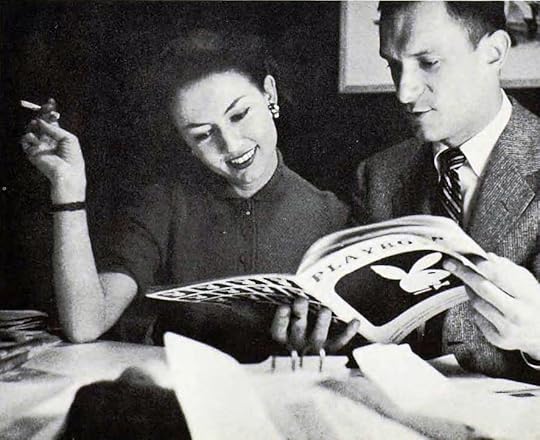
Playboy was more than a magazine filled with pictures of nude women and advice on how to mix the perfect martini. Indeed, the magazine's vision of sexual liberation, high living, and "the good life" came to define mainstream images of postwar life. In exploring the history of America's most widely read and influential men's magazine, Elizabeth Fraterrigo hones in on the values, style, and gender formulations put forth in its pages and how they gained widespread currency in American culture. She shows that for Hugh Hefner, the "good life" meant the freedom to choose a lifestyle, and the one he promoted was the "playboy life," in which expensive goods and sexually available women were plentiful, obligations were few, and if one worked hard enough, one could enjoy abundant leisure and consumption. In support of this view, Playboy attacked early marriage, traditional gender arrangements, and sanctions against premarital sex, challenging the conservatism of family-centered postwar society. And despite the magazine's ups and downs, significant features of this "playboy life" have become engrained in American society.
*4.5 This was a fascinating book on the history of one of America's most controversial magazines, "Playboy". Originally I intended to read this book for uni and so I didn't need to read every single word as certain chapters didn't apply to what I was studying, such as the chapter on architecture and the "Playboy Pad". However, the book was just so interesting and so short that I decided to read it all and I'm very glad I did.
The only reason I didn't give this book 5 stars is that it was reading for uni which kind of sucked some of the enjoyment out of it as I had to analyse and read everything twice to make sure I didn't miss anything. Also there were a few minor grammatical issues I had, as some phrases were repeated in their entirety which happened multiple times.
Having said that, I highly recommend this book to anyone interested in gender and sexuality in Post-War American society or to fans of the TV show Mad Men!
"Remember," Hugh Hefner advised photographer Vince Tajiri in 1970, "pubic hair is no longer a taboo in PLAYBOY as long as it is handled in good taste." (p. 170)
It is easy to come away from this book with the conclusion that there is no such thing as the purely aesthetic appreciation of a nude. You can only perceive one in terms of the socioeconomic chain: changing gender roles, government sanctioned policies on the family.
Elizabeth Fraterrigo's look at the Playboy phenomenon shows that Hefner's vision was totally driven by sociological drift; in other words, he didn't aim to capture the beauty of a woman's body in terms of poetry, as something gorgeous in its own right. For those with a sense of art history it is almost comical to see Americans groping around postwar for aesthetic appreciation we seemed to be discovering for the first time in our history. As critic Robert Hughes observed, one of the most striking facets of art history in America is the complete absence of any sense of eroticism. Give credit to Hefner for going where artists refused to go.
It is our contemporary religion of consumerism that instructs us there is no such thing as nudity perceived in its purity. Wherever it exists it is evaluated solely through aspiration, career advancement, status attainment, achievement in education. It is simply taken for granted that a woman's body perceived in its own right - its shape, form, loveliness - never arrives in terms other than our place in society.
This would come as a surprise to the great European painters from Manet to Matisse who painted to capture that purely aesthetic charge, not the economic ones of desire. Photographs of nudes were part of the landscape but this technological breakthrough didn't deter the great painters: they were convinced it was still possible to capture a woman in the nude, matching genius for genius, despite the presence of photographs that supposedly could capture the thing in itself.
Significantly, painters gave up on the idea of the purity of the nude somewhere around the advent of modernism in the 1920s, not because of the ubiquity of photographs but due to the triumph of capitalism. A purely aesthetic experience was no longer possible if it didn't come packaged as product and advertising. In fact I am reading many theorists of our age argue that art history died several decades ago, replaced forever by the mainstreams of the market.
Hefner actually had the instincts of the fin de siecle painters but lacked their socialism and intellect. It is my feeling that he achieved a purely aesthetic appreciation of the nude with these stunning American women shown in his magazine (that is, up until about the late 1980s where the centerfolds ceased resembling women and became indistinguishable from manufactured product).
He knew what he was doing. The spreads from the 1960s document as well as anything from Degas or Bonnard what domestic interiors were like. Personally, it thrills me to see the kind of wall paneling, coffee tables, record players and sofas in those spreads that were still around in the homes I grew up in, just with gorgeous nudes in them and not friendly moms making grilled cheese sandwiches.
Surprisingly, he resisted the depiction of pubic hair around 1970 when there began a demand for it; Bob Guccione with his magazine Penthouse forced his hand, in that Guccione declared that the sexual revolution (including the advances made by feminism in the 1960s) had already been won. Thus began "the Pubic Wars" which for my tastes represented a Golden Age for the nude.
My preference is definitely for the pubic triangle, but it annoys me to see men online describe it as "women as they naturally are" or "women how they ought to be." There are plenty of lovely women who still maintain a bush, but the environment for creating art from their nudity is gone - certainly that slim window of opportunity no longer exists as seen in the 1970s where a social and political movement met an artistic one, creating the Playboy centerfold of that decade. If a model nowadays will capture your eye, you know for sure the art is all in the woman and not in "the artist" or the production team bringing her nudity to your eyes. A woman without a pubic triangle could just as well be seen as "how they naturally are": it is not the shaved, pubescent look that is so offensive but the way women are being depicted in a world without art.
Fraterrigo goes on at length detailing the climate of postwar, anti-communist, 1950s "organizational man" (what everyone found so riveting about Mad Men) and how Playboy as an institution was designed to free men from these corporate fetters. Thus it is interesting to see Playboy in terms of the same impulses as the Beat movement. They are surprisingly not all that different: one opted for penthouse apartments and the other the open land, yet both lifestyle choices were trying to avoid the process of becoming a statistic.
Playboy is assumed to be conservative, i.e. degrading to women, but Fraterrigo shows that Hefner and Helen Gurley Brown (of Cosmopolitan) both had the same idea in mind, of the single, sexually available girl, not the drudge at home. She is professional, forging a culture of her own through choice and individual effort, not the elite one prescribed by universities like Wellesley, Vassar, Smith and Radcliffe.
The problem is that a life of choice is exactly what consumerism is about. You certainly cannot blame Hefner and Gurley Brown for the advent of Neoliberalism but you can see the perversion of their magazines' aesthetic in the horror of what the Playboy phenomenon became and the nightmare (to me at least) of the kind of Sex & the City girl still haunting our media: everything is up for sale including sex, which I'm sure is not what Gurley Brown had in mind. Hefner's turn to pornography in the early 2000s suggests that, ultimately, puckishly, his vision had flirted with prostitution all along.
This was a solid read, although it perhaps felt a bit long to me - I think I could have absorbed its main message in the form of an article. Some of the chapters were thus interesting but largely peripheral. Overall the book shows just how much the creation of Playboy Magazine in the 1950s shaped the culture of the day (for instance, drawing close comparisons to the Bond movies) and affected later social developments, especially with paving the way for the loosening of moral standards in the 60s. Playboy emphasized the creation of a period of life for young men and women in which they focused on living it up and enjoying themselves (prominently though certainly not exclusively through sex) before settling down with a family. This is very similar to the creation of teen culture during the same era, which emphasizing similar tones of carefree and fun living. Both of these things ultimately helped lead to the vast changes in cultural expectations during this era.
Excellent book about not only Playboy magazine, but also postwar culture, American consumerism, and shifting gender roles in the 1960s and 1970s. You don't even have to have read Playboy to understand them!
This book is pretty interesting. It outlines the historic trends stemming from the founding of playboy until contemporary times. In some sense, playboy was the first "instagram" as it showed off the playboy lifestyle, which was largely in line with how American consumerism, sexual liberation and male privilege reconfigured a lifestyle that promised complete consumption of high end products, living and sexually available loose women without the confides of a middle class monogamy.
From this telling, it is clear that at first playboy was radical, as an everyman magazine, but for finer products, one that was edgy because of the looseness of its sexual morales. However, it was not pornographic the way other magazines were purely so. And it proved too be too prudish and not prudish enough for the coming of the feminist era. Playboy has come to mark for Americans and people all around the world, a version of the American dream, one from a privileged male view. Nowadays that kind of view is everywhere nowhere more so than the cartoon American Dad where Stan gets all the pleasure and his wife is often relegated to "side kick" status, or all the unwanted consequences pile onto her
On the one hand, this is not what Playboy espouses to do -- to punish women -- but as much of American culture has shown, women get the short stick, while men get their male sexual desires fulfilled. Yes, Playboy has provided expectations for men (and women) as to what modern sexuality should look like. But on the other hand, it has equated the good life of consumer products, cool men, and sophistication (jazz, cocktails, gourmet cooking, fast cars) as the hallmark of what makes a modern man, other than someone who works for a living, as other than a provider for the family.
In a deeper sense, Fraterrigo shows how Playboy was really a reflection of the lifestyle Hefner made for himself after his divorce, when he got to sow his seed without the baggage of a wife and all the entrapment of domesticity. In some sense, while women got feminism and civil rights to air their oppression, men had Playboy to hold a fantasy life for the male version of freedom in suburbia. This also highlights how women have less of a space in post-WW2 life for their own than men did.
Penetrating look at how Playboy contributed to the culture of consumption as virtue. No matter how good the articles were, I'm convinced that Hefner was a thoroughly malign influence on us.
The role of Hugh Hefner in shaping and promoting a bachelor lifestyle in the 50s and 60s is the strongest element in this scholarly history of Playboy.The magazine advanced and reflected changing mid-century morality, its image of the gentleman, aspirational consumerism, sexual engagement for the single man and the good life. In the 70s, Playboy launched Clubs and resorts and the Playboy bunny to extend its philosophy. The impact of the women's liberation movement on both the Playboy culture and American society is another highlight of this book. Because author Fraterrigo focuses on gender politics she tends to overlook other elements of Playboy that set it apart from competitors such as Penthouse. Hefner provided a platform for authors and artists that gave the magazine great appeal. Most of the great writers of the late 20th century contributed short stories in every issue; art and illustrations came from Andy Warhol, Keith Haring, LeRoy Neiman and Shel Silverstein. Playboy's television program promoted the leading jazz artists of the day which continues in the annual Playboy Jazz festival.
Anyone who knows me knows that I LOVE history. Especially what you can consider the.. steamier side. I had to read this book for a class, but it was well worth the time to read it!
Playboy is known for many things, but not necessarily as a force of change in American history, but according to Elizabeth Fraterrigo, that is exactly what it was: a force of change. Hugh Hefner sparked an avalanche of transitions during the 1950s and 60s.
Fraterrigo takes the reader on an astounding journey of exploration of what became known as "the good life" in America. I recommend this book for anyone that likes to read about post WWII America or cultural history in general. This is also a good book to read if you would like to discover what Playboy and Hugh Hefner accomplished besides displaying pictures of partially nude women.
This is a monograph on consumer ethos in America after the Second World War. Fraterrigo is great at revealing how Playboy created a large segment of this conversation on the good life. She's especially good at demonstrating how "second-wave" feminists and Playboy formed an unholy coalition in order to combat the New Puritans. Her methodology stands in the Western Marxist tradition - The Frankfurt School - which is popular now.
A fascinating cultural study on Playboy magazine and its impact on politics, sexual mores, and Hugh Hefner's seemingly prophetic promotion of the luxurious, consumption-based bachelor life. A very thorough read, Fraterrigo does an excellent job providing thoughtful context and critical commentary without finger wagging or tacit acceptance. In many ways, the story of Playboy is the story of US cultural development from the 50s to the 80s and what that has wrought today. Recommended.
Somehow a bio of Playboy magazine comes off as dull. The book digresses onto tangents that aren't germane to the topic. There is little biographical information about the magazine or Hugh Hefner that hasn't been covered elsewhere. The last 30 years of Playboy and Hefner are part of an epilogue. A much more interesting book is "Mr. Playboy: Hugh Hefner and the American Dream" by Steven Watts.
Having never read much about Hugh Hefner and coming from my women's studies background, I thought this was a fascinating blend of biography and the shaping of cultural norms and identity.