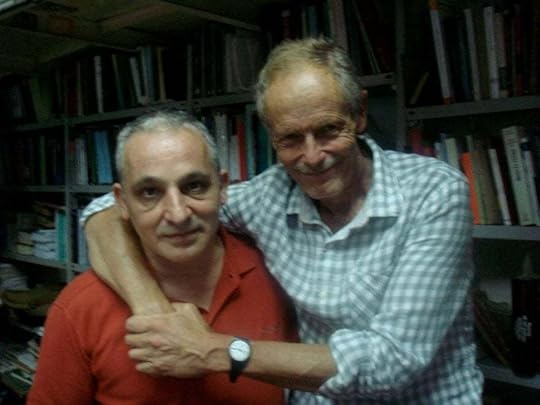
Upon completing high school in 1968 Erri De Luca joined the radical left-wing movement Lotta Continua. After the organization's disbandment he worked as a blue collar at the Fiat factory in Turin and at the Catania airport. He also was as a truck driver and a mason, working in job sites in Italy, France and Africa. He rode relief convoys in Yugoslavia during the war between 1993 and 1999.
He is self-taught in several languages including Ancient Hebrew and Yiddish.
De Luca is a passionate mountain climber. A reclusive character, he currently lives in a remote cottage in the countryside of Rome.
Although he never stopped writing since he was 20, his first book is published in 1989, Non ora, non qui (Not now, not here). Many more books followed, best sellers in Italy, France and Israel, his work being translated and published in Spain, Portugal, Germany, Holland, USA, Brazil, Poland, Norway, Danmark, Romania, Greece and Lithuania. He has himself translated several books of the Bible into Italian like Exodus, Jonah, Ecclesiastes, Ruth, and explored various aspects of Judaism, as a non-believer.
In France, he received the France Culture Prize in 1994 for Aceto, arcobaleno, the Laure Bataillon Award in 2002 for Tre cavalli and, also in 2002, the Fémina Étranger for Montedidio, translated in English as God's Mountain. He was a member of the jury at the Cannes Festival in 2003.
Erri De Luca writes regularly for various newspapers (La Repubblica, Il Manifesto, Corriere della Sera, Avvenire), and magazines.
On the first afternoon upon our arrival in Naples we decided to head towards the famous Spaccanapoli street – the axis that cuts or breaks (spaccare) the city into two. Very close to the apartment we began to climb the hilly street that borders the University, Via Mezzocannone, when we saw a couple of tables with cases of books standing outside a very small bookshop. Unavoidably, we stopped there, mesmerized, looked at the books outside and then entered the shop. This was one of the most serendipitous events of our entire visit. This small place is also the office of the editorial Dante and Descartes, managed by Raimondo de Maio and his son (we later discovered they have a second shop across the church of Gesù Nuovo, which we visited another day).
Inside the shop there was amongst the very many and disordered piles of books, other memorabilia such as photographs. One of them was of Erri de Luca and Raimondo. They were also promoting Luca’s latest book Impossibile, which I have also bought and hope to read/review soon.
This is my first Erri de Luca, and it is published by this specialized editorial. It is a collection of short essays/tales/conti that portray Luca’s love and estrangement from his native city. They are like meditations on certain themes, on certain people--comedians, journalists, actors, soccer players, (mostly Neapolitans not so well known outside specific and local circles, except for Maradona), but which overall produce a very personal portrayal of this bewitching city.
De Luca was born in 1950 and left the city when he was still very young, in 1968. In the first essay, the longest one and which gives its title to the whole collection, Napòlide, the author explains the term. As a Neapolitan who has exiled himself, he has not altogether extradited his soul from his city; he has not altogether De-Neapolitanized himself: he has just embraced the world and thus become, simply, a Napòlide.
There are several reminiscences from his childhood – from the amusing and sad story of the mothers in his school wanting to thank a teacher for his patience and dedication by buying him a gold watch, which he violently rejects taking it as an insulting bribery – to his walks to the very end of the Neapolitan dock, the Molo di Mergellina, where he would dream of becoming a sailor. And this image of the sailor takes us to Conrad’s Lord Jim, for part of that novel takes place in this legendary Parthenope, the siren and the city. De Luca reminds us that the famous epigram “See Naples and Die” comes from Conrad.
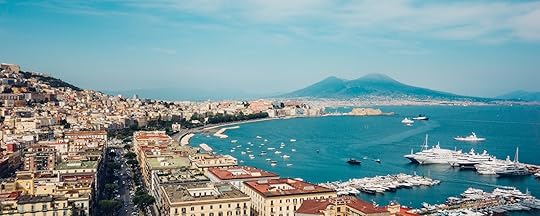
De Luca evokes many aspects of the city: its boisterousness; its labyrinthical streets; the military character it acquired after WW2 when Nato chose it as its Mediterranean base; the unfortunate year of 1799 which meant that after Napoleon the former kingdom was not united to the one in the north, but colonised by it. We are also told how the inhabitants of that magnificent bay don’t look at the sky, at the stars, to know their cosmological position but instead use a volcano as their compass. Their souls are tuned to the moods of the Vesuvius. And if their streets are an entanglement with surprising and treacherous corners—for after all it was in one of those where Caravaggio was stabbed, and the wound would bring about his end--, below the ground there is another mesh of tunnels that, as Aeneas learnt, can lead your way to Hades. There are also practical comments such as that pasta ought not to be cooked with too much water, and some very lyrical sections, such as his conception of what a landscape is: that where the air does not hit the walls, where the eyes can free themselves of any short-sightedness, and where the human species are a minority in comparison with the birds, the trees and the fish.
Erri De Luca writes in a highly distilled prose. It is not easy to read because there is so much intention in it; each word has its own weight. There is no superfluity. And behind the words there has been a prolonged, calmed, observant and judicious reasoning.
Even if De Luca considers himself a Napòlide, for me, together with the bookshop, he remains at the core of my idea of Naples.
Otra preciosidad de novela del napolitano Erri de Luca. Un día, paseando la mirada por los estantes de Letras Corsarias, apareció el pequeño lomo rojo que identifica los libros de Periférica.
Ya el título lo dice todo, Napátrida. El autor mezcla las palabras "Nápoles" y "apátrida", generando una disonancia al unir en un solo término una ciudad y la idea de no tener patria ninguna. El subtítulo, por su lado, reza "Volver a Nápoles". Y digo rezar también en su sentido literal, porque Nápoles es una ciudad ultraconservadora y porque al autor le hizo falta mucha oración para atreverse a volver a Nápoles.
Aunque me lo leí hace cosa de un mes recuerdo que era muy crítico con la ciudad, aunque todo estaba contagiado por el cariño que guardamos a los lugares de nuestra infancia. Aun así habla mucho de la naturaleza volcánica tanto de Nápoles como de los napolitanos, con una capa externa dura y quemada que hace difícil que germine allí cualquier forma de vida. También hace un repaso a la historia de Nápoles, desde la formación de la ciudad hasta las guerras mundiales, donde tuvieron una gran importancia estratégica por su salida al mar.
Es, tirándome un triple desde el otro lado del campo, la historia de un Pedro Páramo que regresa a Comala años después, por curiosidad, por necesidad, por incertidumbre, para ver si todo sigue donde lo dejó. Aunque, en lugar de hacer calor llueve mucho y en lugar del horizonte del desierto está el del mar.
Un "olio", dipinto con i sentimenti di un ritorno, dopo lunga assenza. Con quell'amore che alleggerisce i difetti. L'incipit e il nucleo principale sono notevoli. Alcune pagine, soprattutto alla fine, sanno di quantità. Necessario a chi voglia completare la conoscenza di De Luca; non a chi pensi di "cominciare" da qui.
És De Luca fent de De Luca. I és per això mateix que en continuo encisat. En aquest cas, carrega Nàpols de protagonisme fins i tot quan no pot evitar la cruesa del retrat. Com sempre, un doll de bellesa.
“De vez en cuando algún periódico publica una clasificación sobre la habitabilidad de las ciudades: Nápoles no sobresale. La culpa es de los parámetros que se toman en consideración. No se incluye el apartado mar, que consuela y perfuma, ni tampoco el del viento, que transporta arenas y especias lejanas, pero sobre todo no figura el apartado volcán, que otorga el peso de la ceniza y la desenvoltura del fogonero a la forja de un pueblo, y menudo pueblo”.
Este libro está hecho para corazones melancólicos🩵
me gusta como escribe él, pero siento que me perdí varias cosas. Casi me ofendo cuando habló de fútbol y casi no hizo alusión a Maradona. Por suerte sobre el final le dedica un capítulo. Un capítulo bastante más optimista del decantar de la realidad. En fin, tengo que conocer Napoles 😌
Tactus Mi fermo a questo, non vado e non vedo oltre la superficie, il tatto, tactus in latino: quello che ci ha toccato, che poi è molto di quello che ci è toccato. La pelle d'oca è una reazione di superficie, Napoli è una città contropelo, di quelle che sfregano unghie sulla lavagna e lama di coltello sul marmo. Ai suoi inquilini suscita sfoghi cutanei.
Generalmente si conozco más o menos el idioma (o sea, inglés, o en menor medida, italiano) prefiero leer el original, pero me encontré este libro en la sección de viajes de la bonita librería Amapolas en Octubre, y me encantó el formato y la edición. Y ahora, aquí entre nosotros, habría sido incapaz de leérmelo en italiano. El traductor ha hecho una gran labor no sólo en traducir un libro muy lírico y rico en léxico, sino también en traducir del napolitano (que es un idioma bastante diferente al italiano) cuando era pertinente. En libros en italiano no suele suceder, porque como les llaman “dialectos”, “se entienden”, y aquí me tienes tratando de enfrentarme a la primera página de un libro de Montalbano, escrita casi enteramente en siciliano, sin enterarme nada más que del sentido general de la frases. El libro no es exactamente un libro de viajes; habla de Nápoles desde una persona que ha nacido allí y que no deja de volver, a través de diferentes etapas de su vida. Cada capítulo habla de una persona, de una sensación, de un evento como el fútbol, y en general transmite si no “el sentido de un lugar”, el sentido de un sentimiento, el sentimiento de una ciudad que pasó de la riqueza de una capital europea a la miseria y no ha salido de ella. La sensación que da una visita es la de una miseria como no se ha visto en occidente; los barrios pobres de Nápoles se parecen más a los barrios de chabolas de Medellín que a unas 3000 viviendas de cualquier capital. Pero no se puede negar el lugar que ocupa Nápoles en la cultura y en el corazón italiano. Y este libro, hasta cierto punto, lo transmite. Aparte de la cultura ingente de la persona que lo ha escrito; un escritor a descubrir.
Alto peso specifico E' stato il momento giusto: basso volume, adatto ad un viaggio… sui binari, ma alto peso delle parole. Alta densità di pensieri, dunque. Densità che obbliga all’interruzione, alla riflessione, con la vista che si perde oltre il finestrino per cercare dentro di sé le immagini, per 'ruminare’ i pensieri in tempi allungati. Perché ogni frase merita tempo e va assaporata lentamente, con la mente appesa a quelle parole, mai banali o scontate, sempre intense. Pur non condividendone a volte le idee. E parlando di sé e del suo sentirsi Napòlide, Erri non fa che parlare di solitudini, in un ventaglio aperto tra il primo racconto: A Napoli, quando scendo gli scalini del treno, non mi sento tornato. Invece mi sento solo con un diritto più intimo di quello che provo altrove (pag. 5) e l’ultimo Pasta, il più struggente, che vale tutta la raccolta: Un uomo in cucina si apparecchia la cena. E’ solo, mette ogni sera un coltello, una forchetta, un piatto, mosse soprappensiero. Quando prende il bicchiere si accorge di essere lui e basta. Il bicchiere accusa, non si solleva verso nessuno […] (pag. 95).
Scritto in maniera accattivante (detto da chi non ama molto De Luca), è un po' troppo incentrato sui personali ricordi dello scrittore. Speravo/pensavo a qualcosa di più generale.