

What do you think?
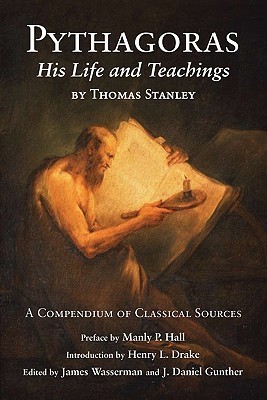
Pythagoras: His Life and Teachings
The timeless brilliance of this exhaustive survey of the best classical writers of antiquity on Pythagoras was first published in 1687 in Thomas Stanley's massive tome, The History of Philosophy . It remains as contemporary today as it was over three hundred years ago. The text of the 1687 book has been reset and modernized to make it more accessible to the modern reader. Spelling has been regularized, obsolete words not found in a modern dictionary have been replaced, and contemporary conventions of punctuation have been used. Biographical sketches of Thomas Stanley and Pythagoras by Manly Palmer Hall, founder of the Philosophical Research Society, have been included, along with a profound overview of Pythagorean philosophy by Platonic scholar Dr. Henry L. Drake. The extensive Greek language references throughout the text have been corrected and contextualized, and reset in a modern Greek font. Each quotation has been verified with the source document in Greek. An extensive annotated appendix of these classical sources is included. A complete bibliography details all the reference works utilized, and a small Glossary defines a number of terms, especially those from musical theory, which may be unfamiliar to the non-technical reader.
352 pages, Paperback
First published June 1, 1979
About the author
Thomas Stanley
47 booksThomas Stanley, M.A. (Cambridge. 1641), was a wealthy commoner, translator, and the last of the so-called "Metaphysical poets" of 17th-century England.
Ratings & Reviews
Friends & Following
Create a free account to discover what your friends think of this book!
Community Reviews
Displaying 1 - 8 of 8 reviews

October 3, 2021
I initially picked up this book to find out more about Pythagoras and his obsession with numbers. I found out that Pythagoras belonged to the pre-Christianity era c. 570 BC and he lived a radically different life from me. There are mentions about the theories of the numbers correlating to the divinity of the Universe but it sounded gibberish to me. Explanations to Pythagoras' train of thoughts were unclear. There are many unsubstantiated statements about his philosophy but I am unsure if certain nuances were lost along the way, after all the man passed on for more than two thousand years ago. It makes the book really hard to comprehend and digest.
I was pleasantly (not) surprised that the concept of God existed way before Christianity became popular. Pythagoras attributed many of his number theories to the doings of God. He revered the divine beings for the creation of the Universe. Even for ancient philosophers, God played a big part in their lives.
It was quite challenging to read through the book because many unfamiliar terms were used but not properly explained. Maybe there's a better book to read about Pythagoras?
I was pleasantly (not) surprised that the concept of God existed way before Christianity became popular. Pythagoras attributed many of his number theories to the doings of God. He revered the divine beings for the creation of the Universe. Even for ancient philosophers, God played a big part in their lives.
It was quite challenging to read through the book because many unfamiliar terms were used but not properly explained. Maybe there's a better book to read about Pythagoras?

August 23, 2024
Thomas Stanley's Pythagoras: His Life and Teachings delves into the life and philosophy of one of antiquity's most influential figures. Pythagoras, best known for his contributions to mathematics, particularly the Pythagorean theorem, was also a philosopher and mystic whose ideas shaped Western thought. Stanley, a 17th-century scholar, compiled this work as part of his larger historical treatise on the lives of ancient philosophers. This book is a meticulous effort to reconstruct Pythagoras's life and teachings based on classical sources, making it a crucial text for those interested in the origins of Western philosophy.
Summary:
The book is divided into several sections, each exploring different aspects of Pythagoras's life, travels, and teachings. It begins with an account of his early years on the island of Samos, where he was born around 570 BCE. Stanley details Pythagoras's extensive education, which included time spent in Egypt and Babylon, where he absorbed a wide range of knowledge that would later influence his philosophical and mathematical ideas.
Pythagoras's teachings, as presented by Stanley, cover a variety of topics, including the immortality of the soul, the transmigration of souls (reincarnation), and the profound role of numbers in understanding the cosmos. Stanley emphasizes Pythagoras's belief that numbers are the fundamental principles of reality, an idea that later became central to the development of mathematics and science in the Western world. The book also describes the esoteric nature of Pythagoras's teachings, which were often reserved for a select group of disciples and were shrouded in secrecy.
Analysis:
Stanley’s work is both comprehensive and detailed, drawing on a wide range of ancient sources such as Diogenes, Iamblichus, and Porphyry. One of the key strengths of the book is its exhaustive collection of these sources, which allows readers to gain a nuanced understanding of Pythagoras’s life and philosophy. Stanley’s narrative is methodical, providing readers with a thorough exploration of Pythagoras’s ideas and their impact on his contemporaries and on subsequent generations.
Conclusion:
Pythagoras: His Life and Teachings by Thomas Stanley is a foundational text for anyone interested in the historical and philosophical significance of Pythagoras. Its detailed use of classical sources provides a comprehensive view of Pythagoras's life and legacy, making it a key resource for scholars and serious students of philosophy.
Summary:
The book is divided into several sections, each exploring different aspects of Pythagoras's life, travels, and teachings. It begins with an account of his early years on the island of Samos, where he was born around 570 BCE. Stanley details Pythagoras's extensive education, which included time spent in Egypt and Babylon, where he absorbed a wide range of knowledge that would later influence his philosophical and mathematical ideas.
Pythagoras's teachings, as presented by Stanley, cover a variety of topics, including the immortality of the soul, the transmigration of souls (reincarnation), and the profound role of numbers in understanding the cosmos. Stanley emphasizes Pythagoras's belief that numbers are the fundamental principles of reality, an idea that later became central to the development of mathematics and science in the Western world. The book also describes the esoteric nature of Pythagoras's teachings, which were often reserved for a select group of disciples and were shrouded in secrecy.
Analysis:
Stanley’s work is both comprehensive and detailed, drawing on a wide range of ancient sources such as Diogenes, Iamblichus, and Porphyry. One of the key strengths of the book is its exhaustive collection of these sources, which allows readers to gain a nuanced understanding of Pythagoras’s life and philosophy. Stanley’s narrative is methodical, providing readers with a thorough exploration of Pythagoras’s ideas and their impact on his contemporaries and on subsequent generations.
Conclusion:
Pythagoras: His Life and Teachings by Thomas Stanley is a foundational text for anyone interested in the historical and philosophical significance of Pythagoras. Its detailed use of classical sources provides a comprehensive view of Pythagoras's life and legacy, making it a key resource for scholars and serious students of philosophy.

December 1, 2020
Excellent resource if you're studying Pythagoras, which is why I bought this book. Not a light read, but a well-produced one.

September 26, 2023
Comprehensive but dry as a bone.
March 22, 2026
Pythagoras is a rational nutcase, who not only contributed to Mathematics, but also believed you shouldn't eat beans or touch roosters...
Want to Read
June 26, 2026Thinking
August 20, 2014
Worth adding to your library. It is the best Pyrhagoras book I've read to date.

September 7, 2014
nice to see work by John Reuchlin, but i prefered "the Pythagorean Sourcebook".
Displaying 1 - 8 of 8 reviews