

What do you think?
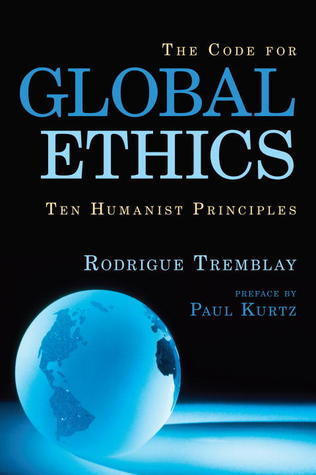
Code for Global Ethics: Ten Humanist Principles
Humanists have long contended that morality is a strictly human concern and should be independent of religious creeds and dogma. This principle was clearly articulated in the two Humanist Manifestos issued in the mid-twentieth century and in Humanist Manifesto 2000, which appeared at the beginning of the twenty-first century. Now this code for global ethics further elaborates ten humanist principles designed for a world community that is growing ever closer together. In the face of the obvious challenges to international stability-from nuclear proliferation, environmental degradation, economic turmoil, and reactionary and sometimes violent religious movements-a code based on the "natural dignity and inherent worth of all human beings" is needed more than ever. In separate chapters the author delves into the issues surrounding these ten humanist preserving individual dignity and equality, respecting life and property, tolerance, sharing, preventing domination of others, eliminating superstition, conserving the natural environment, resolving differences cooperatively without resort to violence or war, political and economic democracy, and providing for universal education. This forward-looking, optimistic, and eminently reasonable discussion of humanist ideals makes an important contribution to laying the foundations for a just and peaceable global community.
- GenresReligionNonfiction
300 pages, Hardcover
First published January 1, 2010
About the author
Rodrigue Tremblay
16 books4 followersDr. Rodrigue Tremblay is a Canadian-born economist, humanist and political figure who teaches at the University of Montreal.
Professor Tremblay has a B.A. from Laval University (1961), a B.Sc. in Economics from the University of Montreal (1963), an M.A. in Economics from Stanford University (1965) and a Ph.D. in Economics from Stanford University (1968). He is emeritus professor since 2002. Among other organizations, Dr. Tremblay is a former president of the North American Economics and Finance Association.
Dr. Tremblay has also held public office in the Government of Quebec, from 1976 to 1979. His previous book The New American Empire was published in English, in French and in Turkish. His most recent book The Code for Global Ethics, Ten Humanist Principles is published in English by Prometheus Books (April 2010. ISBN: 978-1616141721) and in French by Les ditions Liber (February 2009, ISBN: 978-2895781738).
"
Ratings & Reviews
Friends & Following
Create a free account to discover what your friends think of this book!
Community Reviews
Displaying 1 - 2 of 2 reviews

November 22, 2010
This is an absolutely fantastic, unapologetic dose of reality. It lays out a very clear picture of ten vital, humanist principles to live by. In great detail, using examples we can all understand, this book explains the pitfalls of religious thought when designing and living by a moral code. In many terrifying ways, organized religion always has and always will push humanity through mazes of violence and war, justifying death and destruction in its wake. This book explains how religion is completely unnecessary in crafting the perfect moral code and is, in fact, a detriment to the development of a more perfect moral code.
I couldn't believe how perfectly this system fit with my own philosophies. Every page was so full of perfect, sound rationale, that I now want to go out and buy thousands of copies and just start passing them out on the streets. The American political system now is so shaky, and is now teetering back on the brink of religious fundamentalist conservative thought, that the public is allowing its own intellect to be hijacked by the Tea Party and their radical anarchist views, that I do seriously fear for our future as a nation. I truly believe that unless the United States returns to the humanist principles of the Founding Fathers, we are in a collapsing system.
I couldn't believe how perfectly this system fit with my own philosophies. Every page was so full of perfect, sound rationale, that I now want to go out and buy thousands of copies and just start passing them out on the streets. The American political system now is so shaky, and is now teetering back on the brink of religious fundamentalist conservative thought, that the public is allowing its own intellect to be hijacked by the Tea Party and their radical anarchist views, that I do seriously fear for our future as a nation. I truly believe that unless the United States returns to the humanist principles of the Founding Fathers, we are in a collapsing system.
April 17, 2010
Review of: The Code for Global Ethics, Ten Humanist Principles, by Rodrigue Tremblay (Prometheus Books)
Great minds such as Voltaire, Hume, Locke, and others made the eighteenth century the century of the Enlightenment. They showed humanity that there was a better way to organize its affairs on a firmer moral foundation than what various religions had provided until then. This was the way of humanism and empathy. For them, human beings have an innate capacity for basic morality, for developing sympathy for others, and for treating others with empathy by putting oneself in the context of other people. Such a natural inclination does not come from gods, but is the end result of natural evolution. In that, they were worthy precursors of Charles Darwin and his "moral sense or conscience".
Three centuries later, there is a most urgent need to remind humanity of these fundamental truths, before catastrophe strikes again, i.e. that man has inalienable natural rights, that man is naturally a moral animal and that, in return, man has a duty of not abusing his power over nature.
In “Global Ethics: Ten Humanist Principles”, Mr. Tremblay has expanded on these great thoughts by showing how a commitment to humanist values can help everyone in developing a moral conscience. -How the classical 'Golden rule' can be expanded to embrace empathy for other people, outside of our immediate social or political groups. –Why a truly global approach to morality is needed today to tackle global problems. –How the disasters of the past can be prevented in the future. The answer is to be found in the great humanist principles of global ethics that can be applied worldwide, beyond borders, to build the foundations for a better world community.
-A lot of myths and sacred cows are demolished in “The Code for Global Ethics” without even a hint of remorse or hesitation by the author. This makes it thrilling to read. We are not accustomed to being told things so openly and frankly about ethics and religion, at least in the United States.
In other pre-Vatican II times, the Catholic Church would have put such a book in the Index.
Displaying 1 - 2 of 2 reviews