With the help of Jinx, the cat, and Jinx's sister, Minx, as well as many other well-known animals on the Bean Farm, Freddy pulls some wonderful tricks, not the least of which is outwitting the fraudulent magician who comes to entertain the unsuspecting inhabitants of the nearby town of Centerboro. Freddy is simply one of the greatest characters in children's literature! (School Library Journal)
Walter Rollin Brooks (January 9, 1886 – August 17, 1958) was an American writer best remembered for his short stories and children's books, particularly those about Freddy the Pig and other anthropomorphic animal inhabitants of the "Bean farm" in upstate New York.
Born in Rome, New York, Brooks attended college at the University of Rochester and subsequently studied homeopathic medicine in New York City. He dropped out after two years, however, and returned to Rochester, where he married his first wife, Anne Shepard, in 1909. Brooks found employment with an advertising agency in Utica, and then "retired" in 1911, evidently because he came into a considerable inheritance. His retirement was not permanent: in 1917, he went to work for the American Red Cross and later did editorial work for several magazines, including The New Yorker.
In 1940, Brooks turned to his own writing for his full-time occupation. Walter married his second wife, Dorothy Collins, following the death of Anne in 1952.
The first works Brooks published were poems and short stories. His short story "Ed Takes the Pledge" about a talking horse was the basis for the 1960s television comedy series Mister Ed (credit for creating the characters is given in each episode to "Walter Brooks"). His most enduring works, however, are the 26 books he wrote about Freddy the Pig and his friends. Source
Impressed by the performance of a circus magician, intellectually curious Freddy resolves to learn magic. When the animals meet Zingo, however, he dismays them by shamelessly bragging of his international fame (“a performance that has been given before all the crowned heads of Europe, that has won deafening applause in every first-class theatre”) and insulting Mrs. Wiggins the cow (“your fat silly face gives me acute indigestion”). When Zingo’s magic hat is lost, Presto, the magician’s white rabbit, enlists Freddy to recover it. When Presto claims (falsely) that the magician has fired him, the kind-hearted Bean animals make him at home on the Bean farm. To reciprocate, Presto gives Freddy magic lessons. Freddy finds the magic hat, inside of which is money that Zingo had stolen from the circus. The novel’s plot culminates in Freddy’s and Zingo’s on-stage competition in magic prowess. Zingo loses ignominiously; and Freddy’s friend, Leo the circus lion, frightens Zingo into fleeing town.
As in FREDDY AND THE SPACE SHIP, Freddy the Pig utilizes his skills as a detective to expose and expel a villain who preys on Centerboro animals and humans. In Brooks’ fictional world, Zingo and Presto are stock characters—unscrupulous outsiders who prey upon the innocent, unsuspecting residents of Centerboro.
Brooks’ Freddy books, popular in the 1940’s and 50’s, display the mandatory didacticism characteristic of children’s books of the time. Because Freddy continues to enchant readers of all ages today, it is worth examining Brooks’ moral universe. In THE RHETORIC OF FICTION, Wayne C. Booth maintains that a reader’s willingness to embrace a novel’s implied value system is far more important than a reader’s “willing suspension of disbelief.” In Booth’s terms, it is less important that a child accept talking animals per se than that she buy into the value system of Freddy’s “implied author”—values that underlie Cemterboro’s harmonious human/animal cooperation.
The Freddy books celebrate modesty, selflessness, and empathy. In FREDDY THE MAGICIAN, the cat Minx, is punished for her self-centered boasting when the Bean animals pretend she is invisible. Charles the rooster, in love with his own oratory, is periodically chastened. What, for me, however, is most endearing about Freddy is his championship of underdogs. Freddy is unfailing ready to rescue any exploited creature, no matter how lowly. In FREDDY THE MAGICIAN, FREDDY GOES TO FLORIDA, and FREDDY AND MR. CAMPHOR, Freddy displays compassion for insects, tiny creatures that humans and animals routinely ignore or kill. The insects Freddy rescues aid him in crises. In FREDDY THE MAGICIAN, Zingo has connived to eat for free at Ollie Groper’s Centerboro hotel by planting insects, caterpillars, and spiders in his food, loudly proclaiming that the hotel is contaminated. When Freddy releases them from an airless box, they (along with the Bean mice, Eek, Eeny, Quik and Cousin Augustus) assist Freddy in his magic competition with Zingo. Freddy wins the duel against the experienced magician because mice and insects sabotage Zingo’s tricks and aid Freddy’s performance. In an era of authoritarian parenting, Brooks’ child readers must have identified with small life forms treated as second-class citizens!
A consideration of the moral universe of the Freddy books would, unfortunately, be incomplete without noting their odd xenophobia. In FREDDY THE MAGICIAN, Zingo and Presto are devious Italians; in FREDDY AND THE SPACE SHIP, the Midwestern Bismuths are intruders in upstate New York. FREDDY AND THE SPACE SHIP and FREDDY THE MAGICIAN end similarly, when the evil outsiders are forced to leave Centerboro on a bus. Though Mr. Bismuth (SPACE SHIP) and Zingo (MAGICIAN) are criminals, they do not belong in the Centerboro jail. Zingo and Bismuth would contaminate an environment so pleasant that one recently released criminal steals a chicken in order to play on the jail’s baseball team. Though Freddy’s fictional milieu teaches compassion to the smallesst Centerboro resident, outsiders are, all too often, stereotypical villains. The Freddy books, alas, teach suspicion of geographical outsiders.
Freddy is quite the protean pig (poet, detective, newspaper editor, banker, etc.), but when he starts taking magic lessons from Presto, the fired white rabbit of an unpleasant and shady magician called Signor Zingo, who himself has been fired from Boomschmidt's Colossal and Unparalleled Circus after pilfering the petty cash, Freddy realizes there will be some limits to what he can accomplish: “Of course I could never do card tricks; you have to have hands for that and I’ve got trotters. But I bet I could learn some of the others. Maybe I could give performances.” (He is often an optimistic pig, which is one of his charms.)
In Freddy the Magician (1947), the fourteenth Freddy the Pig book, then, author Walter R. Brooks demystifies “magic” by humorously anatomizing its trickery, from misdirection and secret pockets and hidden clips and elastic bands to sibling look alike cats and unobtrusive mice. The novel features not one but two climactic magical performances that devolve into duels between rival magicians featuring numerous feats of sleight of hand (or of trotter) and revealing to the audiences the tricks which have been deceiving them. Will Signor Zingo or Professor Frederico get the upper hand/trotter in their feud? Which magician will prove to the people and animals of the fictional New York town of Centerboro and environs that he’s the better mind reader? Will Freddy ever be able to get the unpaying and unwanted Zingo to move out of the town hotel? Why does Zingo want his missing magic hat so badly?
In addition to Freddy’s magician’s war with Zingo, the book (like most Freddy novels) features at least one sub-plot: Leo the circus lion has to shave his luxuriant locks and come to terms with his new identity as the Great Bald African Lion, while Jinx the black cat has to deal with his irritatingly boastful sister Minx.
In addition to the pleasures of talking animal fantasy as performed by Brooks (it’s a given that animals can talk with each other and or with humans) and of the comical situations he imagines (a fired magician’s rabbit teaching magic to a pig, a lion disguising himself as a pig disguising himself as a boy disguising himself as an Indian, a jail so appealing that released inmates commit crimes to get put back in, a henhouse blown into a tree on the local millionaire’s estate, a department store where the clerks and customers regularly end up deservedly slapping each other, and so on), like most Freddy novels, this one also has plenty of the following virtues:
“Cows are plain and there is nothing they can do about it, but they are very kindhearted animals, and it is a pretty mean man who will deliberately insult a cow,”
and
“People who don’t know much about pigs are not likely to class them as dangerous animals; but an angry pig is something that no farmer in his senses will tackle barehanded.”
Brooks’ humor for adults (as a boy, I read the Freddy books as serious adventures and never laughed at anything in them, but reading them now I regularly smile and chuckle), as when an aggrieved Leo greets Freddy:
“Ah, it’s the pig,” said Leo as if speaking to himself. “Come to look his last upon an old comrade. Come to gibe and to sneer, no doubt—to point the finger of scorn and make the dirty crack. Ah, me, the great King of Beasts, to be made a laughingstock for those who, in the days of his greatness, stood in awe before his strength; who, in the words of Shakespeare, ‘smiled at his purr and trembled at his growl!’”
“That’s not in Shakespeare,” said Freddy. “I have his Complete-Works-in-One-Volume at home, and there’s nothing like that in it.”
Brooks’ quirky wisdom for adults, as when Freddy and Leo the circus lion talk about self-identity and mirrors:
“When I see myself, I think I look one way, and then I find out that I look quite different. And it makes me wonder if when I think I look sort of noble I’m not really looking just sort of half-witted. Like when I’m talking to you, now, for instance—I think I look probably worried, but reasonably intelligent. But—do I? I just can’t be sure. Maybe I’m really making idiotic faces at you. You got a mirror handy?”
“You, being a lion, I suppose want to look dignified and interesting, with just a little touch of ferocity. I, being a pig, want to look clever and good-humored, with just a dash of romance. Probably neither of us will ever look the way we want to. But if we forget mirrors we may get somewhere close to it. Watching mirrors all the time just makes us look anxious and a little foolish.”
Brooks’ flexible and capable style, which ranges from the G-man slang favored by Jinx the black cat to the elevated “poetry” of Freddy when he has some spare time to compose.
Brooks’ life lessons for kids, as when Freddy feels sorry for his enemy or accepts the aid of caterpillars and beetles or the narrator opines that “in a fight, or in a contest of any kind, the one who keeps his temper has an advantage that is equal to two shotguns and a small cannon.”
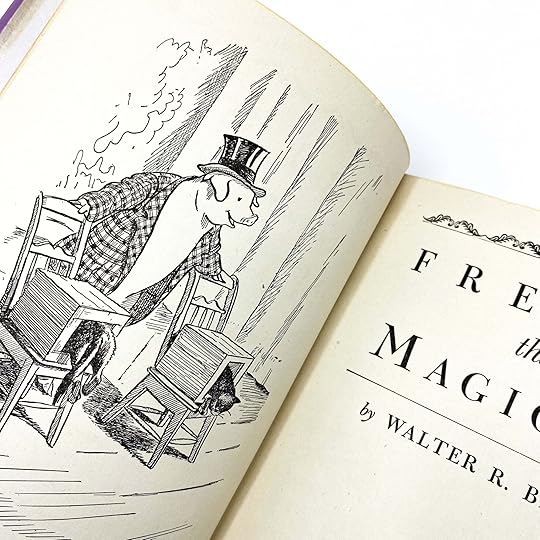
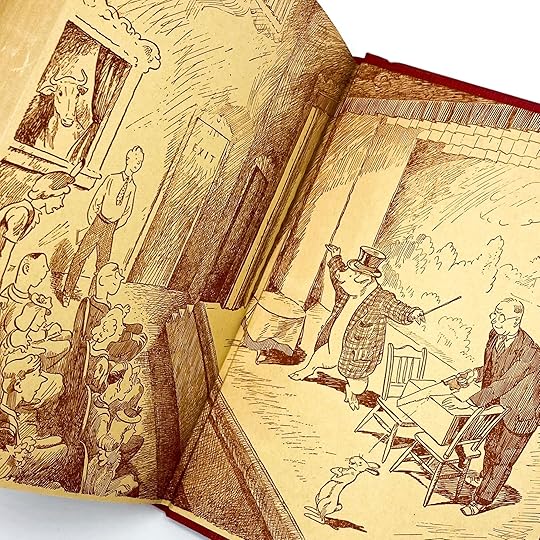
Kurt Wiese’s monocrhome illustrations, which are mostly fine, for, in addition to drawing animals more realistically than, say, Disney, he has a knack for choosing the most interesting to see scenes in each chapter.
While being an entertaining entry in the series, Freddy the Magician is not perfect. Signor Zingo is too early too clearly a villain (his mustache’s ends turn up like horns!), and with his name is a bit too much of an unsavory non-WASP character. The hotel manager Mr. Groper’s “sesquipedalianism” becomes too much of a good thing: a little “I ain’t mad… Just, as you might say, kind of reduced to the nadir of pessimistic hypochondriasis… the ultimate and nethermost profundity of the abyss” goes a long way. And the story ends too abruptly and incompletely.
I recommend readers new to Freddy to start with Freddy the Politician, Freddy the Detective, Freddy and the Poppinjay, or Freddy and the Ignormus, but really any of the books can be read in any order and most of them, like this one, should amuse you.
A poetry writing detective magician pig solves numerous mysteries in this unusual book. Freddy stars in a series of books for kids, though I'm not sure of the age level aimed for. The multiple subplots, one pedantic loquacious character and the nonchalant mix of humans and talking animals could make this a challenging read for younger readers, while also a bit off-putting for older ones. There is, fortunately, lots of magic in the story, good, poor, bad, and criminal.
Unfortunately this book is marred by a segment that is ignorantly very racist against "Indians." I'm sure Brooks meant no harm, but a Native child (of any Nation or Tribe) would be very hurt to read the references to war whoop, scalping, and feathered headdress. In my opinion it's a weak entry, anyway, and is totally skippable.
"... in a fight, or in a contest of any kind, the one who keeps his temper has an advantage that is equal to two shotguns and a small cannon."
Freddy books are great. I never read them as a child. My husband did and loved them. We have read to our grandkids over Skype and they love the Freddy books too now that we introduced them to them. There is humor and pathos and wonderful characters. Always a treat to read a Freddy book!
I feel this is actually one of the weaker books in the series. The Minx plotline seems to me to be particularly unsatisfactorily handled--a bit mean-spirited. And what happens with Presto the rabbit? Not much. Just disappears, ha ha. Whatever; of course it still has its moments.
We loved this book. Senor Zingo it about the most villainous villain in any of the Freddy books. It was hard to stop at the end of some chapters because of the cliff hangers.
As with all the Freddy books, I do edit a bit as I read to the grandkids. Sometimes a character will tell the other to "Shut up." which I change to "Be Quiet." Also, I tone down Henrietta's hen-pecking of her husband Charles. I know; conscientious Grandma. :-)
It was super funny. He becomes a magician. There's a hurricane at the beginning of the book and a magician loses his hat and so a rabbit is like I'll teach you magic if you'll find his hat. So he finds it, so the rabbit teaches him magic.