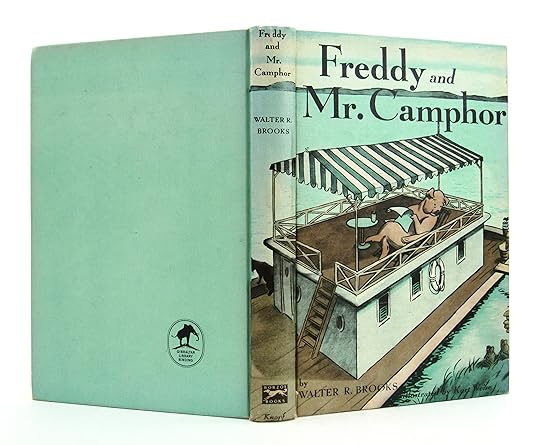
Freddy the Pig, the "Renaissance Pig" (The New York Times Book Review) of Bean Farm, is back to thrill his fans of all ages in facsimile editions of these all-American children's classics. In Freddy and Mr. Camphor, Freddy is in need of a change and finds an opportunity for one as a caretaker on Mr. Camphor's houseboat. Of course, things never go as Freddy expects and a series of strange, amusing, and sometimes alarming adventures ensue.
Walter Rollin Brooks (January 9, 1886 – August 17, 1958) was an American writer best remembered for his short stories and children's books, particularly those about Freddy the Pig and other anthropomorphic animal inhabitants of the "Bean farm" in upstate New York.
Born in Rome, New York, Brooks attended college at the University of Rochester and subsequently studied homeopathic medicine in New York City. He dropped out after two years, however, and returned to Rochester, where he married his first wife, Anne Shepard, in 1909. Brooks found employment with an advertising agency in Utica, and then "retired" in 1911, evidently because he came into a considerable inheritance. His retirement was not permanent: in 1917, he went to work for the American Red Cross and later did editorial work for several magazines, including The New Yorker.
In 1940, Brooks turned to his own writing for his full-time occupation. Walter married his second wife, Dorothy Collins, following the death of Anne in 1952.
The first works Brooks published were poems and short stories. His short story "Ed Takes the Pledge" about a talking horse was the basis for the 1960s television comedy series Mister Ed (credit for creating the characters is given in each episode to "Walter Brooks"). His most enduring works, however, are the 26 books he wrote about Freddy the Pig and his friends. Source
What better way to ring in the New Year than with a look back (and continued re-read) of one of my favorite book series as a child?
Post-Read: An enjoyable read, and a good return to the series, even if it's not my favorite book to date.
And now, as an adult, I find it oddly satisfying that poor put-upon Freddy needs a break from his responsibilities. Just that tiny touch of "Realism" gave the book a new resonance for me.
Bored with the Bean farm routine, Freddy becomes caretaker for the estate of a rich politician, Mr. Camphor. Because the cook Mrs. Winch and the butler Bannister do the housework, Freddy anticipates a leisurely summer. Shortly after Freddy’s arrival, however, evildoers threaten Mr. C’s domain. Simon and his band of rats maliciously gnaw the faces from Mr. C’s ancestral portraits. Also, the “man with the black moustache” and dirty-faced son, who had menaced the Bean animals in Florida, appears. Having tracked down Mrs. Winch, his estranged wife (and meal-ticket), Winch seeks to replace Freddy as caretaker so as to rob Mr. C with impunity. To discredit Freddy, Winch plants one of Mr. Camphor’s rare coins in Freddy’s room. Mr. C sends Freddy back to the Bean farm, where he organizes animal friends to evict the rats and expose Winch. Harmony restored to Mr. C’s idyllic home, Freddy repairs and repaints the portraits. To Mr. C’s delight, he gives them all Mr. C’s face. Under Freddy’s guidance, Winch and his son Horace are redeemed. They wash away layers or dirt, and Freddy gives Horace painting lessons.
In FREDDY AND MR. CAMPHOR (1944), the Beans’ patriotic support for the “war effort” brought back fond childhood memories of buying war bond stamps and tending my parents’ Victory garden. At the Bean farm, the spiders, Mr. and Mrs. Webb, launch a campaign to convince the insects to spare the garden: “This year I don’t think that you should destroy any of the crop. Mr. Bean is rationed in what he eats, and if you are patriotic bugs, you won’t object to being rationed too” (135). Sent back to the Bean farm through Winch’s machinations, Freddy thwarts another self-serving villain. The horsefly, Zero, destroys the Webb’s patriotic billboards and loudly debunks their message of self-sacrifice: “Patriotic your grandmother! Go on eat what you’ve always eaten” (147). Freddy ends Zero’s disruptions by inviting his toad friends, Waldo and Elmo, to the Webbs’ rally. One of the two (Freddy does not know which) snags the fly out of the air with his tongue.
With Freddy as problem-solver and catalyst, Bean humans and animals are a harmoniously functioning ecosystem Though titular head of the farm, Mr. Bean gives his animals little direction. He relies on Freddy and other trusted animals to solve any problems that might interfere with the farm’s operation. When, for example, a hurricane hits Centerboro (FREDDY THE MAGICIAN), Bean does not need to tell the animals to undertake repairs and cleanup. Though the Bean animals travel and pursue their own projects, they never lose sight of the farm’s welfare. With boundless energy and eagerness to master new skills, Freddy the Pig is key not only to the Bean enterprise, but to Centerboro’s quality of life. Freddy-initiated projects like the First Animal Bank and the BEAN HOME NEWS make Centerboro a better place.
In his recent op-ed piece, “Everyone a Changemaker,” David Brooks describes the kind of people society needs: “Changemakers are people who can see the patterns around them, identify the problems in any situation, figure out ways to solve the problem, organize fluid teams, lead collective action and then continually adapt as situations change.” “Changemakers,” Brooks maintains, embody “empathy-based living for the good of all” (https://www.nytimes.com/2018/02/08/op...). By Brooks’ definition, Freddy is an ideal “Changemaker.” He determines which animals, wild or domestic, possess the skills to perform an undertaking, then convinces or bribes them to undertake it.
I am rereading Walter R. Brooks’s books as a senior citizen, but would love to have children today discover them. The Freddy books seek to instill the values children need to become community-minded Changemakers. To share enthusiasm for these wonderful books with other fans, go to Friends of Freddy: http://www.freddythepig.org
A Christmas gift from my fiancé, Freddy and Mr. Camphor was my first foray into Brooks' Freddy the Pig series. The book falls in the middle of the 25-or-so volume series, yet the reader feels right at home jumping in here. It is a charming, witty, entertaining story for readers of all ages. Freddy and his fellow animal characters are equally at home on their upstate New York farm as they are in the houseboat on Mr. Camphor's estate. These are characters that my younger self would have identified with unequivocally. I admired the way the plot worked itself out--the best laid plans of mice and pigs not coming to fruition. Brooks' sweet animal protagonist's true character shines not in his attempts to fix problems but in his willingness to listen to his friends. I'm excited to dive into the rest of the Freddy books!
Another Freddy story with the usual villains and opportunities for Freddy to disguise himself. I don't remember much standing out in the plot as particularly funny, but Brooks has a kind of charm in his story telling that carries the reader along.
Freddy the Caretaker, Rat Art Critics, Patriotic Insects, the Man with the Black Mustache and his Dirty Faced Boy, a Rich Man and His Butler, and Proverbs
“It’s because you’re too fat,” said Jinx, the cat. “Golly, it makes me hot just to look at you, pig, sitting there grunting and mopping your face.”
Freddy the Pig wants to escape a hot spring and his duties as Editor of the Bean Home News and President of the First Animal Bank, so he leaves the Bean farm for a cushy summer job as caretaker of the wealthy Mr. Camphor’s estate: for keeping an eye on the place, Freddy will get fifty dollars, meals, and lodging in a well-appointed houseboat on the lake.
Furthermore, as Mr. Camphor and his butler Bannister hope to write a book disproving proverbs like “a rolling stone gathers no moss,” the rich man will pay Freddy $10.00 for every saying he can test by experiment. This leads to humorous moments like when Mr. Camphor complains, “Money is the root of all evil,” only to have Bannister point out, “If you really believed money were the root of all evil, sir, you’d get rid of all your money!”
It all goes well for caretaker Freddy, lounging on Mr. Camphor’s houseboat (“I’m a lucky pig!”), until some old antagonists from previous books show up. Simon the rat and his clan have moved into Mr. Camphor’s mansion and don’t take kindly to his attic-stored “family” portraits (“Why, it’s our artistic duty to chew ’em up”), while the Man with the Black Mustache and the Dirty Faced Boy drive noisily in and try to muscle (and frame) Freddy out of his job (“It needs a man around the place”).
A WWII subplot runs through this eleventh of Walter R. Brooks’ Freddy the Pig books, Freddy and Mr. Camphor (1944). As the patrons of the First Animal Bank are withdrawing all their money to invest in government war savings stamps, the spider Mr. Webb is holding patriotic mass meetings to persuade insects to refrain from eating farm vegetables for the duration of the war: “we are still all good Americans… Are we not?” Threatening the spider’s campaign is an obnoxious horsefly called Zero who points out that spiders don’t eat vegetables and scoffs at the patriotic agenda.
A few other Freddy books also reveal their WWII era provenance, but less earnestly and intrusively than this one. The fate of Zero after losing a political debate (in which “calling names is entirely permissible”) is disturbing because the novel approves of it. Most villains in Freddy books, from needlessly destructive rats to animal-hating robbers, are defeated, humiliated, exiled, arrested, and/or reformed. But because Zero (a reference to the Japanese fighter aircraft?) is “unpatriotic,” his epitaph is “So perish all traitors!” And maybe because I dislike patriotism, the busybody Mr. Webb, who spreads his patriotic no-vegetable eating movement from farm to farm, and calls his wife “Mother” (even though they apparently have no children), is irritating, and I found myself unusually not wholly enjoying the novel.
The story also has some loose ends. Brooks never explains how Zero became able to spin webs and leaves the proverbs sub-plot unfinished.
Luckily, there are plenty of the usual virtues of the Freddy books here: humorous scenes and conversations, concise and vivid descriptions, quirky wisdom, nonsensical animal “facts,” formidable foes, savory friends, and, of course, the protean pig Freddy, who, while serving as Mr. Camphor’s estate caretaker, finds time to don a smock and beret and do a little painting restoration on the side.
I love Brooks’ quirky nuggets of wisdom, like “For pigs understand boys pretty well, perhaps because they are so much alike. If fathers and mothers who have trouble with bad boys would consult pigs oftener, they would profit by it.”
And his straight-faced animal facts, like “Even a cat cannot see anything in complete darkness, although all cats pretend that they can,” and “Fleas are so nearly invisible that they find it easy to get away with things that wouldn’t be tolerated for a moment in larger creatures.”
And his wide range of registers, including Jinx the cat’s demotic English (“Hi, old pig! … We thought the old sausage grinder had got you at last”), Simon the rat’s unctuous English (“Well, well . . . fancy meeting you here, pig! What a small place the world is, to be sure. Well, don’t you recognize me? Haven’t you a warm handshake for your old friend, Simon?”), and Breckenridge the eagle’s “high-flown” English:
“Your young friends, with a fortitude out of all proportion to their size, descended by way of the chimney. They found much to criticize in the housekeeping, I am given to understand. But after a prolonged search they discovered large quantities of plunder—much of it merely heaped up in the bathtub. Which indicates quite sufficiently, I feel, the character of this Mr. Winch and his offspring.”
By the way, as I’m reading my way through all twenty-six of Brooks’ great, too much forgotten Freddy the Pig books, I realize how much adult targeted verbal humor they have and recall that when I read several of them as a boy, I thought they were serious talking animal adventures and never dreamed they were funny. But now! Brooks was writing children’s novels for adults.
Another interesting point in this novel is a minor touch that, I believe, E. B. White took and flew with in Charlotte’s Web: a spider writing English messages in its web! Here it’s Mr. and Mrs. Webb writing signs in their webs announcing the patriotic rallies. Both E. B. White and Brooks worked at The New Yorker, and I’ve been noticing other things from the Freddy books that may have inspired White with his classic children’s novel.
The illustrations by Kurt Weise are top notch: monochrome; more realistic than Disney; showing choice moments from the text (like when a troop of fleas attack some pesky rats or like when Freddy dresses in some of Mr. Camphor’s clothes to pass for a burglar).
I did notice a few typos in the Kindle version.
Anyway, if you can stand the patriotic subplot, this novel should be amusing for you, but Freddy the Detective, Freddy the Politician, and Freddy and the Poppinjay are much better.
This one's extra interesting. More dramatic, and more thoughtful. It's not Freddy or the animals in trouble from humans so much, as it is animal vs. animal and human vs. human. I like the exploration of the character of Mrs. Winch, who left no-good husband. I like the project of analyzing the truth of proverbs. Also I appreciate that Charles got a chance to be helpful using his oratory skills. These are just full of little details like that, including a note that Uncle Wesley, the duck, got seasick on a large lake....
Another highly enjoyable Freddy book. In this one, Freddy is looking for a change of pace, so he applies for a cushy job as the caretaker of a large estate owned by Mr. Camphor. Everything seems to be going just great until some of Freddy’s old enemies show up and start causing trouble! As usual, Freddy manages to get out of a jam with cleverness and a little help from his friends—and he even manages to help some patriotic bugs in his spare time. This isn’t our very favorite Freddy, but it was a lot of fun. We especially enjoyed Waldo the grouchy toad and Bannister the proverb-quoting butler.
My second favorite Freddy book. I need to get my hands on images of the paintings he creates in this book. The plot was probably the most tightly knit of any of the Freddy books I have read so far. Mr. Camphor is someone I would love to visit some day.
Sly Humor, Homespun Wisdom, and Moral Authority From A Stand Up Pig
Do not make the mistake of dismissing Freddy as merely a cute character or the books as just charming animal tales. To me, Freddy stands tall as the next step beyond as the young reader progresses from Winnie the Pooh, to Paddington Bear, to the regulars at Toad Hall. Freddy can dither like Winnie, he can be as confused and out of his element as Paddington, and he can be as raucous or dryly humorous as the "Wind in the Willows" characters, but he is a great deal more.
In each Freddy book we see our hero as a leader, an organizer, a planner and a thinker. He is bold and decisive. He does not suffer fools gladly. He can charm and persuade, but he can also stand up forcefully for right. He is honest and he is trustworthy and reliable. That said, he can also be vain, priggish, and a bit of a drama queen.
This particular book displays all of those aspects of Freddy's personality. He is bored and stressed out by his many farm responsibilities, so he takes a supposedly relaxing and carefree summer job as a caretaker. Many complications ensue, with Freddy in the middle trying to cope. There is marvelously witty dialogue, antic situations, deadpan humor, bits of Andrew Carnegie-style wisdom, bits of silly business, but also some menace that requires action. Of course, it's all in a day's work for Freddy and it's all conducted with humor and dispatch. Happy. or at least well deserved, endings for all of the characters are always guaranteed in a Freddy book. (I see Freddy as an odd amalgamation of Jeeves, Teddy Roosevelt and Hercule Poirot. Picture that if you can.)
You could probably write a couple of dissertations on the 1940's political/social/cultural subtext that is reflected in the Freddy books. Captain of industry or champion of the working masses? Political manipulator or idealistic progressive? Symbol of a vanished rural ideal or harbinger of urbanization and modernity? This is interesting to think about as you read these books as an adult, but for the purpose of choosing books to read to kids or for kids to start reading on their own I was just content to conclude that there is no overt lesson learning here, apart from honorable lessons about traditional virtues. This isn't "Animal Farm"; it's not even "Charlotte's Web". It is, though, a lot more than, say, the Thornton Burgess animal stories like 1915's "Danny Meadow Mouse". Freddy is entertaining, but he has some heft.
So, not to be a tedious crank, these are entertaining books of real value. They are dated in the sense that there is mention of war bonds and victory gardens and the like. But they don't read old, they are phrased in a surprisingly breezy modern style, and they move along at a faster rate than what you usually find in the more leisurely paced kids books from the 40's. And, like Freddy, these books have some weight and could be a rich and rewarding find for a younger reader.
Please note that I received a free ecopy of this book in exchange for a candid review. Apart from that I have no connection at all to either the author or the publisher of this book.
Freddy the pig is tired! He loves living on Mr. Bean's farm, but his responsibilities keep growing and growing. From his duties at the bank to his job as editor of the Bean Home News, Freddy's got a lot on his plate and he just wants a break! And so, when he hears about a summer job opening as a caretaker for a local lakeside home, Freddy can only hop at the chance to have a leisurely summer aboard the caretaker's houseboat while he tends to the few jobs needed on the large estate. Though the proverb-loving owner is at first leery of hiring a pig to do a man's job, Freddy eventually convinces him of his trustworthiness and is hired. Things go splendidly at first but soon deteriorate when the troublesome Mr. Winch and his son Horace arrive. Can Freddy prevent his old enemies from causing all sorts of trouble at the lake house and throwing Freddy's honor into question with the owner? When he fails to prevent their mischief, Freddy turns to his old friends Jinx and the other Bean farm animals for help. With a little ingenuity and a lot of bravery, despite the interference of a pesky horsefly and some sly rats, Freddy and his friends win the day once again.
Another adventure with Freddy the poet-detective-bank president-newspaper writing pig is always a treat, made sweeter this time by the chance I had to listen to this installment while riding in the car on errands and trips to the beach with my parents. We're all adults but we enjoyed our time with Freddy as much as any kid would! Though I didn't quite like the narrator's voices for the characters, once I got used to them, I was able to focus on the tale and enjoy it for its humor, patriotism, sweet moral lessons and clean fun.
This book, like all the other Freddy books, is far-fetched and entertaining. The plot seems like it should be predictable- when the characters encounter some problem, you can guess what they're going to do to solve it, but then they never do that thing. The Bean farm animals have absolutely no common sense, making the stories far more fun than they would be otherwise. It's like the villagers in Monty Python's Holy Grail, reasoning that they can determine that a woman is a witch if she weighs the same as a duck. Anything like a rational progression of thought through that scene would have been dull and landed flat, but as it is, you laugh the whole way through. Freddy's kind of like that- I laugh the whole way through the books, and somehow always find myself actually caring about the fate of the characters.
It was ok. It's about him and the witches and the witches try to steal a lot of the camphor's things and he tries to tell Mr. Camphor he isn't the person stealing. But Mr. Camphor believes the witches. At the end they find out it was the witches. Mr. Camphor wants him to write a book about it and when it was published, the publisher changed the names to the "Life and Times of Freddy."
I grew up on the Freddy the Pig books, and what a treat to find them again. The library where I work can hardly keep them on the shelves. Folksy, humorous and wise, they're good for children and mellow adults alike.
Four Freddy books in four days. This is becoming an adddiction. I am on my fifth book and waiting for more in the mail. Please get them here before I finish this one. I don't want to be Freddyless for a day. What fun.
There's a reason the Freddy books were brought back into print through the effort of fans--though the first was published 75 years ago. Nice night flight read.
Borrowed. This Freddy book is like about every Freddy book that I read. It began with an ad in the Bean Home News. If you want to know more, read Freddy and Mr. Camphor by Walter R. Brooks!