

What do you think?

Sweet Honey, Bitter Lemons: Travels in Sicily on a Vespa
Please Read Brand New, International Softcover Edition, Printed in black and white pages, minor self wear on the cover or pages, Sale restriction may be printed on the book, but Book name, contents, and author are exactly same as Hardcover Edition. Fast delivery through DHL/FedEx express.
352 pages, Paperback
First published April 3, 2008
Ratings & Reviews
Friends & Following
Create a free account to discover what your friends think of this book!
Community Reviews
Displaying 1 - 30 of 37 reviews

August 21, 2016
I was so excited going into this. Travel writing combined with food writing. What's not to like?
Well. What I didn't like, and what made me put it down (at least I put it down gently, I didn't cast it aside with great force) was that it didn't do enough of either. I stopped reading at page 58 so it is entirely possible (but not probable) that it suddenly improved but i doubt it.
I'll give an example: the book is about a journey through Sicily (on a Vespa, natch) to eat and write about the island. It starts in Marsala. Where the fortified wine comes from. And indeed one of the first visits is to a producer of the stuff, which was very popular a few hundred years ago with the British. (I'm partial to a drop myself). But there is no real explanation of the production process, why it's different from, say, sherry, and so on. That's not a massive loss. But to drive past the main square and drop into the narrative the fact that the main church (or was it a cathedral?) is dedicated to Thomas à Beckett (yes, the turbulent priest murdered at Canturbury cathedral. Yes that Thomas à Beckett who was sainted. To whose tomb the pilgrims in the Canturbury Tale were travelling. In short, a very interesting personage) and then not tell us why . Why? Why would you do that? Sheesh.
I pushed on but when that happened the book was on warning. There was description of food, using just too much Italian (which I don't speak) for me to know just what he was talking about. So that was annoying. I pushed on into the next chapter because i really like travel books. But again something really interesting was just mentioned in a throwaway comment and I was left wondering why the book had been written at all. Left wanting.
So I decided not to waste any more time on it. 2 stars is generous.
Well. What I didn't like, and what made me put it down (at least I put it down gently, I didn't cast it aside with great force) was that it didn't do enough of either. I stopped reading at page 58 so it is entirely possible (but not probable) that it suddenly improved but i doubt it.
I'll give an example: the book is about a journey through Sicily (on a Vespa, natch) to eat and write about the island. It starts in Marsala. Where the fortified wine comes from. And indeed one of the first visits is to a producer of the stuff, which was very popular a few hundred years ago with the British. (I'm partial to a drop myself). But there is no real explanation of the production process, why it's different from, say, sherry, and so on. That's not a massive loss. But to drive past the main square and drop into the narrative the fact that the main church (or was it a cathedral?) is dedicated to Thomas à Beckett (yes, the turbulent priest murdered at Canturbury cathedral. Yes that Thomas à Beckett who was sainted. To whose tomb the pilgrims in the Canturbury Tale were travelling. In short, a very interesting personage) and then not tell us why . Why? Why would you do that? Sheesh.
I pushed on but when that happened the book was on warning. There was description of food, using just too much Italian (which I don't speak) for me to know just what he was talking about. So that was annoying. I pushed on into the next chapter because i really like travel books. But again something really interesting was just mentioned in a throwaway comment and I was left wondering why the book had been written at all. Left wanting.
So I decided not to waste any more time on it. 2 stars is generous.

July 17, 2019
The first time Matthew Fort set foot on the island of Sicily he was the tender age of 26. He was visiting in the early 1970s and was looking forward to the beaches and spending time with his brother. What he didn’t realise was just how this place would get its hooks into him.
Which was why three decades after that first visit he was back again to explore the island. Travelling backwards and forwards on a scarlet Vespa, that he had named Monica this was a pilgrimage with the sole intention of discovering the nicest foods that he could find.
Occasionally this book will terrify you, as he takes his life into his own hands to ride the scooter from place to place, and I know how bad it is even when you are in a car. Each meal that he has with the locals seems more memorable than the last, as they welcome his curiosity about their culture and produce from the land. Mixed in with all of this is a little history, landscape and snapshots of some great people who care about the food that they eat and who work the magic to turn ingredients that are full of flavour into mouth-watering dishes. Reading this book will make you very, very hungry. Wonderful stuff.
Which was why three decades after that first visit he was back again to explore the island. Travelling backwards and forwards on a scarlet Vespa, that he had named Monica this was a pilgrimage with the sole intention of discovering the nicest foods that he could find.
Occasionally this book will terrify you, as he takes his life into his own hands to ride the scooter from place to place, and I know how bad it is even when you are in a car. Each meal that he has with the locals seems more memorable than the last, as they welcome his curiosity about their culture and produce from the land. Mixed in with all of this is a little history, landscape and snapshots of some great people who care about the food that they eat and who work the magic to turn ingredients that are full of flavour into mouth-watering dishes. Reading this book will make you very, very hungry. Wonderful stuff.

June 24, 2011
An entire book focusing on the food of Sicily. Is there really enough to talk about? Clearly! Matthew Fort is a well-known food writer in the UK, and I enjoyed his descriptions of the landscape and the food, particularly the historical bits of which cultures and empires different foods come from. I wish there had been more pictures, and that they had converted the recipes into American-friendly measurements. :)

June 27, 2024
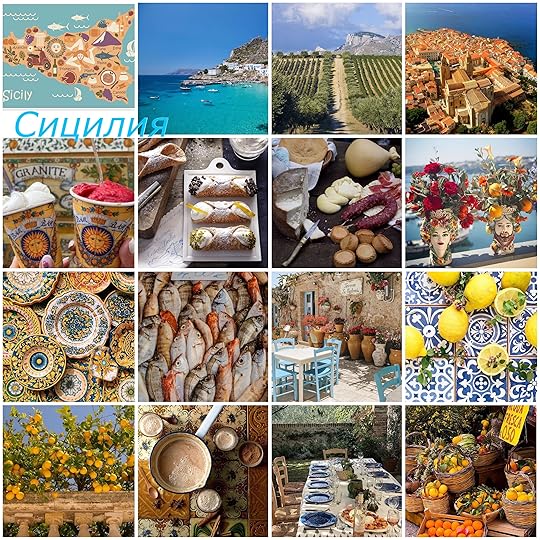
Гастрономическое путешествие и никакого обмана
Очень вкусная кулинарная книга.
Была бы она у меня не в электронке, я бы точно ее надкусила. Очень, очень-очень, много в ней еды и для радивых хозяюшек, ну и так, кто готов стоя у плиты себя порадовать, огромное количество рецептов, мне кажется, всего, что автор на этом прекрасном острове попробовал. Вы уж простите, что я в этом не точна, на рецептах меня вырубало, то есть я их читала, но они сливались просто в поток вкусных вещей и я себя ловила на полдороге к кухне, чтобы салатика себе настругать. Они вроде бы и мимо меня не прошли, но у меня цели их запомнить и применить, не было. А почему?..
Да потому, да потому... что читать аннотацию надо было вдумчивей, а не думать, что ты только про путешествие по Сицилии прочитаешь.
Мой мозг даже не предполагал, что "роман-гастрономический дневник" - это реально гастрономический дневник, а не красное словцо. Автор именно что ел. Все время ел. Ну, не на каждой странице, нужно отдать ему должное, но как он в самом начале книги заявил - "Итак, попытаюсь понять Сицилию желудком" - так слово свое и сдержал.
И отсюда у меня предупреждение, если вы хотите больше знать об острове, городах, деревнях, людях, дорогах, жизни, то это будет в самых минимальных количествах и вас это не удовлетворит. Вы либо принимаете это как данность, либо ищите себе о Сицилии другую книгу.
Я не хочу сказать, что вы совсем уж ничего про жизнь острова, ее историю и как она повлияла на людей, не узнаете. Это тоже будет, в разных местах что-то свое, но все через еду, да. Откуда пришли специи, как они тут оказались, почему что-то сменилось, что-то осталось, как еда бедняков оказывалась на столах богатых и из-за этого тоже менялась. Как выращивают овощи для национальных блюд. Почему полей становится меньше, почему фермеров становится меньше, где ловить и как ловить рыбу. Про дороги и полное отсутствие указателей и когда ты понимаешь, что у нас дороги еще ничего. Про жизнь простых рабочих людей. Почему женщина там все еще занимается семьей, а не строит карьеру (не думаю, что что-то изменилось с момента написания книги). Все это будет, но крупицами. Я бросалась на них, как на жемчуг, мне было совсем скучно читать про еду и какая она на вкус и чем отличается одно пирожное от другого, мне были интересны всегда люди, которые эту еду готовили, которые для этой еды сажали, взбивали, ловили.
И опять же, ничего нельзя сказать в упрек автору, мало того, что он сразу предупредил, буду говорить о еде, так он и по книге не раз говорил, что кроме еды он ни о чем другом не умеет рассуждать - и я конечно, прямую его цитату потеряла... поверьте на слово, и глубоких философствований не ждите, но! автор отлично сумел провести параллели и сопоставления объясняя, откуда что взялось и как повлияло на людей. Он не упустил значимых вещей для острова, его жизни и работы, он подмечал и мелкие детали, которые говорили о жизни людей, об их характере, об их мечтах, заботах и о том, что их беспокоит. Просто на этом у него не было акцента, на таких моментах нужно самостоятельно останавливаться и в себя вбирать. И тогда получится не только кулинарное путешествие.
И если вы согласны, что большая часть книги будет про еду и только про еду, иногда затрагивая моменты спасения бобовых, которые произрастают только на Сицилии, про мафию, которая очень сильно повлияла на людей и влияет до сих пор, про серные рудники, единственное, что давало работу мужчинам острова, про архитектуру и что нравится больше именно автору, про дорогу и придурковатость карт и направлений, тогда берите книгу смело. Потому что в дополнение она подарит вам ароматы, вкусы, солнечное тепло, фиесту под тенью деревьев и опьянение, что можно поехать хоть направо, хоть налево, лишь бы красная веспа-трудяга (эммм... в книге это "весла", не знаю, кто из нас тут прав, переводчик или я) вас не подвела, хотя это еще как посмотреть, иногда создавалось впечатление, что веспу подводил водитель)
November 19, 2020
Ooooofff it took me soooo long to read this. I really struggled as it was so relaxing that it would send me to sleep within about two and a half minutes. But when it wasn't sending me off to sleep it was quite frustrating. I was going to give it to my Gran but I dont think that she would like it. There is too much Sicilian/ Italian without translation, and not enough detail about places that were visited. The history that was mentioned would stop before it got juicy or was super brief and left me wanting more, having to pick up my phone to google it (rather than picking up my phone to google translate it!). Nevermind, I'm sure that someone else will enjoy it!

March 12, 2017
Ура, я дочитала! Читала я книгу долго, но, согласитесь, сложно читать быстро, если после каждой страницы начинаешь хотеть жрать :)
Читать было довольно интересно, тем более мне в свое время на Сицилии очень понравилось (жаль только, что Трапани, где я была, автор посвятил всего пару страниц, да и то вскользь, - а так было бы интересно сравнить впечатления).
Минусы - за некую сухость и высокопарность изложения (хотелось больше страсти - это же Сицилия, ну!), за невыполнимость большинства рецептов и за то, что корректор к концу книги явно подустал и приуныл :)
Читать было довольно интересно, тем более мне в свое время на Сицилии очень понравилось (жаль только, что Трапани, где я была, автор посвятил всего пару страниц, да и то вскользь, - а так было бы интересно сравнить впечатления).
Минусы - за некую сухость и высокопарность изложения (хотелось больше страсти - это же Сицилия, ну!), за невыполнимость большинства рецептов и за то, что корректор к концу книги явно подустал и приуныл :)

March 15, 2012
I adored this book...it had wonderful descriptions of the places the writer visited as he pootled around Sicily on his scooter; the people he met, and the superabundance of wonderful food.I don't eat pork or take alcohol, so wouldn't eat many of the dishes he came upon , but the fabulous writing still hooked me..and made me wish I was there... Add to that a dash of history as he describes all the influences that have made Sicily the unique place it is.. thoroughly enjoyed it..

December 7, 2020
The saving grace for this light hearted (and slightly dull) travel book is its recipes. Matthew Fort writes about Food for the Guardian and various other publications and recreates a 1973 trip he made to Sicily by traveling across and round the island on a Vespa. It’s a succession of meals with friends of friends which aren’t particularly insightful but the way he evokes the tastes and smells of Sicilian cooking is mouth watering.

March 20, 2023
Well, this started as a nice little bit of escapism on a dull February weekend, but by the end I found the endless description of drive -meal - drive - meal a bit tedious. Perhaps if I had followed some of the recipes I would have felt a bit more of the epicurean pleasure of the adventure, but as it was I just got a bit fed up and envious of Matthew having yet another lovely feast of a four-course lunch followed by a snooze under an olive tree.

Currently Reading
December 9, 2017Enjoyable read and like the recipes.
July 25, 2018
Enjoyable enough whilst travelling in Sicily, but it never really hooked me.
February 15, 2020
Very food-based. Lots of Sicilian words, which slowed down the flow of the book quite a lot. This book would have benefitted from either footnotes with translations, or a glossary at the end.
January 22, 2022
A thoughtful, witty and interesting exploration of Sicily, its culture, food and drink.
June 25, 2022
Slow going and hard to finish. Some fantastic recipes to try.
May 16, 2026
But repetitive as travelogues often are. But good insights into Sicilia and some good descriptions

March 15, 2015
Readers interested in Italian food and culture will enjoy this vibrantly written account of the author's solo culinary trip through Sicily. The author, a food writer from the UK, introduces readers to authentic Sicilian food that's most likely not accessible to people who travel to Sicily by cruise ship or tour bus. The informal writing reads like an food/travel journal and weaves in the author's observations about Sicilians, their nature and history, and both ancient and modern influences on the food of Sicily. As someone now cultivating an interest in the food of my southern Italian immigrant ancestors, which they continued to grow and eat after emigrating to the US, I was especially keen on descriptions of how Sicilian dishes are made. Like so many regional cuisines, many of the Sicilian cooks whom the author encountered had his or her own idea of how a traditional dish should be made--usually "because that's the way we do it here." Some dishes are quirky: zucchine a coniglio has no "coniglio" (rabbit); spaghetti con le sarde scappate has no "sarde" (sardines), the fish having "escaped". Explanations for those idiosyncrasies make the narrative all the more engaging. That said, the book would have benefited from some editing. Why, for example, is the cauliflower dish on page 150 called "Broccoli con olive" and not "Cavolfiore con olive"?" Why is there no parsley ("premezzolo") in the "Insalata di manzo con cippolle, capperi e premezzolo"? Nitpicking aside, this is a satisfying volume for the armchair traveler who wants to imagine what it would be like to travel off the beaten track in Sicily and eat like a native as they explore the island region.

January 18, 2019
This is one of those books I had bought because of its lovely cover and a promising summary, ahead of my Sicily travel. I really wanted to prove wrong the age-old adage ' don't judge a book by its cover' and so I tried hard to like the book, trudging along patiently, fighting the urge to give it up. I managed to somehow finish the book, literally skipping one third of the pages.
I will partly attribute my impatience with the book to the fact that I'm not it's rightful reader. This book belongs to a very specific genre of food-related-travel, not sure if there is a word for it. The author tracks his journey through Sicily and it's history through food, explaining in great detail the history and geography of an ingredient, something which didn't suit my palate.
What I did enjoy in the book are those few non-food musings and thoughts of the author while he was traveling through Sicily. Some of those were quite thought provoking as well.
So my comment on the book is, understand what the book is about and then take a call if it's meant for you.
I will partly attribute my impatience with the book to the fact that I'm not it's rightful reader. This book belongs to a very specific genre of food-related-travel, not sure if there is a word for it. The author tracks his journey through Sicily and it's history through food, explaining in great detail the history and geography of an ingredient, something which didn't suit my palate.
What I did enjoy in the book are those few non-food musings and thoughts of the author while he was traveling through Sicily. Some of those were quite thought provoking as well.
So my comment on the book is, understand what the book is about and then take a call if it's meant for you.

March 9, 2012
While it's a generally nice read, the writing just doesn't flow. Here's an example paragraph:
"What makes penne streaked with a sauce of tomato and pork so satisfying? Could there be anything more straightforward? Well, yes, there probably could be, but you could never have said this was a fancy dish. Yet it was fabulously pleasing on so many levels." (p. 101).
What dish is he talking about? You don't know reading this review, and I didn't know when I was reading the book. This is typical of his writing style throughout.
I was in the mood to be wooed by this book, to become obsessed with Sicily and envious of his adventures there. The wooing did not happen. There were moments of delight, and he is definitely at his best when describing a meal. Everything else was mush.
"What makes penne streaked with a sauce of tomato and pork so satisfying? Could there be anything more straightforward? Well, yes, there probably could be, but you could never have said this was a fancy dish. Yet it was fabulously pleasing on so many levels." (p. 101).
What dish is he talking about? You don't know reading this review, and I didn't know when I was reading the book. This is typical of his writing style throughout.
I was in the mood to be wooed by this book, to become obsessed with Sicily and envious of his adventures there. The wooing did not happen. There were moments of delight, and he is definitely at his best when describing a meal. Everything else was mush.

June 25, 2015
As I am planning a trip to Sicily in September I chose this one to get a sense of the island; it's culture, and especially the food. I found Fort's writing informative and enjoyable. I love the dry English humour that comes through every now and then.
To my amusement the staple food of Sicily is the melanzane (aubergine) I am very allergic to the gorgeous purple vegetable! I will need to eat with care.
A recomended read for anyone planning a trip to Sicily. Lots of detailed information on the less touristy aspects of the Island.
To my amusement the staple food of Sicily is the melanzane (aubergine) I am very allergic to the gorgeous purple vegetable! I will need to eat with care.
A recomended read for anyone planning a trip to Sicily. Lots of detailed information on the less touristy aspects of the Island.
August 30, 2013
This book is good for a cursory look at Sicily, but I would expect more from an author who has been a food writer for the Guardian for more than 10 years. He seemed to be going through the motions of writing a book about traveling around Sicily on a Vespa and I was neither engaged in his plight nor satisfied with his descriptions of the food. I finished it quickly, before my own trip to Sicily and I think that's the only way and time to read this book.
August 22, 2015
Only read if you are 1) a foodie and 2) are planning a trip to Sicily. It helps to set your expectations for a wonderful experience. Started reading the book right before our trip to Sicily, but did not finish it, since or trip was over and it no longer seem relevant. Replaced it with a new Sicilian cookbook, "Coming Home to Sicily" that puts our experiences in a more useful and more memorable light, particularly since we stayed, cooked and drank at CASA Vecchie.

October 27, 2015
An informative "taste" of part of my heritage. (I was pleased to see the reference to my ancestral town, Racalmuto, on the travel map at the front of the book, but, alas, the author's experience there was described in half a sentence.) A little slow and difficult in some parts, particularly with all the foreign words (Italian, Sicilian, and, yes, British), but overall a fun and interesting read. It inspires me to experiment more with Sicilian food.
May 21, 2016
Read it while travelling round Sicily because someone lent it to me. Didn't expect to enjoy it much - I'm not a foodie and anyway lots of the food described I don't eat. But I loved it and found so many coincidences, eg we'd have been talking about some aspect of Sicilian history, or visited a particular café, and the next time I started to read, Fort was doing the same! Also have used a number of the recipes, and thoroughly recommend it as a holiday accompaniment.

April 30, 2020
Book Review 18/50: Sweet Honey, Bitter Lemons by Matthew Fort🍋 Longtime food critic of The Guardian, Fort relives a summer holiday of his youth, touring Sicily with his brother on a motorcycle. Thirty years on, he’s travelling solo on a Vespa named Monica. This is a delicious travelogue by a writer with an obvious passion for food. Packed full of recipes and interesting titbits of the region’s history, it’s enough to make a person start researching their next gourmet adventure 🛵🇮🇹⭐️⭐️⭐️⭐️

October 27, 2013
This is OK but not hugely enthralling. There is some sense of place but it mostly seems to be about his own gluttony and vignettes of random people he meets. Most of the food sounds absolutely disgusting, though he raves about it. Intestines. Lungs. There is a LOT of octopus.
It is an easy read. Didn't love it; didn't hate it.
It is an easy read. Didn't love it; didn't hate it.
March 29, 2012
What a treat to read Matthew Fort's book before & while traveling in Sicily! No, I'm not on a Vespa, but it feels like he is keeping me company, making me more knowledgeable & eager for more contact with Sicily' s people & places.

January 6, 2014
This book looked very promising, very exciting on the library shelf. Sounded absolutely wonderful. Alas, the book itself fell short of expectations. The narrative didn't capture my imagination like some other travelogues did, and sadly, neither did the recipes excite me. Sigh!

June 16, 2014
Enjoyable book (liked it better than his travels through Italy), but would probably enjoy it more if I spoke Italian (or even had a passing knowledge of it), or if I had been to Sicily. Still, well written, some fun travel tales, and a few quite interesting recipes. My copy is now dogeared...
September 28, 2022
I’m struggling with this book. The descriptions seem long but don’t move past a string of adjectives. It’s getting me excited about the food I hope to enjoy when I got to Sicily next week but aside from that it does feel like a chore to read and more of a travel guide than an enjoyable travel book.
May 31, 2008
He travels through Sicily on a Vespa. Some fun parts but not as good as his prior book Eating Up Italy.
Displaying 1 - 30 of 37 reviews