Jump to ratings and reviews
Rate this book

El Rabino

Rate this book
Criado en un gueto de los barrios judios, Michael Kind vivio su infancia en los suburbios de Nueva York. El tragico recuerdo de un pueblo perseguido, herencia de su abuelo Isaac Rivkind, la presencia de un Dios inefable, legado del rabino y educador Max Gross, Y el placer por la vida sin normas que ha heredado de su padre son aspectos principales que confluyen en la formacion de la personalidad de Michael Kind.

532 pages, Paperback

First published January 1, 1965

361 people are currently reading
1096 people want to read

About the author

Noah Gordon

54 books1,176 followers
Noah Gordon was an American novelist.

Librarian Note: There is more than one author in the GoodReads database with this name.

Ratings & Reviews

What do you think?
Rate this book

Friends & Following

Create a free account to discover what your friends think of this book!

Community Reviews

5 stars
752 (26%)
4 stars
1,035 (35%)
3 stars
842 (29%)
2 stars
212 (7%)
1 star
46 (1%)
Displaying 1 - 30 of 153 reviews
Profile Image for Allison.
568 reviews625 followers
sampled-not-finished
February 18, 2017
I've enjoyed Noah Gordon's style in his Historical Fiction books. There's an earthiness to his writing that makes the past feel immediate and his characters real.

Unfortunately, I like those qualities much less in a contemporary setting. Even though The Rabbi focuses on a way of life that is less familiar to me, that earthiness becomes too realistic and depressing - and even boring - in a setting that is too close to current day for my comfort. Contemporary here is the 1960s, but it feels very much like the type of contemporary that I read in school and ran away from as fast as I could once reading it was no longer required.

I will continue to pursue Gordon's other historical work, but I'll be steering clear of anything set in the 20th Century or later.
Profile Image for Vygandas Ostrauskis.
Author 6 books157 followers
March 1, 2023
Debiutinis žymaus amerikiečių rašytojo Noah Gordon romanas. Kodėl tai pabrėžiu? Nes debiutiniai net pagarsėjusių rašytojų romanai dažnai nebūna stiprūs – literatūrinis debiutas ne toks jau lengvas dalykas... Tiesa, N. Gordon jau buvo 39-rių, kai debiutavo, vis dėlto garsiu tapo išleidęs romanus „Gydytojas. Avicenos mokinys“ ir „Šamanas“. Tad leidykla, knygos viršelyje anonsuodama apie tai, kad romanas – pirmasis rašytojo kūrybiniame kelyje, elgiasi sąžiningai, nes „Rabis“ turėtų pirmiausia sudominti tuos skaitytojus, kurie jau skaitė paminėtus autoriaus romanus, ir jie patiko. Tuo pačiu noriu pabrėžti, kad anonsavimas sureikšminant romane pateiktą žydų rabino ir protestantų pastoriaus dukters meilės istoriją, truputį perdėtas, nes ta istorija yra tik dalelė šioje plačios apimties knygoje. Joje pateikiama labai daug faktų iš žydų istorijos (pradedant XIX amžiaus pabaiga), tiesa, per vienos šeimos, gyvenusios dabartinėje Moldavijoje, kuri tada vadinosi Besarabija, likimo vingius, pasibaigusius Niujorko žydų kvartale jau XX amžiaus viduryje (romanas pirmą kartą išleistas 1965 m.).

Kadangi esu perskaitęs ne vieną žydų kilmės autorių romaną, man nebuvo sunku perprasti tautinę ir religinę žydų terminologiją, skaitymui jos gausa (gan įprasta žydų autorių romanuose) man netrukdė, tačiau jei skaitytojas pirmąkart paėmė į rankas žydų autoriaus knygą, problemėlių gali kilti. Bet jei domitės judaizmu, sužinosite tikrai daug. Gal kam pasirodys, kad per daug, bet žingeidžiam skaitytojui gan įdomu, nes pateikta ne tik profesionaliai literatūriškai, bet ir su dideliu išmanymu. Tuo labiau, kad judaizmas nėra priešpastatomas krikščionybei.

Knyga rašyta ne kaip bestseleris, joje nėra nieko labai sukrečiančio, graudinančio ar nustebinančio. Nors skaitosi lengvai (ypač kas mėgsta klasikines knygas), bet ji kiek per ilga, struktūriškai netobula. Autorius pasistengė į ją sudėti kuo daugiau informacijos apie žydų tradicijas, papročius, buitį, keistenybes (be abejo, ne žydų požiūriu) – tai įprasta daugelio bet kurios tautybės ar religinių pažiūrų autorių debiutinių knygų bėda.
Netrūksta romane ir žydų autoriams būdingos švelnios saviironijos. Štai kaip autorius aprašo merginą, su kuria pagrindinis herojus patyrė pirmą sekso nuotykį: „Apkūnoka, ne itin elegantiška, nei daili, nei nedaili; visą savo moteriškumą sukaupusi rudose akyse, ji skleidė jaukią karvės šilumą ir vos juntama keistoką, tartum pieno kvapą“.

Mano nuomone, didelis romano minusas – psichologiškai nepagrįstas, skubotas pastoriaus dukros-krikščionės atsivertimas į judaizmą. Jokiu būdu neteigiu, kad tai neįmanoma, bet taip, kaip patekta autoriaus, neįtikina. Kitas minusas – per daug vietos romane skiriama epizodiniams veikėjams, jų gyvenimo istorijoms, skaitytojas kartais pernelyg nutolinamas nuo pagrindinės fabulos.
Profile Image for Rachel Std.
225 reviews6 followers
December 12, 2021
Como primera toma de contacto con el autor, esta novela ha sido un tira y afloja toda la lectura. A ratos me encantaba, a ratos me resultaba un poco pesada (con demasiado vocabulario judío, mayoritariamente). De todas formas es una lectura agradable, bastante amena, en la que relata la vida de un rabino y de su familia, con una redacción muy llevadera, y en una historia tierna en la que te zambulles hasta el fondo.
Profile Image for Judy.
1,965 reviews461 followers
June 5, 2022
This was an interesting and well-written novel about a young rabbi finding his way in the first half of 20th century America. Grandson of an immigrant orthodox rabbi, he was a sensitive man who studied his Hebrew diligently and tried his best to fulfill the role of Rabbi.

He married a Christian woman who converted to Judaism for her love of him. That was often an issue for both, as they moved around the United States following his assignments to various temples.

Thus Noah Gordon portrayed many of the religious and social situations during those years. But his wife had a tragic past with her strict Christian father, a minister. Sexual mores of the times figure quite a bit in the novel. As their two children grew up she fell into a deep depression and was treated with electric shock, the approved but barbaric solution in the 1950s. That shocked me!

I could never tell, while reading, how it would all work out for this family in the end. The recipe for a good read!
Profile Image for Nacho.
34 reviews1 follower
Read
November 24, 2025
Bueno, pues es evidente que he tenido problemas leyendo este libro… jeje. En fin, el relato de una vida, y ya. No hay mucho más. No es que sea un mal libro… pero creo que el único interesante que ha escrito este autor es El Médico.
89 reviews1 follower
May 11, 2013
The book is certainly readable - Gordon has a nice writing style, but I found the book rather disappointing. The book has an interesting story, but everything related to "being a Rabbi", or Judaism, is so superficial.

First, Michael Kind's decision to become a Rabbi come out of nowhere - the only clue being the name of the book. The link with his grandfather and some months study is not enough to explain why he suddenly decides to become a Rabbi. And then, despite his learning with an Orthodox Rabbi, he himself becomes a Reform Rabbi. This is explained in exactly one sentence - a vague feeling that there should be some progress. And with that he finishes with the decision to become a reform rabbi, as if the decision of whether to be an Orthodox rabbi or a Reform rabbi is like deciding which entree to choose for dinner.

The same is true of his wife's conversion. She goes to lessons, "passes the test" as if becoming a Jew is more or less the same as getting a driver's license.

Moreover, I know things have changed, but I doubt that Jews belonging to a Reform synagogue would be put off by a rabbi's being married to a convert - as presented in the book.

Most of all, I was surprised by the flippant attitude toward the Holocaust. At one point, he writes that not only were the Germans destroying European Jewry, but they were also destroying his sex life. As if these two "problems" were equivalent. There is one other very brief mention of the Holocaust - also with some rather flippant remark. How can a Jew, and a Rabbi at that (even a Reform Rabbi) be so disconnected emotionally from the Holocaust?

So the book is a nice read, but is disappointing in terms of developing any Jewish themes.
30 reviews1 follower
February 4, 2013
The Rabbi was Gordon's first book. It is the story of Michael Kind, a rabbi who was raised in the NY / NJ area in the 1920s-1940s. He is heavily influenced by his close relationship with his grandfather who was an immigrant from eastern Europe. Michael meets, falls in love with and marries a minister's daughter who converts to Judaism. The story is told from Rabbi Kind's present time (in the 1960s) back to his childhood, then through the years as a teen, college-aged young man, and as a rabbi, married and with children. I have previously read the 3 Cole series books (The Physician, Shaman & Matters of Choice) as well as his latest book, The Winemaker. I love Noah Gordon but I do not think The Rabbi is as good as the others that I have read. The characters seemed less developed as those in his later books. That being said, I enjoyed this book and recommend Gordon to anyone who loves a good storyteller.
Profile Image for Adrián.
175 reviews52 followers
November 16, 2020
Se me hizo eterno. La recuerdo como una lectura anodina e indiferente, sin alicientes de ningún tipo. Los personajes no me transmitieron ningún sentimiento, ni bueno ni malo, nada.
Profile Image for Fabián  Tapia Quintero.
Author 16 books208 followers
October 27, 2019
Leer este libro solo sirvió para darme cuenta del avance que tuvo el autor en «El Médico».

En cuanto a calidad «El Rabino» es muy distante; no hay drama entre sus personajes, no hay conflicto y todo pasa sin pena ni gloria. Estoy seguro de que en una hora olvidaré toda esta historia. Me llevo un sabor muy agrio, pues nunca noté la propuesta de Noah Gordon. Se va a los peores del año. Por suerte tiene una prosa muy ligera, de otro modo lo hubiera abandonado.
Profile Image for Patricia.
697 reviews15 followers
October 5, 2017
I think I read somewhere that this is Noah Gordon's first book, written as he made a decision to pursue writing as a career. I loved The Physician. I loved The Last Jew. Reading The Rabbi was a shock, in comparison.

I am cutting him some slack, believing he developed a stronger idea of what makes good writing and what makes a good book as he wrote more books. What I liked about The Rabbi is that I think Gordon captures the realities faced rather well, and if his main character is shallow in his attitudes and observations, especially of women, it is not uncharacteristic of the attitudes of his generation. I found it disappointing that he had such low opinions of most women, and especially women who were fat, which he mentions often enough to be distracting. The difficulties The Rabbi faced as he assumed his rabbinical duties had the ring of truth, and he educated those of us who are not Jewish in the matters important to Jewish life.

It might be that we have such unrealistically high standards for the clergy, Catholic, Protestant, Evangelical, Jewish, as a whole that I found Gordon's rabbi and his wife to be not particularly likable or relatable. It might be that I find this book uncomfortable because it was uncomfortably close to the truth.
74 reviews23 followers
June 17, 2018
And the Rabbi thought

What I liked about the book was there were two interwoven layers to the book. There's the story that a biographer could observe or find out about via interviewing family or those who consider him their Rabbi. What pushed it to 5 stars was his private thoughts, emotions, and how he and his wife viewed the various placements he accepted. As I read I'd ask myself questions: Is this what a young man might think when a girl is just a first impression? What happens to both the Rabbi and the wife when she is viewed as an obstacle to his advancement? What are considered less desirable placements and is that really true. Is there something of value wherever you find yourself if you are willing to accept a challenge? The family involves 4 generation beginning with the Rabbi's Othodox grandfather, his garment manufacturing father, the Rabbi and his son who is at the age the Rabbi's story begins wondering about girls and not knowing his future direction. There's also the Rabbi's mother, wife, sister and daughter with all but the daughter having made big choices that complicated their lives when they decided who to marry. Different choices might have been happier choices but that wouldn't have held my interest.

Profile Image for Joe Stack.
917 reviews6 followers
December 14, 2017
A very pleasant, rewarding read that follows the maturation of a rabbi and a marriage. The main conflict in the story is the rabbi grappling with who he is in a world that he is part of and yet isn't. He's a rabbi in a gentile world; he's a Reform rabbi that always doesn't see eye to eye with his congregations. A parallel conflict flows with the story of Leslie, his wife who has converted from Christianity to Judaism and endures the label of "shickseh." While the story focuses on Rabbi Kind, I think Leslie's part is as interesting and I was wishing for more from Leslie's perspective. The marriage is a moving story of how love changes. Noah Gordon's writing is sensitive and keeps the reader involved.
Profile Image for Sue.
769 reviews
March 17, 2020
Even taking the passage of time and custom into account, Mr Gordon really cannot write women at all.

Which is a shame. But the rest of the book is a very good look at Jewish life in america...level of devotion, what a synagogue means to its members, what the life of a rabbi is really like. It's also a pretty honest, unvarnished look at how converts are seen and treated.

I can't see this being interesting to anyone but a Jew...but I could be off-base! Read if you're a Gordon fan.
Profile Image for Remo.
2,553 reviews181 followers
September 29, 2014
Relato intimista que tiene por base la vida de un rabino que no ha alcanzado casi éxito en su ministerio. A pesar de todo, él es feliz. Muy bonita, aunque me pilla lejos el personaje. Hay partes emotivas y ola lectura es agradable, pero no es lo mejor de Gordon.
12 reviews
Read
April 8, 2014
Loved this book and want my husband to read it as well
Profile Image for El Bibliófilo.
322 reviews64 followers
January 4, 2025
No es de las mejores obras del autor, pero lo curioso es que maneja las mismas preocupaciones y dilemas, donde entreteje la discriminación, la mirada religiosa desde diferentes creencias, y cómo una ocupación nos define (por ello un título tan sugerente como el rabino, similar al médico), o mejor aún, nos permite realizar nuestra búsqueda espiritual y de realización humana. Particularmente me gustaron los dilemas planteados, desde la juventud, las decisiones laborales, las preocupaciones de los padres, la sexualidad, entre otras. Por lo anterior, el libro resulta un viaje interesante de auto-descubrimiento que nos permite ahondar en el judaísmo. En general, es una lectura entretenida y amena, pero no tan cautivadora como otras, y más cuando se descubren algunos errores temporales (alguien más detectó que el restaurante Miyako no existía todavía en la parte que lo expone?).
Una frase que me gustó y que puede servir como crítica a las historias de autoayuda que hablan de lo mismo es:
El rabino
"-He entrado en el bosque -dijo Michael-, porque quería vivir deliberadamente, enfrentarme solo a los hechos esenciales de la vida y ver si podía aprender lo que tenía que enseñar y no descubrir, en la hora de la muerte, que no había vivido".


Porque estas preocupaciones son muy humanas y me gustan más cuando están contextualizadas y trabajadas de forma literaria, y no como algunos mercachifles de conferencias lo trabajan. Tal vez hable de ello cuando hable de Bronnie Ware y su libro The Top Five Regrets of the Dying

Saludos.
Profile Image for Eduardo Literario  (Torres Literarias) .
229 reviews13 followers
July 22, 2021
Contexto de cómo terminé leyendo este libro:

Audible web se cayó como una semana y en la aplicación web solo se podía escuchar los títulos que uno compra. Entonces, este era de los pocos libros que no había leído, sumale que en una librería de libros usados, escuché que mencionaron a Noah Gordon como un gran autor, así que decidí darle una oportunidad.

No les voy a mentir, es una historia larguísima donde en la primera mitad no dice nada, quizá el contexto histórico de los años 40 podía dar algo, pero nunca se menciona nada de la guerra ni del holocausto, Leslie no aparece hasta la mitad del libro.

Y el final dice, mira, los judíos si pueden comprar todo el mundo, por ahí tiene un par de puntos que me gustaron y hace que le dé 2🌟
Si reducen este libro a 200 paginas nadie se va a quejar.
Profile Image for Fred Rojo.
52 reviews
January 5, 2025
Creo que conocí un poco más profundamente sobre el judaísmo y sus costumbres, además del mismo vocabulario (buen detalle tener un glosario al final del libro).
Las referencias a la religión, con los mismos pasajes bíblicos, me hicieron conectar mucho más con la vida de Michael, aunque por mi parte, desde la vereda del cristianismo.
Eso sí, me hubiese gustado saber más sobre Leslie.
11 reviews
October 7, 2020
La lectura de este libro me ha parecido un poco pesada en algunos momentos,tiene tramos que me ha conseguido enganchar y una buena reflexión final, pero tampoco sería un libro que recomendaría a cualquiera que no estuviese interesado en la cultura y tradición judía.
Profile Image for Lynn.
1,141 reviews
September 3, 2021
This was good. And interesting. And obviously about a rabbi and his life and family and work.
Profile Image for Mariana Salazar.
655 reviews24 followers
August 6, 2023
2.5 estrellas

No el mejor libro de Noah Gordon, realmente es una historia anodina de esas que se te olvidan a las horas de haberlo terminado.
Profile Image for Felicidad.
90 reviews1 follower
October 11, 2025
Siguiente novela que leo del gran Noah Gordon. El rabino es una historia entrañable y reflexiva, que plasma el gran conocimiento rabínico y, del judaísmo en general, del autor.
Para nada ha sido de mis favoritas, pero el ingenio narrativo de este hombre es maravilloso. Siempre sorprende, engancha y satisface.
Profile Image for annapher.
128 reviews1 follower
July 2, 2024
Seit dem Medicus bin ich großer Noah Gordon Fan (wie wahrscheinlich jede Person, die den Medicus gelesen hat) und auch dieses Buch mochte ich sehr gerne. Ich mochte die zwei Handlungsstränge, Gordons anschaulichen Schreibstil und das Thema Judentum sehr gerne.
Profile Image for Rocío Villares.
23 reviews1 follower
February 12, 2025
Delicioso relato del amor, la lealtad y la serena pasión a través de los ojos y las vivencias de un rabino.
Profile Image for Leeloo Lavine.
16 reviews
November 27, 2020
Teils eine Story, die leicht und seicht vor sich hin plätschert. Teils musste ich mich echt zwingen weiter zu lesen, weil es mir sehr langweilig erschien. Alle anderen Bücher von Gordon haben mir bisher besser gefallen. Leider keine Leseempfehlung von mir.
Profile Image for Diego S..
28 reviews
August 29, 2025
Es literal el libro sobre la vida de un chiquillo que llega a ser Rabino y viaja de aca para alla.
Profile Image for Leib Mitchell.
514 reviews11 followers
November 3, 2021
Book Review
The Rabbi
Noah Gordon
3/5 stars
"Meandering. Some information, but generally low value-added"

Every once in a while, it's a good idea to read a palate-cleansing book like this one after reading other books that are too heavy or depressing.

My aim in reading this was to try to get some information about three phenomenon that I myself have noticed:

1. Orthodox Jews have been having huge families for many decades, and yet they stay a minor fraction of all Jewry.

Whither the leakage?

2. I don't know anything about Reform Judaism. (And, I will not likely be learning about it since more than one Orthodox Rabbi has told me to not even go into any building where they hold services.) Was it different just a half century ago to what it is today?

3. Can I draw parallels between the Jewish Community as I see them today and an American Jewish Community half century ago?
*******

Sometimes you know that certain historical events have happened but it takes a little bit more dramatization/narrative arc in order for them to seem more real.

The technique of reverse engineering characters to build a narrative arc around factual historical events has been mastered byJames Michener (long, multi-generational sagas).

Gordon's attempt to do the same thing takes place over a much shorter span of time and only three generations.

In many ways, the book is all over the place.

It describes:

-A clergyman at a Reform synagogue who is waiting for 10 men (!) for a minyan for daily (!) prayers? (Can I deduce that the counting of women was something that would not have been done a half century ago? How far back do we have to go into the history of reform to see when they did have three daily minyonim?)

-A Reform "Talmudist"?

-A Rabbi with children in public school who participated in a Christmas play?

-A Rabbi who entered into a church for his father-in-law's funeral service? And had enough familiarity to suspect that they were reading from I Corinthians?
*******

There was a bit too much sturm und drang about young people engaging in sexual relationships. (Michener's good historical fiction shows that people have been doing "it" for a long time without much thought all over the world.)

What are the things that were brought to life from this book?

1. Way back when, conversion was a much simpler thing: 3 months of study under an Orthodox rabbi and the mikvah visit was scheduled. (Compare this to the 3 years that we spent working on our Orthodox conversion.)

The conversion characterized here also appeared to be interdenominational: An Orthodox Rabbi converting a woman who would marry a Reform Rabbi. (The Converting Rabbi was also unaware that the woman planned to get married.)

2. Even way back around the time a couple of years after WWII, the problem was the same: it's a piece of cake to build an expensive new Temple, but the problem is to actually get people to put into it. (p.281: "Just realize that you've got enemies, Rabbi. Rows of empty seats.")

3. Jews From Somewhere (Eastern Europe in this case) give birth to more Americanized Jews that progressively slacken in ritual observance.

4. As observance slackens, Judaism becomes more about race and less of a religion. (Orthodox Jews are mostly unwilling to entertain the racial aspects of the Jewish people because that would mean that they would have to accept reform and conservative as Jews of lower observance. Reform Jews did not have the shield of punctilious observance, and so being Jewish must be about appearance/genetics/race.)

Even though the wife of the protagonist (a Reform Rabbi) was as Sparkling White as everyone else, the fact that she was not racially Jewish came up over and over again in the book--at least frequently enough for us to know that Gordon was trying to tell us something.

5. Observance is a continuum and not really a very consistent one even with respect to one individual over time: People may slip on and off of observance many times during a single life. (One character here never keeps kosher or goes to services, and yet he feels the need to shroud the mirrors during shiva. A character is non-practicing all of his life but his second wife is much more Orthodox.)

6. The future is the past: the great majority of Jewish people are happy to go to services once or twice a year when they need to be Jewish--otherwise, it's not a significant part of their lives.

Then as now: those semi annual types greatly outnumber the people who daven three times a day by a factor of 8.

7. Rabbis are (in the apt words of Shalom Aualander--author of "The Foreskin's Lament") "beggars, quibblers, and handshakers."

"Hand shakers" is a fairly cynical descriptor that could charitably be called political strategists: A Rabbi trying to find the political position to take on any given topic such that he offends the fewest number of members/gets his contract renewed is a tiger searching to find the size of his cage.

Then, as now.

8. (p.308) So many rabbis dream to "sit with hordes of people at his feet and listen to his brilliant 20th century interpretations of Talmudic wisdom."

And yet almost all settle for grunt work. (Leining, fundraising, trying to assemble smaller than hoped-for classes. Trying to keep a minyan together.)

*******
I did go into this book trying to get some number of shapeless questions answered that I've had for a number of years after my own conversion:

1. Q: "Why are (Haredi) Orthodox people so *mean*?"

A: If I believe what was written in this book, I would get the idea that the general unfriendliness / coldness was a reaction to being surrounded by hostile neighbors that could break out into a pogrom at any second.

2. Q: "Why do they speak in such an unclear/misleading way?"

A: It might be from times in the past where offering information to directly could lead to getting your throat slashed or your farm burned down. I can deduce that, but that's not something that the author directly showed us by way of his characters.

*******

I do wonder' who was the audience of the book?

I'm not certain that it was for gentiles, in spite of how many copies it sold. He had a ton of words that only an "insider" would know. And this was written decades the before Google search.

The whole book can be read through in about
5 and 1/2 to 6 hours.

Verdict: Not recommended.

Acquired vocabulary:

Chert
Peau de soie
Dottle
Seersucker
Borax (furniture)
Carillon
Campanologist
Kishke=stuffed derma
Guano
Guck
Nosegay
Plunging back
Bubbling (the baby)
Lochinvar
Chagall (artist)
Dower rights
Saltonstall Jaw (not really a word; Gordon's attempt at neologism)
Stubby Kaye
tayglech
This entire review has been hidden because of spoilers.
Profile Image for Ariadna73.
1,726 reviews122 followers
January 7, 2021


;I came to this book after reading "The winemaker" Noah Gordon absolutely trapped me with that one, and I felt that I needed to read everything I could put my hands on.

So I ran out and found this copy of the author's opera prima:
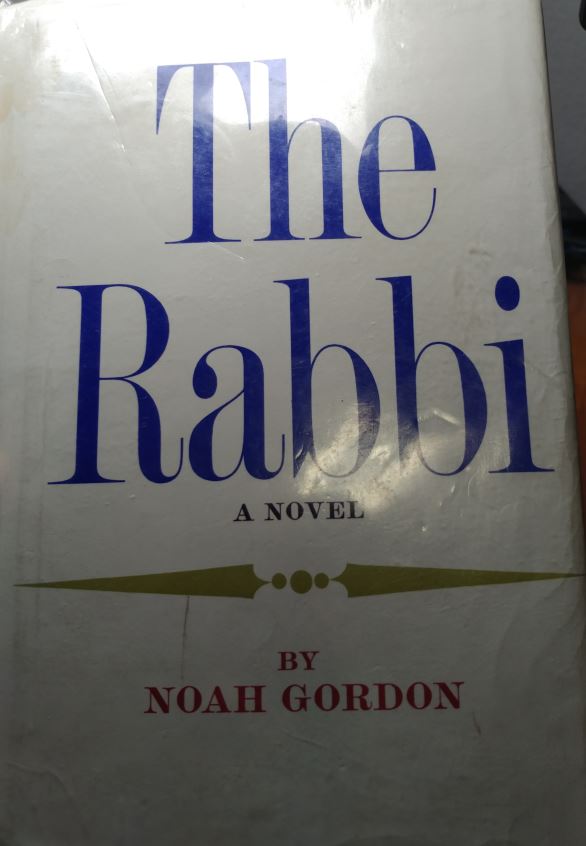

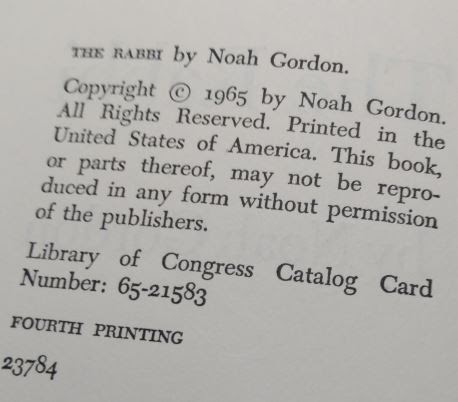
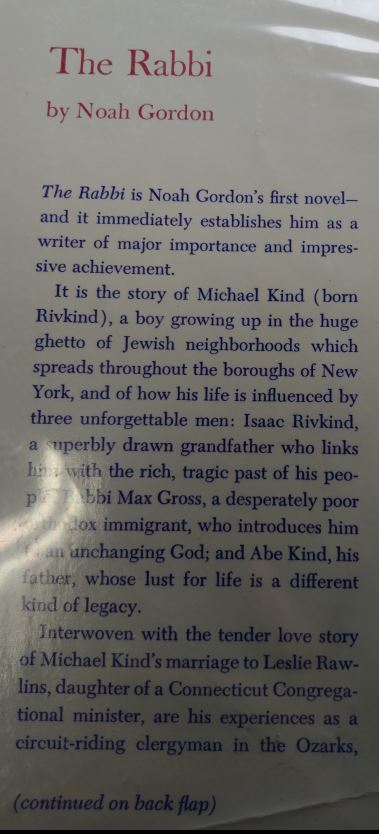
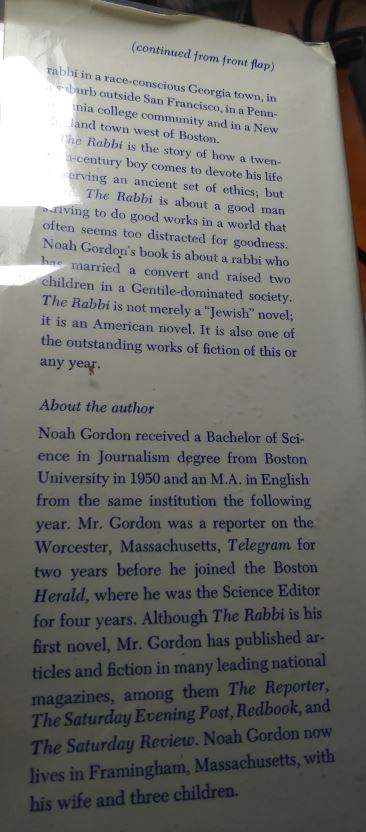
This is the presentation of the book. Of course it says the novel is good:


Then come the dedicatory:

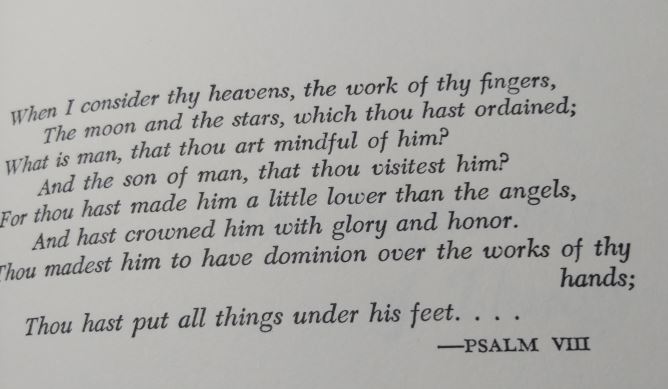
A couple of quotations:

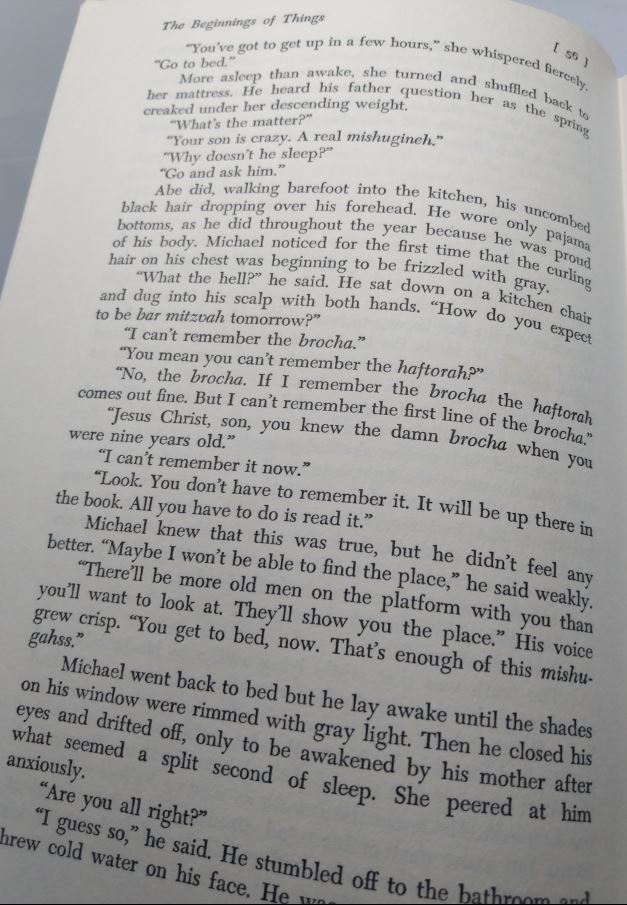
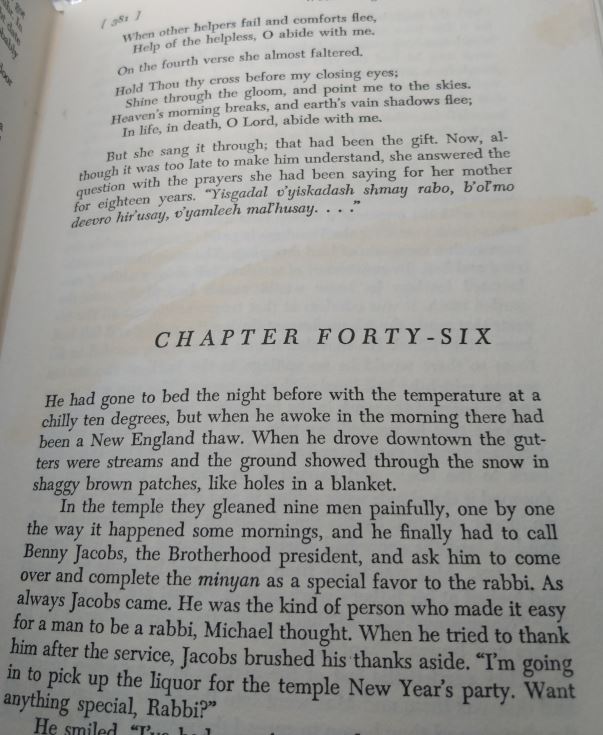
And then there is the actual reading of the novel:


For me, it was not the same experience as The Winemaker; and this impression was because various factors:
;
It is a previous work, so it probably does not have the benefit of Noah Gordon's experience in telling the story It tells the story of a religious man; and I am not particularly religious, so I found myself struggling to connect with him. It deals with mental illness and depression, and those topics are very sensitive to me, since I believe that when they are real, they are devastating, dangerous and destructive forces of nature.
In conclusion, I will still try other works by this author, but I am suspecting that the one I liked the most is going to remain the best to my eyes for a few books more.


***

I also have a blog! Link here:

http://lunairereadings.blogspot.com
Profile Image for Luz Angela.
265 reviews15 followers
September 15, 2019
“El Rabino” de Noah Gordon, nos acerca al judaísmo en Estados Unidos en el siglo XX y al conflicto personal de su protagonista, Michael Kind, quien debe decidir si continuar con el legado de su abuelo o con las enseñanzas de su padre, en un ambiente donde la religión condiciona en gran parte al ser humano.

Gracias a la narración de la vida de Michael desde su niñez hasta convertirse en Rabino, el lector tiene un acercamiento a los fundamentos, creencias y costumbres de esta religión y sus diferentes prácticas; unas vertientes más rígidas y ortodoxas y otras más flexibles y adaptadas a su entorno. Así mismo, el autor nos cuenta los obstáculos que deben afrontar las relaciones entre los miembros de la comunidad judía con los seguidores de otras creencias, como es el caso del protagonista y Leslie.

Me gustó mucho este libro, sin embargo creo que la obra maestra de Gordon es “El Médico”.

¿Conocen este autor?, ¿Han leído alguno de sus libros?


*Más reseñas en mi cuenta de Instagram @luzangelalectora
Displaying 1 - 30 of 153 reviews

Can't find what you're looking for?

Get help and learn more about the design.