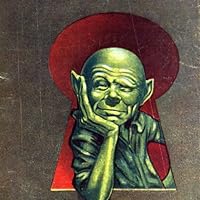
Three memorable creatures world jump in a meta-cosmic universe that orbits with nightmarish landscapes that thrive on anti-matter, anti-space, and anti-time. What mind and body searing challenges await the Pilger, Pilgrim, and Polder, who are really one man?
Raphael Aloysius Lafferty, published under the name R.A. Lafferty, was an American science fiction and fantasy writer known for his original use of language, metaphor, and narrative structure, as well as for his etymological wit. He also wrote a set of four autobiographical novels, a history book, and a number of novels that could be loosely called historical fiction.
lafferty in novel form doesn't seem an easy thing to handle. At the time I read this book, I thought that possibly I understood what it was about. I laughed a lot, and was surprised by the sudden outbursts of violence and death. The main character resurrects over and over, in many forms and with slightly altered monikers (this to clue you in that he's now operating in a world that might be different from the place you were in the last chapter), but in all his incarnations he possesses a dangerous thirst for power. He's a rampant materialist who doesn't understand or even acknowledge the spiritual gifts he's been given. In the end this leads to his downfall.
At least, this is what I think happens. But Lafferty's narrative is so strange, so wild and untethered, that I guarantee you'll be confused and bewildered at least half the time. Just go along for the ride and let Lafferty take you where he wants. I imagine I'll be reading this one again sometime. If you're new to Lafferty, I don't recommend starting here; try some of his short stories, which are occasionally at least very accessible.
Lafferty doesn't write sci-fi by starting with What-Ifs and building a plausible world around them, he hallucinates a whole system of existence, then just starts reporting from within it. Ordinary questions, or answers, are tossed to the winds. That's even with this novel being distinctly theological -- besides a casual brutality in line with the old testament, this still feels very, very unorthodox. Non-linear, multiverse-spanning, morally ambivalent, and filled with singularly Laffertian moments and turns-of-phrase.
Whoah! This book is Lafferty in excelsis, utter insanity from start to finish, not for the faint hearted either as it's a brutal festival of violence to boot!
I don't really think it's worthwhile explaining the plot, which seemed to go awry anyhow, but for what it's worth there is something going on involving the astral projection of personalities, cult leaders, "eidetic life,' the innate human thirst for power, camels, needles and stools.
Only who knows and who cares? Simply dive in and see if you can swim to the end without laughing or drowning beneath the sheer feverish nonsense of it all.
"Cleansing for the tract, camels." Dusmano smiled. "Very.'
This is probably the most brain-melting work of fiction I've ever read. I'm a huge fan of Lafferty, but I would not recommend the novice start here. (Then again, I once saw someone on a forum say this was the first thing they had read by Lafferty and they were hooked.) The novel's quite exciting, full of very strange and gruesome wonders, but possibly even fuller of philosophical exposition about the multiple identities of one person instantiated across various possible worlds: 'that wide tangle of buckling, parallel worlds' and 'the smell of bi-location' or 'bi-location kickback' and 'interworld routes' and 'transworld impetus' and many other such modal locutions abound. Characters often chat to one another thusly: 'It is the slight deplacement of two coincident worlds that generates incredible force in the line of creativity and shaping also. Half the pattern has to come from another world' (p. 42).
Even the names of the characters add to the oddity in the air of the narrative: Pilgrim Dusmano, Aubry Pim, Cyrus Evenhand, Howard Praise, Rhinestone Suderman, Noah Zontik, Mary Morey and many more.
The protagonist (Dusmano) is an unlikeable political villain, which makes for unpleasant reading sometimes. Then again, the lampooning of media-manipulated spin of political-celebrity identity is some of the most enjoyably acerbic I've ever seen. There are Media Lords and cults of personality and at one point a meteorological Hand of Heaven pointing down at the political candidate, which has been contracted in advance. This manufactured divine approval is a central motif of the novel. It's a viciously satirical study of the intersection not only of media and politics, but also of theologies, both bogus and true.
Resistance to the cult/cultural group-think is dispatched by 'the chopping down of uncultic and unelectronic persons... Who would want to save them? They are the unelectronic people, the nontinsel people, the folks of the unfractured flesh, and they never showed a deep love for us of the Media' (p. 73). Remember, this was published in 1976. I can't imagine what Lafferty would make of our internet generation. No, I think I can. I think he'd just quietly sardonically remark: 'Told ya.'
Counterpoising the jargon and philosophical discourse are moments of focalised narration that can reach grotesque lyricism:
'To swoop it all in! That would be the last great commercial stroke for Pilgrim Dusmano before leaving the world. This would be the real final pleasure, a break-bone and blood-suck pleasure. The red joy of it, gathering in all the fine property with its long roots with bits of flesh still clinging to them, would go far to nourish even the parallel Dusmanos on alternate worlds or aspects. It was a corporate good, really' (p. 89).
It's not all dialogue and terminology and commentary, of course (though there's a ton, which is often the case in Lafferty). Vivid (but usually brief) scenes of action are furnished now and again as well:
'The scarf that Pilgrim had been twisting in his hands now overflowed or exploded into a mantle or a cloak. Arrayed in this, Pilgrim went right through the walls of the Prismatic Room and the Personage Club in incipient flight. Noah Zontik stepped to a window and watched Pilgrim ascend the incandescent blue air of the outdoors in slanting, soaring flight. He had a finesse beyond that of any bird. A bird doesn't understand how to pose in the air, how to get the most from his natural lines, how to live a lyric in quick stanzas of flight. Pilgrim covered half a city in the ticking off of a dozen seconds. It was perfection... Pilgrim Dusmano, halfway across town, descended from his flight into the interior of an unspecified house. He quickly killed a startled man there.
"A bit casual, was it not?" the victim rasped with his dying breath' (p. 24).
Or witness a snippet of the boar hunt that takes place as part of the festivities on Hieronymous Bosch Day in one alternate world:
'Parrots were like flights of fat green arrows in the air. Dogs had a catchy bark on every gasping breath... But the present and embattled boar wheeled again and killed several of the harrying peasant girls and lads. It left them awkwardly broken in the sunny grass. The boar coursed again, and it foamed, not with weariness, but with fury.
Lorica, on a steep bay horse, closed in on the boar and let his horse overrun itself and become impaled on the wheeling boar. At the moment of overrunning, Lorica's lance went into the boar in snout and mouth and throat, but the bogus-stone lance head did not touch the boar brain in any way. That animal, disdaining even to notice the lance, was into the horse with long tusks, richly and redly into the belly; and it raised horse and rider high into the air as it reared on giant bristled hams and small feet' (152-153).
The modus operandi of the book appears to be: 'This requires a new way of looking at margins, which are spaces outside of accepted spaces' (p. 15). The action usually takes place in fairly solid and essentially rational, if wild and violent and dystopian, variations of worlds. But late in the book there's even some time spent right inside one of those psycho-freakish liminal voids:
'Foremost of the threats was a hulking apelike creature that the polymorph saw high ahead. (This was all by firelight, there being no sun in the iron sky, so the seeing and the seeming ran together.) The ape-thing was moving down the terrible and steep path toward the three climbers. It was coming fast enough to intercept them at the Narrow Corner. The path was fearfully narrow even where the three climbed it. The ariel had her crest drooping and smoking; the dog had his singed tail between his legs; the polymorph himself had teeth in his heart that crunched it and gnawed it away' (p. 123).
Oh heck, there's even a bit of loveliness thrown in here and there:
'She was freckled and unaccountably brilliant. She was dappled and sunbeamed. She was daylight itself, freckled daylight with clouds roiling up behind her' (p. 150).
I really can't begin to convey how chock full of delightfully inventive jargon and mind-bending ontology this novel is. It simultaneously hurts and thrills the brain. You often feel as some characters are early on described as feeling: 'There was a bit of horror gnawing at them in the area there, but also some ultra-purple fun' (p. 10).
I leave you with a final sample of the visceral carnival ontological chatter that bristles throughout the book:
'Let me tell you a little bit more about the Prime World of prime people, Pilgrim. It is the uninfused world, the grubby world, the spiritualist world, the quack world, the Fortean world. That world is real, and all others are shadows of it. You say this, but you are afraid to mean it, and you are afraid to acknowledge yourself a citizen of it. But your only alternative is to own yourself to be a reflected and not a real person. On Prime World, fish and rocks and blood do indeed fall on the earth out of low and stationary skies. For these are stale skies and do not turn. One can reach those skies with stones thrown by a ballista, and such shots will bring other stones falling in showers onto prime earth. Everything moves very slowly on prime, like objects moved by poltergeists. It is like things moving underwater. It is things moving in prime atmosphere and the reek and heaviness of it. There are vulgar shouts out of that lowering sky. Why not? There are giants living up there, dimwit giants who are the original people. What, Pilgrim - would you swallow only half a camel? And what will you do with the rest of it?' (p. 24).
I don’t know where to begin with this one. I also don’t know how to end this one. And I don’t know what to put between those two extremes. I would give it my Lafferty 5 Star, but I would be rubber stamping my inability to follow the story. However it is Lafferty so even the writing generates four stars.
I had heard this was Lafferty’s hardest, least approachable book, so I was expecting to have trouble following along. However what was happening was plain enough. But I feel I certainly missing the forest for the trees. I just couldn’t put this one together.
Maybe it is because i have read too much Lafferty but this sort of just happened. It doesn’t have the expertly crafted plot threads of something like ‘Past Master’ or ‘Space Chantey’ nor the deep philosophical astute investigations of ‘Arrive at Easterwine’ so the book for me was just a mess of Lafferty’s esoteric imagination partly mixed with an old man yelling at the sun.
If you want to read Lafferty, my only advice is not to begin with this novel. Paradoxically, it is the most Lafferty-ish thing I've ever read; but only for the initiated.