What do you think?
Rate this book


546 pages, Hardcover
First published April 15, 2006
“In the eyes of William Penn and his fellow Quakers the ‘Inner Light’ that guided them was not simply reserved for a select few but was to be found in everyone. This meant that the new colony, unlike Massachusetts, was designed from the start not only as a place of refuge for persecuted members of a single religious group but for all believers in God who wished to live together in harmony and fellowship.”
“From the start, however, Pennsylvania offered itself as a haven both for the economically aspiring and the religiously distressed. As the news spread back in Europe, a growing streams of immigrants, many of them arriving with their families, landed in Philadelphia to build for themselves new and better lives — British and Dutch Quakers, Huguenots expelled from the France of Louis XIV, Mennonites from Holland and the Rhineland, Lutherans and Calvinists from south-west Germany. As prospective settlers they looked forward to establishing their own independent family farms, which they would build up through hard work and mutual support. As God-fearing Protestants, they would enjoy, many of them for the first time, the right to worship as they wished, without fear of persecution.” ~Chapter 7: America as Sacred Space, page 211 & 213.
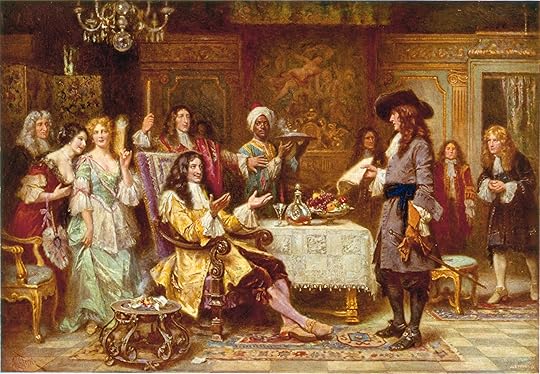
The Birth of Pennsylvania in 1680 painted by Jean Leon Gerome Ferris. It depicted the authorization given to William Penn to establish a colony on the North American soil. Penn is seen holding a document (possibly a royal decree granted by King Charles II of Britain).
"Jews, Moors, gypsies and heretics were all forbidden entry to the Indies. In the earlier years of colonisation it was possible to find ways around these prohibitions, but evasion became more difficult after 1552, when it was decreed that potential immigrants must furnish proof from their home towns and villages of their limpieza de sangre, demonstrating the absence of any taint of Jewish or Moorish blood.” ~Chapter 2: Occupying American Space, page 51.