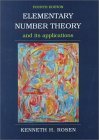
This latest edition of Kenneth Rosen's widely used Elementary Number Theory and Its Applications enhances the flexibility and depth of previous editions while preserving their strengths. Rosen effortlessly blends classic theory with contemporary applications. New examples, additional applications and increased cryptology coverage are also included. The book has also been accuracy-checked to ensure the quality of the content. A diverse group of exercises are presented to help develop skills. Also included are computer projects. The book contains updated and increased coverage of Cryptography and new sections on Mvbius Inversion and solving Polynomial Congruences. Historical content has also been enhanced to show the history for the modern material. For those interested in number theory.
Dr. Rosen received his B.S. in Mathematics from the University of Michigan, Ann Arbor (1972), and his Ph.D. in Mathematics from M.LT. (1976).
Dr. Rosen has published numerous articles in professional journals in the areas of number theory and mathematical modeling. He is the author of the textbooks Elementary Number Theory and Its Applications, published by Addison-Wesley and currently in its fifth edition, and Discrete Mathematics and Its Applications
Try working problems 12, 13, 14, 15, 16, 17, 20, 23, 25, 27, 28, 29, 33, 34, 44 and 45 of section 1.1 from the sketchy exposition provided.
Try working problems 5, 10, 14, 15, 16, 17, 21, 22, 23, and 24 from the sketchy exposition provided.in section 1.2
Try working out the proofs of Bertrand's Conjecture and Bonse's Inequality, topics which deserve their own exposition, asked for in the problems for Section 3.2.
Try understanding the least remainder theorem which deserves its own exposition, but instead is relegated to problems 14-18 of Section 3.4, much less working the problems themselves.
Problems 10-25 of Section 3.4 or over half are unworkable from the exposition!!!!!
Problems 19-42 of Section 7.5 cannot be worked from the exposition.
This is only the tip of the iceberg.
In addition numerous answers in the back of the book are completely unintelligible.
Rosen has gone out of his way to transmogrify an interesting subject into a nightmare of incomprehensibility and frustration and managed to collect royalties for it. I don't know who is more despicable, Rosen or the reviewers on this thread who are obviously lying through their teeth about this book.
In short, this book is roughly 500 pages of incomprehensible trash for which no one reading the dishonest reviews on this thread should be conned into shelling out his hard-earned dollars.
This book has a possibility to change the way that you see the set of integers and the underlying interactions that we have made up/discovered about them. One of the most beautiful books in all of mathematics